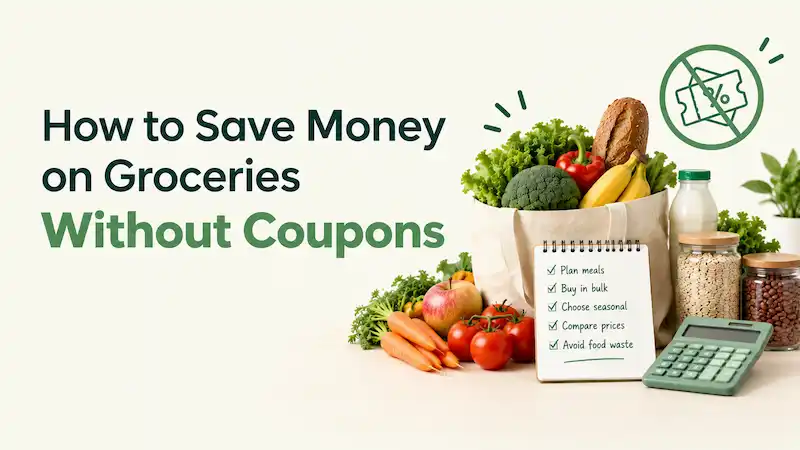
You can save money on groceries without coupons by changing what you buy, how much you buy, and how much of it you actually eat. Coupons are one way to lower a price. They are not the only way, and for many households they are not the most important one. The larger opportunities usually sit in the decisions around the purchase: buying a second jar of something you already own, choosing a package too big to finish, or paying for food that ends up in the trash.
Going coupon-free also does not mean ignoring discounts. Sales, store promotions, and loyalty pricing can still help. The point is to use them when they fit what your household needs, rather than letting them decide what goes in the cart.
This guide walks through a repeatable routine you can use every week:
Inventory → Plan → Compare → Decide → Shop → Store → Use → Review
Each step is simple on its own. Together, they make it harder for money to leak out of your grocery budget.
What Saving Without Coupons Actually Means
A coupon reduces the price of a specific product. That can be useful, but it only helps if the product was worth buying in the first place. Plenty of shoppers save money without ever clipping one, because they spend less through planning, comparison, and restraint.
Two ideas are worth separating here. A discount lowers what you pay for an item. Savings, in any meaningful sense, means your total food spending goes down for the same practical result. Buying something unnecessary at 40% off is still spending money you would otherwise have kept.
That is why this article looks past the shelf tag. A useful way to think about any grocery purchase is what we will call usable value: how much of the food your household will actually eat, safely and willingly, for the money spent. It is not a formal economic term. It is a practical lens that combines the price on the shelf, the price per unit, the quantity you will really use, how long it keeps, and whether the convenience is worth paying for. The sections below apply it to everyday decisions.
Inventory What You Already Have
Your shopping list should start in your kitchen, not in the store. Food you already own is food you have already paid for.
Check Your Pantry, Refrigerator, and Freezer
Before writing a list, take a few minutes to look through all three storage areas. You are looking for:
- Duplicates, such as a second open bag of pasta behind the first
- Unopened products that were bought for a meal that never happened
- Essential pantry staples that are running low and will genuinely need replacing
- Leftovers that could become a lunch or dinner this week
- Food that needs to be used soon, like softening vegetables or opened sauces
The freezer deserves special attention because it is where food tends to get forgotten.
Create a Simple “Use First” List
Write down the handful of items that should be eaten in the next few days. Keep it short and visible, on the fridge door or in your phone’s notes. This list does two jobs: it shapes your meal plan, and it reminds you not to buy replacements for food that is still waiting to be eaten.
Build Meals Around Existing Ingredients
Suppose your check turns up half a bag of frozen peas, a few eggs, some cooked rice from the weekend, and a half-used bottle of soy sauce. That is most of a fried rice dinner. You may only need to buy an onion or some green onions to finish it. Starting from what you have turns a full shopping list into a much shorter one.
Plan Your Grocery Trip Around What You’ll Actually Use
Plan Realistic Meals, Not Perfect Meals
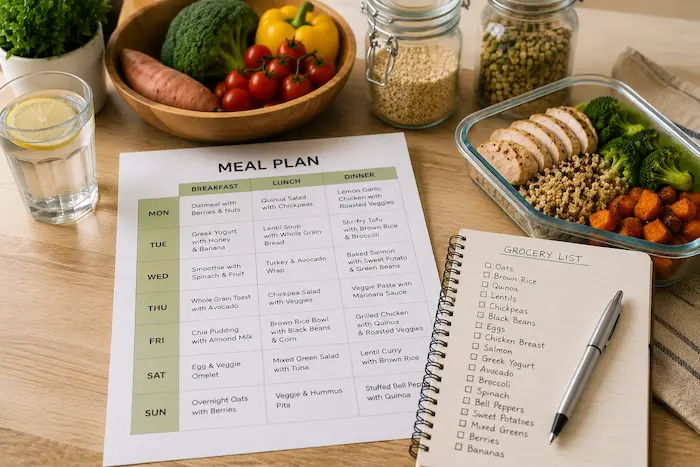
A meal plan only saves money if you follow it. For more ideas on building affordable meals around your grocery budget, see these cheap healthy meal plan ideas that actually save money. Look at the week honestly. Which nights will run late because of work or school? Which days will someone eat out, attend an event, or skip dinner at home? Plan simple meals for busy nights and save anything more involved for days when you actually have time.
If elaborate batch cooking is not realistic for you, skip it. A plan with four dependable dinners and a couple of “use what’s left” nights is often more useful than seven ambitious recipes.
Reuse Ingredients Across Multiple Meals
Ingredient overlap reduces the number of items you buy and lowers the chance that half a package goes unused. A single head of cabbage, for example, can become a slaw for tacos early in the week, part of a stir-fry midweek, and an addition to soup by the weekend. The same logic works for a bunch of herbs, a large bag of carrots, or a tub of plain yogurt that serves as both breakfast and a sauce base.
When you choose recipes, notice which ones share ingredients. That small habit can shorten your list noticeably. If you’re new to this approach, these meal planning tips for beginners can help you build the habit.
Plan Leftovers Before You Shop
Leftovers work best when they are planned rather than accidental. If you intend to cook a large pot of chili on Sunday and eat it again on Tuesday, you can buy for one fewer dinner. If nobody in your household likes eating the same meal twice, cook smaller amounts instead. Either way, deciding in advance affects how much you buy.
Set a Realistic Spending Target
There is no single correct grocery budget. Household size, ages, dietary requirements, local prices, and access to stores all affect what is reasonable. If you’re trying to establish a starting point for a household of four, this guide to how to budget groceries for a family of 4 walks through monthly and weekly targets. The most reliable starting point is your own history. Look at receipts or bank statements from the past month or two and find your typical weekly or monthly spending.
Set your first target a little below that figure rather than dramatically lower. A target you can meet consistently is more useful than an aggressive one you abandon after two weeks. If anyone in your household has medically necessary dietary needs, build the budget around those needs rather than cutting them.
Compare the Real Value of What You Buy
The package price tells you what you will pay at the register. It does not tell you whether the purchase is good value. Before a less obvious item goes in the cart, a few questions help:
- Do I actually need it?
- What is the unit price?
- Will we use this quantity?
- Is there a suitable alternative?
- Could this purchase create waste?
- Is the convenience worth the extra cost?
Compare Unit Prices, Not Just Package Prices
The unit price is the cost per standard measure, such as per ounce, per pound, per 100 grams, or per item. Many stores print it on the shelf tag, though practices vary by retailer and location. When it is missing, you can calculate it by dividing the price by the quantity.
Hypothetical example:
- Product A: $4.00 for 16 oz. $4.00 ÷ 16 = $0.25 per ounce
- Product B: $5.25 for 24 oz. $5.25 ÷ 24 = about $0.22 per ounce ($0.21875)
Product B costs more at the register but less per ounce. For the same 16 ounces, Product B works out to $3.50, compared with $4.00 for Product A.
This is why package prices can mislead. A bigger price tag does not always mean a worse deal, and a smaller one does not always mean a better deal. When comparing, make sure both unit prices use the same unit. A shelf tag showing price per pound next to one showing price per ounce is not a direct comparison until you convert one of them.
Compare Store Brands With Name Brands
Store brands, also called private labels, are often priced lower than national brands, but that is not guaranteed for every product or store. Compare them the same way you compare anything else: by unit price.
Hypothetical example: A name-brand can of tomatoes is $1.89 for 15 oz, or about $0.13 per ounce. A store-brand can is $2.99 for 24 oz, or about $0.12 per ounce. The store brand is only slightly cheaper per ounce, and the bigger can only makes sense if you will use all 24 ounces.
Beyond price, check the ingredient list and nutrition label when they matter to you, particularly for sodium, added sugar, or allergens. Products that look similar are not always made to the same recipe. Taste matters too. A cheaper product your family refuses to eat is not a saving. Many shoppers find it useful to test a store brand once and keep switching only where it works. For more ideas on affordable staples, see this cheap and healthy grocery list for frugal living.
Compare Fresh, Frozen, Canned, and Prepared Foods
No category is automatically the cheapest or the best choice. Each involves tradeoffs:
- Fresh food may be the right choice when you will eat it within a few days, but it can spoil before it is used.
- Frozen food can be portioned as needed and generally keeps longer, which can reduce waste for small households or unpredictable schedules.
- Canned food is shelf-stable and convenient, though it is worth checking labels for added salt or sugar if those matter to you.
- Prepared food saves time and usually costs more per serving.
The right answer often depends on timing. Fresh spinach may be ideal for a salad tomorrow night. Frozen spinach may be the better buy for a soup you might make sometime next week.
Decide Whether Convenience Is Worth the Extra Cost
Pre-cut vegetables, shredded cheese, individual snack portions, and ready-made sauces generally cost more than their basic counterparts. That extra cost can be worth it. If pre-chopped onions mean you actually cook dinner instead of ordering takeout, they may save you money overall.
The useful question is not whether convenience food is “bad.” It is whether you are paying for convenience you will use. Buying a large bag of individual snack packs for lunches is reasonable if they get packed every day. Buying pre-cut fruit that sits unopened because plans changed is a different story. Time and energy have real value, so decide based on your week, not on a rule.
Buy the Quantity Your Household Can Actually Use
A lower unit price only helps if you use what you buy. Food that spoils raises the real cost of everything you did eat.
When Buying in Bulk Can Make Sense
Larger quantities tend to work well when:
- you use the item often and predictably
- it has a long shelf life or freezes well
- you have space to store it properly
- the unit-price difference is meaningful
- the larger upfront cost fits your budget this week
Items like rice, dried beans, oats, and frequently used frozen foods are common candidates for many households, but only if they match your actual habits.
When Bulk Buying Can Backfire
Bulk purchases often go wrong with perishable food, products you are trying for the first time, items you use rarely, and anything that disappears to the back of a crowded cupboard. Limited storage space is a real constraint, especially in apartments and shared housing.
Use a Bulk-Buying Test
Before buying the larger size, ask:
- Will we use all of it?
- How quickly will we use it?
- Can we store it properly?
- Is the unit-price difference big enough to matter?
- Could buying more lead to more waste?
Hypothetical example: A 16 oz container of salad greens costs $6.00 ($0.375 per ounce). A 5 oz container costs $3.50 ($0.70 per ounce). The larger container looks like the obvious deal. But if your household usually eats only about 6 ounces before the rest wilts, you have effectively paid $6.00 for 6 ounces, or $1.00 per ounce eaten. The small container, fully used, costs $0.70 per ounce eaten, and $2.50 less at the register.
Control What Goes Into Your Cart
Use a Prioritized Grocery List
A plain list tells you what to buy. A prioritized list also tells you what to drop if prices are higher than expected. Try sorting items into three groups:
- Essential: needed for planned meals or daily basics
- Useful: helpful to have, but could wait a week
- Optional: nice extras
If the total is running high, the optional group is where you cut first.
Handle Sales and Promotions Strategically
Sales can be genuinely useful. They make the most sense when the household already needs the item, will use it before it spoils, can store the quantity, and the price is actually lower than usual. Knowing the regular price of the items you buy most often helps you recognize a real discount.
A discount can lower the price of something you need, but it does not make an unnecessary purchase necessary. For more practical ways to reduce grocery spending, see these 25 grocery budget tips that actually save money.
Hypothetical example: A “buy two, get one free” offer on a $3.00 box of crackers gives you three boxes for $6.00. If you would normally buy one box every two weeks and they stay fresh long enough, stocking up could be sensible. If you rarely buy crackers, you have spent $6.00 instead of $0.
Handle Impulse Purchases
Unplanned items are not always mistakes. Sometimes you spot something you genuinely forgot. A quick pause helps tell the difference:
- Do I already have something similar at home?
- What specifically will I use this for?
- Will we finish the whole package?
- Would I still buy it if it weren’t on promotion?
If the answers are vague, leave it. It will likely still be there next week.
Don’t Chase Tiny Savings Across Multiple Stores
Visiting several stores for the lowest price on each item can cost more than it saves once you count fuel or transit fares, time, and the extra impulse purchases that each trip invites. Delivery fees, pickup fees, tips, and membership costs also belong in the comparison when you shop online or at a membership warehouse. For many households, choosing one or two stores that are reasonably priced for their regular items is the more practical approach. No retailer is cheapest for everything everywhere, so compare the stores you can actually reach.
Reduce Food Waste After You Shop
Food waste is money already spent. In the United States, the USDA estimates that about 30 percent of the food supply is lost or wasted at the retail and consumer levels, according to its Food Safety and Inspection Service guidance on food product dating. That is a broad, national estimate covering stores as well as households, not a measure of any single home, but it shows why the steps after shopping matter.
Make Food Visible and Easy to Use
When you unpack groceries, move older items to the front and put newer ones behind them. Keep your “use first” foods at eye level. Clear containers and a dedicated shelf for leftovers make it easier to see what needs eating. A short list on the freezer door of what is inside can prevent forgotten purchases.
Use Leftovers Intentionally
Schedule leftovers into the week rather than hoping someone eats them. Repurpose where it makes sense: roasted vegetables can go into an omelet or grain bowl, and extra rice can become fried rice. If you consistently throw leftovers away, cook smaller quantities.
For timing, the USDA’s guidance on leftovers and food safety says leftovers can be kept in the refrigerator for 3 to 4 days or frozen for 3 to 4 months, noting that frozen leftovers remain safe but can lose quality over longer storage. It also advises discarding cold leftovers left at room temperature for more than 2 hours, or 1 hour when the temperature is above 90°F. If you know you will not get to something within a few days, freezing it early preserves both the food and the money.
Store Food Appropriately
Proper storage protects both safety and value. U.S. food-safety guidance from the USDA’s basic steps to keep food safe advises refrigerating perishable food within 2 hours, or within 1 hour when it is above 90°F, and dividing food into shallow containers so it cools quickly. Follow the storage instructions on the package as well. If you live outside the United States, check your national food-safety agency’s guidance.
Understand Date Labels
Date labels do not mean the same thing everywhere, so it helps to know the rules where you live.
In the United States, the USDA’s food product dating guidance explains that, except for infant formula, product dating is not required by federal law and dates are not indicators of safety. According to that guidance, “Best if Used By” refers to best flavor or quality, “Sell-By” is for the store’s inventory, and “Use-By” marks the last recommended date for peak quality. The USDA also notes that foods not showing signs of spoilage should be wholesome past a “Best if Used By” date. Spoilage signs still matter, and when in doubt, throw it out.
In the United Kingdom, the meaning is different. As a local council’s summary of UK food labelling explains, a “use by” date relates to safety, and food should not be eaten, cooked, or frozen after it, even if it looks or smells fine. “Best before” dates relate to quality. The same guidance notes that many foods can be frozen before the use-by date to prevent waste.
In other countries, check your national food regulator. Never assume one country’s definition applies elsewhere.
Review Your Spending and Waste
Review Your Grocery Receipt
After a shopping trip, spend a few minutes with the receipt. Look for:
- items that were not on your list
- duplicates of things you already had
- categories that are consistently expensive, such as snacks, drinks, or meat
- convenience purchases, and whether they got used
- substitutions that worked, like a store brand your household liked
- products you have bought and thrown away more than once
Track What Gets Thrown Away
You do not need a detailed log. A simple note on your phone each time food goes in the trash is enough. After a few weeks, patterns usually appear: the bagged salad that never gets finished, the bread that goes stale, the yogurt nobody eats after the first few cups.
Fix the Biggest Recurring Problems
Focus on the problems that repeat. If you throw away half a loaf of bread every week, buying a smaller loaf or freezing half as soon as you get home will probably matter more than saving a few cents on a single can of beans. Recurring leaks add up; one-off differences rarely do. For more strategies focused specifically on reducing your grocery bill, see these 15 ways to cut your grocery bill.
The Coupon-Free Grocery System
- Inventory: Check what you already have.
- Plan: Choose realistic meals around existing food.
- Compare: Check unit prices and suitable alternatives.
- Decide: Weigh quantity, expected use, waste, and practical value.
- Shop: Follow the prioritized list.
- Store: Store food appropriately and keep older products visible.
- Use: Follow the plan and manage leftovers.
- Review: Examine spending and waste before the next trip.
Try This on Your Next Grocery Trip
Before shopping
- Check your pantry, refrigerator, and freezer.
- Write a short “use first” list.
- Plan meals that fit your actual week.
- Make a list sorted into essential, useful, and optional.
- Set a spending target based on your recent receipts.
At the store
- Compare unit prices, using the same unit.
- Check package sizes against what you will really use.
- Consider store brands and frozen or canned alternatives.
- Pause before unplanned purchases.
- Judge sales against what you actually need.
After shopping
- Store food properly and promptly.
- Move older food to the front.
- Schedule leftovers.
- Note anything that gets thrown away.
Before the next trip, ask:
- What did I buy that I didn’t need?
- What was wasted?
- Which substitutions worked?
- Which category ran over?
- What will I change this time?
Common Mistakes to Avoid
- Assuming the larger package is always the better deal
- Comparing package prices instead of unit prices
- Buying discounted items you did not need
- Buying more fresh food than your household can eat in time
- Treating the cheapest option as automatically the best one
- Driving between stores to save very small amounts
- Assuming store brands are always cheaper
- Setting a grocery target you cannot sustain
- Believing coupons are the only way to save
Conclusion
You do not need coupons to build a more economical grocery routine. If you want to build a broader system for controlling grocery spending, see our ultimate guide to budgeting groceries. Steady savings tend to come from ordinary decisions made consistently: buying what your household needs, comparing prices by the unit rather than the package, choosing quantities you will finish, and questioning purchases that only look like bargains. Protecting the food you bring home matters just as much, because anything thrown away is money you have already spent. Over time, your receipts and your trash will show you which habits deserve attention first.
On your next trip, start before you leave home: check your refrigerator, write down three items that need to be used first, and plan at least one meal around them.
Frequently Asked Questions
Yes. Coupons reduce the price of specific products, but many savings come from other decisions: avoiding duplicate purchases, comparing unit prices, buying quantities you can use, and wasting less food. How much any household saves depends on its current habits and local prices.