
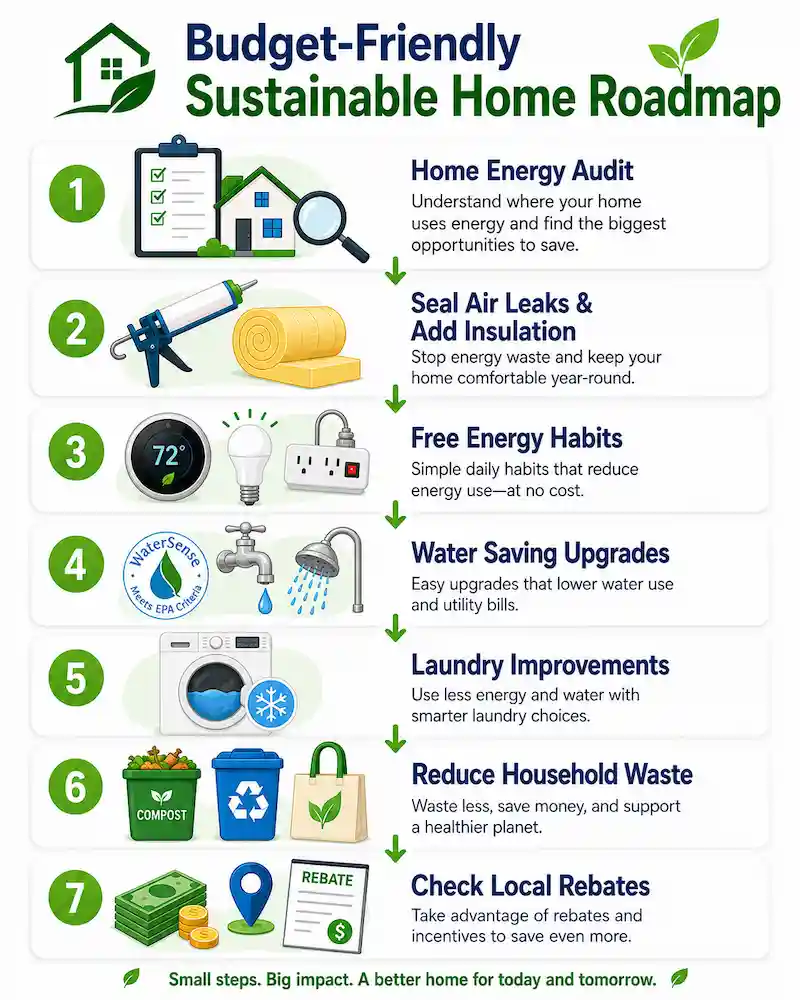
Most guides to a sustainable home give you a long list of ideas with no order to them. That’s backwards. The order you tackle things in determines whether you save money or waste it, since insulating a house before you know where it’s leaking, or buying new appliances before fixing your habits, means paying for upgrades that a free fix would have covered. This guide gives you that order.
Key takeaways
- Free behavioral fixes come first: thermostat scheduling, cold-water laundry, unplugging idle devices.
- Under-$50 purchases come second: LED bulbs, faucet aerators, weatherstripping.
- Bigger spending (insulation, fixture replacement) only makes sense once you know where your specific home is losing money, which is why the audit is step one, not step five.
- Federal tax credits for these upgrades expired after December 31, 2025. State and utility rebates are still active in most areas.
A quick reality check before you start: a 2026 Pew Research Center survey found that most Americans already limit home water use and buy secondhand goods, and they mostly do it to save money rather than for environmental reasons. That’s the right instinct. Every fix below is chosen because it pays for itself, not because it’s virtuous.
Step 1: Start With a Home Energy Audit
Do this before spending anything else. A professional audit runs $100 to $400, though many utilities offer them free. A DIY walkthrough works too if budget is tight: check for drafts at doors and windows, thin spots in attic insulation, and appliances that run constantly.
The Department of Energy estimates that fixing the issues an audit identifies can cut a home’s monthly energy bill by 5 to 30 percent. That’s a wide range on purpose. It depends entirely on your specific house, which is the whole point of doing this first instead of guessing.
Step 2: Seal and Insulate Before Anything Else
The EPA estimates homeowners save an average of 15 percent on heating and cooling costs, or about 11 percent on total energy costs, from air sealing and adding insulation in attics, crawl spaces, and basement rim joists. The scale of the problem is bigger than most people assume: roughly 9 out of 10 U.S. homes are under-insulated.
Caulk, foam sealant, and weatherstripping cost very little and are a weekend project. If you’re on a limited income, the DOE’s Weatherization Assistance Program has helped participating households save an average of $372 or more per year through free professional weatherization; check eligibility before paying for this yourself.
Step 3: The Fixes That Cost Nothing
Thermostat scheduling. You can save as much as 10 percent a year on heating and cooling by turning the thermostat back 7 to 10 degrees for 8 hours a day, such as while you’re at work or asleep. A basic programmable model runs $25 to $50 and automates it.
LED bulbs. ENERGY STAR certified LEDs use up to 90 percent less energy than incandescent bulbs and last far longer.
Unplugging idle devices. Standby power, sometimes called phantom load, accounts for 5 to 10 percent of residential energy use and can cost a household as much as $100 a year, according to the DOE. A $15 power strip with a physical switch handles an entire entertainment center at once.
Step 4: Cut Water Waste
The EPA reports that the average family saves more than $380 a year by retrofitting with WaterSense labeled fixtures and ENERGY STAR certified appliances. Toilets matter most: replacing old, inefficient toilets with WaterSense models cuts toilet water use by 20 to 60 percent, saving close to 13,000 gallons a year for an average household. A WaterSense faucet aerator costs a few dollars and installs in minutes without a plumber.
Step 5: Fix Laundry Habits Before Buying a New Washer
ENERGY STAR clothes washers use nearly 35 percent less water and 25 percent less energy than standard washers, per the DOE, but you don’t need a new machine to save. Washing in cold water with cold-water detergent and running full loads cuts energy use with the washer you already own. Save the appliance replacement for when your current one actually dies.
Step 6: Reduce Waste at the Source
Food is the single most common material sent to U.S. landfills, making up 24.1 percent of municipal solid waste, per EPA data. A countertop compost bin diverts scraps for free and produces fertilizer in return. Secondhand shopping is another free-to-start habit already mainstream: about half of Americans regularly buy clothes or goods secondhand, per Pew Research, usually to save money first.
See 25 Sustainable Home Ideas That Save Money and Reduce Waste for a longer list of small changes beyond what’s covered here.
Step 7: What About Rebates in 2026?
If you’re budgeting around federal tax credits, they’re gone for new projects. The Energy Efficient Home Improvement Credit and the Residential Clean Energy Credit applied only to property placed in service by December 31, 2025, per current IRS guidance. If you didn’t complete a qualifying project last year, these specific federal credits don’t apply to 2026 purchases.
State and utility rebates are a different story and many are still active. Use the ENERGY STAR Rebate Finder and enter your zip code before buying anything, since this changes by location and by year.
An Illustrative Budget Scenario
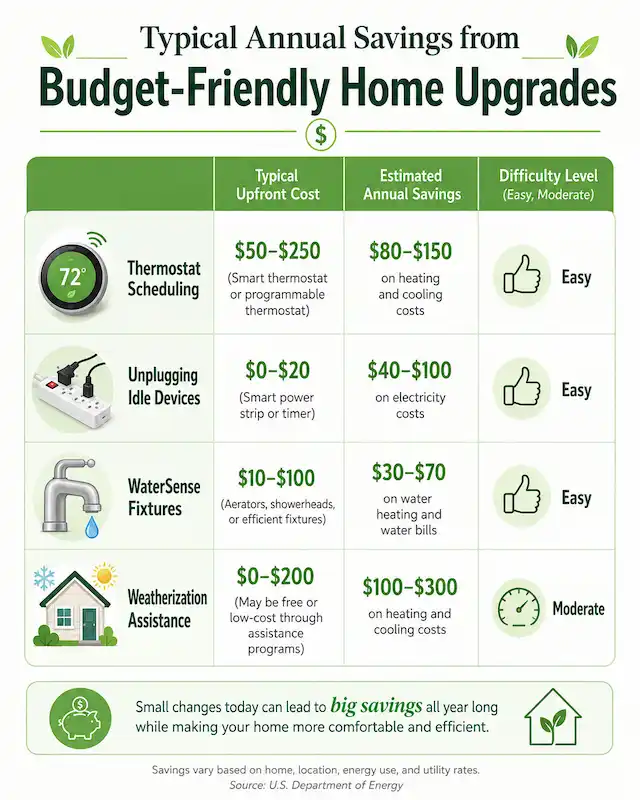
| Fix | Sourced annual savings | Upfront cost |
| Thermostat scheduling | ~$180/year | $0–$50 |
| Unplugging idle devices | up to $100/year | ~$15 |
| WaterSense fixtures | up to $380/year | $10–$60 |
| Full weatherization | ~$372/year (program average) | $0 if WAP-eligible, otherwise varies |
These figures come from separate studies with separate assumptions, so they aren’t strictly additive (a fully weatherized home, for instance, already accounts for some of the same heating/cooling savings a thermostat schedule targets). Treat a combined total as a rough ceiling, not a guaranteed number. The calculator below applies the same logic and is built to be embedded directly on the page.
Frequently Asked Questions
What’s the cheapest way to make my home more sustainable?
Behavioral changes cost nothing: thermostat scheduling, cold-water laundry, unplugging devices you’re not using.
How much does it cost to make a home eco-friendly?
It scales with how far you go. The free and under-$50 fixes above cover most of the easy savings. Bigger investments like insulation or new windows pay off over several years, especially now that the federal tax credits for them have ended.
Can an old house be made sustainable without a full renovation?
Yes. Air sealing, insulation top-ups, and fixture swaps work on homes of any age and require no structural changes.
Do I need to do these steps in order?
Not strictly, but skipping the audit and jumping straight to buying insulation or new appliances is the most common way people overspend on upgrades a free fix would have covered.
Next Steps
Start with the audit this week. It tells you exactly where your specific home is losing money, which every other step in this guide depends on. Then work down the list in order, and check the Sustainable Home: The Complete Guide to Creating an Eco-Friendly and Budget-Friendly Home for how this fits into a longer-term plan.