Figuring out a grocery budget for a family of 4 feels harder than it should. Prices at the register jump around, kids eat differently every few months, and generic advice like “just spend less” doesn’t tell you what number to actually aim for.
This guide starts with real numbers from the USDA, then walks through a simple method for turning that number into a monthly plan you can actually follow.
How Much Should a Family of 4 Spend on Groceries?
The USDA publishes an official answer to this every month. Its Cost of Food at Home reports track four spending tiers, Thrifty, Low-Cost, Moderate-Cost, and Liberal, each representing a full nutritious diet prepared entirely at home. They differ in variety and convenience, not nutrition.
For the reference family the USDA uses, two adults ages 20 to 50 and two children ages 6 to 8 and 9 to 11, the May 2026 report puts the Thrifty plan at $235.00 a week, or $1,018.20 a month. Add up that same report’s per-person costs for the other three tiers, and the range for this household looks like this:
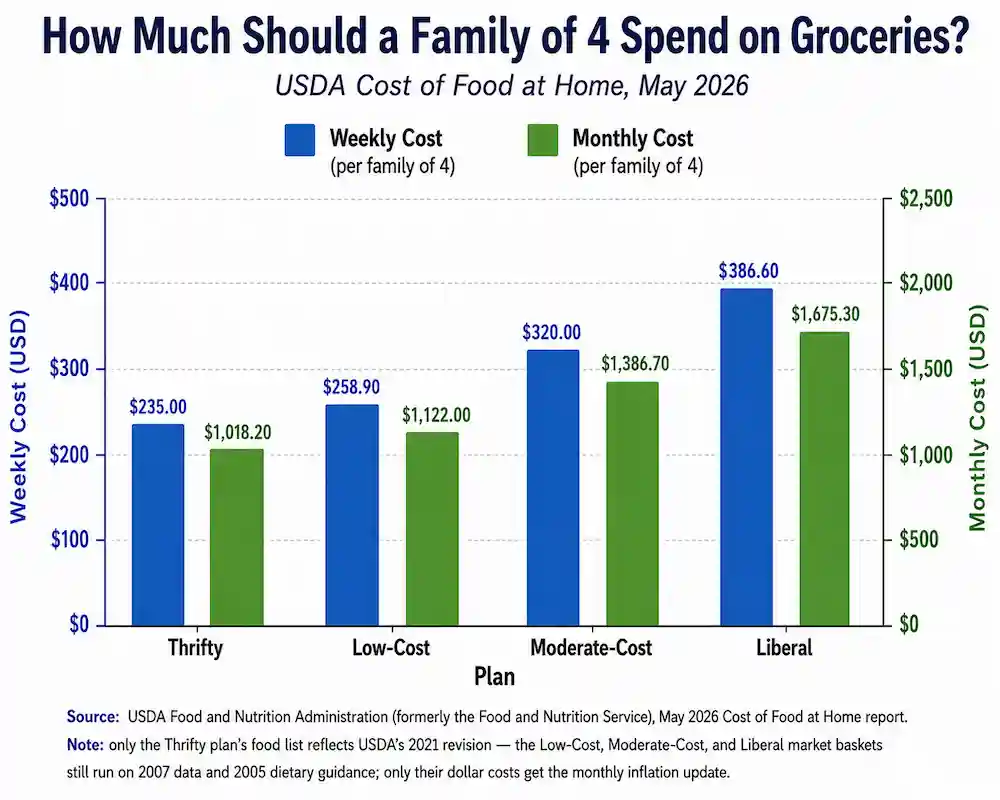
| Plan | Weekly Cost | Monthly Cost |
| Thrifty | $235.00 | $1,018.20 |
| Low-Cost | $258.90 | $1,122.00 |
| Moderate-Cost | $320.00 | $1,386.70 |
| Liberal | $386.60 | $1,675.30 |
Source: USDA Food and Nutrition Administration (formerly the Food and Nutrition Service), May 2026 Cost of Food at Home report. Note: only the Thrifty plan’s food list reflects USDA’s 2021 revision, the Low-Cost, Moderate-Cost, and Liberal market baskets still run on 2007 data and 2005 dietary guidance; only their dollar costs get the monthly inflation update.
Takeaway: If you’re trying to save money without cutting nutrition corners, the Low-Cost to Moderate-Cost range, roughly $1,120 to $1,390 a month, is a realistic target for most four-person households by USDA’s own quartile definitions, those two tiers roughly bracket the middle half of what American households actually spend on food.
Why Your Number Might Look Different
These are national averages, so a few things will push your real number up or down:
- Location. Grocery prices in high-cost metros and in Alaska or Hawaii run well above the national figures.
- Kids’ ages. A household with two teenagers spends noticeably more than one with young children, since USDA per-person costs rise sharply for teens.
- Inflation. Grocery prices don’t sit still. As of June 2026, food-at-home prices were running 2.7% higher than a year earlier, while food eaten away from home rose 3.4%, according to the Bureau of Labor Statistics. That means last year’s budget probably needs a small bump this year just to buy the same groceries.
- Diet and shopping habits. Buying mostly fresh, organic, or specialty items pushes you toward the Moderate or Liberal end. Cooking from scratch with store brands pulls you toward Thrifty or Low-Cost.
How to Build Your Family’s Grocery Budget in 4 Steps
Once you have a target range, turning it into a working budget takes four steps.
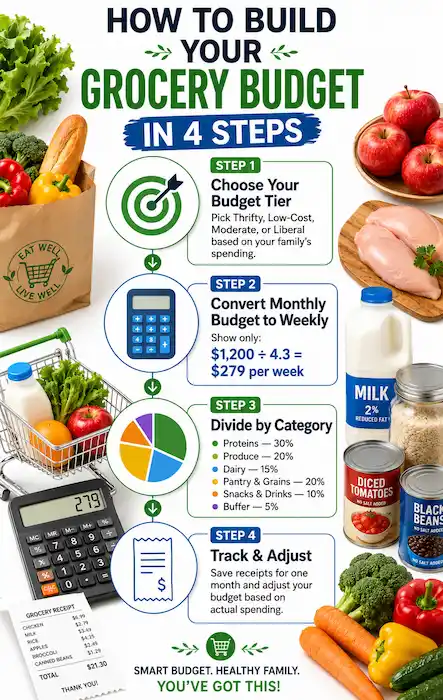
Step 1: Choose your target range.
Pick a tier from the table above based on your household’s real habits, not your ideal ones. If you’re currently spending closer to Liberal and want to trim costs, aim for Moderate first rather than jumping straight to Thrifty.
Step 2: Break the month into weeks.
A monthly number is easy to lose track of. Divide it by 4.3 (the average weeks per month) to get a weekly cap you can check against every receipt. For a $1,200 monthly budget, that’s about $279 a week. Our How to Meal Plan and Budget Groceries for an Entire Week guide walks through building a week’s worth of meals around that number.
Step 3: Split the total by category.
A rough category split keeps any one area, usually meat or snacks, from quietly eating the whole budget. A common starting point is proteins 30%, produce 20%, dairy 15%, pantry staples and grains 20%, snacks and beverages 10%, and a 5% buffer for anything unexpected. Adjust these shares to match how your family actually eats.
Step 4: Track for one month, then adjust.
Save receipts or use a budgeting app for one full shopping cycle. Most families find their real spending doesn’t match their plan on the first try, and that’s normal. Use that first month as data, not a failure.
Sample Monthly Grocery Budget for a Family of 4 ($1,200 Example)
Here’s what that category split looks like applied to a $1,200 monthly budget, a middle-ground number between the USDA’s Low-Cost and Moderate tiers:
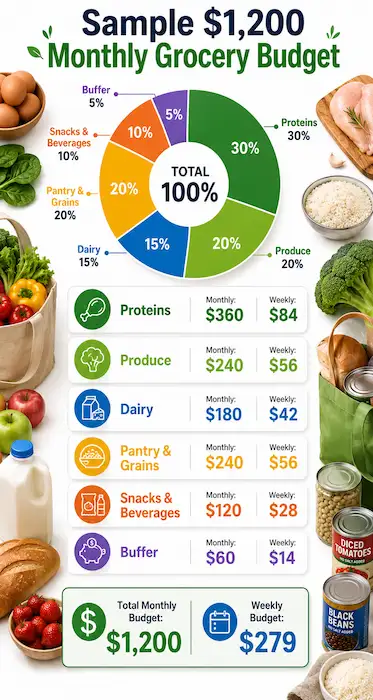
| Category | Monthly Amount | Weekly Amount |
| Proteins (meat, poultry, fish, eggs, beans) | $360 | $84 |
| Produce (fruits and vegetables) | $240 | $56 |
| Dairy | $180 | $42 |
| Pantry staples and grains | $240 | $56 |
| Snacks and beverages | $120 | $28 |
| Buffer / miscellaneous | $60 | $14 |
| Total | $1,200 | $279 |
For ready-to-use shopping lists built around a tight budget, our Cheap and Healthy Grocery List for Frugal Living breaks down specific items that fit each category above. If you’re trying to stretch your grocery budget further, see our guide on how to feed a family of 4 for $150 a week.
7 Practical Ways to Lower Your Grocery Bill Without Cutting Corners
Once your budget is set, these habits do the most to keep you inside it. For more ways to save money on groceries without coupons, see our guide.
- Plan meals before you shop. A written meal plan stops the impulse buys that blow up a weekly budget.
- Switch to store brands where it matters least. A recent pricing analysis of major retailers found store-brand items can cost more than 40% less than name-brand equivalents on average, according to a store-brand pricing study. Pantry staples like pasta, canned goods, and cereal are usually the safest swaps.
- Reduce food waste. Waste is a bigger budget leak than most families realize. One federal analysis estimates a household of four wastes about $56 worth of food a week, or roughly $2,913 a year, based on data from the EPA food waste report. Planning portions and using up leftovers can claw much of that back.
- Compare unit prices, not shelf prices. The per-ounce or per-pound number on the shelf tag is the only fair way to compare package sizes.
- Shop the sale cycle. Stock up on non-perishables when they’re discounted rather than buying at full price every week.
- Buy shelf-stable staples in bulk. Rice, oats, and dried beans cost less per serving in larger quantities and don’t spoil.
- Batch-cook proteins. Cooking a large batch of chicken, ground beef, or beans once and using it across several meals cuts both cooking time and per-meal cost.
For a longer, more detailed list of tactics, see 25 Grocery Budget Tips That Actually Save Money.
Key Takeaways
- The USDA estimates that a family of four typically spends $1,000–$1,650 per month on groceries, depending on shopping habits and food choices.
- For most households, a monthly grocery budget of $1,100–$1,365 strikes a practical balance between nutrition, variety, and affordability.
- Turn your monthly budget into a weekly spending limit by dividing it by 4.3, making it easier to stay on track throughout the month.
- Allocate your grocery budget across categories like proteins, produce, dairy, pantry staples, and snacks to prevent overspending in any one area.
- Small habits—such as meal planning, buying store brands, reducing food waste, comparing unit prices, and shopping sales—can significantly lower grocery costs without sacrificing healthy meals.
- Review your grocery spending regularly and adjust your budget as food prices, family size, or eating habits change to keep it realistic and sustainable.
Bringing It All Together
A grocery budget for a family of 4 doesn’t need to be a guess. Start with the USDA’s official ranges, pick a weekly number you can track, and adjust your category splits as you learn your family’s real habits. For the full strategy behind building and maintaining a grocery budget long-term, see our How to Budget Groceries: The Ultimate Guide to Saving Money on Food Without Sacrificing Quality.