Standing in front of the refrigerator at 6pm, tired and hungry, is exactly when people make expensive decisions. Delivery apps get opened. Something quick gets grabbed at the store on the way home. A meal gets thrown together from whatever is available, and the grocery budget quietly drains a little more than planned.
Meal planning for beginners breaks that cycle. This guide walks through every step, from the first time you sit down to plan a week’s worth of dinners to the moment you realize you’ve got meals sorted for the next four nights without thinking about it. No cooking school required. No elaborate apps or fancy systems. Just a practical approach that works for real schedules and real budgets.
Key Takeaways
- Meal planning is the simple habit of deciding your meals in advance, making grocery shopping, cooking, and budgeting more organized.
- Beginners should start by planning three to five dinners each week instead of every meal to build a sustainable routine.
- Planning meals before shopping helps reduce impulse purchases, cut food waste, and lower grocery spending.
- Reusing ingredients across multiple meals and preparing a few components ahead of time saves both time and effort throughout the week.
- A successful meal plan should fit your schedule, budget, and cooking skills, not strive for perfection.
- Following a simple meal planning routine consistently can reduce weeknight stress, make healthy eating easier, and help you stay on track with your budget.
What Is Meal Planning?
Meal planning means deciding in advance what you’ll eat for the coming days, then shopping and prepping around those decisions. At its simplest, it’s a weekly routine: look at your schedule, choose a handful of recipes, make a grocery list, and shop once.
Two terms get confused here and it’s worth separating them. Meal planning is the strategy. Meal prep is one possible execution of it. Some people plan every meal for seven days and cook everything on Sunday. Others sketch out dinners and handle everything else day by day. Both count as meal planning, and both beat making zero decisions until you’re already hungry and looking for shortcuts.
The right version for you depends on your schedule, household size, and how much variety matters to you. For most beginners, starting small is more effective than attempting an ambitious full-week cooking overhaul on the first try.
Why Meal Planning Works
The case for meal planning isn’t abstract. There’s solid data showing what it does to your budget, your food waste, and even your health.
It Cuts Your Grocery Bill
Americans spend more on food than most people track carefully. According to the USDA Economic Research Service, U.S. households allocated 12.9% of their budgets to food in 2024, on average. Based on the Bureau of Labor Statistics Consumer Expenditure Survey, total annual household expenditures averaged $78,535 in 2024, which puts average food spending at roughly $10,169 per year.
Unplanned shopping inflates that number consistently. Without a list, you buy what looks good in the moment rather than what fits a plan. A 2026 ReFED food waste report found that 72% of consumers adopted meal planning specifically to better manage their food spending during a sustained period of high food prices.
Takeout is the other significant budget drain that meal planning directly competes with. Bureau of Labor Statistics Consumer Price Index data shows that the cost of eating food away from home rose 3.6% in the one-year period through November 2024, compared to just 1.6% for food purchased at a grocery store. Having a plan for Tuesday night directly reduces how often you reach for a delivery app instead.
It Reduces Food Waste
Food waste is one of the most overlooked household expenses. The EPA’s analysis estimates that food waste costs the average American $728 per year, or roughly $2,913 annually for a household of four, representing approximately 11% of total food expenditures.
The USDA estimates food loss at the consumer and retail levels at between 30 and 40% of the U.S. food supply. Meal planning directly attacks this by matching what you buy to what you’ll actually cook. When you know Monday is chicken night and the same chicken carries into Wednesday’s grain bowl, you buy exactly the right quantity instead of guessing.
It Saves More Time Than You Think
Planning takes about 20 to 30 minutes at the start of each week. That’s the upfront cost. What it eliminates is more valuable: daily store trips, 6pm recipe searching, and the nightly back-and-forth about what to eat. Over seven days, those small time drains add up to far more than the planning session itself.
The routine also becomes faster over time. Most consistent meal planners eventually rotate through 10 to 15 trusted recipes, which turns planning into a quick matching exercise rather than fresh research every week.
It Supports a Healthier Diet
A peer-reviewed study published in the International Journal of Behavioral Nutrition and Physical Activity analyzed data from 40,554 adults in the NutriNet-Santé cohort. Researchers found that meal planners had higher overall diet quality, greater food variety, and significantly lower odds of obesity compared to those who did not plan their meals. The researchers noted that promoting meal planning could be a practical tool for improving dietary quality and supporting home cooking.
Having a plan doesn’t just prevent expensive decisions. It prevents poor nutritional ones as well. When dinner is already decided before 5pm, fast food loses most of its appeal.
How to Start Meal Planning: A Step-by-Step Guide for Beginners
These steps work whether you’re cooking for one or feeding a household of five. The process scales easily.
Step 1: Audit Your Pantry and Fridge First
Before planning a single meal, spend five minutes looking at what you already have. Check your fridge for items that need using before the week is out. Scan your pantry for grains, canned proteins, beans, and sauces. Glance at the freezer for anything that’s been buried since last month.
This does two important things. It prevents you from buying duplicates, and it gives you natural starting points for your first few meals. Half a bag of lentils and a can of diced tomatoes is already the foundation of a solid weeknight soup. Starting with what you have reduces both waste and cost from week one.
Step 2: Set a Realistic Weekly Food Budget
Know your number before choosing any recipes. Without a budget as a guardrail, it’s easy to plan meals that cost far more than you realize until you’re standing at the register. Look at last month’s grocery spending and aim for a target that’s 10 to 15% lower as a starting benchmark.
For a practical framework on building a complete week of meals around a specific price point, this meal plan and grocery list for under $50 a week breaks down exactly how to structure a budget-first approach from scratch.
Step 3: Choose a Planning Style That Fits Your Life
There’s no single correct method. The best approach is the one that creates the least friction for your actual schedule.
| Planning Style | How It Works | Best For |
| Full week, all meals | Every breakfast, lunch, and dinner mapped out | Families with structured routines |
| Dinners only | Plan 5 dinners, handle other meals flexibly | Busy singles and couples |
| Theme nights | Monday = pasta, Tuesday = tacos, Wednesday = soup, etc. | Decision fatigue |
| Component planning | Stock versatile ingredients, not set recipes | Experienced home cooks |
For most beginners, starting with dinners only is the right entry point. It creates enough structure to reduce waste and grocery guesswork without requiring you to pre-decide every snack and lunch for the week.
Step 4: Choose Recipes Strategically
This is where beginners most commonly over-complicate things. You don’t need seven unique recipes for seven nights. Instead, aim for three to four recipes that share key overlapping ingredients.
Here’s a practical example: roast chicken thighs on Monday, use the leftovers in tacos on Tuesday, and fold the remaining chicken into a grain bowl on Wednesday. The chicken was cooked once but appeared in three completely different meals. This approach, sometimes called ingredient crossover or “cook once, eat twice,” is one of the most effective strategies for stretching both your time and your budget without repeating the same exact dish.
Think about your real schedule before locking in recipes. A slow cooker meal works well on a Tuesday when you’ll be home after 7pm. A 20-minute stir-fry is better for a packed Wednesday evening. Your plan should reflect the week you’ll actually have, not the idealized one.
Step 5: Write Your Grocery List by Store Section
Once your meals are chosen, build your shopping list organized by store section: produce, meat and seafood, dairy, frozen, and pantry staples. This reduces time in the store and, more importantly, forces you to reconcile quantities across all recipes before you shop.
Write amounts next to every item. If recipe A needs two chicken thighs and recipe B needs four, you need six. Doing that math at home means no mental arithmetic in the meat aisle while someone waits behind you.
Step 6: Shop With Intention
The grocery list only works if you follow it. This single habit, more than any app or technique, determines whether meal planning actually saves you money.
A few practices that reinforce it:
Don’t shop hungry. Hunger reliably amplifies impulse buying regardless of how well-prepared you think you are.
Check store sales and weekly circulars before planning, not after. Build your recipe choices around what’s on sale that week rather than writing a plan first and then being tempted by deals that don’t fit it. Frozen vegetables are a consistently reliable budget tool. USDA MyPlate guidance emphasizes filling half your plate with fruits and vegetables at every meal, and frozen produce makes that achievable and affordable year-round with no waste.
Buy store-brand pantry staples. For canned tomatoes, dried pasta, beans, broth, and similar items, the difference from name brands is minimal. The savings over a full year of weekly cooking add up meaningfully.
Step 7: Do Ingredient Prep, Not Necessarily Full Meals
Meal prep and meal planning are related but not identical. You don’t need to spend all of Sunday cooking finished meals and stacking them in matching containers. For most beginners, that approach leads to food fatigue by Thursday.
Component prepping is more flexible. In a focused 60 to 90 minute session, you can:
- Cook a pot of grains like rice, farro, or quinoa
- Roast a sheet pan of vegetables
- Cook and shred or slice a protein
- Wash and dry salad greens
These components combine into different-feeling meals each night, which reduces the monotony that kills most people’s motivation to continue.
One important safety note: the USDA Food Safety and Inspection Service recommends using most cooked leftovers within 3 to 4 days when stored in a sealed container at or below 40°F. For anything beyond that window, freeze it. Plan your prep quantities around this guideline rather than cooking a full week’s worth of food and expecting it all to hold in the refrigerator.
Pantry Staples Every Beginner Meal Planner Should Keep Stocked
A well-stocked pantry is the quiet infrastructure that keeps meal planning consistent. When your basics are always on hand, a last-minute change of plans doesn’t become a takeout order.
These are the items worth keeping in regular rotation:
Grains and legumes: dried or canned lentils, canned black beans and chickpeas, rice, pasta, oats, farro or quinoa
Canned goods: diced tomatoes, crushed tomatoes, coconut milk, chicken or vegetable broth, canned tuna or salmon
Cooking fats and condiments: olive oil, a neutral cooking oil, soy sauce, wine or apple cider vinegar, Dijon mustard, hot sauce, Worcestershire sauce
Spices: cumin, smoked paprika, garlic powder, onion powder, chili flakes, oregano, cinnamon, black pepper
Freezer staples: frozen vegetables (broccoli, corn, peas, edamame, spinach), frozen proteins (chicken thighs, ground beef, shrimp), frozen fruit for breakfasts and smoothies
With these stocked, most weeknight dinners require buying only fresh produce and occasionally a specific protein. That keeps your weekly shopping list short and prevents the bare-pantry moments that derail even well-intentioned plans.
What Should a Beginner Meal Plan Actually Look Like?
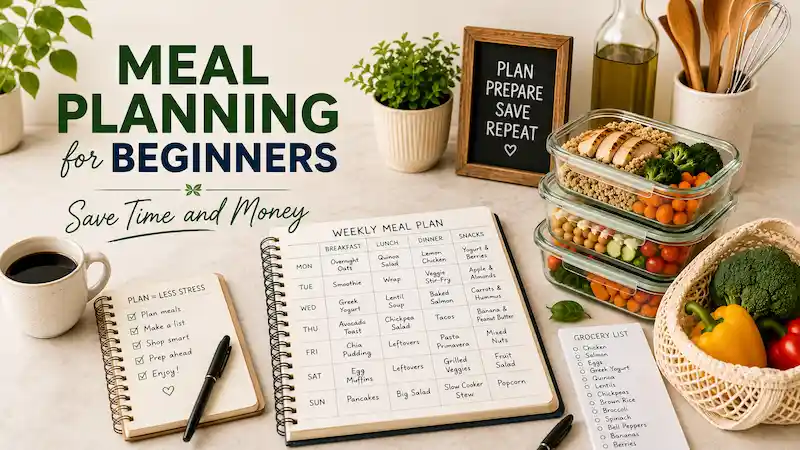
A solid first-week plan doesn’t require impressive recipes. Here’s a realistic 5-day dinner framework built on ingredient crossover:
| Day | Dinner | Active Prep Time |
| Monday | Sheet pan chicken thighs + roasted vegetables | 40 min |
| Tuesday | Tacos using leftover Monday chicken + canned beans | 15 min |
| Wednesday | Pasta with marinara + simple green salad | 20 min |
| Thursday | Stir-fry using Sunday-prepped rice + frozen vegetables + soy sauce | 20 min |
| Friday | Homemade pizza or flexible fend-for-yourself night | Flexible |
Monday’s chicken carries into Tuesday. Sunday’s pre-cooked rice makes Thursday a 20-minute dinner. Two real cooking sessions cover four planned meals. One night stays intentionally unstructured so the plan doesn’t feel like a rigid obligation.
For families who want ready-made examples with full shopping lists, these cheap weekly meal plans for families offer complete, budget-friendly options you can follow directly or adapt to your household’s tastes.
Practical Meal Planning Tools
You don’t need to purchase anything to start. Most helpful tools are already free or built into your phone.
| Category | Free Option | Paid Option |
| Meal planning template | Google Sheets, paper and pen | Mealime, Plan to Eat |
| Recipe organization | Pinterest boards, browser bookmarks | Paprika, Whisk |
| Grocery list | Phone notes app | AnyList, OurGroceries |
| Sale tracking | Individual store apps, weekly circulars | Flipp (aggregates multiple store deals) |
The most effective tool is the one you’ll actually use every week. A handwritten sticky note on the refrigerator door beats a sophisticated app that requires too many steps to feel worth opening.
How to Save More Money With Meal Planning
Meal planning creates the conditions for spending less. These strategies make the financial impact more deliberate.
Build meals around inexpensive proteins. Eggs, canned beans, lentils, canned tuna, chicken thighs, and pork shoulder consistently deliver the best cost per serving. Ground beef is also economical when purchased in bulk and divided for multiple uses. For a plant-focused approach to low-cost eating, these cheap vegetarian meal plans show how to stretch plant proteins across a full, satisfying week of meals.
Plan around sales before choosing recipes. Check your store’s circular before deciding what to cook that week. If chicken legs are on sale, build the plan around chicken. If zucchini is inexpensive, let it appear in three dishes. This approach reverses the usual sequence and keeps your shopping list aligned with what’s actually affordable that week.
Use ingredient crossover intentionally. If one recipe calls for half a can of coconut milk, plan a second recipe that week using the other half. The same logic applies to fresh herbs, specialty cheeses, and any produce that won’t last more than a few days. Deliberate crossover cuts both waste and spending in a single decision.
Build a freezer buffer. When you cook a batch of soup, chili, or pasta sauce, freeze half for a future week. Over a few months of this habit, you build a reliable stockpile that covers your least-planned evenings far better than a delivery app.
For a complete guide to managing your food budget from the ground up, this resource on eating well on a budget covers the full picture in one place.
Common Beginner Mistakes and How to Avoid Them
Planning too many new recipes at once. Your first week shouldn’t include five dishes you’ve never cooked. The cognitive load of unfamiliar recipes makes the whole system feel harder than it is. Stick to two or three familiar meals and introduce one new recipe per week as a controlled experiment.
Over-prepping for the entire week at once. Cooking 14 identical portions on Sunday sounds efficient until you’re sitting down to the same lunch for the fifth time and dreading it. Build variety into your week from the start. Overlapping ingredients don’t have to mean identical meals.
Not matching recipe complexity to your real schedule. A slow-roasted dinner on your most exhausting weekday is a plan that will fail before you make it. If Wednesday is consistently your hardest day, Wednesday should always be a 20-minute meal. The plan should reflect your life, not an idealized version of it.
Buying too much fresh produce without a specific plan for all of it. Fresh herbs, delicate greens, and quick-turning vegetables have short windows. If you buy something perishable, know exactly when you’re using it. Swap fresh herbs for dried when you won’t go through a full bunch. Choose sturdier vegetables like cabbage, carrots, sweet potatoes, and broccoli when you need produce that can hold until the end of the week.
Giving up after one imperfect week. The first two or three attempts will have problems. You’ll misjudge quantities, forget an ingredient, and probably order pizza at least once. That’s normal and expected. The habit gets faster, more accurate, and less effortful as you build familiarity with your own patterns. Give it a genuine four-week run before evaluating whether it’s working.
Meal Planning FAQs
How long does meal-prepped food stay safe in the refrigerator?
The USDA Food Safety and Inspection Service recommends using most cooked leftovers within 3 to 4 days, stored in a sealed container at or below 40°F. Beyond that window, freeze the food rather than extending the refrigerator timeline. For meal planning purposes, this means prepping enough food for about three to four days at a time, not a full seven.
How much time does meal planning take each week?
Most people spend 20 to 30 minutes planning and building a grocery list, plus one to two prep sessions ranging from 30 to 90 minutes depending on the week. The first few attempts take longer while you’re building your recipe rotation. Once you have 10 to 15 trusted meals in regular use, the planning portion becomes much faster.
Can meal planning work on a very tight budget?
It works especially well under budget pressure because it eliminates the unplanned spending that steadily inflates grocery costs. These healthy meal plans that save money provide specific examples of nutritious weekly plans built specifically around cost-conscious ingredients.
What if I get bored eating the same things?
The ingredient crossover strategy keeps meals from feeling repetitive even when they share components. The same roasted chicken thighs taste genuinely different in a grain bowl, in a taco, and as a simple salad topping. Introducing one new recipe per week also adds variety without disrupting the routine.
Is meal planning worth it for single people or couples?
Yes, often more so than for larger households. Smaller households waste proportionally more food because most grocery items come packaged in quantities designed for families. Planning specifically for one or two people allows you to buy accurate quantities and use everything before it spoils.
Start Simple, Stay Consistent
Meal planning for beginners doesn’t require a perfect system. It requires a consistent one.
Start this week with three dinners. Pick recipes that share at least one ingredient. Write a grocery list, shop once, and spend 30 minutes on Sunday prepping a few components. Repeat that four times in a row and the habit starts to feel automatic rather than effortful.
The goal isn’t flawless execution every week. It’s a predictable rhythm that keeps your fridge stocked, your budget on track, and the 6pm dinner panic from taking over your evenings. Three dinners planned is a better start than waiting for the perfect system to materialize.