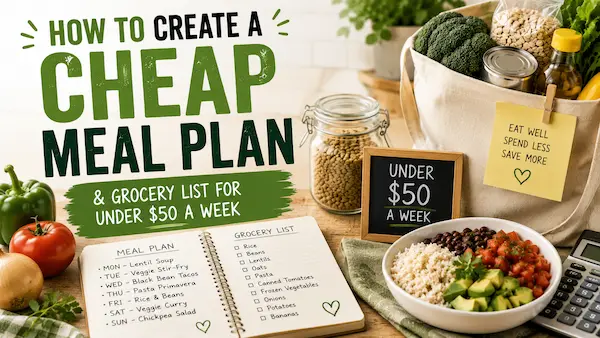
Feeding yourself well on $50 a week sounds like a stretch, and for a lot of households, it is. But it’s not impossible if you build your budget meal plan around a handful of cheap, flexible staples instead of pricing out a full week of separate recipes.
USDA’s own Thrifty Food Plan data shows just how tight that number is: a single woman aged 20 to 50 spends about $58.20 a week and a single man about $73.20 a week under the government’s lowest-cost food plan, while a reference family of two adults and two children runs about $235 a week. That means a $50-a-week budget meal plan sits below even the federal government’s leanest benchmark for one adult, so getting there takes real intention.
This guide walks through how to build a budget meal plan and grocery list that lands under $50 a week for one person, plus how to scale the approach for a couple or a family.
Key Takeaways
- A $50 weekly meal budget is realistic for one adult when meals are built around affordable staples like rice, beans, eggs, oats, and frozen vegetables.
- Planning meals before shopping helps you avoid impulse purchases and make the most of every ingredient.
- Reusing the same ingredients across multiple meals reduces food waste and keeps your grocery bill under control.
- A short, well-planned grocery list is one of the easiest ways to stay within a tight food budget.
- Cooking at home, buying store brands, and using leftovers strategically can stretch your grocery dollars even further.
- While $50 per week works for many single adults, larger households typically need a higher grocery budget based on the number of people being fed.
Is $50 a Week Actually Enough to Eat On?
For one adult, $50 a week is realistic if most meals are cooked from scratch around rice, beans, eggs, oats, and frozen vegetables, with meat used as a flavor booster rather than the main event. It gets harder per person in smaller households, since USDA’s own cost adjustments assume single-person households need about 20% more per person than a four-person household, because smaller households buy in smaller quantities and can’t spread bulk purchases as far.
For a couple or family, treat $50 per person as the working target and scale up from there. Our Cheap Meal Plans: The Ultimate Guide to Eating Well on a Budget breaks down how those numbers shift by household size.
Step 1: Set a Real Weekly Number
Before writing a grocery list, decide the actual dollar figure you’re shopping to. Write it down, and if you’re feeding more than one person, divide it by household size so you know what each meal needs to cost per serving. A written number is what stops a grocery trip from creeping past budget once you’re standing in the aisle.
Step 2: Build the Plan Around Cheap, Flexible Staples
A budget meal plan works because a small set of ingredients does a lot of jobs. These staples are the backbone of most cheap meal plans, and each one stretches across several meals:
| Staple | Typical role | What it becomes |
| Rice or pasta | Base carb | Stir-fries, casseroles, soups |
| Dried or canned beans | Cheap protein | Chili, burritos, soups, salads |
| Eggs | Fast protein | Breakfast, fried rice, egg salad |
| Rolled oats | Cheap breakfast | Breakfast, baking, thickener |
| Frozen vegetables | Produce that keeps | Stir-fries, soups, sides |
| Chicken thighs | Cheaper cut | Sheet-pan dinners, soups, tacos |
| Peanut butter | Shelf-stable protein | Breakfast, sauces, snacks |
| Canned tuna | Portable protein | Sandwiches, pasta, salads |
Prices vary by store, region, and season, so treat this as a planning guide, not a price guarantee.
Step 3: Plan Meals That Share Ingredients
The fastest way to blow a $50 list is buying separate ingredients for every recipe. Instead, plan a week where three or four proteins and vegetables repeat across different dinners. Michigan State University Extension recommends building a grocery list around the meals you’ve actually planned and skipping anything already on hand, so the list matches the week instead of guesswork.
Batch cooking earns its keep here too: cook a big pot of rice or a tray of chicken thighs once, then reuse it across two or three meals. For ready-made weekly structures built this way, 7 Cheap Weekly Meal Plans for Families on a Budget has full plans using this shared-ingredient approach.
Step 4: Write a Grocery List That Actually Saves Money
Once meals are set, turn them into a list organized by store section so nothing gets missed and nothing extra sneaks into the cart.
- Shop the pantry and freezer first. Note what you already have before adding anything new.
- Check store-brand versions. Generic groceries are typically similar in quality to name brands but can cost 20 to 25 percent less, according to Utah State University Extension.
- Stock shelf-stable and frozen staples when they’re on sale, since canned and frozen fruits and vegetables last much longer than fresh and still work in weekly meals, per University of Minnesota Extension.
- Shop with a full stomach. Hungry grocery trips cost more.
- Stick to the list. Impulse items are the easiest way to push $50 to $65.
Sample 7-Day Budget Meal Plan Under $50 (One Person)
This is one illustrative structure, not a fixed menu — swap in whatever’s cheapest at your store that week.
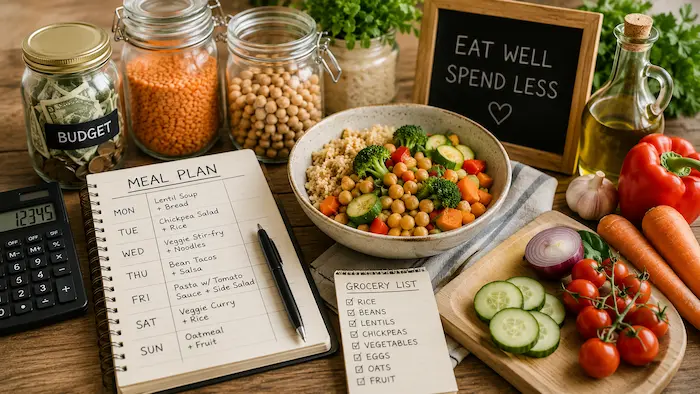
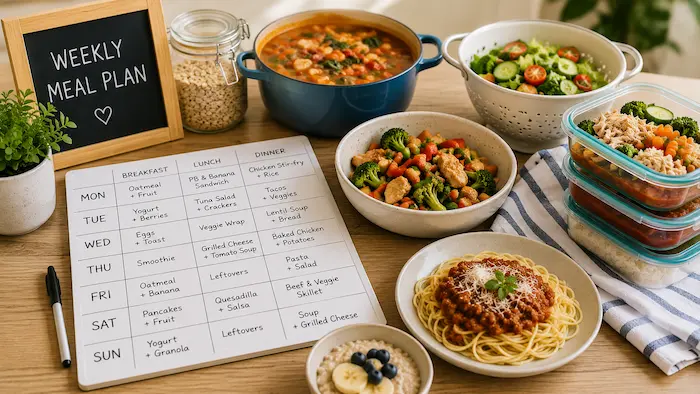
| Day | Breakfast | Lunch | Dinner |
| Mon | Oatmeal + banana | Rice and beans | Baked chicken thighs + frozen veg |
| Tue | Eggs + toast | Leftover chicken + rice | Bean chili |
| Wed | Oatmeal | Tuna sandwich | Leftover chili over rice |
| Thu | Eggs | Peanut butter sandwich | Stir-fry with frozen veg + rice |
| Fri | Oatmeal + banana | Leftover stir-fry | Egg fried rice |
| Sat | Eggs + toast | Bean and rice bowl | Pasta with canned tomatoes |
| Sun | Oatmeal | Tuna salad | Leftover pasta |
Because the same eight or nine staples repeat all week, the grocery list stays short — which is what keeps the total near $50 instead of $80.
Grocery List for This $50 Budget Meal Plan
The sample meal plan above is built around a short list of affordable, versatile ingredients that can be used in multiple meals throughout the week. Prices vary by location, store, brand, and seasonal sales, but this example shows how a one-person grocery list can realistically stay under a $50 weekly budget.
| Grocery Item | Estimated Cost |
|---|---|
| Rolled oats (18–42 oz) | $4.00 |
| Bananas (1 bunch) | $2.00 |
| Eggs (1 dozen) | $4.00 |
| Bread (1 loaf) | $2.50 |
| Peanut butter (16 oz) | $3.00 |
| White or brown rice (5 lb) | $5.00 |
| Dry beans (2 lb) or 4 cans | $4.00 |
| Chicken thighs (2–3 lb) | $8.00 |
| Frozen mixed vegetables (2 bags) | $4.00 |
| Pasta (1 lb) | $2.00 |
| Canned tomatoes (2 cans) | $2.50 |
| Canned tuna (2 cans) | $3.00 |
| Cooking oil and basic seasonings* | $2.00 |
| Estimated Total | ≈ $46–$48 |
*If you already have pantry basics such as cooking oil, salt, pepper, or common spices, your grocery bill may be even lower.
Why This Grocery List Works
The key to eating well on a tight budget isn’t buying the cheapest food, it’s buying ingredients that can be used in several different meals. Rice serves as the base for rice bowls, stir-fries, fried rice, and chili. Eggs work for breakfast, sandwiches, and quick dinners, while beans, chicken, and tuna provide affordable protein throughout the week. Reusing the same core ingredients reduces food waste, keeps your shopping list short, and makes it much easier to stick to a $50 weekly grocery budget.
Step 5: Shop Smart to Protect the Budget
Where and how often you shop matters almost as much as what you buy. Fewer trips mean fewer impulse buys, and eating at home has stayed meaningfully cheaper than eating out. The food-at-home index rose 2.7 percent over the 12 months ending in June 2026, while overall food prices climbed 3.0 percent, according to the Bureau of Labor Statistics — so cooking at home remains the more budget-stable choice even as prices move.
Food waste is also a bigger leak than most people realize. The average American family of four loses about $1,500 a year to food that’s bought and never eaten, according to USDA. A tight weekly list, built around meals that actually get cooked, closes most of that gap on its own.
For plans built around nutrition as well as cost, Cheap Healthy Meal Plans That Save Money Without Sacrificing Nutrition covers how to keep a $50 week balanced.
Track What You Actually Spend
A plan only works if it’s checked against reality. Writing down every food purchase, down to the penny, for a few weeks shows exactly where a budget holds and where it slips, and some shoppers set aside cash in an envelope for the week and spend only what’s inside, a method recommended by Penn State Extension. That feedback loop is what turns a one-time $50 week into a repeatable budget meal plan.
Stretching $50 Further: Vegetarian and Family Swaps
Dropping meat from a few meals a week is one of the fastest ways to lower a total, since beans, eggs, and peanut butter cost less per gram of protein than most cuts of meat. If plant-based proteins are the plan rather than an occasional swap, Cheap Vegetarian Meal Plans for Frugal and Sustainable Living builds full weeks around that approach.
For a family, the same staples work at bigger quantities — buying rice, oats, and dried beans in bulk lowers the per-serving cost further, which matters more the more people are eating from the same list.
Common Mistakes That Blow the Budget
- Planning meals before checking what’s on sale
- Buying pre-cut or single-serving versions of things that are cheaper whole
- Letting produce spoil before it’s used
- Shopping without a list, or shopping hungry
- Not planning what leftovers become tomorrow’s lunch
Next Steps
Start with one week: pick five staples, plan meals that reuse them, write the list before you shop, and track what it actually costs at checkout. Adjust the following week based on what ran out too fast or didn’t get eaten. A $50 budget meal plan gets easier the second and third week, once the staples and the shopping habit are already in place.