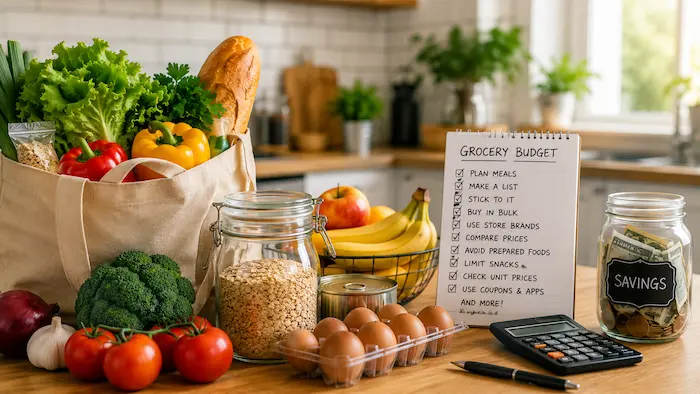
Grocery prices don’t feel like they’re slowing down, and the data backs that up. Food-at-home prices rose 2.7% over the 12 months ending June 2026, according to the Bureau of Labor Statistics. If your cart feels more expensive than it used to, it’s not just you.
The good news: most of what drives up a grocery bill isn’t the price of food itself. It’s habits: what you buy, when you buy it, and how much of it goes to waste. Below are 25 grocery budget tips that actually move the needle, organized so you can start with whichever step fits your week. For a deeper, start-to-finish strategy, our How to Budget Groceries: The Ultimate Guide to Saving Money on Food Without Sacrificing Quality walks through the full system these tips are pulled from.
Key Takeaways
- The biggest grocery savings come from better habits, not extreme couponing. Meal planning, shopping with a list, comparing unit prices, and reducing food waste can have a bigger impact than chasing discounts.
- Know your grocery budget benchmark. USDA Food Plans provide a realistic monthly spending target based on household size, making it easier to see whether you’re overspending.
- Food waste is one of the largest hidden expenses. Using what you already have and storing food properly can save hundreds of dollars each year.
- Store brands, seasonal produce, and frozen foods often deliver the best value without sacrificing quality or nutrition.
- Small, consistent changes add up. Choosing just a few of these 25 tips and sticking with them is more effective than trying to change everything at once.
Why Your Grocery Bill Feels Bigger Than It Used To
Before the tips, it helps to know what “normal” spending actually looks like. The USDA publishes four official food spending benchmarks each month: Thrifty, Low-Cost, Moderate-Cost, and Liberal. They’re built from a reference family of two adults and two school-age children, with every meal cooked at home, and updated monthly for inflation.
| USDA Food Plan | Weekly Cost (Family of 4) | Monthly Cost |
| Thrifty | $231 | $1,002 |
| Low-Cost | $255 | $1,106 |
| Moderate-Cost | $315 | $1,366 |
| Liberal | $381 | $1,649 |
Figures reflect USDA’s official March 2026 Cost of Food at Home report. Smaller households pay more per person, so use these as a directional benchmark, not a hard target. Our How to Budget Groceries for a Family of 4: A Practical Monthly Plan breaks this down by household size.
Part of the gap between what you spend and what you could spend is waste. USDA estimates that 30 to 40 percent of the U.S. food supply goes uneaten, and the agency puts the average cost of that waste at roughly $1,500 a year for a family of four. That’s real money sitting in the crisper drawer.
25 Grocery Budget Tips That Actually Save Money
Plan Before You Ever Push a Cart
1. Know your real number. Compare your current spending to the USDA benchmarks above for your household size. If you’re well above the Moderate-Cost tier and not buying much specialty or organic food, that’s your first clue where to look.
2. Build a plan around what you already have. Meal planning works because it forces you to shop with intention instead of guessing. Research on household food waste shows that planning meals around a checked pantry and fridge, rather than shopping first and figuring out meals later, meaningfully cuts what ends up thrown away, according to Utah State University Extension. Our How to Meal Plan and Budget Groceries for an Entire Week walks through the process step by step.
3. Shop your pantry and freezer first. Before you write a single line on your list, check what’s already in the house. Half a bag of rice, a lonely can of beans, and three eggs are often the start of a meal you don’t need to buy ingredients for.
4. Write a list, and actually stick to it. This sounds obvious, but the research on it is strong. In controlled studies, shoppers who wrote a list before heading out spent measurably less than those who didn’t, largely because the list acts as a plan that makes unplanned items stand out, according to research summarized in Psychology Today.
5. Eat something before you shop. Skipping this one is expensive. A widely cited university study found that hungry shoppers spent as much as 64 percent more than shoppers who weren’t hungry, and the effect extended even to non-food items, as reported by Smithsonian Magazine. A snack before you shop is one of the cheapest budgeting tools you have.
6. Set a price point for the staples you buy every week. Know roughly what you should pay for a dozen eggs, a gallon of milk, or a pound of chicken thighs at your usual store. When something’s above that number, that’s your cue to substitute or wait for a sale.
Make Smarter Choices in the Store
7. Compare unit price, not shelf price. The bigger box isn’t always the better deal, especially with package sizes shrinking industry-wide. Unit pricing, the cost per ounce, pound, or count, is the tool made for exactly this comparison, and it’s used by roughly 82 percent of consumers when it’s available on the shelf tag, per research cited by NIST. Get in the habit of checking it before anything goes in the cart.
8. Switch to store brands for pantry staples. Flour, spices, canned beans, and baking basics are commodities regardless of the label. In price comparisons across major grocery chains, Consumer Reports found store brands averaged 30 percent cheaper than name brands, with savings as high as 52 percent on some items. Our Cheap and Healthy Grocery List for Frugal Living flags exactly which items are safe to switch without a quality trade-off.
9. Buy produce in season. Berries in December and asparagus in October carry a premium because they’re shipped further and stored longer. A quick look at what’s in season regionally usually points you to the cheapest, freshest option in the produce aisle.
10. Shop the perimeter first, then fill in from the center aisles. Produce, meat, and dairy live around the edges of most stores. Starting there and filling in pantry items after tends to naturally limit impulse buys from the processed-food aisles in the middle.
11. Watch for shrinkflation. If a product feels like it’s not lasting as long as it used to, check the package size against what you remember. Comparing unit prices, rather than trusting that the price you remember still applies, catches this every time.
12. Buy in bulk only when the unit price is actually lower. Warehouse clubs and larger packages aren’t automatically cheaper. Run the unit-price math before assuming a bigger size saves money, especially for anything perishable that might spoil before you finish it.
13. Skip pre-cut, pre-washed, and single-serve packaging. Convenience has a price tag. A bag of whole carrots costs a fraction of pre-cut carrot sticks, and a block of cheese is cheaper per ounce than the same cheese shredded.
14. Set a hard spending cap before you check out. Whether that’s cash in an envelope or a running tally on your phone, having a visible limit changes behavior in the aisle, not just at the register.
Waste Less of What You Already Bought
15. Freeze what you won’t use this week. Bread, meat, shredded cheese, and even milk generally freeze well. If a recipe called for half an onion, freeze the rest instead of letting it liquefy in the crisper drawer.
16. Cook once, eat twice. Batch-cook a protein or a grain and use it across two or three meals with different seasonings. This cuts both cooking time and the chance that a random ingredient goes unused.
17. Store produce the right way. Potatoes and onions want a cool, dark, dry spot, not the same drawer as your apples, which release a gas that speeds up spoilage in nearby produce. A few small storage habits add real days to how long food stays good.
18. Keep an “eat me first” spot in the fridge. A designated shelf or bin for food nearing its use-by date keeps it visible instead of buried behind newer groceries, which is one of the simplest ways to catch food before it spoils.
19. Turn leftovers into a new meal, not a repeat. Roast chicken becomes chicken tacos. Extra rice becomes fried rice. Reframing leftovers as ingredients rather than reheated identical meals makes people far more likely to actually eat them instead of tossing them a few days later.
Use Tools, Timing, and Programs to Stretch Further
20. Use cash-back and rebate apps for things you already buy. These work best when they’re layered onto a purchase you were making anyway, not when they talk you into buying something new to chase a rebate.
21. Stack digital coupons with store sales. Most major chains let app-based coupons combine with weekly promotions. Five minutes of clipping digital coupons before you shop can meaningfully lower a bill that was already planned around sale prices.
22. Join free store loyalty programs. These typically unlock member-only pricing at no cost and often include personalized coupons based on your actual shopping history, which tend to be more useful than generic ones.
23. Time bigger shopping trips around your pay cycle and sale cycles. Many stores run predictable weekly or biweekly sale cycles on staples like meat and pantry goods. Planning larger purchases around those cycles, rather than shopping reactively, captures more markdowns over a month.
24. Compare price per serving across stores, not just the total receipt. A store with a higher total bill can still be the better value if it’s feeding your household more meals per dollar. This is especially useful when deciding between a full-service grocery store and a discount chain.
25. Track your spending weekly against your benchmark. Pick a number, whether that’s a USDA tier from the table above or your own target, and check your actual spending against it every week rather than only at the end of the month. Small overages are easy to correct early and much harder to fix after four weeks of drift.
Quick Checklist Before You Shop
- [ ] Checked the pantry, fridge, and freezer for what’s already on hand
- [ ] Built a meal plan and list around that, plus this week’s sales
- [ ] Eaten something in the last few hours
- [ ] Comparing unit price, not shelf price, on staples
- [ ] Set a spending cap for the trip
- [ ] Have a plan to freeze or repurpose anything that won’t get eaten in time
Grocery Budget Tips FAQ
How much should I spend on groceries per month?
It depends heavily on household size and location. USDA’s benchmarks above are a reasonable starting point: a family of four spending close to the Moderate-Cost tier is roughly in line with typical U.S. spending. Your own target should factor in your area’s cost of living and how many meals you eat at home.
Does meal planning actually save money?
Yes, mainly by cutting food waste. Planning meals around what you already have, rather than shopping first and improvising later, is one of the most consistently effective ways to reduce the amount of food that goes uneaten, which is where a lot of grocery spending quietly disappears.
What’s the single biggest grocery budget mistake?
Shopping without a list while hungry. Both habits independently push spending up, and combined they’re one of the most common reasons a “quick trip” turns into a bill well above what was planned.
Are cash-back apps and coupons worth the effort?
They’re worth using on things you were already going to buy, but they shouldn’t drive what goes in your cart. The bigger savings almost always come from planning, unit-price comparisons, and cutting waste, with coupons and cash back layered on top.
Your Next Step
None of these 25 tips require a total lifestyle overhaul. Pick two or three that fit your week, whether that’s writing a real list, checking unit prices, or setting up a freeze-first habit for leftovers, and build from there. For a complete system that ties planning, shopping, and storage together, the How to Budget Groceries: The Ultimate Guide to Saving Money on Food Without Sacrificing Quality is the natural next read.