The average U.S. household spent over $475 per month on groceries in 2024, according to the Bureau of Labor Statistics Consumer Expenditure Survey. For families managing tight budgets, that figure feels locked in place. But the research tells a different story: the gap between households that spend $250 per month on food and those that spend $600 is not income, not lifestyle, and not willingness to cook. It is almost always the presence or absence of a plan.
Cheap meal plans are the most reliable tool available for cutting food costs without gutting the quality of what you eat. Whether you’re feeding yourself on $30 a week or a family of four on $75, the same core framework applies. This guide covers that framework completely: how to build a plan from scratch, which foods deliver the best value per dollar, what real budget looks like for different household sizes, and how to shop smarter once the plan is built. If you want to skip straight to family-specific weekly menus, the guide on 7 cheap weekly meal plans for families on a budget offers complete meal-by-meal breakdowns you can use immediately.
By the time you finish reading, you will have a working system, not just a list of recipe ideas.
What Is a Cheap Meal Plan (and Why Most People Do It Wrong)
A cheap meal plan is a structured weekly schedule of meals built around a defined grocery budget, designed to minimize food waste, eliminate impulse purchases, and ensure every dollar spent returns the maximum amount of nutritious, satisfying food. It is not a deprivation plan. It is not a list of sad, repetitive meals. Done correctly, a budget meal plan feeds a household well at a fraction of what most people currently spend.
The failure rate is high not because budget meal planning is complicated, but because most people approach it backwards. They pick appealing recipes first, then build a grocery list that has no relationship to what’s already in the pantry, what’s on sale this week, or what they’ll realistically have time to cook on a Wednesday night after work.
The Real Definition of Budget Meal Planning
Budget meal planning means making deliberate, specific decisions about what you will eat before you go to the store, rather than making those decisions at the store, or worse, at 6 PM while staring into an empty refrigerator. The practical difference between a household that spends $300 per month on groceries and one that spends $650 is rarely about which store they shop at or how skilled they are at cooking. It is almost always about whether a plan existed before the shopping began.
The USDA Thrifty Food Plan provides a useful benchmark. A family of four can meet all major USDA nutritional guidelines on approximately $217 per week using the Thrifty plan, which is built entirely on deliberate ingredient selection, batch preparation, and strategic use of shelf-stable foods. That number surprises most people because the assumption is that healthy eating requires expensive ingredients. The USDA data consistently shows the opposite.
PRO INSIGHT: The fastest path to a lower grocery bill is not finding cheaper food. It is stopping the purchase of food that does not get eaten. The Natural Resources Defense Council estimates that American households discard between 30 and 40 percent of the food they purchase each year, according to their Wasted food report. A meal plan eliminates the majority of that waste by ensuring every item purchased has a specific meal assignment before it enters the cart. The cost savings from waste reduction alone often exceed the savings from switching grocery stores.
The Five Habits That Keep Grocery Bills Artificially High
Grocery spending patterns that drain budgets are remarkably consistent across households. These five behaviors account for most of the excess spending:
- Planning ambitious meals that require time and energy the week rarely provides, then ordering delivery when life gets in the way
- Buying fresh produce without a specific recipe attached to it, so items rot before use
- Treating every weeknight dinner as a standalone, original meal rather than building on components cooked earlier in the week
- Shopping at multiple stores reactively, picking up items at whichever store is closest rather than cheapest
- Underestimating how far pantry staples like lentils, brown rice, oats, and canned tomatoes stretch per dollar and per serving
The single biggest money-waster in most grocery budgets is not the food itself. It is the gap between food that is purchased and food that is actually eaten.
How to Build a Cheap Meal Plan From Scratch
Building a cheap meal plan that sticks requires five steps in order. Skipping any of them tends to break the system within a week, which is why so many people try once, feel overwhelmed, and give up. This section covers each step with specific guidance you can act on today. For the grocery list side of this process, the companion guide on creating a cheap meal plan and grocery list for under $50 a week provides a line-by-line shopping framework.
Step 1 – Set a Hard Weekly Budget Before You Plan Anything
Choose a specific number before opening a recipe, browsing a store app, or writing down a single ingredient. Not a range. A number. Most households that fail at budget meal planning do so because “spending less” is not a measurable target, and without a fixed ceiling, grocery spending expands to fill whatever is available.
Reasonable starting points for most U.S. households in 2026:
- One person: $30–$50 per week
- Two people: $60–$90 per week
- Family of four: $100–$150 per week
- Family of four on an aggressive budget: $75–$100 per week
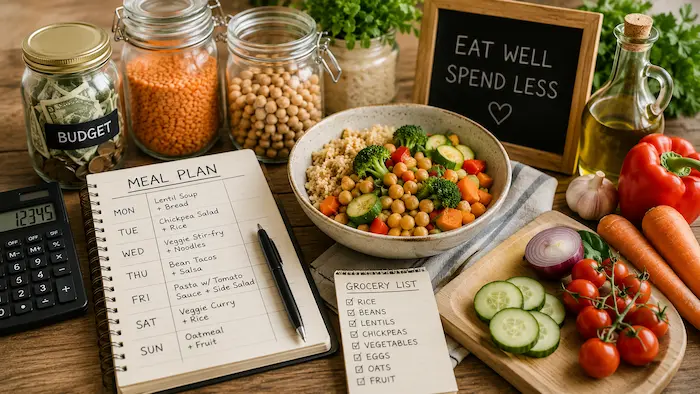
Write the budget number at the top of your planning document before anything else. Every meal decision, ingredient choice, and grocery list item gets filtered through whether it fits within that number.
Step 2 – Choose Your Base Ingredients First
Base ingredients are affordable, shelf-stable items that anchor multiple meals across the week. They reduce per-meal cost significantly because they are purchased in bulk, carry no spoilage risk, and combine with different proteins and vegetables to produce variety without requiring a different pantry item for every recipe.
The most effective base ingredients for cheap meal planning include dried or canned legumes (lentils, black beans, chickpeas), whole grains (brown rice, oats, whole wheat pasta), eggs, frozen vegetables, and canned tomatoes. A $30 investment in these five categories at the start of the month provides the backbone for 20 or more meals throughout the following weeks.
Once the base is set, you only need three to four proteins and two to three fresh produce items per week to build a complete rotation. The plan stops feeling restrictive when you recognize that the same rice, the same black beans, and the same frozen spinach can form a burrito bowl on Monday, a vegetarian soup on Wednesday, and an egg scramble on Friday without any of them tasting like repetition.
Step 3 – Build Every Meal Around Weekly Sales and Seasonal Produce
Rigid meal plans that ignore sale pricing will always cost more than plans that flex around real-time deals. Check your primary store’s weekly circular before finalizing any week’s plan, not after. The sequence matters: sales first, menu second.
If chicken thighs are marked down to $0.99 per pound, that protein anchors three dinners. If zucchini is $0.79 per pound because it is peak summer, it appears in meals twice that week. Produce in season costs 30 to 40 percent less than out-of-season alternatives and tastes significantly better. The USDA Seasonal Produce Guide is a free, region-specific reference for what is in season each month across the United States.
AUTHOR NOTE: The shift that changed how I approach meal planning permanently was this: I stopped deciding what I wanted to eat and then shopping for it. I check the sales circular first, then build the plan around what is cheap that week. A $1.29-per-pound whole chicken on sale becomes the centerpiece of Monday’s roast dinner, Tuesday’s chicken soup made from the carcass, and Wednesday’s grain bowl built from pulled leftovers. The same bird, three meals, under $7 total. That is not a compromise. That is a system.
Step 4 – Write a Precision Grocery List, Not a Wish List
Your grocery list is a purchasing document with one rule: every item on it maps to a specific meal in the plan. If an item does not correspond to a meal, it does not go on the list. This one discipline eliminates most impulse spending, which research consistently shows accounts for a significant portion of unplanned grocery expenditure.
Organize the list by store section: produce, proteins, dairy, canned goods, grains and dry goods, frozen. This structure minimizes browsing time and reduces the exposure to in-store displays designed to trigger off-list purchases. Set a 20-minute time limit for the shopping trip. Longer trips in grocery stores correlate reliably with higher total spend.
Step 5 – Batch Cook Components, Not Complete Dishes
Batch cooking is the mechanism that turns a meal plan on paper into food that actually gets eaten across the week. The most common mistake in batch cooking is preparing complete dishes in bulk, such as six portions of a specific casserole. That approach works until boredom sets in, usually by day three.
The more effective approach is component cooking: prepare ingredients rather than finished meals. Cook a large batch of brown rice. Roast two sheet pans of whatever vegetables were on sale. Hard-boil a dozen eggs. Simmer a pot of lentils. These individual components then assemble into different meals throughout the week in under 15 minutes each night, eliminating the “it’s too late to cook” problem that drives most households toward expensive takeout.
Batch cooking components rather than complete dishes is the single habit that separates households that maintain a meal plan from those that abandon it by Wednesday.
PRO INSIGHT: Pick two batch cooking sessions per week rather than one large Sunday session. Sunday handles the week’s base grains, proteins, and roasted vegetables. A short Wednesday refresh restocks anything running low and adds one or two new components to prevent flavor fatigue. Two 45-minute sessions per week provide more flexible fuel than one long cooking block and reduce the burnout that causes even well-intentioned meal plans to fall apart.
The Best Cheap Foods to Center Any Meal Plan Around
Not all inexpensive foods earn their place in a budget meal plan. Some are cheap per package but weak on satiety or nutrients, meaning you eat more and spend more to feel adequately fed. The foods below earn their place because they deliver protein, fiber, and micronutrients per dollar spent, not just low sticker prices.
For households prioritizing nutrition alongside cost, the cheap healthy meal plans guide provides a complete breakdown of the highest-nutrient, lowest-cost foods across all major food groups, with specific guidance on hitting key micronutrient targets on a restricted budget.
Budget Proteins That Deliver the Most Per Dollar
Protein is typically the most expensive component of any meal. These options cost significantly less than beef or pork while delivering comparable or superior nutrition per serving:
| Protein Source | Average Cost | Protein Per Serving | Key Advantage |
| Eggs (1 dozen) | $2.50–$4.00 | 6g per egg | Most versatile budget protein; works across all meals |
| Canned tuna | $1.00–$1.75 per can | 22g per can | No cooking required; long shelf life |
| Bone-in chicken thighs | $0.99–$1.50/lb | 26g per 4oz | More flavorful and cheaper than chicken breasts |
| Dried lentils | $1.00–$1.50/lb | 18g per cooked cup | Also a complex carbohydrate; zero prep beyond simmering |
| Canned black beans | $0.75–$1.25 per can | 15g per cup | No-cook protein option; pairs with nearly any cuisine |
| Canned chickpeas | $0.89–$1.50 per can | 14.5g per cup | Extremely versatile; roasts into a crunchy snack too |
Households looking to reduce meat spending without sacrificing protein can find full guidance in the cheap vegetarian meal plans guide, which includes strategies for combining plant proteins to cover complete amino acid profiles within a strict budget.
Affordable Carbohydrates That Actually Keep You Full
Refined carbohydrates, including white bread, white rice, and sugary cereals, are inexpensive per package but deliver minimal satiety, which means total food spending increases because you eat more to compensate. These complex carbohydrate options cost roughly the same per serving and sustain energy and fullness significantly longer:
- Brown rice: approximately $0.10–$0.15 per cooked serving, high in fiber, pairs with every protein on the list above
- Rolled oats: approximately $0.15–$0.20 per serving, works as breakfast, overnight oats, or even a savory grain base
- Whole wheat pasta: $0.20–$0.30 per serving, versatile base for dozens of quick weeknight dinners
- Sweet potatoes: $0.50–$1.00 each, high in vitamins A and C, extremely satiating
- Whole grain bread (store brand): $1.50–$2.50 per loaf, adequate for 10 to 14 servings depending on slice thickness
Budget-Friendly Vegetables and Fruits Worth Buying Regularly
Fresh produce is where most budget meal plans fall apart, because people shop aspirationally rather than practically. Beautiful berries at $4.99 per pint, a bunch of asparagus at $3.50, a bag of specialty salad greens that wilts within four days — these purchases eat through a grocery budget before the main proteins are even purchased.
The vegetables below earn their place in every cheap meal plan because they are inexpensive, nutritionally dense, and last long enough to actually get used:
- Frozen spinach and mixed vegetables: nutritionally equivalent to fresh, last months, cost $1.00–$2.00 per bag with zero spoilage risk
- Cabbage: one of the cheapest vegetables by weight, lasts two to three weeks refrigerated, works raw in slaws or cooked in soups
- Carrots: $0.89–$1.50 per pound, extremely versatile across roasted dishes, soups, stir-fries, and raw snacking
- Bananas: typically the cheapest fresh fruit at $0.19–$0.25 per piece, high in potassium and natural sugar
- Canned corn, peas, and green beans: 12 to 18 month shelf life, $0.75–$1.25 per can, ready without cooking
Frozen vegetables are nutritionally equivalent to fresh because they are frozen at peak ripeness, and they eliminate the spoilage risk that makes fresh produce the most budget-hostile item in most grocery carts.
Sample Cheap Meal Plans for Every Household Size
Generic meal plan templates fail most people because they ignore the realities of specific household sizes, cooking schedules, and food preferences. The three plans below are built for real use, with real cost estimates based on 2026 U.S. average grocery prices at discount and mid-range stores.
Cheap Meal Plan for One Person (~$30/Week)
This plan assumes shopping primarily at ALDI, Walmart, or a comparable discount grocer. It covers seven breakfasts, five lunches (two days use restaurant or workplace eating assumptions), and five dinners for approximately $28–$33 per week.
Monday: Oatmeal with banana and peanut butter (breakfast); peanut butter toast with sliced banana (lunch); red lentil soup with whole grain bread (dinner)
Tuesday: Scrambled eggs with frozen spinach (breakfast); leftover lentil soup (lunch); whole wheat pasta with canned tomato sauce and canned tuna (dinner)
Wednesday: Overnight oats with canned peaches (breakfast); grain bowl with brown rice, black beans, frozen corn, salsa (lunch); vegetable stir-fry with egg over rice (dinner)
Thursday: Toast with peanut butter and banana (breakfast); tuna wrap with shredded cabbage and mustard (lunch); baked sweet potato topped with black beans, salsa, and plain yogurt (dinner)
Friday: Oatmeal with canned fruit (breakfast); leftover rice bowl (lunch); chickpea and tomato stew with brown rice (dinner)
Estimated grocery list: rolled oats, bananas, eggs, peanut butter, whole wheat bread, dried red lentils, canned tuna (3 cans), whole wheat pasta, canned tomatoes (2 cans), brown rice, canned black beans (2 cans), canned chickpeas, frozen mixed vegetables, frozen spinach, sweet potatoes, plain yogurt (small tub), salsa. Total: approximately $28–$33.
Cheap Meal Plan for a Family of Four (~$75/Week)
Feeding four people for $75 per week requires leaning heavily on bulk purchases, batch cooking, and meals that stretch one protein across multiple servings. The framework that consistently works for families at this budget uses the following structure each week:
- Three dinners built around chicken thighs or ground turkey, the most cost-effective whole-food proteins for family portions
- Two meatless dinners built around black beans, lentils, or eggs (these typically cost $2–$5 total for four servings)
- Breakfasts rotated across oatmeal, scrambled eggs, whole wheat toast with peanut butter, and plain yogurt purchased in bulk
- Lunches sourced almost entirely from dinner leftovers, with peanut butter sandwiches as a reliable backup
Estimated cost breakdown: $20–$25 on proteins, $15–$20 on produce and frozen vegetables, $15–$20 on pantry staples, $10–$15 on dairy and eggs. Total: $60–$80, landing at approximately $75 with deliberate shopping.
Cheap Healthy Meal Plan Optimized for Weight Loss
A cheap meal plan tuned for weight loss operates on the same budget principles but adjusts the macronutrient balance: higher protein for satiety, more non-starchy vegetables for volume and micronutrients, moderate complex carbohydrates for sustained energy. The practical mechanism that makes this work on a budget is not exotic ingredients. It is strategic swaps within the same price range.
Key adjustments for a weight-loss-focused cheap meal plan:
- Replace half the rice portions with cauliflower rice (frozen, approximately $1.50 per bag) or roasted cabbage to add volume without significant calories
- Prioritize eggs, canned fish, and legumes over higher-fat proteins
- Build at least one large salad per day around shredded cabbage, grated carrots, canned chickpeas, and a simple vinegar-based dressing, costing approximately $1.00–$1.50 per large serving
- Use vegetable broth or bone broth as the base for soups to add satiety-supporting volume without excess calories
Harvard T.H. Chan School of Public Health’s Healthy Eating Plate is a free, evidence-based framework for balancing food groups that adapts cleanly to a budget meal planning context without requiring expensive specialty foods.
How to Push Your Grocery Bill Even Lower
A strong meal plan without smart shopping still leaves money on the table. The strategies below layer onto the planning framework to reduce costs further without adding complexity to the weekly routine.
A Store-by-Store Budget Shopping Comparison
Not all grocery stores charge the same price for the same items. The difference between shopping at ALDI and shopping at a conventional regional grocery chain for a standard budget grocery list runs $20–$40 per week for a family of four. That is $80–$160 per month on functionally identical products.
For most U.S. markets, the budget shopping hierarchy looks like this:
- ALDI / Lidl: Consistently lowest prices on private-label staples including grains, canned goods, dairy, eggs, and frozen vegetables. The trade-off is a limited selection and no name brands.
- Walmart Supercenter: Competitive pricing on packaged goods and proteins. Rollback pricing on meats and produce changes weekly.
- Costco / Sam’s Club: Best unit pricing on high-volume staples like olive oil, oats, rice, and canned goods, but only justifies membership for households that can realistically use bulk quantities before expiration.
- Kroger / Safeway / regional chains: Most competitive when using digital loyalty coupons and store-specific weekly deals. The base price without coupons is often 15–25% higher than ALDI.
- Trader Joe’s / Whole Foods: Select items only. Both chains significantly overprice most staples. A bag of brown rice at Whole Foods costs approximately twice what it costs at ALDI.
The strategy that works for most households: purchase proteins and pantry staples at ALDI or Walmart, and use a mainstream chain’s loyalty app for specific deal categories those stores do not carry well.
The Unit Price Rule That Changes How You Shop
The shelf price of a grocery item is almost meaningless without context. A $4.49 jar of peanut butter might be a better value than a $2.79 jar, or a worse value, depending entirely on the unit price displayed on the shelf tag. Every grocery store in the United States is required to display unit pricing (price per ounce, per pound, or per count) on the shelf label.
Always check the unit price before defaulting to the larger or smaller size. The larger size almost always wins, but there are consistent exceptions, particularly on produce and perishable items where buying more than you can use before spoilage increases your effective per-serving cost. Store brands consistently run 20 to 40 percent cheaper per unit than name brands for equivalent quality on oats, rice, pasta, canned vegetables, frozen fruit, and cooking oils.
Switching from name brands to store brands on your five most purchased pantry staples will reduce your grocery bill faster than any other single purchasing change.
PRO INSIGHT: The unit price rule applies with equal force in the household and personal care aisles, a category most budget meal planning guides ignore entirely. Dish soap, laundry detergent, and shampoo purchased in the largest available size at a discount store free up $15–$25 per month that can be reallocated directly to food spending. Most households that feel perpetually short on grocery budget are actually absorbing the cost of small-format, name-brand household products purchased at convenience stores or drug stores.
Free Apps and Tools That Reduce Grocery Costs
Several free digital tools compound the savings generated by a well-built meal plan. None of them require extreme couponing behavior or significant time investment:
- Flipp: Aggregates weekly store circulars and allows you to search for a specific item across all local stores simultaneously. Particularly useful for identifying which store has the best price on that week’s chosen protein before finalizing the plan.
- Ibotta: Cash-back app that provides rebates on specific grocery purchases after uploading a receipt. Regular users average $10–$20 per month in rebates with minimal active effort.
- Store loyalty apps (Kroger, Publix, Safeway, Albertsons): Digital coupons load directly to your account and deduct automatically at checkout. No physical clipping required. Most apps also offer personalized deals based on purchase history.
- USDA MyPlate on a Budget tools: A free resource from the federal nutrition program that provides budget meal planning worksheets, seasonal food guides, and cost-per-serving calculators at no cost.
The most consistently underused tool in this category is the store’s own website or app. Most major chains post digital-only deals that do not appear in the printed circular and are only accessible to loyalty account holders. Setting up a free account at your primary grocery store’s app takes under five minutes and typically surfaces $5–$15 in immediate savings.
Frequently Asked Questions About Cheap Meal Plans
What is the cheapest meal plan possible?
The cheapest functional meal plan is built entirely around dried legumes, whole grains, eggs, and frozen vegetables. A diet centered on lentils, brown rice, oats, eggs, and frozen mixed vegetables can sustain a single adult for approximately $15–$20 per week at 2026 U.S. grocery prices. This approach is nutritionally adequate but benefits from a daily multivitamin to cover micronutrient gaps from the limited variety.
How do I eat on $50 a week?
Eating on $50 per week per person is consistently achievable with a structured plan. Allocate roughly $15 on proteins (eggs, canned tuna, dried lentils), $10 on produce and frozen vegetables, $10 on grains (oats, rice, pasta), $8 on canned goods (tomatoes, beans), and $7 on dairy and condiments. Cook from scratch, avoid pre-packaged convenience food, and use dinner leftovers as lunch every day without exception.
Can you eat healthy on a very tight budget?
Yes, and the evidence is well established. The USDA Thrifty Food Plan demonstrates that a nutritionally complete diet meeting all major dietary guidelines is achievable at low cost. The key is prioritizing minimally processed whole foods: lentils, eggs, oats, frozen vegetables, canned fish, and sweet potatoes are among the most nutrient-dense options available in any grocery store, and all of them are consistently affordable.
What are the cheapest foods to meal prep?
The cheapest foods to meal prep share three characteristics: low cost per serving, high yield per batch, and a refrigerator life of at least four days. Dried lentils, brown rice, roasted sweet potatoes, hard-boiled eggs, and overnight oats top the list. One 45-minute prep session using these five ingredients produces 10 to 12 ready-to-use meal components for under $12 total.
How do I start meal planning if I’ve never done it before?
Start with three dinners, not seven. Pick three simple meals for the coming week, build a grocery list around exactly what those three meals require, and purchase nothing outside that list. Once planning before shopping becomes a habit, expand to five dinners, then seven. Adding too much complexity too early is the primary reason most people abandon meal planning within the first two weeks of attempting it.
Conclusion
Cheap meal plans work because they replace reactive food spending with intentional decisions made before you set foot in a grocery store. Every dollar has a purpose, every ingredient has a meal, and the weekly chaos of “what are we eating tonight” gives way to a system that runs on near-autopilot once it is established.
The framework is three-layered: plan around a hard budget and reliable base ingredients, build meals around weekly sales and seasonal produce, and batch cook components that assemble quickly throughout the week. Start with one week at a defined target budget, track actual spending against the plan, and adjust the following week based on what worked.
Your most useful next step is a simple one: pick a budget number for this week, choose five meals from the sample plans above, build your grocery list from those five meals only, and make one shopping trip with the list in hand. For ready-made plans organized by family size and week, explore the 7 cheap weekly meal plans for families on a budget to find a complete starting template that fits your household.