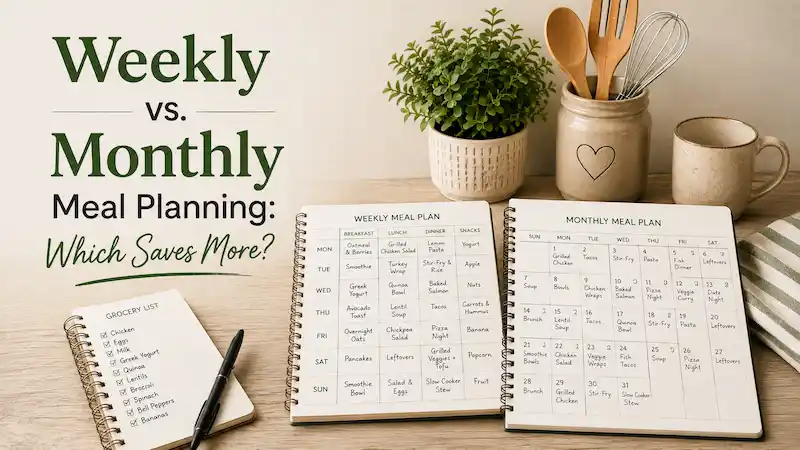
If you have ever walked out of the grocery store spending $40 more than you intended, without any real plan, you already understand why meal planning matters. The more useful question comes next: should you plan meals one week at a time, or map everything out for the entire month?
Both approaches can reduce your food bill. But the honest answer to which one saves more is that it depends on your household size, storage space, shopping habits, and how much food you tend to waste. Neither system is universally cheaper. This article breaks down the actual trade-offs, based on available cost data and the documented variables that affect each approach, so you can figure out which starting point makes sense for you.
The Short Answer
Neither weekly nor monthly meal planning universally saves more money. Weekly planning tends to reduce food waste more reliably and suits households with changing schedules. Monthly planning can create more opportunities for bulk purchasing and fewer unplanned shopping trips, which may lower grocery costs for larger households with adequate storage.
For many households, a layered approach works better than either system alone: plan pantry staples and proteins on a monthly cadence, then do a quick weekly adjustment for fresh ingredients and produce. The rest of this article explains why, with the specific variables that determine which end of the spectrum is better for your situation.
What Is Weekly Meal Planning?
Weekly meal planning means choosing your meals for the next seven days, building a grocery list from that plan, and shopping one or two times to cover the week.
Most people run this cycle on Sunday. The planning session takes around 30 to 60 minutes. The shopping trip takes an hour or so. By the end of the day, you know what you are cooking all week, what is already in the house, and what you need to pick up.
The structure is intentionally flexible. If your schedule shifts mid-week, adjusting a seven-day plan is straightforward. You have only committed to one week at a time.
This is also the lowest-friction starting point for anyone new to food planning. Our guide to meal planning basics walks through the full process if this is unfamiliar territory.
What a typical weekly rhythm looks like:
- 30 to 60 minutes of planning each week
- One main shopping trip, sometimes a midweek top-up
- Primarily fresh ingredients with some pantry overlap
- Easy to adapt without disrupting the whole month
What Is Monthly Meal Planning?
Monthly meal planning means building a four-week framework of meals at the start of each month, doing one large bulk shopping trip, and relying on the freezer and pantry to carry the load through the weeks ahead.
The upfront planning session is longer, typically two to four hours. That investment front-loads the decision-making so you are not starting from scratch every Sunday. After the initial setup, your weekly check-in shrinks to about 15 minutes: confirm what needs to come out of the freezer, note what fresh items you need, and move on with your weekend.
Monthly planning works best when it is paired with a freezer system and a well-stocked pantry. The week-to-week flexibility you get with a weekly plan is traded for structural efficiency. Whether that trade-off is worth it depends on your household’s specific situation.
Head-to-Head Comparison
| Factor | Weekly Meal Planning | Monthly Meal Planning |
| Planning time | 30–60 min/week | 2–4 hrs once/month |
| Shopping trips | 1–2 per week | 1 large + 1–2 small fill-ins |
| Fresh produce variety | High | Lower (more freezer reliance) |
| Food waste risk | Lower with small, focused batches | Higher without an inventory system |
| Potential grocery savings | Moderate | Higher, if paired with bulk buying |
| Flexibility | High | Lower |
| Upfront cost | Spread across the month | One larger initial outlay |
| Freezer space required | Minimal | Significant |
| Best starting point for | Small households, shifting schedules | Larger families, stable routines |
Which Approach Saves More? The Real Cost Variables
There is no single number that answers this cleanly, because the cost outcome depends on a set of intersecting variables. Here is what the data shows about each.
What American Households Spend on Groceries
According to the Bureau of Labor Statistics 2024 Consumer Expenditure Survey, the average household spends $847 per month on food overall. That figure covers both food at home (groceries) and food away from home (dining out and delivery). Grocery spending specifically averages around $519 per month, with dining and takeout accounting for the remainder.
Food prices have also been rising steadily. The USDA Economic Research Service reports that food prices rose roughly 25% in cumulative terms between 2020 and 2024. That context makes the efficiency of your planning system more consequential than it was a few years ago.
Where Monthly Planning Can Create Cost Advantages
The primary cost mechanism behind monthly planning is bulk buying. A 2025 LendingTree analysis comparing prices at Walmart, Costco, and Whole Foods found that buying in bulk saves an average of 27% across common grocery items. Monthly meal planning is the organizational structure that makes bulk buying practical: without knowing what you will cook for the next four weeks, it is difficult to buy large quantities of proteins and staples in proportions you will actually use.
Monthly planning also typically means fewer total shopping trips, which reduces exposure to impulse purchases and unplanned additions. More store visits generally means more small spending decisions that add up across the month.
That said, the 27% bulk buying figure reflects savings on items that are well-suited to bulk purchase. Not every item on your grocery list qualifies, and how much of your total cart this affects varies significantly by household. The actual saving will depend on what you buy, how much freezer space you have, and whether you use what you stock before quality declines.
Where Weekly Planning Can Hold Its Own
Weekly planning avoids the larger upfront grocery outlay of a monthly shopping run. It also reduces the risk of buying quantities that exceed what your household can realistically use, which matters particularly for smaller households or anyone without much freezer or pantry space.
Shopping more frequently also allows you to buy what is on sale that week, take advantage of seasonal produce at peak price, and adjust for what your household genuinely needs rather than what you estimated a month ago.
The Honest Assessment
Monthly planning can create more structural opportunities for cost reduction through bulk buying and fewer trips. Weekly planning can reduce waste and avoids the storage requirements that monthly bulk buying demands. Whether monthly planning actually costs less for any specific household depends on whether the bulk savings outweigh the food waste and storage challenges it introduces.
For a comprehensive look at structuring your grocery budget within either system, this cheap meal plan guide covers the full strategy for eating well without overspending.
Food Waste: Where Many Households Lose More Than They Realize
Food waste is one of the most significant and underestimated budget leaks in any household, and the two planning approaches handle it differently.
The Environmental Protection Agency’s 2025 report on the cost of food waste estimates that each U.S. consumer spends $728 per year on food that is purchased and never eaten. The same report separately estimates the annual cost for a household of four at $2,913. These figures come from the EPA’s analysis of USDA food availability data and retail price data, and reflect the money households spend on food that goes to waste rather than being consumed.
That level of spending represents a meaningful budget variable, and the two planning approaches address it in different ways.
Weekly Planning and Food Waste
Weekly planners buy fresh ingredients for seven specific days of meals. When produce is purchased for a defined purpose, it tends to get used. Buying cilantro for Tuesday’s tacos and Wednesday’s grain bowls means it gets used before it wilts. Buying that same cilantro without a specific meal in mind is how it ends up composted by Friday.
Smaller, focused weekly purchases also align naturally with the shelf life of fresh ingredients. Leafy greens, fresh herbs, and most proteins last five to seven days under proper refrigeration. Weekly planning is built around that reality.
Monthly Planning and Food Waste
Monthly planning introduces a different kind of waste risk. When you buy proteins and pantry staples for four weeks at once, your system depends on actually working through what is stored. Without consistent tracking, items get buried in the freezer, forgotten in the pantry, and eventually discarded.
According to the USDA Food Safety and Inspection Service, food stored continuously at 0°F is safe indefinitely, but quality declines over time. Most raw ground meats maintain best quality for three to four months in the freezer. Cooked casseroles and soups are typically best within two to three months. Monthly planners who are not rotating inventory consistently risk losing the bulk savings they worked to capture.
A simple fix: label everything with a date, keep a handwritten inventory on the freezer door, and build oldest-first rotation into your weekly cooking habit.
Takeaway: Weekly planning has a structural advantage in reducing food waste because smaller, purpose-driven purchases align better with fresh ingredient shelf life. Monthly planning can match that performance only with a disciplined inventory system.
Time Investment: What Each Approach Actually Costs in Hours
Weekly planning requires a consistent recurring commitment each week. Around 30 to 60 minutes for planning, one to two hours for shopping depending on store and household size, and whatever time you set aside for prep. When the habit is consistent, this becomes routine. When life interrupts it for two or three weeks in a row, the system stalls.
Monthly planning front-loads the time investment. A thorough monthly planning session, including a pantry audit, building your four-week meal framework, and writing a master shopping list, takes two to four hours. The large warehouse shopping run typically adds another two to three hours including travel and unloading.
The trade-off is that after the initial setup, the ongoing weekly time requirement can shrink significantly. Instead of a full weekly planning session, many households find a 15-minute check-in is enough: confirm what to pull from the freezer, note what fresh items to pick up midweek, and move on.
Whether monthly planning requires less total time than weekly planning depends on how detailed your planning sessions are, how far the warehouse store is from your home, and how smoothly your inventory system runs. The time savings are real for some households and minimal for others.
There is also a decision-fatigue variable. When meals are largely set four weeks in advance, the daily question of “what is for dinner tonight?” is answered before it becomes a 5pm stress point. That is a qualitative benefit, not a measurable cost saving, but it is a genuine advantage for households that find weeknight dinner decisions draining.
Which Is the Better Starting Point for Your Household?
This table is not a savings guarantee. It is a starting framework based on the variables that most consistently determine which system performs better.
| Your Situation | Better Starting Point |
| 1 to 2 person household | Weekly |
| Family of 4 or more | Monthly or hybrid |
| Limited freezer or pantry space | Weekly |
| Large freezer available | Monthly or hybrid |
| Frequently changing schedule | Weekly |
| Predictable weekly routine | Monthly or hybrid |
| Frequent food waste problem | Weekly |
| Strong bulk-buying habits | Monthly or hybrid |
| New to meal planning | Weekly |
| Experienced planner, want lower cost | Monthly or hybrid |
Who Should Start with Weekly Meal Planning?
Weekly planning is generally the better starting point when:
Your household is small. One to two people rarely use bulk quantities before quality declines. A large pack of ground beef makes sense for a family of four. For one person, it often leads to the freezer waste the system was supposed to prevent.
Your schedule changes week to week. Travel, irregular work hours, children’s activities, or social plans that shift on short notice make monthly rigidity impractical. A weekly plan can absorb a last-minute dinner out without derailing anything.
You have limited freezer or pantry storage. Monthly planning depends on storage capacity. Without it, the system cannot function as intended.
You prioritize fresh ingredients. Some households prefer fresh proteins and daily-cooked produce over frozen alternatives. Monthly planning works against that preference.
You are new to meal planning. One week at a time is far less overwhelming than trying to plan a full month on your first attempt.
If you have a family and want a practical weekly starting point, this collection of cheap weekly meal plans for families gives you real menus that work within a weekly structure and a realistic budget.
Who Should Consider Monthly Meal Planning?
Monthly planning is worth exploring when:
Your household is larger. Three or more people move through bulk quantities quickly enough to reduce the risk of quality loss, and the per-unit savings scale more meaningfully with household size.
Your schedule is relatively predictable. Monthly planning thrives on a consistent routine. If your weeks generally follow a reliable pattern, the structured approach fits naturally.
You have adequate freezer storage. A chest freezer or a large upright freezer makes monthly planning significantly more practical. Without it, the bulk purchasing advantage largely disappears.
You already shop at warehouse stores. Costco, Sam’s Club, and similar retailers are organized around bulk purchasing. Their pack sizes reflect an assumption that you will not be back for the same item next week.
You want to reduce ongoing weekly planning effort. Once a monthly framework is running, the recurring weekly time investment can meaningfully decrease.
The Hybrid Approach: Addressing Both Trade-Offs at Once
The most balanced system for many households is not a strict choice between weekly and monthly. It is a layered approach that uses both together.
Monthly layer: Plan and stock pantry staples, bulk proteins (frozen), and household essentials. Do one large shopping run at a discount or warehouse grocery store. Set rough meal themes for the four weeks ahead. Monday is grain bowl night. Wednesday is pasta. Friday is whatever clears out the fridge. Themes give structure without locking you into specific recipes.
Weekly layer: A 15-minute Sunday check-in. Confirm what needs to come out of the freezer, note what fresh items you need (produce, dairy, bread), and write a short grocery list for a quick midweek stop at a regular grocery store.
Daily layer: Decide the specific recipe within the nightly theme, based on what is freshest, what is closest to expiration, and what sounds good.
This structure addresses the main weakness of each standalone system. The monthly layer creates opportunities for bulk purchasing. The weekly fresh-food run keeps produce variety high and waste low. And a well-stocked pantry provides a fallback when your schedule throws a surprise.
If you want a hands-on process for building a weekly list within either system, this guide on creating a grocery list for under $50 a week walks through the list-building steps in practical detail.
Common Mistakes That Undercut Both Systems
Planning too many different meals per month. Mapping out 28 unique dinners with non-overlapping ingredients guarantees complexity and burnout. Successful monthly planners work with meal themes, rotating proteins, and batch-cooked staples that work across multiple meals.
Skipping the pantry and fridge audit. Every planning session, weekly or monthly, should start with a look at what is already on hand. Planning meals around existing inventory is the most direct way to reduce grocery spending and waste at the same time.
Buying fresh produce for a full month. Fresh vegetables and fruits do not keep for four weeks. Monthly planners need to incorporate a small weekly produce run and rely on frozen vegetables for the rest of the month. According to FoodSafety.gov, most frozen vegetables maintain quality for eight to twelve months at 0°F, making them a reliable and cost-efficient foundation for monthly planning.
Not treating leftovers as a planned meal. Leftovers are a built-in cost tool. Planning four nights of new cooking and three nights of leftovers every week is a deliberate strategy, not a shortcut.
Skipping monthly tracking. Whichever system you run, compare your grocery total month over month. Without a baseline, you have no way to know whether the approach is working or where adjustments are needed.
Conclusion: An Answer That Fits Your Household
Neither weekly nor monthly meal planning wins across the board. The approach that reduces your grocery spending is the one that fits your actual household size, storage situation, schedule, and shopping habits.
If you are a smaller household, managing a shifting schedule, or approaching structured meal planning for the first time, a weekly system is a lower-risk starting point. It builds the planning habit, reduces food waste through focused purchasing, and does not require a large freezer or a big upfront shopping outlay.
If you have a larger family, a predictable routine, and the storage to support bulk buying, monthly planning with a warehouse shopping run can meaningfully lower your per-unit grocery costs. The savings are more likely to show up for households that can actually use what they buy before quality declines.
For the majority of households sitting somewhere in the middle, a hybrid system addresses both trade-offs: monthly structure for cost efficiency, weekly flexibility for freshness. It is not a perfect system, but it is the most adaptable one.
Your next step: Pick one approach and track your grocery receipts for 30 days. Compare that total to what you spent the previous month. The numbers will tell you whether the system is delivering for your household, and whether it is worth keeping, adjusting, or combining with the other approach.
For households looking to stretch their grocery budget further by adding more plant-based meals into the rotation, our guide to cheap vegetarian meal plans shows how plant-forward planning can reduce costs within either a weekly or monthly system.