
If you’ve ever felt like saving money is a luxury reserved for people with bigger paychecks, you’re not imagining it. Building savings on a low income takes a different strategy than the advice written for people with room to spare. This guide skips the generic tips and walks through exactly how to save money fast on a low income, starting from wherever your budget is right now.
Key Takeaways
- Saving money fast on a low income starts with a realistic budget, not a perfect one. Even setting aside 2% to 5% of your income is a meaningful first step.
- Focus on building a small emergency fund first. A target of $500 to $2,500 can help cover unexpected expenses and reduce the need for high-interest debt.
- Automate your savings with a recurring transfer, even if it’s only $10 to $25 per paycheck. Consistency matters more than the amount.
- Keep your emergency fund in a high-yield savings account so your money earns more interest while remaining easily accessible.
- Cut the expenses that have the biggest impact first, such as unused subscriptions, bank fees, expensive grocery habits, and high-interest debt.
- Check your eligibility for tax credits and assistance programs, and direct any tax refunds, windfalls, or side hustle income straight into savings.
- Small, repeatable habits build financial security over time. Creating reliable systems is far more effective than relying on motivation alone.
Why Saving on a Low Income Feels Nearly Impossible (and Why It Isn’t)
It helps to know you’re not behind some invisible curve. Lower-income households report the highest rates of living paycheck to paycheck of any income group, and the pressure has been building for years, according to Ramsey Solutions’ 2026 State of Personal Finance report.
The emergency fund numbers tell a similar story. About six in ten adults nationwide say they could cover an unplanned $400 expense with cash, according to the Federal Reserve’s 2026 household well-being report. But that average hides a wide gap: among the lowest-earning households specifically, research from the JPMorgan Chase Institute found fewer than half could cover that same expense from savings alone.
None of this means saving is impossible on a low income. It means the standard advice, built around discretionary income most low-wage households don’t have, needs to be replaced with a plan that fits reality.
Step 1: Build a Bare-Bones Budget That Reflects Reality
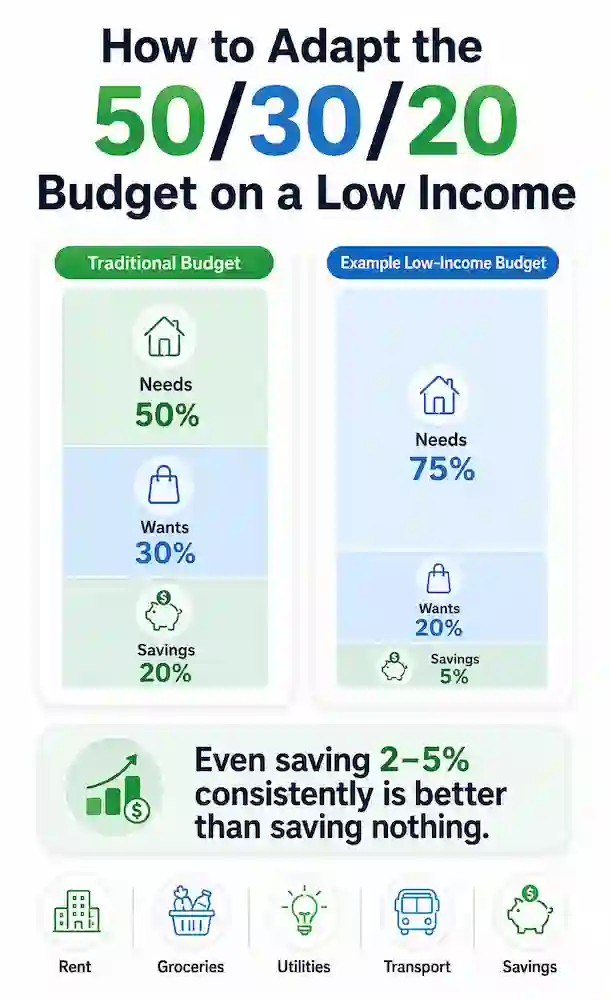
Before you can save fast, you need to know exactly where your money is going. A popular starting framework is the 50/30/20 rule: roughly 50% of income toward needs, 30% toward wants, and 20% toward savings and debt, a structure commonly recommended by the CFPB and cited by state financial planning resources.
On a low income, the math often doesn’t split cleanly, and that’s fine. Treat 50/30/20 as a compass, not a rule. If needs eat up 70% or 80% of your paycheck, the real goal becomes squeezing out any percentage for savings, even 2% or 5%, and growing that share over time as expenses shift.
Write down every fixed cost (rent, utilities, minimum debt payments) and every variable cost (groceries, transportation, subscriptions) for one full pay cycle. You can’t redirect money you haven’t accounted for. For a deeper walkthrough of budgeting when your entire check is spoken for before it arrives, see our guide on How to Save Money Living Paycheck to Paycheck: 15 Strategies That Work.
Takeaway: Use 50/30/20 as a direction, not a strict target. Any savings percentage beats zero.
Quick Wins: 5 Ways to Start Saving Today
You don’t have to wait until you’ve perfected your budget to start saving. A few small actions today can free up extra cash, build momentum, and help you see progress right away.
- Transfer $10–$25 into savings today. Starting small builds the habit, and consistency matters more than the amount.
- Cancel one unused subscription or recurring charge. Removing even one unnecessary expense creates extra room in your budget every month.
- Plan your next grocery trip before you shop. Shopping with a list helps reduce impulse purchases and food waste, making it easier to stay within your budget.
- Review one monthly bill. Compare your phone, internet, or insurance plan to see if you can lower your costs without sacrificing essential services.
- Sell one unused item this week. Clothes, electronics, or household items you no longer use can provide a quick boost to your emergency fund.
Quick Tip: Don’t try to do everything at once. Completing just one of these actions today is enough to start building momentum toward your savings goal.
Step 2: Set a Savings Goal You Can Actually Hit
The standard advice to save three to six months of expenses can feel discouraging, or even pointless, when you’re not sure how you’ll cover next week’s groceries. It’s worth knowing that even small amounts of savings measurably reduce financial stress. People who save any amount for emergencies have meaningfully higher financial well-being scores than people who save nothing, based on CFPB research on saving habits.
There’s also a more realistic benchmark than the traditional three-to-six-month rule. A widely cited study from researchers at the University of Colorado Boulder found that roughly $2,467 in savings, not months of full expenses, was a more attainable and effective cushion for low-income households, as described by Synchrony Bank’s overview of the research.
A practical approach:
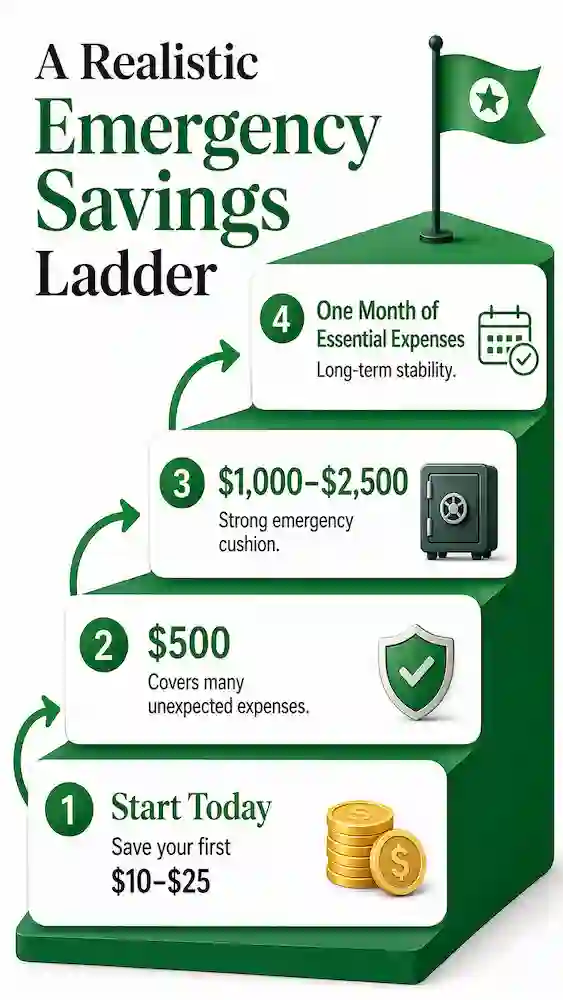
- First milestone: $500, enough to cover a car repair or utility shutoff notice without a payday loan
- Second milestone: $1,000 to $2,500, aligned with the Boulder study’s realistic threshold
- Long-term milestone: one month of essential expenses, then build from there
For a full step-by-step savings ladder starting from zero, see How to Build an Emergency Fund on a Low Income (Even Starting From $0).
Step 3: Automate Your Savings So You Don’t Have to Rely on Willpower
Willpower runs out. Systems don’t. One of the most consistent recommendations from the Consumer Financial Protection Bureau is setting up an automatic transfer from your paycheck or checking account into savings, even a small one, so the decision only has to be made once.
This isn’t just intuition. In a review of savings interventions, the CFPB found that automatic and default-based savings programs, along with prompts to save part of a tax refund at filing time, consistently outperformed programs that relied on people remembering to save on their own, according to the CFPB’s evidence-based strategies report. If your bank or employer allows split direct deposit, even $10 to $25 per paycheck routed automatically adds up faster than most people expect, and you never have to “decide” to transfer it.
Round-up apps that sweep spare change from purchases into savings work on the same principle: automatic beats manual, even in tiny amounts.
Step 4: Put Your Money Somewhere It Actually Grows
Where you keep your savings matters more than most people realize. The national average savings account pays just 0.61% APY, while many high-yield savings accounts (HYSAs) currently pay closer to 4%, according to Bankrate’s July 2026 rate survey.
| Account Type | Typical APY (July 2026) | $500 Grows to in 1 Year |
| Traditional bank savings | ~0.61% | ~$503 |
| High-yield savings account | ~4.0% | ~$520 |
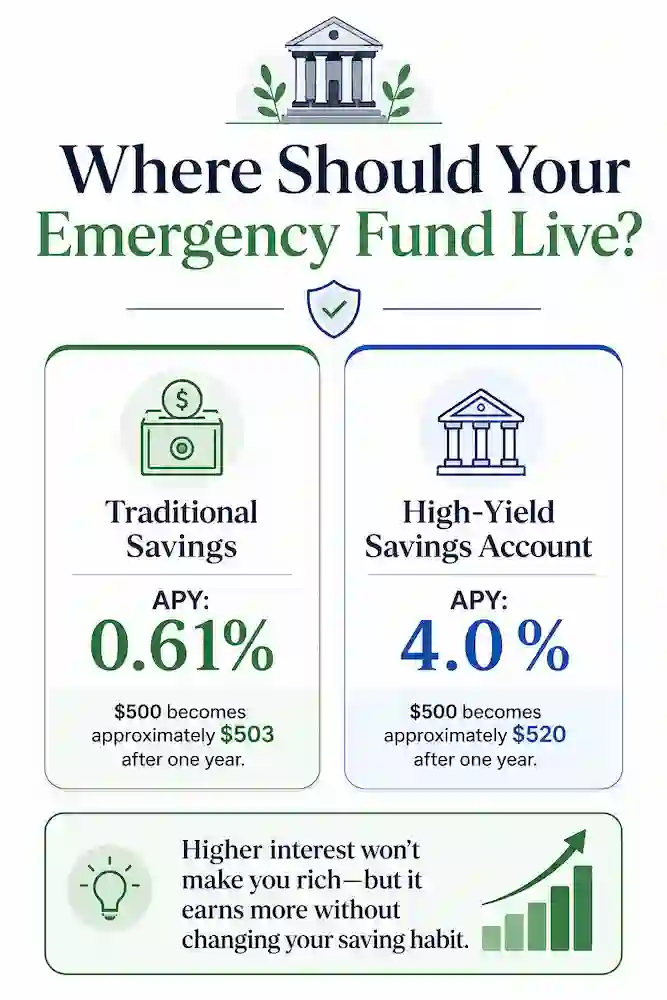
It’s a modest difference on small balances, but it costs nothing to switch, most online HYSAs have no minimum balance requirement, and the habit compounds as your balance grows. Look for FDIC-insured online banks or credit unions with no monthly fees and no minimum deposit.
Step 5: Free Up Cash by Cutting the Right Expenses First
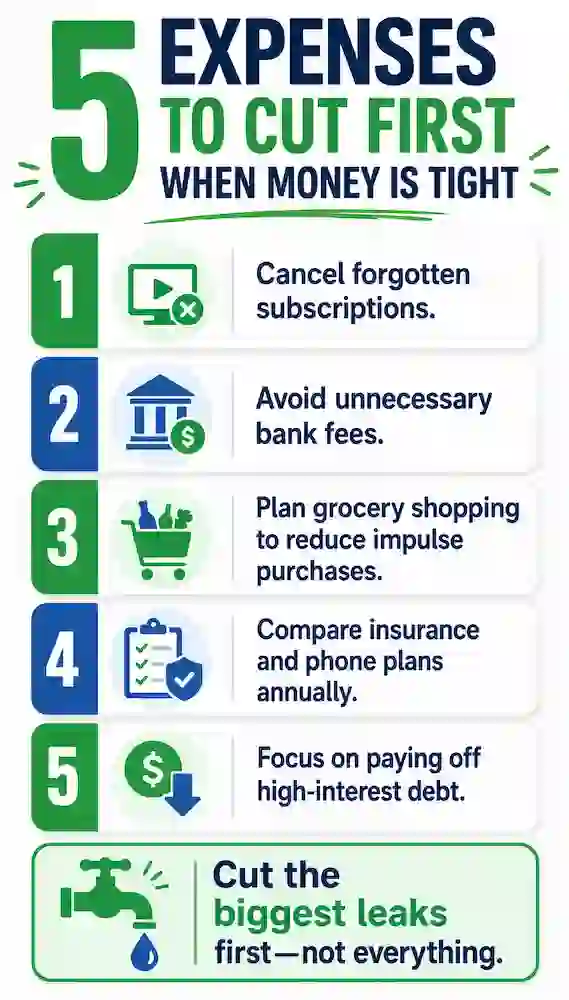
Not all cuts are equal. Instead of trimming a little from everything, target the categories with the biggest and most immediate impact:
- Recurring subscriptions you forgot you had (streaming, apps, memberships)
- Bank and overdraft fees, which can often be avoided entirely with the right account
- High-cost grocery habits, like frequent convenience store trips instead of batch shopping
- Insurance and phone plans, which are worth shopping around annually
- Minimum debt payments on anything carrying double-digit interest (more on this below)
For a full list of specific spending categories to cut without sacrificing quality of life, see 50 Things to Stop Buying to Save Money on a Low Income. For a broader lifestyle approach to stretching every dollar, our guide on Frugal Living Tips for Low-Income Households: Save More, Waste Less goes deeper into daily habits that add up.
Step 6: Attack High-Interest Debt Before It Eats Your Savings
Saving money while carrying high-interest debt is like filling a bucket with a hole in it. The average credit card interest rate sat at roughly 21% on accounts carrying a balance in mid-2026, according to Federal Reserve data compiled by LendingTree. At that rate, a $1,000 balance can cost more in interest over a year than most people manage to save in the same period.
If you’re carrying credit card debt, a simple approach works best:
- Pay minimums on everything to protect your credit
- Direct any extra dollars toward the single highest-interest balance first (the “avalanche” method saves the most money) or the smallest balance first (the “snowball” method, which builds momentum through quick wins)
- Once that balance is gone, roll its payment into the next one
Even redirecting savings efforts toward debt payoff for a few months before building a full emergency fund can be the faster path to financial breathing room.
Step 7: Claim Every Dollar You’re Already Owed
Before looking for extra income, make sure you’re not leaving money on the table that’s already yours. The Earned Income Tax Credit (EITC) is one of the largest anti-poverty tools in the tax code, yet about one in five eligible taxpayers doesn’t claim it, and the average credit was $2,916 for tax year 2024, according to the IRS.
Eligibility depends on income and household size, and it changes slightly each year. For 2026, the federal poverty guideline sits at $15,960 for a single person and $33,000 for a family of four in the 48 contiguous states, per HHS’s official poverty guidelines, figures many assistance programs and tax credits use as a reference point. If your income is near or below these levels, it’s worth checking your eligibility for the EITC and any state-level version of the credit when you file.
Routing part of a tax refund directly into savings at filing time is also one of the most effective single moves low-income households can make, since it’s a lump sum that didn’t come out of an already tight monthly budget.
Step 8: Add a Small, Steady Stream of Extra Income
For many households, cutting alone can only go so far. About 27% of Americans reported having a side hustle in 2025, according to Bankrate’s Side Hustle Survey, and even modest, consistent extra income (freelancing an evening a week, selling unused items, tutoring, pet sitting) can be redirected entirely into savings since it isn’t already committed to fixed expenses.
The key is treating side income differently than your primary paycheck: if it’s not needed for bills, move it straight into savings before it blends into everyday spending.
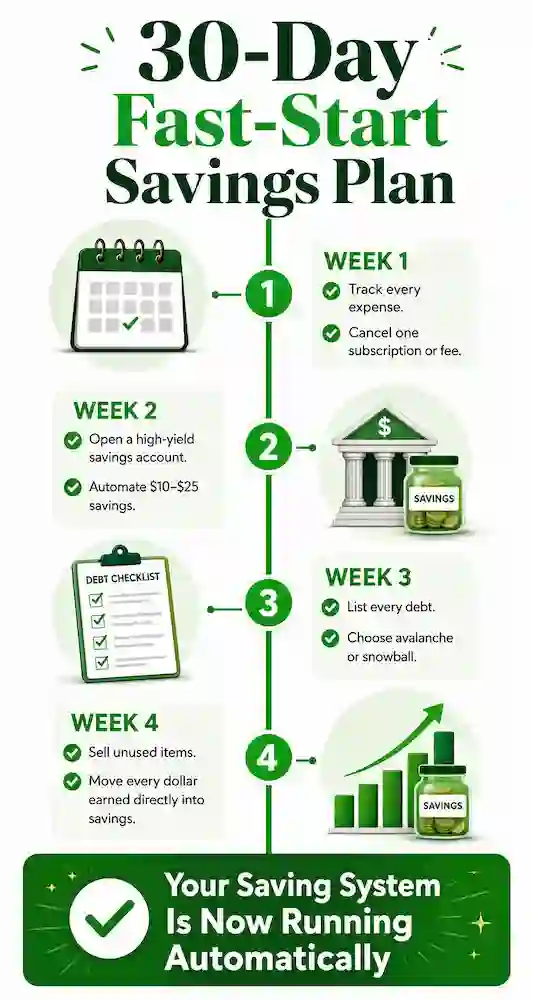
A Sample 30-Day Fast-Start Savings Plan
| Week | Focus | Action |
| Week 1 | Awareness | Track every expense; identify one subscription or fee to cancel |
| Week 2 | Structure | Open a high-yield savings account; set up a $10-$25 automatic transfer |
| Week 3 | Debt check | List all balances and interest rates; pick avalanche or snowball method |
| Week 4 | Extra income | Sell 3-5 unused items or pick up one small gig; move proceeds straight to savings |
Quick Reference: Your Low-Income Savings Roadmap
| Step | Focus | What to Do |
|---|---|---|
| Step 1 | Build a realistic budget | Track every expense for one pay cycle and identify where your money is going. Focus on creating a budget you can actually stick to, even if you can only save a small percentage of your income. |
| Step 2 | Set an achievable savings goal | Aim for a realistic first milestone of $500, then gradually build toward $1,000–$2,500 before working toward a larger emergency fund. |
| Step 3 | Automate your savings | Set up an automatic transfer of $10–$25 per paycheck so saving happens consistently without relying on willpower. |
| Step 4 | Choose the right savings account | Keep your emergency fund in a high-yield savings account (HYSA) to earn more interest while keeping your money accessible. |
| Step 5 | Cut high-impact expenses | Prioritize reducing recurring costs like unused subscriptions, bank fees, grocery spending, insurance premiums, and other monthly expenses that have the biggest impact on your budget. |
| Step 6 | Pay off high-interest debt | Continue making minimum payments on all debts while directing extra money toward the highest-interest balance first to reduce interest costs faster. |
| Step 7 | Claim every dollar you’re entitled to | Check your eligibility for tax credits such as the Earned Income Tax Credit (EITC) and direct refunds or other windfalls into your savings whenever possible. |
| Step 8 | Boost your savings with extra income | Use side hustle earnings, freelance work, or money from selling unused items to grow your savings without affecting your regular budget. |
Bottom Line: Saving money fast on a low income isn’t about making one dramatic change. It’s about combining realistic budgeting, automatic savings, smart spending cuts, debt reduction, and every available income opportunity to make steady progress over time.
Common Mistakes That Derail Low-Income Savers
- Chasing a “perfect” budget instead of starting with an imperfect one
- Setting a savings goal so large it feels pointless, like six months of expenses right out of the gate
- Relying on willpower instead of automatic transfers
- Ignoring high-interest debt while trying to save at the same time
- Not checking eligibility for tax credits or assistance programs out of assumption rather than actually confirming
Your Next Step
Saving money fast on a low income isn’t about one dramatic change. It’s a handful of small systems working together: a realistic budget, automatic transfers, the right account, targeted cuts, and every dollar you’re already entitled to from tax credits. Start with just one step this week, whether that’s opening a high-yield savings account or setting up your first automatic transfer, and build from there.