Money feels tighter when there’s no cushion behind it. According to the Federal Reserve’s most recent household survey, only 63% of U.S. adults could cover a $400 emergency using cash or its equivalent, a number that hasn’t moved in three years. If that sounds familiar, you’re not doing anything wrong. You’re just working with a system that leaves very little room for error.
The good news is that you don’t need a bigger paycheck to start building breathing room. You need a handful of habits that target where low-income budgets actually leak money: groceries, utilities, and waste. This guide walks through those habits one at a time. For the full framework, start with our Complete Guide to Building Savings on Any Budget.
Key Takeaways
- Build your budget around your lowest expected income, not your average paycheck.
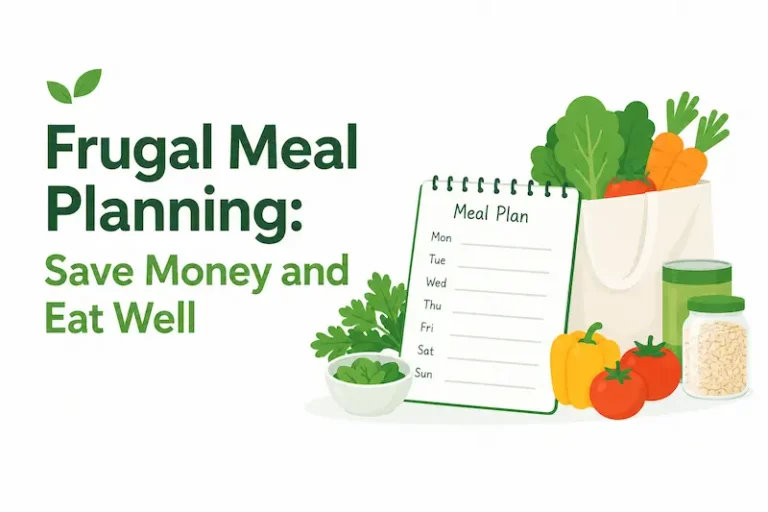
- Cut grocery costs by choosing store brands, planning meals, and reducing food waste.
- Lower utility bills with simple, low-cost energy-saving habits.
- Buy second-hand, borrow, or use community resources before purchasing new items.
- Check whether you qualify for programmes like SNAP, LIHEAP, WIC, or local assistance.
- Save even small amounts automatically each payday to build an emergency fund over time.
Build a Bare-Bones Budget First
Before you can save money on a low income, you need to know exactly where it’s going. That doesn’t require an app or a spreadsheet degree. A simple needs-first budget works:
- List fixed needs (rent, utilities, minimum debt payments, groceries) first
- List irregular but predictable costs (car maintenance, school fees) next
- Whatever’s left is your flexible spending, savings, or debt paydown
If your income changes week to week, budget off your lowest expected paycheck, not your average one. That single shift prevents the overspending that happens when a good week gets treated as the new normal.
Quick takeaway: A budget only works if it’s built around your worst week, not your best one.
| Money-Saving Area | Best Habit to Start With | Why It Works |
| Budgeting | Budget from your lowest expected income | Prevents overspending during lower-income weeks. |
| Groceries | Buy store brands and plan meals around weekly sales | Reduces one of the biggest controllable household expenses. |
| Food Waste | Freeze leftovers and use the most perishable foods first | Helps prevent food from spoiling before it’s eaten. |
| Utilities | Seal drafts, switch to LED bulbs, and adjust your thermostat | Lowers energy bills with little or no upfront cost. |
| Shopping | Buy second-hand, borrow, or use Buy Nothing groups | Reduces spending on household items and clothing. |
| Savings | Automatically transfer a small amount each payday | Builds an emergency fund consistently without relying on willpower. |
Cut Your Grocery Bill Without Cutting Nutrition
Food is usually the second or third biggest controllable expense after housing. Nationally, households spent an average of 4.8% of disposable income on food at home in 2025, but that share is much higher for lower-income households, where groceries compete directly with rent and utilities for the same dollars.
The single biggest lever is switching from name brands to store brands. Consumer Reports testing has found that store brands typically cost up to 25% less than national brands while often using the same or comparable ingredients. A 2026 pricing study of major retailers found the gap is even wider in specific categories, as the table below shows.
| Grocery Category | Typical Store-Brand Savings vs. National Brand |
| Dairy (milk, cheese) | Around 60% less |
| Frozen foods | Up to 57% less |
| Pantry staples (condiments, pasta) | Roughly 49-67% less |
| General grocery basket | Up to 25% less |
Pair store brands with a loose weekly meal plan built around what’s on sale, and batch-cook proteins and grains you can reuse across two or three meals. This is exactly the kind of spending our companion post, 50 Things to Stop Buying to Save Money on a Low Income, digs into item by item.
If you’re food insecure or close to it, it’s worth knowing where the floor is. USDA’s Thrifty Food Plan, which sets the maximum monthly SNAP benefit, currently caps out at $994 a month for a family of four in the 48 contiguous states. Not everyone qualifies for the maximum, but if you’re not currently using SNAP and think you might be eligible, it’s worth checking.
Waste Less Food, Save More Money
You can shop perfectly and still lose money if food goes bad before you eat it. USDA estimates that 30 to 40% of the entire U.S. food supply goes to waste, and at the household level, the average family of four loses about $1,500 a year to food that never gets eaten.
A few habits close most of that gap:
- Shop with a list built from what’s already in your fridge, not against it
- Freeze anything you won’t use in the next two to three days
- Cook the most perishable items (leafy greens, soft fruit, ground meat) first in the week
- Repurpose scraps: vegetable ends for stock, stale bread for croutons or bread pudding
None of this requires special equipment. It just requires treating your fridge like a budget line item instead of a black box.
Lower Your Utility Bills for Free (or Almost Free)
Energy costs are one of the few expenses you can shrink without spending money first. A few fixes, in order of easiest to most impactful:
- Swap your five most-used bulbs. ENERGY STAR estimates this saves about $40 a year on its own.
- Seal drafts around windows and doors. The Department of Energy estimates that caulking gaps saves 10 to 20% on heating and cooling costs, or up to $166 a year.
- Turn down your water heater. Lowering it from 140°F to 120°F can save up to $400 a year, and you likely won’t notice the difference in your shower.
- Use a programmable or smart thermostat setting, even a manual schedule. ENERGY STAR puts the savings at more than 8% off heating and cooling costs, roughly $50 a year on average.
If you’re behind on utility bills or facing a shutoff, LIHEAP is worth applying for before things get worse. It’s a federally funded program that helps cover home energy bills, energy crises, and weatherization, and it exists specifically for households in your situation, not as a last resort.
Quick takeaway: Most energy savings come from behavior and cheap fixes, not new appliances.
Shop Smarter: Thrift, Borrow, and Buy Nothing
A few habits that don’t show up in most frugal-living lists but move the needle for low-income households specifically:
- Buy Nothing groups. Local Facebook and app-based groups where neighbors give away usable items for free, from furniture to kids’ clothes to kitchen gear.
- Library extras. Beyond books, many public libraries lend tools, sewing machines, or offer free museum passes and streaming access.
- Facebook Marketplace and thrift stores for anything durable. Furniture, tools, and appliances hold value and rarely need to be bought new.
- Buy once, buy used, for anything kids outgrow fast. Clothing and gear for growing children is one of the highest-waste categories in any household budget.
None of this requires a citation because it’s not a statistic, it’s just a mindset shift: default to “can I get this for less or for free” before “where do I buy this.”
Use Every Assistance Program You Qualify For
There’s no shame math here. These programs exist because the cost of living has outpaced wages for a lot of households, not because something went wrong with your budgeting. If you’re not sure what you qualify for, 211 is a free, confidential helpline that connects people to local housing, utility, and food resources in almost every part of the country, at no cost, 24 hours a day.
Worth checking, even if you’ve been turned down before or think you make “too much”:
- SNAP for grocery costs
- LIHEAP for heating and cooling bills
- Local food banks and community action agencies (often listed through 211)
- WIC if you have young children or are pregnant
Rules and thresholds change year to year, so it’s worth re-checking eligibility even if you didn’t qualify in the past.
Turn Small Savings Into a Real Cushion
Every tip above is only useful if the money it frees up goes somewhere specific. Even $10 or $20 a week, moved automatically the day you get paid, adds up faster than most people expect, and it builds the buffer that keeps a car repair or a slow week from turning into debt. If you’re starting from nothing, our guide on how to build an emergency fund on a low income, even starting from $0, walks through exactly how to get that first cushion in place.
Frequently Asked Questions
How can I save money if I have a low income?
Start with a needs-first budget built around your lowest expected income, then target the two biggest controllable costs: groceries (store brands, meal planning, less waste) and utilities (free efficiency fixes, LIHEAP if you qualify).
Is it possible to save money while living paycheck to paycheck?
Yes, though it usually starts with small, automatic amounts rather than a big lump sum.
What’s the best budgeting method for a low-income household?
A simple needs-then-wants budget, built off your worst-case income, tends to work better than complex systems, since it’s easier to stick with when money is tight and income is unpredictable.
How much should a low-income family spend on groceries?
There’s no single right number, since it depends on household size and location, but USDA’s Thrifty Food Plan (the basis for maximum SNAP benefits) estimates around $994 a month for a family of four as a reasonable low-cost baseline.
Next Steps
None of these tips require a windfall to start, just a willingness to change a few habits this week: swap one brand for a store brand, seal one draft, call 211 once. Small, repeatable changes are what actually help you save money on a low income over time, more than any single big cutback. For the full roadmap from budgeting to building real savings, head to our pillar guide: How to Save Money Fast on a Low Income.