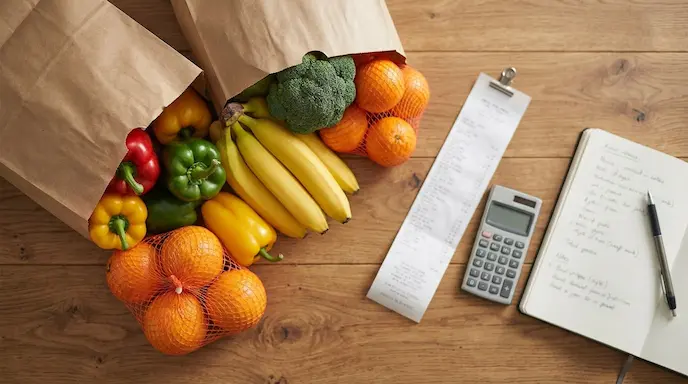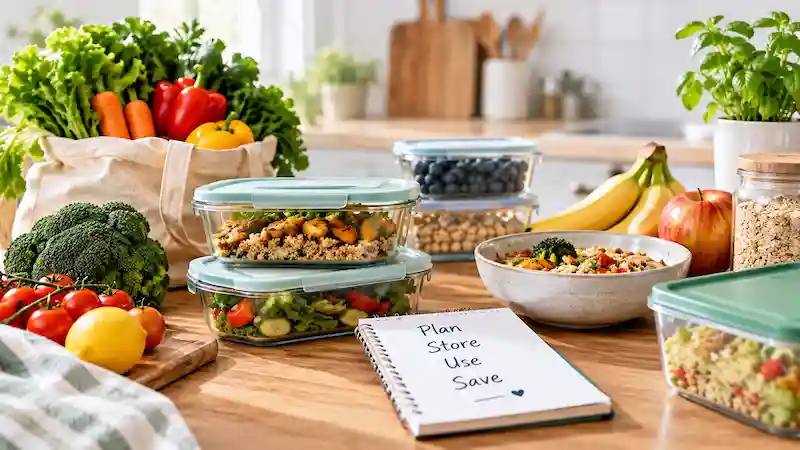
The spinach you bought Sunday is now green slime, and you can’t remember what’s in that container at the back of the fridge. This guide shows how to reduce food waste on a real budget. You’ll see what wasted food likely costs a household like yours, learn the three habits to start with this week, and get seven free-first habits to cut it.
EPA’s 2025 cost study puts wasted food at about $2,913 a year for a household of four. That’s money already spent on food that never gets eaten. This guide draws on public data from EPA, ReFED and FDA, checked as of October 2026, and every price example is hypothetical.
To reduce food waste at home, plan meals around what’s already in your fridge, store produce the way it keeps best, and eat leftovers before cooking something new. ReFED’s 2026 household survey linked meal planning and leftover use with reporting less waste, though the findings are self-reported and show association, not cause.
How to Reduce Food Waste: The 7 Habits at a Glance
Short on time? Here’s the whole plan in seven lines.
- Plan meals around what you have.
- Check your kitchen, then shop with a quantified list.
- Store food where it lasts longest.
- Use leftovers and freeze before food turns.
- Decode date labels.
- Buy smaller, skip deal traps, serve right-sized portions.
- Use scraps and past-prime food.
These food waste tips start with what you already own, and the last-resort options, donating or composting, come after the seven.
How Much Does Food Waste Cost Your Household?
EPA’s 2025 study puts wasted food at $728 per consumer a year, or $2,913 for a family of four, about $56 a week. The estimate uses 2023 grocery prices and counts food bought at both stores and restaurants, so treat it as a national average.
If you live in a family of four, picture a $56 charge on your grocery receipt every week for food that never gets eaten. Here’s how the yearly cost scales with household size, plus two illustrative scenarios.
| Household | Est. yearly cost | If cut 25% (illustrative) | If cut 50% (illustrative) |
|---|---|---|---|
| 1 person | $728 | about $182 | $364 |
| 2 (est.) | about $1,456 | $364 | $728 |
| 3 (est.) | about $2,184 | $546 | $1,092 |
| 4 | $2,913 (EPA) | about $728 | about $1,457 |
| 5 (est.) | about $3,640 | $910 | $1,820 |
Estimated rows use $728 × the number of people. The 4-person row is EPA’s own figure, which differs from $728 × 4 by $1 because of rounding. The 25% and 50% columns are illustrations, not promises.
ReFED’s 2026 report offers a second view: about $762 per person a year. The two organizations used different methods and years, so the figures aren’t averaged here. Both are national averages, and your number depends on what you buy, how often you eat out and who lives in your home. EPA’s 2025 report also notes that waste per person tends to fall as households grow, so the estimated rows are rough.
That’s the cost of food waste per household in plain terms, and the habits ahead show how to reduce food waste and save money. There’s some progress to report, too: ReFED estimates households generated 950,000 fewer tons of surplus food in 2024, a drop of almost 4%. To see how these dollars compare with your own spending, check our grocery budget by household size benchmarks.
Habit 1: Plan Meals Around What You Already Have
It’s Sunday night, and you’re staring at half a bag of carrots, three eggs and no plan. To reduce food waste at home, start from the fridge outward: whatever needs using first should decide your first few dinners.
EPA’s tips for preventing wasted food at home put the same idea into practice. Check the fridge, freezer and pantry first, plan the week’s meals before you shop, and buy only what those meals need.
ReFED’s 2026 survey points the same way. Among the 560 households that spent more on groceries, ReFED reported an association of +9.9% between planning meals more closely and reporting less waste. Among the 72 households that spent less, the association was +53.0%, but that group is small, so treat it as directional only. All of this is self-reported, and it shows association, not cause.
For help building the plan, try SaveTheFood’s planning tools. Planning takes time, so start with a few dinners instead of the whole week. If you’ve never built a plan, our meal planning for beginners guide walks through the first steps.
Habit 2: Check Your Kitchen First, Then Shop With a Quantified List
You’re in the produce aisle, and you can’t remember whether you already have celery. A quick check before you shop settles that, and a better list keeps it from happening again.
- Spend 60 seconds checking the fridge, freezer and pantry before you write the list, including the back of the shelves where forgotten food hides.
- Write amounts, not just items, such as “greens for two lunches” instead of “greens.” EPA’s guidance suggests noting how many meals each item will cover.
- Count the meals you’ll actually eat at home this week, leaving out nights you’ll eat out, have leftovers or heat a frozen meal. Then size each amount for the people at the table, and try SaveTheFood’s planning tools if you want help.
- Run the deal math from Habit 6 before you buy in bulk.
EPA’s shopping guidance rests on one idea: buy what you expect to use. If a quantity still feels like a guess, buy the smaller one and accept an extra store trip as the trade-off.
Habit 3: Store Food So It Lasts (A Produce Cheat Sheet)
The berries molded two days after you washed them. How to store fruits and vegetables comes down to two things: temperature and placement.
Start with temperature. FDA’s guidance on cutting food waste and keeping food safe says to keep your fridge at 40°F or below and your freezer at 0°F or below, and it suggests a fridge thermometer to check. Then use the table, which follows EPA’s produce storage tips. Ethylene is a gas some fruits release as they ripen, and it can speed up spoilage in nearby produce.
| Produce | Where | Tip |
|---|---|---|
| Leafy greens, carrots, cucumbers, broccoli | High-humidity drawer | |
| Most fruits, mushrooms, peppers | Low-humidity drawer | |
| Bananas, apples, pears, stone fruits, avocados | Keep away from other produce | They release ethylene |
| Berries, cherries, grapes | Fridge | Wash just before eating |
| Potatoes, onions, garlic, winter squash, eggplant | Cool, dry, dark, ventilated spot |
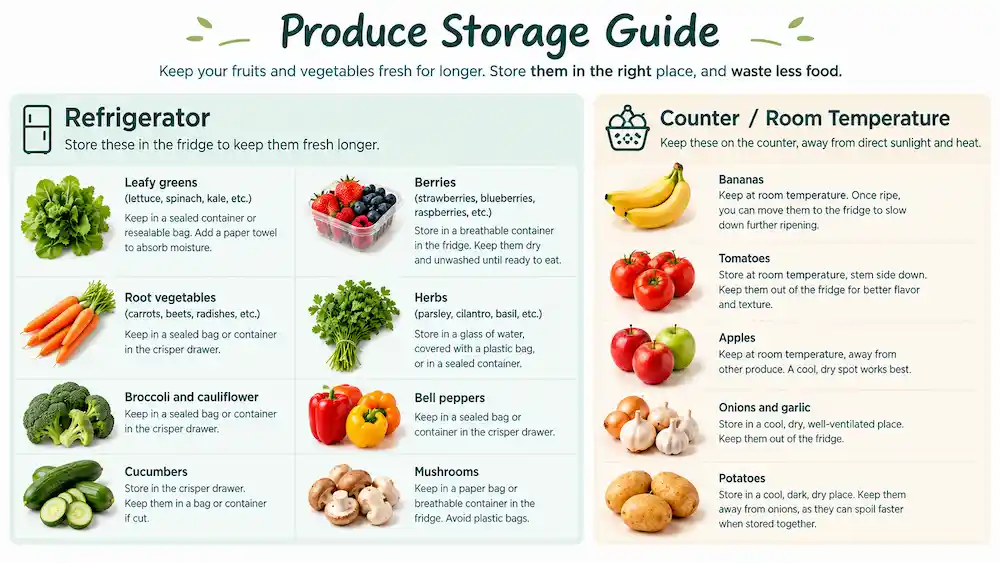
Label and date what you store, and put older food in front so it gets eaten first. For how long specific foods keep, check USDA’s FoodKeeper. The fridge door is the warmest spot, so EPA advises against storing milk or eggs there, and it suggests the lower shelves, the coldest part, for meat, poultry and fish. FDA also warns against overpacking, since cold air has to circulate around food.
Small fridge? Give your most perishable items priority in the fridge, and expect more frequent shopping trips as the trade-off. If your fridge can’t hold 40°F, have an appliance technician look at it.
Habit 4: Use Leftovers and Freeze Before Food Turns
You open last Tuesday’s chili and wonder how long it has been there. What to do with leftovers starts with a clock: FDA’s advice is to refrigerate them within 2 hours, or within 1 hour when it’s above 90°F.
FDA also says to check leftovers daily, and it notes that Listeria bacteria can grow at fridge temperatures. So give each batch a use-it-or-freeze-it point: a day when it either gets eaten or goes into the freezer.
Freeze in portions before the food turns, with the freezer at 0°F or below, and label and date each container. Freezing costs freezer space and a few minutes of portioning. With a small freezer, freeze only the portions you’ll actually eat. For the fridge, EPA suggests clear, labeled containers with dates, so you can see what’s inside without opening each one.
A weekly leftover night, or an eat-first shelf in the fridge, keeps leftovers in sight. Home canning is another way to store surplus, but improper home canning can carry a botulism risk, so use tested, current instructions. Our guide to ways to preserve food goes deeper on freezing and other methods.
Leftovers also rank first in ReFED’s survey, which you’ll see in Where to Start below.
Habit 5: Decode Date Labels (Best If Used By vs. Use By)
The yogurt says use by yesterday. Do you toss it? FDA says confusion over date labeling accounts for an estimated 20% of consumer food waste (content as of March 2024).
Labels are largely voluntary. Except for infant formula, federal law doesn’t require quality-based date labels, and FDA supports “Best if Used By” as the standard phrase. The table below paraphrases the definitions in USDA’s guidance on food product dating.
| Label | What it generally signals | What to do |
|---|---|---|
| Best if Used By (or Before) | Best flavor or quality. It is not a purchase or safety date. | Check for changes in color, consistency or texture before you decide. |
| Sell-By | How long the store should display the item. It is not a safety date. | Don’t treat it as a deadline at home, and check quality before you eat. |
| Use-By | The last date recommended for peak quality. It is not a safety date, except on infant formula. | Check quality. For infant formula, don’t use it after the date. |
| Freeze-By | When to freeze the food to keep peak quality. It is not a purchase or safety date. | Freeze it by that date if you won’t use it first. |
Safety note: Infant formula is the exception, because its use-by date matters. Dates assume the food was stored properly, and you can’t judge safety by smell or taste. This is general food-safety information, not medical advice. If someone in your household is in a higher-risk group, ask their doctor or dietitian.
Habit 6: Buy Smaller, Skip Deal Traps, Serve Right-Sized Portions
The 10-pack was cheaper per item, so why are you throwing out six? EPA says buy-one-get-one (BOGO) and other large-quantity deals only save money if you use all the food, and FDA says bulk promotions often result in overbuying. The fix is simple arithmetic: price ÷ portions you actually eat = your real cost per portion.
Here’s a worked example. These prices are hypothetical, not market data.
| Option | Price | Portions you eat | Cost per portion eaten |
|---|---|---|---|
| 10-portion bulk bag | $8 | 4 | $2.00 |
| 4-portion bag | $4 | 4 | $1.00 |
Break-even: $8 ÷ 8 = $1.00, so the bulk bag ties the small bag at 8 portions eaten out of its 10 and costs less per portion above that. BOGO works the same way. Two for $6 is $3 each only if you use both. If you toss one, you paid $6 for one item, versus $4 for a single (assume a single sells for $4).
The example assumes the same food and the same shelf life, and freezing half the bag changes the math (see Habit 4). It isn’t a case against sales, either. ReFED associated looking for sales and deals more often with reporting less waste (+14.9%) and called that link counterintuitive. The evidence on how promotions relate to household waste is mixed, so do the math each time.
ReFED also associates choosing smaller quantities or packages with reporting less waste, and the ranking is in Where to Start. Serving matters, too. Cook and serve for the number of people at the table, and try family-style serving so everyone takes only what they’ll finish.
Habit 7: Use Scraps and Past-Prime Food
Bread heels and broccoli stems sit in the trash, and you’ve already paid for them. EPA says produce past its prime, along with odds and ends and leftovers, may still be fine for cooking, so a few quick rescues put that money to use.
- Stems, tops and peels often have a second life, and root-to-stem cooking shows how. EPA adds that edible parts you normally skip, such as beet greens, are worth a look if they’re safe to eat.
- For leftover recipes, soup or stock, stale bread and wilted vegetables are easy rescues, and a pot of soup can absorb odds and ends from several meals.
- Produce with cosmetic flaws is usually fine to buy and eat when it’s otherwise in good condition. EPA says imperfect produce is just as safe and nutritious, and it can sometimes be found at discounted prices.
- Past-prime isn’t the same as spoiled. If you’re unsure, use the Habit 5 safety note.
When You Can’t Prevent It: Donate or Compost
Sometimes food really is past saving. Now what? EPA says about 96% of households’ wasted food in 2019 went to landfills, combustion or the sewer, and the rest was composted. That figure is national and from 2019, so your area’s options may look different.
EPA points to two options for food that can’t be saved:
- Donate: EPA says nutritious, safe, untouched food can go to food banks. They differ on what they accept, so check locally before you drop anything off.
- Compost: EPA suggests composting food scraps instead of throwing them away. Access and rules vary by city and county, and meat and dairy don’t go in most home compost.
Our guide to composting indoors covers how to get started. Both options depend on where you live, so check local rules before you count on either one. Prevention still comes first, because every item here is money already spent, and neither option gets it back.
Where to Start: Your First 3 Habits and a One-Week Audit
Seven habits is a lot for one week. ReFED’s data points to a shortcut: start with three. ReFED reported that each added habit was associated with an increase of about 8 to 11% in the probability of reporting less waste. Three habits were associated with an increase of at least 24% compared with none.
Read those numbers with care. The survey is self-reported, it shows association rather than cause, and ReFED notes that its smaller estimates, including freezing and planning, rest on weaker statistical evidence. In ReFED’s 2026 survey of 1,000 households, 56% said they wasted less food than a year earlier, and the survey framed that question around grocery prices. That doesn’t show that prices caused the change.
Here’s how four habits ranked among the 560 households that spent more on groceries. These are measures of association, not the share of waste you’d avoid.
| Habit | ReFED association (spending-more group, n=560) | Section |
|---|---|---|
| Using leftovers | +19.6% | Habit 4 |
| Smaller quantities or packages | +11.3% | Habit 6 |
| Freezing | +9.9% | Habit 4 |
| Planning meals | +9.9% | Habit 1 |
Your first three are Habit 4 (leftovers and freezing), Habit 6 (smaller quantities) and Habit 1 (planning). ReFED also linked deal-hunting and cooking at home with reporting less waste, which this guide doesn’t rank.
Before you change anything, run a one-week dollar audit:
- Keep a list by the trash.
- Write down each item, its approximate cost and why it was tossed.
- Total it at the end of the week.
- Estimate your year as the weekly total × 52 (illustrative, since weeks vary).
- Compare that figure with the cost table above.
For help along the way, FoodKeeper and SaveTheFood are two places to find food waste tips.
Your Next Step: Run the One-Week Audit
Seven habits, three to start: leftovers and freezing, smaller quantities, and planning. This week, run the one-week audit. It takes a week and a sheet of paper, and it turns the national averages in this guide into your own household’s number.
Knowing how to reduce food waste starts there, because once you can see what you toss and why, the three starter habits have a clear target. Multiply your weekly total by 52, then see how far it sits from EPA’s estimate for your household size. When you’re ready for more, try building a zero-waste kitchen.
FAQ
No. Start with a notes app or paper list, containers you already own, and tools like FoodKeeper and SaveTheFood. Buy something only if one specific problem keeps repeating, and compare its price with the cost of the food that problem wastes each month.