When you bring home a bunch of carrots with leafy tops, a head of broccoli, or a bunch of beets, a meaningful share of what you paid for often goes straight into the trash. Stems get trimmed off. Tops get cut away. Peels go in the bin before the cooking even starts.
Some of that trimming is necessary. A lot of it is habit. Root-to-stem cooking is the practice of questioning which is which.
The goal is not to eat every part of every vegetable. It is to recover the parts that are genuinely worth keeping and make sensible decisions about the rest. Use what is edible, practical, and in good condition. Store what can realistically be used soon. Freeze what makes sense to freeze. Compost what is suitable for composting. Discard what is unsafe or simply not worth the effort.
That last part deserves emphasis. Root-to-stem cooking works best when it reduces avoidable waste without creating a second problem, like a refrigerator full of forgotten scraps or a pantry stocked with ingredients bought to “rescue” a tablespoon of carrot tops.
What Is Root-to-Stem Cooking?
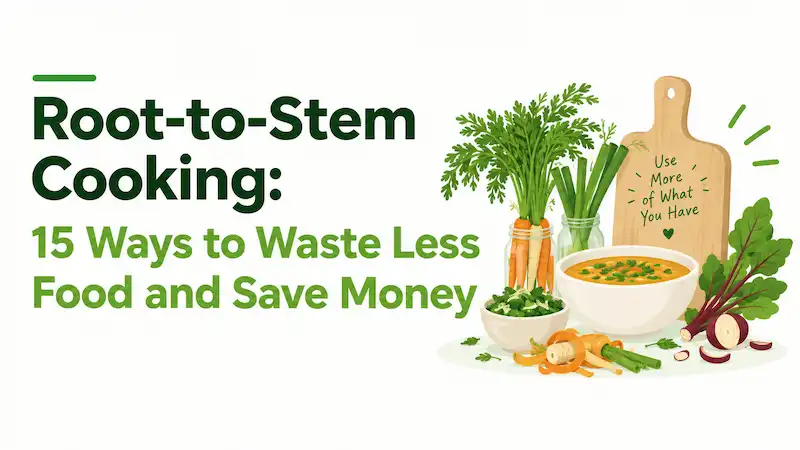
Root-to-stem cooking (sometimes called whole-vegetable cooking) is the practice of using more parts of a vegetable than standard recipes call for. Broccoli stems instead of discarding them. Beet greens alongside the roots. Carrot tops stirred into a sauce. Corn cobs simmered for stock.
The concept overlaps with a zero-waste lifestyle, though “zero waste” is better understood as a direction than a realistic destination. Not every part of every vegetable is edible, safe, or worth preparing. The practical version of root-to-stem cooking is selective: it recovers real food value from purchases already made, rather than treating every peel and trimming as something that must be used at any cost.
Can Root-to-Stem Cooking Actually Save Money?
The financial case is real, but it works differently than most articles describe.
When broccoli stems go into a stir-fry instead of the trash, the household gets more usable food from a purchase already made. That improves the effective cost per usable portion. As an illustrative example: if a $3 head of broccoli yields 600 grams of usable food from the florets alone, the effective cost is around $0.50 per 100 grams. If suitable portions of the stem add another 200 grams, that effective cost drops to roughly $0.375 per 100 grams, from the same $3 purchase. The household spent the same amount. The return improved.
This is recovered food value, and it is genuinely useful. But it is not automatically the same as a cash saving. A real grocery saving only occurs when the recovered food replaces something the household would otherwise have purchased separately. If using the broccoli stem means skipping a separate vegetable purchase, that is actual spending avoided. If the household would not have bought anything else, the benefit is still meaningful, but it should be described as recovered food value rather than reduced spending.
Household results also vary considerably based on cooking habits, household size, produce selection, and how often recovered scraps actually substitute for other purchases. No universal annual figure applies.
The “Don’t Buy Anything Extra” Rule
The cheapest scrap to reuse is one that does not require buying additional ingredients to justify saving it.
If a handful of carrot tops works naturally in a sauce already being made, that is a practical zero-cost use. If saving those carrot tops requires a special trip to buy three other ingredients for a pesto that would not otherwise have been made, the economics no longer support it.
This does not mean never buying an ingredient to complete a recipe. It means not letting the impulse to “use everything” drive spending that exceeds the actual value of the scraps. Use what fits naturally into the cooking already planned. Save, freeze, or compost the rest.
Is This Scrap Worth Saving?
Before setting aside any trimming, a short decision check helps:
- Is it safe to eat?
- Is the edible portion still in good condition?
- Will it realistically be used within the next day or two?
- Does preparation require reasonable effort?
- Would using it replace something that would otherwise be purchased?
- If stored, will it actually be used, or will it just create more waste later?
- Would composting or discarding it make more practical sense right now?
If most of those answers point toward no, compost or discard the trimming and move on. Refrigerating scraps without a concrete plan tends to produce a second round of waste rather than reducing the first.
Quick Root-to-Stem Reference
| Produce | Part to Use | Common Uses | Preparation Level |
| Broccoli | Stems | Stir-fry, slaw, soup, roasted | Minimal to Basic |
| Cauliflower | Leaves | Roasted, sautéed, soup | Minimal |
| Cauliflower | Core and stems | Soup, roasted, stir-fry | Basic |
| Carrot | Tops (fresh only) | Pesto, sauces, soups | Basic |
| Beet | Greens | Sautéed, soups, grain bowls | Basic |
| Radish | Greens | Sautéed, pesto, soup | Basic |
| Kale | Stems | Stir-fry, soup (finely sliced) | Basic |
| Swiss chard | Stems | Sautéed alongside or before leaves | Basic |
| Herb stems | Tender portions (parsley, cilantro) | Sauces, soups, stocks | Minimal |
| Potato | Skins (from sound potatoes only) | Roasted, baked | Minimal |
| Citrus | Zest | Baking, sauces, marinades | Minimal |
| Apple | Peels | Oatmeal, sauce, baked dishes | Minimal |
| Corn | Cobs | Stock, broth | Basic |
| Mixed trimmings | Suitable clean scraps | Homemade stock | Basic |
| Small mixed scraps | Various | Soups, stir-fries, omelets, fritters | Basic |
What Does Your Produce Really Cost After Trimming?
The shelf price is not the same as the cost per usable portion. Normal trimming reduces how much food a household actually gets from any given purchase.
A $2.50 bunch of beets with greens attached might yield around 500 grams of root after trimming, at roughly $0.50 per 100 grams of edible beet. If the greens are fresh and in good condition, they contribute another 150 grams or so of usable food. Using both does not change what was spent. It changes how much food the household gets from it.
That difference matters, not as a guaranteed savings number, but as a habit that extracts more value from purchases already made. The benefit becomes concrete when recovered food replaces a specific purchase. Tracking actual results in a particular household gives a far more useful picture than any generic estimate.
15 Practical Root-to-Stem Cooking Ideas
1. Broccoli Stems
The stem of a broccoli head is dense and mild, with a flavor very close to the florets. Peel or pare away the fibrous outer layer near the base, and the inner flesh works well in stir-fries, slaws, soups, and roasted preparations. Thin matchstick cuts or thin rounds cook quickly. Stems can be stored alongside the broccoli in the refrigerator and used within a few days.
2. Cauliflower Leaves
Remove any outer leaves that are damaged or heavily wilted; those are better composted. The inner, paler leaves in good condition behave similarly to other leafy greens. Tossed with olive oil and roasted at around 400°F, they develop lightly crisped edges with a mild, slightly nutty flavor, comparable to roasted kale in texture.
3. Cauliflower Stems
The core of a cauliflower, once the tougher outer portions are trimmed, provides a firm, neutral vegetable suitable for soups, stir-fries, and roasted preparations. Diced and added alongside the florets, it cooks well; in soup it benefits from going in a few minutes earlier, since the density requires a slightly longer cook time.
4. Carrot Tops
Carrot tops are edible, despite a persistent and unfounded myth to the contrary. Their flavor resembles a mix of parsley and carrot greens with some bitterness, which suits pesto, chimichurri-style sauces, and soups where bitterness is balanced by other ingredients. Some individuals sensitive to the Apiaceae (parsley) family may find them irritating, so a small taste test before preparing a full batch is reasonable.
The practical constraint is freshness. Carrot tops wilt quickly and should be used the same day the carrots are purchased, or trimmed and refrigerated immediately in a damp paper towel to extend their life slightly. If they are not used within a day, composting is the better outcome.
5. Beet Greens
Fresh beet greens in good condition cook similarly to Swiss chard in both texture and flavor. Sautéed with garlic and olive oil, they make a simple and useful side dish. They deteriorate quickly; refrigerate immediately after purchase and plan to use them within a day or two. Rinse thoroughly before cooking, as they tend to hold grit.
6. Radish Greens
Radish greens have a noticeably more peppery, slightly sharp flavor than the root. That quality works well in sautéed preparations with garlic, blended pesto, and soups where some bitterness fits the dish. They are less suited to delicate preparations where a milder green would be preferred. Use them fresh and refrigerate like other tender greens.
7. Kale Stems
Kale stems are considerably tougher than the leaf and need different handling. Very fine slicing before adding to a stir-fry or soup allows them to cook through properly. They can also be sautéed with a head start before the leaves are added. They are not well suited to raw preparations, but with adequate heat they are a reasonable addition to dishes already using the leaves.
8. Swiss Chard Stems
Swiss chard stems are one of the more naturally practical candidates because they are genuinely good with minimal effort. Thinner stems can be cooked alongside the leaves without any special preparation. Thicker stems benefit from going into the pan two to three minutes earlier, since they take longer to become tender. The texture is somewhat like celery, and the mild flavor holds up well in sautéed dishes, soups, and braised preparations.
9. Tender Herb Stems
The stems of parsley and cilantro (coriander) are flavorful and well suited to the same uses as the leaves. Finely chopped parsley stems are standard in many European and Middle Eastern preparations. Cilantro stems carry a slightly more concentrated version of the leaf’s flavor. Both work well in soups, sauces, marinades, and any dish where the herb is already being used. Woody stems from thyme or rosemary are less practical for eating but can be added to braising liquids or stocks for flavor and removed before serving.
10. Potato Skins
This one requires clear safety guidance. Potatoes contain naturally occurring glycoalkaloids, primarily solanine and chaconine, which increase substantially when potatoes are exposed to light, develop significant sprouting, or turn green. According to MedlinePlus, the poison is found throughout the potato plant, particularly in green tubers and new sprouts, and solanine is not destroyed by cooking. Any potato that is green beneath the skin should not be eaten regardless of preparation.
Iowa State University Extension guidance on sprouted and green potatoes indicates that small sprouts and minor surface green spots can be trimmed away, but potatoes that are green beneath the skin or extensively sprouted should be discarded. The food recovered is not worth the health risk.
For potatoes that are firm, sound, and completely free of green coloration, the skins are suitable for use. Washed and roasted with oil and salt until crisp, they make a practical side or snack. They can also be incorporated into soups or gratins. The financial case is clearest when they replace a separate starchy purchase.
11. Citrus Zest and Suitable Peels
The zest of lemons, limes, and oranges (the thin outer colored layer, free of the white pith) adds concentrated flavor to baked goods, dressings, marinades, and sauces with very little preparation. Zest can be made whenever citrus is being juiced or sliced, and it freezes well in a small sealed container for use as needed.
Larger pieces of peel are more situational and work in infusions, preserved preparations, or candied applications when a specific plan is in place. As FDA produce handling guidance recommends, all produce should be washed thoroughly under running water before cutting or peeling, which applies here too.
12. Apple Peels
Apple peels are edible and practical in several common preparations. Stirred into oatmeal during cooking, added to homemade applesauce, or incorporated into baked dishes, they contribute flavor and texture without any additional work. Whether to peel apples at all depends on the recipe: for a smooth sauce or a refined pastry, peels may not be wanted. When they come off as a byproduct of an already-planned recipe, direct use in a secondary preparation is a sensible outcome.
13. Corn Cobs
After kernels are removed, the remaining cob still contains flavor. Simmered in water with a little onion and aromatics, it contributes a mild, sweet corn character to broth well suited to corn-based soups or light stocks. The cob is removed before serving. This is particularly low-effort because the cob would otherwise go directly to the compost bin, and no preparation is required beyond adding it to a pot already simmering on the stove.
14. Suitable Vegetable Trimmings for Stock
Onion ends and papery skins, carrot ends and peels, celery trimmings, leek tops, mushroom stems, and parsley stems all contribute flavor to homemade stock. A practical approach is keeping a container in the freezer and adding suitable, clean trimmings as they accumulate. When the container is full, simmer the contents in water for about an hour, strain, then use or freeze the resulting stock.
One consistent note from culinary sources: cruciferous vegetables such as broccoli, cauliflower, cabbage, and Brussels sprouts tend to make stock bitter and are better kept out of the scrap container for stock purposes. And do not add moldy, rotten, or heavily spoiled trimmings; produce that is slightly past its peak is generally acceptable, but genuinely spoiled material will make the stock taste poor.
15. Small Suitable Scraps for Soups, Stir-Fries, and Other Dishes
A tablespoon of finely sliced kale stems, a small handful of radish greens, a few tender herb stems: individually these seem minor, but they are often exactly right for a soup, stir-fry, omelet, grain bowl, or fritter already being cooked. The most practical use is immediate. Small amounts of scraps added to today’s cooking require no storage and create no second round of waste. Small amounts of scraps refrigerated with no clear plan tend to accumulate and eventually get discarded anyway.
5 Easy Root-to-Stem Mini-Recipes
Broccoli Stem Slaw
Peel the outer fibrous layer from 2 to 3 broccoli stems using a vegetable peeler. Cut the inner flesh into thin matchsticks or grate on the coarse side of a box grater. Toss with a dressing of 2 tablespoons apple cider vinegar, 1 tablespoon olive oil, 1 teaspoon honey or maple syrup, and a pinch of salt. Add thinly sliced scallions (green onions) if available. Serves 2 to 4 as a side. Keeps refrigerated for 1 to 2 days.
Carrot-Top Pesto
Wash a generous handful of fresh carrot tops (about 1 loosely packed cup) and pat dry. Combine in a food processor or blender with 1 small garlic clove, 3 tablespoons olive oil, 2 tablespoons nuts (walnuts or pine nuts both work), a squeeze of lemon juice, and salt to taste. Process until roughly smooth. Use the day it is made or refrigerate for up to 2 days. Works tossed with pasta, spread on toast, or used as a sauce for roasted vegetables.
Roasted Cauliflower Leaves
Preheat the oven to 400°F. Discard heavily damaged outer leaves; keep the inner leaves in good condition. Toss with olive oil, salt, and black pepper. Spread in a single layer on a baking sheet and roast for 15 to 20 minutes until the edges are lightly crisped. Serve as a side alongside the cauliflower, or as a separate preparation on their own.
Quick Vegetable Scrap Stock
Combine about 4 cups of suitable clean vegetable scraps with 8 cups of water in a large pot. Good additions include onion ends and skins, carrot peels and ends, celery trimmings, parsley stems, leek tops, and mushroom stems. Avoid cruciferous vegetables such as broccoli, cauliflower, Brussels sprouts, and cabbage, which tend to make the stock bitter. Bring to a boil, reduce to a low simmer, and cook for about 1 hour. Strain through a fine-mesh strainer and discard the cooked solids. Use within 4 to 5 days if refrigerated, or freeze in containers or ice cube trays for later use.
Sautéed Beet or Radish Greens
Wash the greens thoroughly and dry them; both carry grit. Heat 1 tablespoon of olive oil in a skillet over medium heat. Add 1 minced garlic clove and cook for about 30 seconds. Add the greens and toss to coat. Cook 3 to 5 minutes until wilted and tender. Season with salt, a squeeze of lemon juice, and red pepper flakes if desired. Serve immediately. Beet greens cook similarly to Swiss chard; radish greens have a more pronounced pepperiness that softens with heat.
Food Safety: What You Should Not Try to Reuse
Root-to-stem cooking works with food that is safe and in good condition. It does not change the basic rules of food safety, and some things should not be eaten regardless of how much was paid for them.
Do not eat moldy, rotten, or heavily spoiled produce. Discard or compost it rather than trying to cook it. Do not eat green potatoes or any potato that is green beneath the skin; the solanine content is not removed by cooking. Do not eat heavily sprouted potatoes showing significant greening. Do not attempt to use unknown plant parts without reliable identification; some plants closely resemble edible varieties but contain toxins. Rhubarb leaves, for example, contain high levels of oxalic acid and are not suitable for eating regardless of preparation.
Whether a plant part is edible can also depend on the variety, the condition of the produce, and how it has been stored. The FDA’s guidance on selecting and serving produce safely covers foundational produce handling: wash under running water before cutting or peeling, discard produce that looks rotten, and refrigerate cut and perishable items appropriately.
Most root-to-stem cooking involves common vegetables with well-understood edible parts. The safety principles here are the same ones that apply to everyday cooking, not a special set of rules.
How to Store Root-to-Stem Scraps Without Creating More Waste
The goal is to use scraps, not accumulate them indefinitely, which is an important part of maintaining a zero-waste kitchen.
Use today. If a trimming can go directly into what is being cooked, that is the best outcome. No storage needed.
Refrigerate for short-term use. Tender greens (beet tops, radish tops, carrot tops, cauliflower leaves) deteriorate quickly and should be used within a day or two. A damp paper towel in a sealed container extends their life slightly, while reusable kitchen storage options can also help reduce reliance on disposable plastic.
Freeze for later. A dedicated container in the freezer for stock scraps handles onion ends, carrot peels, celery trimmings, and similar items well. Citrus zest freezes well in a small sealed container. Label and date whatever goes into the freezer. When the stock container is full, make stock.
A few practical notes: only save as many scraps as the household can realistically use. A quart container of suitable trimmings is useful; three overflowing bags of mixed scraps sitting in the freezer for months are not. Periodic audits of the freezer help ensure scrap containers are being used rather than pushed aside.
How to Track the Grocery Value You Recover
Personal tracking is more meaningful than generic estimates, especially when combined with zero-waste grocery shopping habits, because household results depend entirely on individual circumstances.
| What to Record | Example |
| Produce purchased | Bunch of beets with greens attached |
| Part normally discarded | Beet greens |
| Part reused | Most of the greens |
| How it was used | Sautéed with garlic as a side dish |
| Would another purchase have been needed? | Yes, would have bought chard |
| Estimated recovered food value | Personal estimate |
| Actual spending avoided | Yes, in this case |
The final column is the one that matters most. When recovered food genuinely replaces a purchase, that is concrete spending avoided. When it adds food the household would not have bought anyway, the benefit is real but belongs in the “recovered value” category rather than grocery savings.
What Should You Do With Scraps You Cannot Use?
The working hierarchy: Eat, Store, Freeze, Compost, Discard.
Composting suitable organic material is a responsible and practical outcome. It is not a failure. Discarding food that is unsafe, spoiled, or impractical to prepare is also a legitimate choice. The purpose of root-to-stem cooking is not to eat everything. It is to avoid discarding food that could reasonably be used.
Root-to-Stem Cooking and Composting
These approaches work together rather than competing.
Root-to-stem cooking prioritizes edible food by recovering parts with genuine culinary value before they are discarded. Composting handles the organic material that remains: outer leaves too damaged to eat, green potato skins, food that has exceeded its practical life, scraps left over after cooking. The EPA’s food loss and waste reduction goal, which calls for a 50 percent reduction in food waste by 2030, treats source reduction (using more of what is purchased) as the priority, with composting as a valuable downstream option for material that cannot otherwise be used. Neither approach eliminates all food waste. Together, they reduce how much goes to landfill.
Common Root-to-Stem Cooking Mistakes
1. Trying to use every scrap. Not every trimming is worth keeping. Selective use is more practical and sustainable than comprehensive saving.
2. Saving more than the household can realistically use. A container of aging greens in the refrigerator is a second form of food waste, not a reduction of the first.
3. Buying extra ingredients to rescue a small amount of food. When the cost of additional purchases exceeds the value of the scraps being saved, the economics no longer support the effort.
4. Ignoring food safety. Green potatoes, rotten produce, and unidentified plant parts should not be eaten to avoid waste. The health risk outweighs the food recovered.
5. Assuming every plant part is edible. Some parts of familiar vegetables are genuinely unsuitable. Verify before trying unfamiliar portions of even common plants.
6. Confusing recovered food value with actual grocery savings. Using scraps returns value from food already purchased. That is genuinely useful. But it only becomes spending avoided when it replaces a separate purchase that would otherwise have been made.
A Simple 7-Day Root-to-Stem Challenge
For households that want a structured starting point:
Day 1: When prepping a vegetable today, keep one part that would normally be discarded and find a use for it in the same meal.
Day 2: If buying produce with leafy tops (beets, radishes, carrots), use the tops in a side dish or sauce.
Day 3: Peel something (citrus, apple, a vegetable) and find a direct use for the peels rather than discarding them.
Day 4: Start a freezer container for stock scraps. Add suitable clean trimmings from today’s cooking.
Day 5: Use a stem or core from a vegetable being prepared today.
Day 6: Record what was recovered this week and how it was actually used.
Day 7: Review which practices genuinely fit the household’s cooking habits. Keep the ones that do. Skip the rest.
The point is not to complete every step perfectly. It is to identify which habits are actually worth sustaining.
Final Takeaway
The practical version of root-to-stem cooking is not about perfection. Use the parts that are genuinely edible, in good condition, and easy enough to incorporate into what is already being cooked. Store scraps only when there is a realistic plan for using them. Freeze what makes sense to freeze. Compost what cannot be eaten. Discard what is unsafe.
According to ReFED’s 2026 U.S. Food Waste Report, individual consumers spend an average of $762 per year on food that eventually goes to waste, with fresh produce accounting for a disproportionate share of that loss. ReFED’s analysis also found that households making more deliberate choices about how food is used and stored drove the first year-over-year decline in residential food waste since the pandemic. Using more of the produce already purchased directly addresses that problem, whether or not it produces a measurable saving at checkout.
The question worth asking, each time trimming starts: is this part of a vegetable already paid for actually worth using? When the answer is yes, use it now, in something already being cooked, without buying anything extra. When the answer is no, the compost bin is a perfectly reasonable destination.
Frequently Asked Questions
Root-to-stem cooking is the practice of using more parts of vegetables than standard recipes call for, including stems, leaves, tops, peels, and trimmings, when those parts are safe and practical to use. It reduces the amount of food discarded from purchases already made.