A bag of bread goes stale. A bunch of cilantro turns to mush at the back of the crisper. Strawberries you bought three days ago are already soft. If this sounds familiar, you’re spending money on food that ends up in the trash instead of on your table.
Choosing the right food preservation methods can change that calculation. But “preservation” covers a wide range of approaches, from the way you arrange your refrigerator to the involved process of pressure canning low-acid vegetables, and each comes with different requirements, safety considerations, costs, and practical limits.
The right approach depends on what you’re trying to preserve, how you plan to use it later, what equipment you already have, and how much effort makes sense for your budget and routine. This guide covers ten food preservation methods, explains how they work, identifies which foods suit each, and helps you evaluate which options are realistic for your household.
What Are Food Preservation Methods?
Food preservation refers to techniques and practices that slow or prevent spoilage, allowing food to remain usable for longer than it would under normal conditions. The term covers both everyday storage practices, such as refrigerating leftovers, and more involved processing techniques, such as pressure canning or fermentation.
These two categories are related but not the same. Storage practices manage the conditions around food to slow deterioration. Processing techniques actively change the food itself, by destroying microorganisms, reducing available moisture, increasing acidity, or creating conditions that inhibit microbial growth.
Different methods work through different mechanisms. Temperature control slows or stops microbial activity. Drying removes the water microorganisms need to survive. Acid from fermentation or pickling creates an environment hostile to many spoilage organisms. Heat processing during canning destroys pathogens and inactivates enzymes. Because these mechanisms differ, so do the safety requirements, suitable foods, equipment needs, and practical outcomes for each approach. A method that works well for one food may be inappropriate or unnecessary for another.
Which Food Preservation Method Should You Choose?
The table below gives a practical overview of all ten methods. Use it to narrow your options, then read the relevant sections for the safety-critical details.
| Method | Suitable Foods | Storage Requirements | Main Advantage | Key Limitation |
|---|---|---|---|---|
| Refrigeration | Most perishable foods (leftovers, meat, dairy, cut produce) | 40°F (4°C) or below | No extra equipment; works for almost all perishables | Slows, not stops, deterioration; food still spoils |
| Freezing | Bread, meat, fish, blanched vegetables, most cooked food | 0°F (-18°C) or below | Preserves a wide range of foods with no processing | Quality can decline over time; freezer burn risk |
| Cool, dry storage | Potatoes, onions, garlic, hard squash, some root vegetables | Cool, dark, ventilated space (varies by food) | No equipment needed for appropriate foods | Only works for a limited range of produce |
| Drying or dehydrating | Herbs, fruit, selected vegetables, jerky | Airtight, moisture-resistant container in a cool, dry place | Lightweight; no refrigeration needed after thorough drying | Requires proper preparation and adequate drying; not suitable for all foods |
| Canning | High-acid foods (water bath); low-acid foods and meats (pressure canner) | Sealed jars; cool, dry storage away from light | Shelf-stable product from validated recipes | Requires correct equipment, tested recipes, and precise processing |
| Vinegar pickling | Cucumbers, vegetables, some fruits | Refrigerator (quick pickles) or shelf after proper processing | Accessible starting point; quick-pickle option needs no special equipment | Acidity, ingredient ratios, and processing determine whether shelf-stable |
| Fermentation | Cabbage (sauerkraut), cucumbers, other vegetables with salt | Refrigerator or cool space after fermentation completes | Develops distinctive flavor using simple equipment | Specific salt proportions, containers, and conditions matter |
| Salting and curing | Meats and fish (in traditional applications) | Varies; refrigeration usually required at stages | Long history in traditional preservation with appropriate procedures | Requires precise formulations and validated procedures; not suitable for improvisation |
| Smoking | Meat, fish, poultry | Refrigeration or freezing after smoking in most cases | Adds distinctive flavor; hot smoking also cooks food | Smoking alone does not make food shelf-stable |
| Sugar preservation | Fruit jams, jellies, and preserves | Shelf after proper water-bath processing; refrigerator after opening | Tested recipes widely available; versatile fruit applications | Sugar concentration, acidity, and processing all matter for safety and stability |
Storage requirements and outcomes vary by specific food, recipe, altitude, and preparation. This table is a starting point; consult validated recipes and authoritative guidance for safety-critical details.
10 Food Preservation Methods to Make Food Last Longer
1. Refrigeration and Proper Cold Storage
Refrigeration works by keeping food cold enough to slow the activity of bacteria, yeasts, molds, and enzymes that cause spoilage. It doesn’t stop deterioration entirely, but under appropriate conditions it extends the usable life of perishable foods considerably compared to leaving them at room temperature.
The FDA recommends keeping your refrigerator at 40°F (4°C) or below and your freezer at 0°F (-18°C). The same guidance notes that at room temperature, bacteria that cause foodborne illness can double every 20 minutes. Refrigeration slows that growth but doesn’t eliminate it, which is why food stored in the refrigerator still eventually spoils, and why a refrigerator’s temperature matters more than most people check.
Since refrigerator controls often display settings rather than actual temperatures, an inexpensive appliance thermometer is the most reliable way to confirm what’s really happening inside. It’s also worth knowing where you put food in the refrigerator. Temperatures vary between shelves and door compartments, and raw meat should be stored in sealed containers on a lower shelf to prevent drips from contaminating ready-to-eat food. Overfilling a refrigerator prevents cold air from circulating and reduces how effectively it cools.
The 2-hour rule applies outside the refrigerator too. Perishable food left at room temperature for more than 2 hours should be discarded rather than refrigerated and assumed to be safe. That limit drops to 1 hour when the air temperature exceeds 90°F.
Refrigeration doesn’t reverse spoilage. If food was left out too long before being refrigerated, cooling it down again doesn’t undo the bacterial growth that occurred during that time.
2. Freezing Food for Longer Storage
Freezing preserves food by bringing it to temperatures where microbial activity essentially stops, though freezing doesn’t kill all bacteria or molds. When food thaws, surviving organisms can resume activity, which is why proper thawing practices and the condition of food before freezing both matter.
Food kept at 0°F is safe from a microbiological standpoint for an extended period, but quality changes over time as a result of enzymatic activity, freezer burn, and texture changes caused by ice crystals. Safe and high quality are separate questions. Frozen storage significantly extends the practical life of many foods, but food quality may decline before safety becomes an issue.
Freezing is practical for bread, most cooked foods, meat, fish, and many fruits. Most vegetables benefit from blanching before freezing: brief exposure to boiling water or steam slows or stops the enzymes that cause loss of flavor, color, and texture during frozen storage. The National Center for Home Food Preservation notes that skipping blanching for most vegetables is a quality issue rather than a safety concern, but the quality difference can be noticeable.
Packaging matters more than many people realize. Air contact causes freezer burn, which affects texture and flavor but not safety. Freezer-safe bags with excess air pressed out, rigid containers with tight lids, or vacuum-sealed packaging all reduce freezer burn compared to loosely wrapped food. Label packages with the date and contents; unlabeled bags in a full freezer are food that often never gets used.
Freeze food in portions you’re likely to use at one time. Don’t freeze large quantities of warm food at once, as this slows the cooling of items already in the freezer. Thaw food safely in the refrigerator, under cold running water in a leak-proof bag, or in the microwave if you’ll cook it immediately, but not at room temperature.
3. Cool, Dry Storage for Suitable Foods
Some produce doesn’t belong in the refrigerator and actually keeps better outside it. Potatoes, onions, garlic, and hard winter squash are common examples of foods that benefit from cool, dark, dry, and well-ventilated storage rather than refrigeration.
Potatoes stored in the refrigerator develop an off-taste because cold temperatures convert their starches to sugars. They can also discolor when cooked. According to Oregon State University Extension, a cool, dark, well-ventilated location is the right approach for potato storage, with temperature and storage duration varying by variety and handling.
Onions prefer dry conditions with good airflow. Storing them alongside potatoes isn’t ideal because each can draw moisture from the other and shorten storage life. Garlic also stores better in a dry, well-ventilated spot than sealed in a container or refrigerated. Proper ventilation is a common oversight: produce stored in airtight bins or sealed plastic bags without airflow tends to deteriorate faster than the same produce in a breathable mesh bag or open crate.
The key variables for this category are temperature (cool but not freezing), moisture (low humidity for most items), light (darkness prevents greening in potatoes and quality decline in others), and air circulation. Not all produce fits this category. Foods that require refrigeration after cutting, or that are already highly perishable at harvest, should not be treated as pantry staples regardless of how they’re stored.
Proper storage is only part of the equation. Choosing the right quantities of foods you regularly use also helps prevent waste, as explained in our guide to essential pantry staples for frugal living.
4. Drying and Dehydrating Food
Drying works by reducing the water content of food to a level where microorganisms can’t grow easily. It’s one of the oldest food preservation approaches and can be done at home using a food dehydrator, a low-temperature oven, or, in suitable climates, the sun.
The approach works well for herbs, certain dried fruits, fruit leather, selected vegetables, and jerky. The National Center for Home Food Preservation’s drying section provides food-specific preparation and drying guidance.
Successful drying depends on several factors working together. Food needs to be prepared appropriately for the specific item, which may include slicing to uniform thickness, blanching (for some vegetables), or pre-treating to prevent browning. The food must be dried thoroughly; inadequate drying leaves enough moisture for mold to grow during storage. Packaging and storage conditions after drying matter as much as the drying itself: moisture-resistant, airtight containers stored in a cool, dark place maintain quality better than loosely sealed storage in warm or humid conditions.
Temperatures and times for safe dehydration vary by food. The NCHFP’s guidance covers specific products including jerky, which requires particular attention because of the risks associated with meat. Don’t substitute generic rules of thumb for food-specific guidance; for a particular food, check the NCHFP guidance for that product.
Drying is not appropriate for food that’s already in poor condition. Damaged or visibly moldy produce should be discarded, not dried to salvage it.
5. Canning Food for Shelf-Stable Storage
Home canning produces shelf-stable food by placing prepared food in jars, processing them at a temperature high enough to destroy microorganisms and inactivate enzymes, and forming a vacuum seal that prevents recontamination. Practiced correctly with appropriate recipes and equipment, it’s a reliable way to store certain foods without refrigeration.
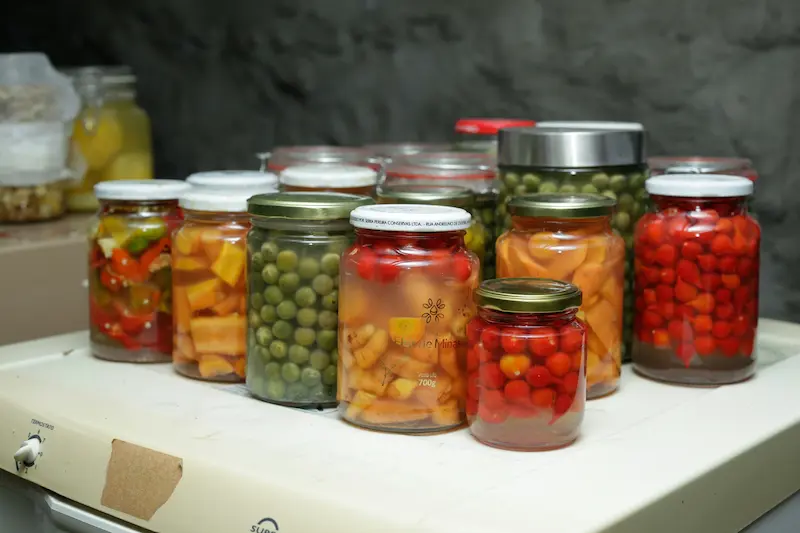
The critical safety distinction is between boiling-water canning and pressure canning. High-acid foods, including fruit, properly acidified tomatoes, and most pickles, can be processed safely using a boiling-water canner, which reaches 212°F (100°C) at sea level. Low-acid foods, including most vegetables, meats, poultry, and fish, need to reach 240 to 250°F (116 to 121°C) to destroy the spores of Clostridium botulinum, the organism responsible for botulism. That temperature is only achievable in a pressure canner. Attempting to can low-acid foods in a boiling-water canner is unsafe and has caused serious illness.
The National Center for Home Food Preservation is the primary source for tested home canning procedures. Using validated recipes matters because the safety of a canned product depends on the specific combination of food type, preparation, acidity, jar size, packing method, processing time, and altitude. Changing a recipe’s critical variables can compromise safety in ways that aren’t apparent when you open the jar.
A sealed jar alone does not confirm that food is safe. Botulism toxin can be present in a canned product without any visible signs: no unusual smell, no discoloration, and no obvious spoilage. Always use tested recipes, use appropriate equipment in good working order, and follow processing instructions precisely.
Oven canning, open-kettle canning, and dry canning are not validated methods and should not be used.
6. Pickling With Vinegar or Brine
Pickled foods preserve through acidity, either from added vinegar or from acid produced naturally during fermentation. These are meaningfully different processes with different safety considerations and storage requirements.
Quick refrigerator pickles involve submerging vegetables in a vinegar solution without heat processing and storing them in the refrigerator. They’re convenient and customizable, but they’re not shelf-stable. They require consistent refrigeration and have a shorter practical life than properly processed pickled products.
Shelf-stable pickled products require appropriate acid concentration, prepared and processed according to validated recipes. For anything intended for pantry storage, the vinegar concentration and the ratio of vegetables to brine aren’t just flavor decisions; they affect safety. The National Center for Home Food Preservation’s pickling section provides tested recipes with specified ingredients and processing procedures.
Don’t substitute untested vinegar ratios for those specified in a validated recipe when making shelf-stable pickled products. Diluting vinegar or reducing the proportion of acid relative to vegetables changes the pH in ways that affect both flavor and safety.
Fermented pickles, such as traditional dill pickles made in a salt brine, are a distinct product covered in the fermentation section below. The mechanisms and safety considerations differ from vinegar pickling.
7. Fermenting Food
Fermentation is driven by microorganisms, primarily bacteria, that break down carbohydrates in low-oxygen conditions. In many home fermentation applications, such as sauerkraut and fermented pickles, naturally present bacteria produce lactic acid, which lowers the pH of the food and creates conditions that limit the growth of many spoilage organisms.
As the National Center for Home Food Preservation describes, this metabolic activity generates acids, gases, and other compounds that both preserve the food and produce the distinctive flavors and textures associated with fermented products like sauerkraut, kimchi, and fermented dill pickles.
Successful fermentation depends on appropriate ingredients in the right proportions, suitable containers, and conditions specific to the product you’re making. For sauerkraut, salt concentration matters: too little and undesirable organisms can dominate; too much and the fermentation doesn’t proceed correctly. The NCHFP’s fermentation guidance includes tested recipes for specific products.
Two things to keep in mind: first, fermented foods should be stored appropriately after fermentation (typically in the refrigerator, unless the product is subsequently processed for shelf stability). Second, unsupported health claims about fermentation should be treated with skepticism. While fermented foods are part of many culinary traditions, claims that fermentation cures illness, detoxifies the body, or guarantees safety are not established by reliable evidence. An improperly fermented batch can be unsafe. Follow tested procedures from a reliable source.
8. Salting and Curing Food
Salt plays a role in food preservation because high concentrations draw moisture from food through osmosis and create conditions many bacteria cannot survive. In practical home preservation, salting and curing are most commonly associated with meats and fish, in products like cured ham, bacon, salt cod, and dry-cured sausages.
Traditional curing is meaningfully different from simply adding salt to food. For meats, appropriate curing involves precise quantities of salt and, in many cases, curing agents, specific processing conditions, and often additional steps such as smoking or drying. The National Center for Home Food Preservation’s curing and smoking section provides guidance for specific products.
Don’t approach meat curing casually. Imprecise formulations, inadequate salt concentrations, or missing critical steps can leave pathogens active in a product that appears cured. This is an area where careful study of validated procedures before you begin is genuinely important, not optional.
For vegetables, salt functions as a supporting ingredient in fermentation rather than the primary preservative on its own. Lightly salting vegetables for quick preparations is not a preservation method.
9. Smoking Food
Smoking adds flavor to food and, used in conjunction with other processes, can contribute to preservation. The relevant distinction for food safety is between hot smoking and cold smoking.
Hot smoking cooks food while applying smoke, bringing it to a safe internal temperature during the process. Cold smoking applies smoke at temperatures below those required to cook food. Cold-smoked products are not cooked during smoking, so their safety depends on prior curing, subsequent cooking by the person consuming them, or other validated processing. Cold smoking is considerably more complex and carries more risk than hot smoking.
The National Center for Home Food Preservation includes guidance for specific cured and smoked products. For temperature targets, processing times, and appropriate storage, consult the NCHFP or USDA guidance for the specific product you’re preparing.
Smoke alone does not make food shelf-stable. Most smoked foods still require refrigeration or freezer storage after smoking. Smoke provides some antimicrobial effect and can help dry the surface of food, but these effects are not sufficient to replace proper cold storage for most applications.
10. Preserving Fruit With Sugar
Sugar plays a preservation role in jams, jellies, and preserves that goes beyond sweetening. At sufficient concentrations, sugar reduces the water available to microorganisms, contributing to preservation. But the specific recipe matters: the relationship between sugar, fruit, acidity, pectin, and water determines both the safety and the stability of the finished product.
The National Center for Home Food Preservation’s jams and jellies section provides tested recipes for a range of fruit spreads. These recipes specify the type and quantity of fruit, acid content, sugar, pectin (where used), and processing method. For shelf-stable products, water-bath processing is part of the required procedure, not an optional step.
Reducing sugar in a recipe intended for shelf storage is not a safe adaptation without reformulation. The NCHFP notes that sugar is required in certain traditional preserves for preservation reasons, not just flavor. Substituting or significantly reducing sugar changes the water activity of the product in ways that can affect its safety and stability. Reduced-sugar and no-sugar recipes do exist, but they are formulated specifically for those conditions rather than being standard recipes with the sugar reduced.
A sealed jar of jam is not automatically safe or shelf-stable. Proper water-bath processing is required for shelf-stable products. Unprocessed jam or jelly, however well it seems to have set, belongs in the refrigerator, not on a pantry shelf.
Common Food Preservation Mistakes to Avoid
A handful of mistakes account for most food safety problems with home preservation. These cut across methods and are worth understanding before you start any preservation project.
Preventing food from being thrown away is also an important part of reducing household waste. For more practical changes that help save money and reduce waste at home, explore our sustainable home ideas.
Leaving perishable food at unsafe temperatures. Perishable food left at room temperature for more than 2 hours should be discarded, not refrigerated and eaten later. The FDA notes that bacteria causing foodborne illness can double every 20 minutes at room temperature. This applies to food left out during preparation, at a buffet, or in a car on the way home from the store.
Relying on smell, appearance, or taste to judge whether food is safe. The most dangerous foodborne illness risks often leave no detectable trace. Botulism toxin in improperly canned food, for example, produces no unusual smell, color change, or texture difference. Do not taste questionable food to evaluate it.
Packaging dried food before it is adequately dry. Moisture trapped in a sealed container after drying creates favorable conditions for mold. Properly dried food should meet the textural standards for its specific product type (firm and pliable for dried fruit, crisp and brittle for vegetables or herbs). Pack it into airtight, moisture-resistant containers and protect it from heat, light, and humidity in storage.
Treating vacuum sealing as a substitute for required cold storage. Vacuum sealing removes oxygen and slows some forms of spoilage, but it creates low-oxygen conditions that can actually favor the growth of Clostridium botulinum in some foods. Vacuum-sealed garlic in oil and similar low-acid items stored at room temperature have been linked to botulism. Food that requires refrigeration or freezing still requires those conditions after vacuum sealing.
Using untested canning recipes or changing critical processing variables. For home canning, the processing time, acidity, jar size, packing method, and altitude all affect safety. A recipe from a social media post, a community cookbook, or a well-meaning relative’s handwritten notes is not a tested recipe unless it can be traced to a source like the NCHFP or the USDA Complete Guide to Home Canning. Adjusting processing times downward or changing acid levels without validation is not safe.
Assuming that salt, smoke, sugar, vinegar, or a sealed container makes food shelf-stable on its own. Each of these factors contributes to preservation in specific, validated applications. None of them automatically confers shelf stability across all uses. The specific food, recipe, and validated processing method determine whether a product can safely be stored at room temperature.
Attempting to preserve food that’s already in poor condition. Preservation methods extend the life of food that starts in good condition. They don’t improve food that was already deteriorating, and they don’t eliminate pathogen contamination in damaged or moldy produce.
How Food Preservation Can Help You Save Money
The financial logic of preservation is straightforward: if you use food that would otherwise have gone to waste, you’ve recovered money you would have spent buying a replacement. Preserving food is one way to get more value from your grocery spending. For a broader strategy covering grocery costs, meal planning, and reducing food waste, see our guide to building a grocery budget for a family of four. That logic holds up, but only when you account for the full picture.
The costs to count when evaluating any preservation method:
- Packaging: Canning jars, lids, freezer bags, dehydrator mats, or vacuum seal bags all add up over time. Reusable options like glass canning jars spread their cost over many batches; single-use packaging adds a per-use cost every time.
- Equipment: A basic water-bath canner or food dehydrator typically runs $30 to $150. A quality pressure canner is generally $80 to $200 or more. These are real upfront costs that need to be spread across however much food you actually process over time.
- Energy: Running a food dehydrator for several hours, maintaining a second freezer, or operating a pressure canner consumes electricity. For most household-scale preservation the cost is modest but not zero.
- Storage space: A dedicated chest freezer, a pantry shelf, or dedicated jar storage all have a real value, particularly in smaller homes.
- Ingredients and preparation: Vinegar, salt, sugar, pectin, and replacement canning lids add to the total cost of preserved products.
- The value of the food being preserved: The financial gain depends on what that food cost, whether it would genuinely have been wasted, and whether the preserved version is something you’ll actually use.
- The likelihood you’ll use what you preserve: A freezer full of unlabeled bags or a pantry of jars that never get opened isn’t generating savings regardless of how little they cost to make.
A worked example using clearly stated hypothetical prices:
Assumption: You buy 2 lbs of strawberries at $2.50/lb in peak season. You wash them, hull them, and freeze them in a quart-size freezer bag. You assume the equivalent out-of-season price would be approximately $4.50/lb.
Hypothetical gross saving: 2 lbs × ($4.50 – $2.50) = $4.00 Estimated cost of one quart freezer bag: approximately $0.20 Net saving (before electricity): approximately $3.80
These are illustrative figures, not verified market averages. Actual prices vary by location, retailer, and season. The structural point is accurate: freezing seasonal produce when prices are lower can generate a meaningful saving, but only if you use the frozen product and find the quality acceptable. If the frozen strawberries sit in the freezer for a year and go into the bin because of freezer burn, the calculation reverses.
Where preservation genuinely earns its keep:
The most impactful preservation decisions are often the simplest ones: freezing bread before it goes stale, refrigerating leftovers promptly instead of leaving them on the counter, portioning bulk meat purchases into individual freezer servings, and storing produce in the conditions that actually suit it. These require little or no additional equipment and recover real money from food that would otherwise be wasted.
More equipment-intensive methods, such as home canning and dehydrating, offer genuine value when you’re working with large volumes of seasonal or home-grown produce that you’d otherwise lose. They’re harder to justify financially if you’re buying retail produce specifically to process it, because the time, ingredient, and equipment costs often offset any theoretical price advantage. Whether preservation saves money in a specific situation depends on the food, the volume, the equipment you already own, the method’s actual costs, and whether you’ll realistically use what you preserve.
Conclusion: Start With One Food Preservation Method
The most useful preservation habit is one you’ll actually maintain. Start with a method that suits a food you regularly buy, the equipment you already own, and the time you realistically have available.
For most households, the highest-impact starting point is getting refrigeration right: storing perishables at the correct temperature promptly after purchase, organizing the refrigerator so food doesn’t get lost, and using leftovers before they deteriorate. Freezing is the next practical layer, especially for bread, meat, and produce that tends to accumulate between uses.
If you want to go further, choose based on what you genuinely have too much of. A large tomato harvest makes home canning or freezing worth the effort. Herbs that regularly wilt before you use them are candidates for drying. If fermentation interests you, the National Center for Home Food Preservation’s tested procedures are a reliable starting point.
Whatever approach you pursue, use guidance from a reliable source. The National Center for Home Food Preservation at the University of Georgia offers tested, research-based procedures for canning, freezing, drying, fermenting, pickling, curing, and smoking. The FDA’s food safety guidance covers the refrigeration and storage fundamentals that underpin every other method.
Preservation is most effective when it fits your actual food habits, not an idealized version of them.
Frequently Asked Questions
The main categories include temperature-based methods (refrigeration and freezing), appropriate storage practices (cool, dry storage for specific produce), moisture reduction (drying and dehydrating), acidity-based methods (vinegar pickling and fermentation), heat processing with validated procedures (home canning), and methods that rely on salt, sugar, or smoke in specific applications. Storage practices and processing techniques are different categories with very different requirements. Refrigerating leftover soup and pressure-canning green beans both preserve food, but the knowledge, equipment, and safety considerations involved are not comparable.