A sustainable home doesn’t have to mean solar panels on the roof and a composting bin in every corner. Most of the biggest wins come from ordinary changes: sealing air leaks, swapping a few fixtures, adjusting a habit or two. This guide walks through what actually makes a home sustainable, what moves the needle most, and how to build toward it in whatever order your budget allows.
What Makes a Home “Sustainable”?
A sustainable home uses less energy, water, and raw material, and sends less waste to the landfill, all while staying comfortable to live in. That can describe a brand-new net-zero build with solar and a heat pump. It can just as easily describe a 1980s house where the owner added attic insulation, switched to LED bulbs, and started composting food scraps. Sustainability is a spectrum, not a certificate you earn once.
It’s gotten more attention lately for a practical reason. Energy and water cost more than they used to, so efficiency gains now show up directly in monthly bills.
Why It’s Worth Doing: The Numbers Behind the Decision
The average U.S. household uses roughly 10,500 kilowatt-hours of electricity a year, according to the U.S. Energy Information Administration. Heating and cooling typically account for about half of a home’s total energy use, with water heating, lighting, and refrigeration making up roughly another quarter, based on EIA residential energy data.
That breakdown matters because it tells you where to focus first. If half your bill goes to heating and cooling, that’s the category with the most room to save, not your phone charger.
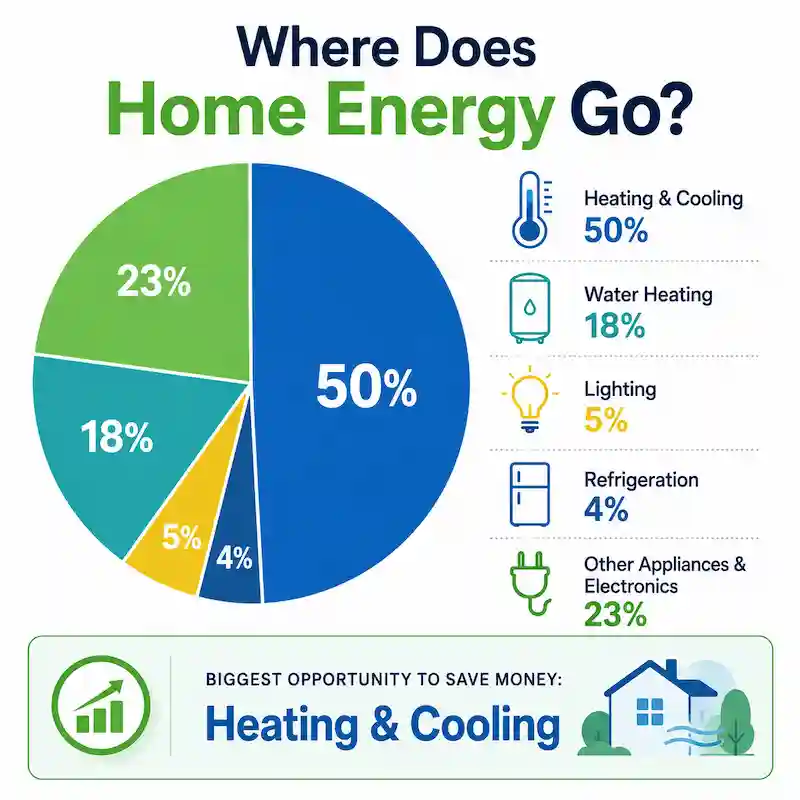
Takeaway: Before spending money, figure out where your home actually loses energy and water. The categories using the most are usually the ones worth fixing first.
Step One: Get a Home Energy Audit Before You Buy Anything
This is the step most guides skip, and it’s the one that prevents wasted money. The Department of Energy runs the Home Energy Score program, which works like a miles-per-gallon rating for your house. A certified assessor walks through your home, and you get a 1-to-10 score plus a specific, ranked list of the upgrades that will actually move your energy use, rather than a generic checklist that applies to every house equally.
Many utilities subsidize or fully cover the cost of this assessment, so check with your provider before assuming it’s an out-of-pocket expense. Skipping this step is how people end up buying a smart thermostat when their real problem is an uninsulated attic.
Energy: Where Most of the Savings Live
Energy upgrades tend to have the clearest, most measurable payoff, which makes them the natural next step after an audit.
Free and Almost-Free Changes
Adjusting your thermostat costs nothing and works immediately. The U.S. Department of Energy estimates that setting it back 7 to 10 degrees for eight hours a day, such as while you sleep or work, can cut heating and cooling costs by up to 10% a year. Sealing obvious drafts around doors, windows, and outlets with weatherstripping or caulk costs a few dollars and usually pays for itself in one season.
Small Purchases Under $100
Switching to LED bulbs is one of the cheapest upgrades available. ENERGY STAR notes that LED lighting produces the same brightness as incandescent bulbs while using up to 90% less energy, and the bulbs last far longer, so you’re not constantly replacing them. Adding a certified smart thermostat is another low-cost option. Field data collected for ENERGY STAR certification shows these devices save households an average of 8% on heating and cooling costs, or about $50 a year.
Bigger Investments: Insulation and Water Heating
Air sealing and insulation deliver some of the strongest returns in this guide. The EPA estimates that sealing air leaks and adding insulation in attics, crawl spaces, and basements saves homeowners an average of 15% on heating and cooling costs, or about 11% on total energy costs. Older, poorly insulated homes often see more.
How much insulation is enough depends on where you live. The Department of Energy’s consumer guide to home insulation sets recommended R-values by climate zone, with colder regions needing substantially more than mild ones. Before buying insulation, check the label. The FTC’s R-value Rule legally requires manufacturers and installers to disclose accurate R-value information, so you’re comparing products on equal footing rather than marketing claims.
Water heating is typically the second-biggest energy user in a home, right behind heating and cooling. A certified heat pump water heater can save a family of four around $550 a year on electricity compared with a standard electric model, and more than $5,600 over its lifetime.
Here’s how those figures compare side by side:
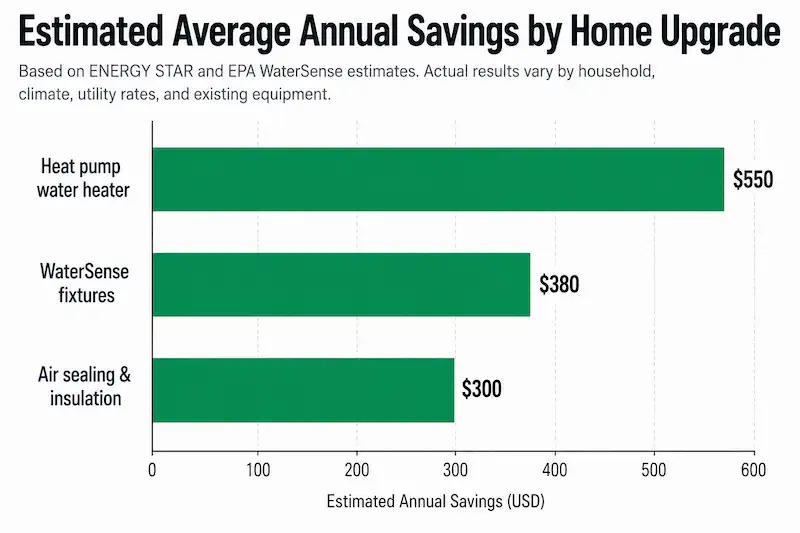
(See chart above: Estimated Average Annual Savings by Upgrade, compiled from ENERGY STAR and EPA WaterSense figures. Actual results vary by household size, climate, and existing equipment condition.)
Takeaway: Insulation and thermostat habits usually beat flashy gadgets for return on investment, because heating and cooling make up the largest slice of most energy bills.
Water: The Upgrade Everyone Skips
Water efficiency gets less attention than energy, but it’s one of the cheapest categories to fix.
According to the EPA’s WaterSense program, the average family spends over $1,000 a year on water and can save more than $380 of that by switching to WaterSense-labeled fixtures and ENERGY STAR appliances. A few specific figures are worth knowing:
| Upgrade | Typical Annual Savings |
| Replacing old toilets with WaterSense models | About 13,000 gallons and $130 |
| Replacing showerheads with WaterSense models | About 2,700 gallons and $70 |
| Fixing household leaks | Up to 9,400 gallons for the average family |
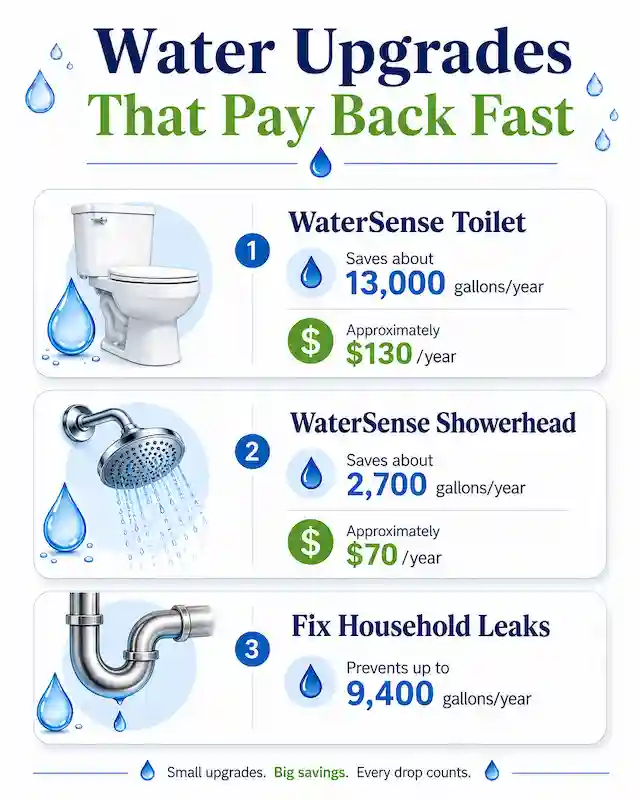
A WaterSense label means a product is independently certified to use at least 20% less water than a standard model while performing just as well, so you’re not sacrificing pressure to save money.
Don’t Forget the Yard
Outdoor irrigation is an easy category to overlook. Replacing an old clock-based sprinkler controller with a WaterSense-labeled irrigation controller can reduce a home’s outdoor water use by up to 30% and save roughly 15,000 gallons a year, per the same EPA data.
Takeaway: A new toilet and showerhead are two of the fastest-paying-back upgrades in this guide, often recovering their cost within a year.
Indoor Air Quality: The Sustainability Factor Most Guides Skip
Sustainability isn’t only about utility bills. What your home is built and furnished with affects the air you actually breathe. The EPA reports that concentrations of many volatile organic compounds, or VOCs, are consistently higher indoors than outdoors, and levels can spike far higher during and immediately after activities like painting.
VOCs off-gas from ordinary things: paint, adhesives, new furniture, and some flooring. You don’t need to gut your house to address this. Choosing low-VOC or zero-VOC paint, letting new furniture and flooring air out before bringing it into a closed room, and running ventilation during and after any painting or finishing work are simple, low-cost habits that make a real difference.
Solar Panels and Renewable Energy in 2026: What Changed
If you looked into solar a couple of years ago and are revisiting it now, the math has shifted. The federal 30% Residential Clean Energy Credit for homeowner-owned solar systems ended for any system placed in service after December 31, 2025, under the One Big Beautiful Bill Act, according to the IRS. If you installed a system in 2025, you can still claim that credit on your 2025 return. Systems installed from 2026 onward don’t qualify for it.
That doesn’t mean solar stopped making sense, only that the calculation now leans more on local electricity rates, equipment and installation costs, and state or utility incentives rather than a federal tax credit. For state-specific programs, the DSIRE database, maintained by N.C. State University with Department of Energy backing, is the most reliable place to check what’s currently available where you live.
Takeaway: Solar can still pay off over its 20-plus-year lifespan, but run the numbers against local electricity rates and state incentives rather than assuming a federal credit applies.
Cut Waste at the Source
Waste reduction is the least glamorous part of a sustainable home, and arguably the most overlooked.
Food waste is a bigger issue than most people realize. The EPA reports that food is the single most common material sent to U.S. landfills, and that in 2019 only about 5% of wasted food nationally was composted. When food breaks down in a landfill without oxygen, it produces methane, a potent greenhouse gas. Composting it at home instead turns that same waste into usable soil, and you don’t need a backyard to start. Countertop composters, curbside organics pickup, and simple worm bins all work for apartments and small yards alike.
For more specific, room-by-room ideas, 25 Sustainable Home Ideas That Save Money and Reduce Waste covers a longer list.
Takeaway: Composting is one of the few sustainability habits that costs nothing, takes minutes a week, and directly cuts methane emissions.
Sustainable Materials, Products, and Certifications
The sustainable home market is full of products claiming to be “eco-friendly,” and not all of them are worth the premium. Look for independent certifications rather than marketing language. ENERGY STAR appliances are tested in EPA-recognized labs and must meet real efficiency requirements, and WaterSense fixtures work the same way.
The certifications extend to entire homes too. New homes built to the ENERGY STAR NextGen standard are about 20% more efficient than typical code-built construction and can reduce greenhouse gas emissions by 40% to 80%. Homes carrying the WaterSense new-homes label are built to use at least 30% less water than typical new construction.
Before buying anything labeled “green,” ask three questions: is it independently certified, does it solve a problem you actually have, and would a cheaper, unbranded option do the same job?
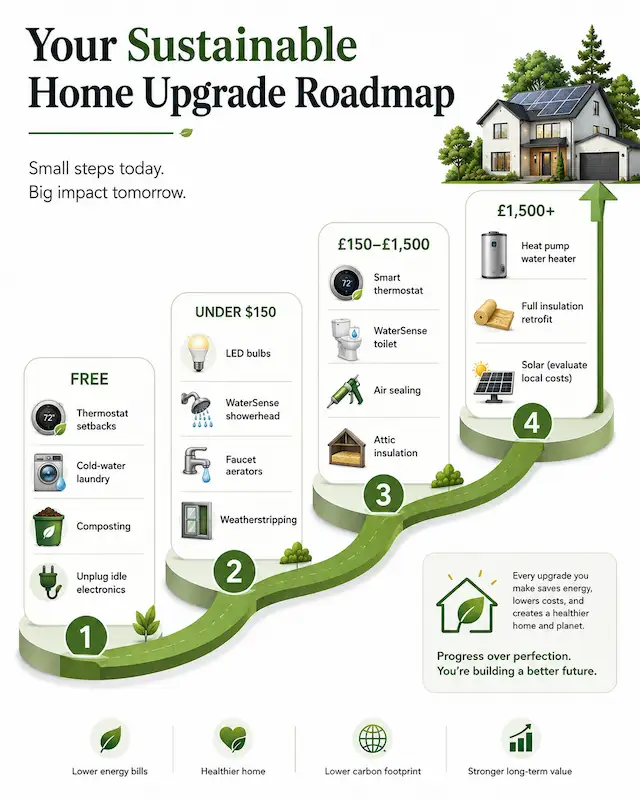
A Budget Roadmap: What to Do First
Common Mistakes to Avoid
- Buying insulation before air sealing. Insulation slows heat transfer through materials, but it doesn’t stop air leaking through gaps. Seal first, insulate second, or you’re paying for performance you won’t get.
- Assuming a federal solar credit still applies. As covered above, it doesn’t for systems installed in 2026 onward. Run the numbers without it.
- Skipping the audit and guessing. A $50 smart thermostat won’t fix a $2,000 insulation problem. Know where the energy is actually going first.
- Trusting a label without checking who certified it. “Eco-friendly” printed on a box means nothing on its own. ENERGY STAR and WaterSense involve independent, EPA-recognized testing. Plenty of other labels don’t.
Common Questions About Sustainable Homes
Is it expensive to make a home sustainable?
Not necessarily. Many of the highest-impact changes, like thermostat habits, air sealing, and composting, cost little or nothing. Bigger investments such as solar or a full insulation retrofit can be spread out over years and often pay for themselves through lower bills.
What’s the fastest way to see savings?
Water fixtures and thermostat adjustments tend to pay back fastest, often within months, because they’re cheap to install and immediately reduce a recurring bill.
Do I need solar panels to have a sustainable home?
No. Solar is one option among many, and depending on your climate, roof, and local electricity rates, it isn’t always the most cost-effective one.
Can renters make their homes more sustainable?
Yes. Removable weatherstripping, LED bulbs, low-flow showerhead attachments, smart plugs, and composting don’t require a landlord’s permission and move with you.
Is the federal solar tax credit still available in 2026?
No, not for homeowner-purchased systems. The 30% Residential Clean Energy Credit ended for systems placed in service after December 31, 2025. Check the DSIRE database for state and utility incentives that may still apply.
Your Next Steps
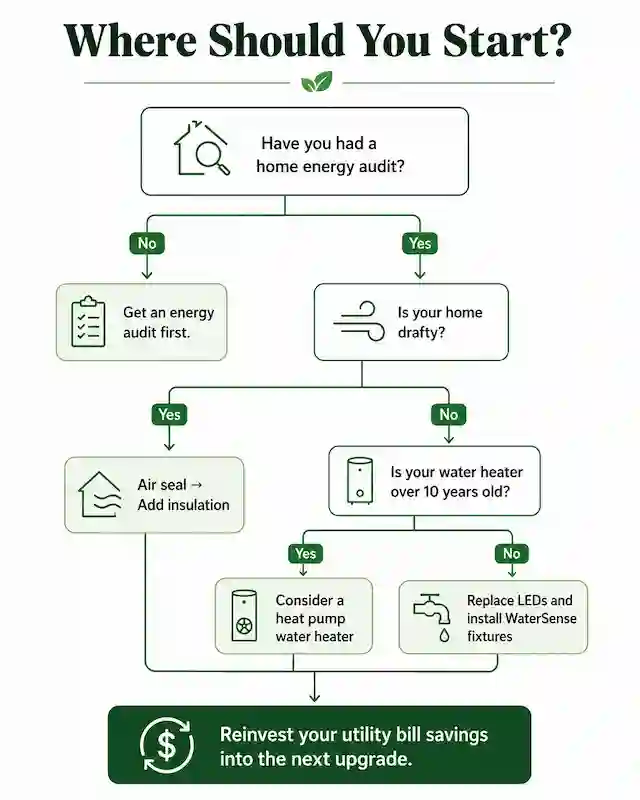
Start with a home energy audit or, at minimum, a walk-through of your own home. Note which rooms feel drafty, check the age of your water heater, and look at your last few utility bills to see where the money actually goes. Tackle the free and low-cost fixes first, then use those savings to fund bigger projects like insulation or a heat pump water heater.
A sustainable home isn’t one purchase. It’s a series of small, mostly inexpensive decisions that add up over time, and every one of them is optional until you’re ready for it.