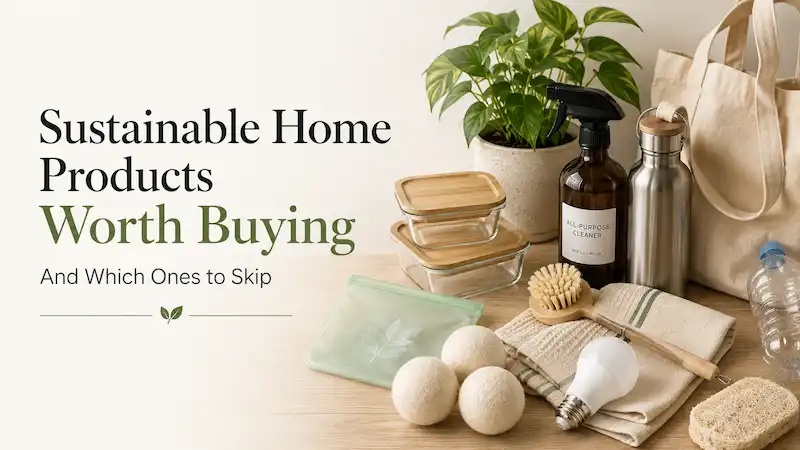
Quick answer: The sustainable home products with real evidence behind them are WaterSense-certified fixtures, ENERGY STAR appliances and thermostats, LED bulbs, weatherstripping, and FSC-certified furniture. Skip anything only labeled “eco-friendly” or “biodegradable” without a certification behind it, since the FTC has repeatedly flagged those exact claims as misleading. Below is the full breakdown, backed by EPA, ENERGY STAR, FTC, and EWG data instead of marketing copy.
Walk down any “eco” aisle and you’ll see the same problem. Everything claims to be sustainable, but almost nothing tells you why. Bamboo toothbrushes sit next to “biodegradable” trash bags next to $80 water bottles, and the labels rarely explain what any of it actually does for your home, your wallet, or the planet.
This guide skips the marketing copy. If you’re building a bigger plan, the pillar guide Sustainable Home: The Complete Guide to Creating an Eco-Friendly and Budget-Friendly Home covers the full picture. This article zooms in on individual products.
How We Built This Guide
Every recommendation and every “skip” below traces back to a primary source: a federal agency (EPA, ENERGY STAR), a federal regulator (FTC), or an established research and watchdog group (EWG, FSC). No figures were invented to fill gaps. Where a specific product is named, its certification and price were checked against current retailer listings at the time of writing. Prices and availability change, so treat listed prices as a snapshot, not a live quote, and confirm current pricing before buying.
What Actually Makes a Home Product “Sustainable”?
The word “sustainable” has no legal definition in the United States, which is exactly why it shows up on products that don’t deserve it. The FTC’s Green Guides do regulate more specific claims, including “degradable,” “compostable,” and “made from renewable materials.” Under those guides, a marketer can only make an unqualified degradable claim if they can prove the entire product will completely break down within a reasonably short period after normal disposal, which the FTC generally treats as one year.
That’s why this guide leans on certifications like WaterSense, ENERGY STAR, and FSC instead of adjectives like “green” or “eco-friendly.” Certifications require independent testing. Adjectives don’t.
Sustainable Home Products Worth Buying
WaterSense Showerheads and Faucet Aerators
A standard showerhead uses 2.5 gallons of water per minute, while showerheads that earn the EPA’s WaterSense label have to use no more than 2.0 gallons per minute and are independently tested to meet spray force and coverage standards, according to EPA WaterSense.
Replacing an old showerhead with a WaterSense model can cut a household’s combined water and electricity costs by about $70 a year and save more than 2,700 gallons of water, and swapping an old bathroom faucet for a WaterSense model can save around $250 over the faucet’s lifetime, per the EPA’s WaterSense statistics page. A full bathroom upgrade (showerhead, faucet aerator, toilet) pays for itself within about a year, per the EPA’s own estimate.
Where to start: Home Depot’s WaterSense-certified lineup starts around $25. The Kohler Forté, a frequently recommended WaterSense pick, runs 1.75 gallons per minute with three spray settings while still meeting EPA efficiency standards. Vetted Home Gear Installation takes about 10 minutes with a wrench.
Bottom line: This is the cheapest swap on this list with the fastest payback. Start here.
LED Light Bulbs
ENERGY STAR certified LED products use at least 75% less energy than incandescent bulbs and last years longer. More than 3 billion ENERGY STAR certified light bulbs have been sold in the US since the label launched in 1997, delivering more than one trillion kilowatt-hours of electric energy savings, according to ENERGY STAR. For a single household, the fastest payback comes from replacing your five most-used bulbs first. Any bulb carrying the ENERGY STAR label from a major retailer qualifies, no specific brand outperforms the certification itself here.
Smart Thermostats
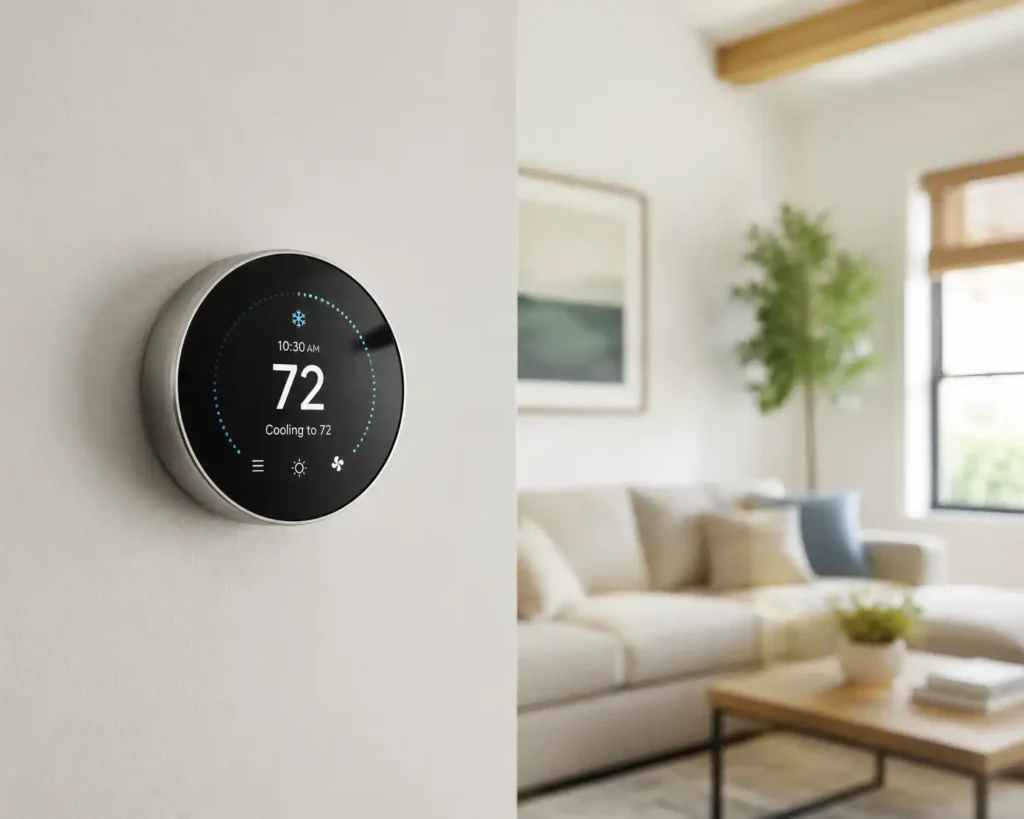
On average, ENERGY STAR certified smart thermostats save about 8% on heating and cooling costs, or roughly $50 a year, according to ENERGY STAR’s own FAQ. Savings run higher in extreme climates and for households with irregular schedules.
Specific models: The ecobee Smart Thermostat Premium, around $249, is a frequently recommended ENERGY STAR certified pick with built-in room sensors, per one 2026 comparison roundup, while the Amazon Smart Thermostat, around $80 and built on Honeywell’s platform, is a lower-cost ENERGY STAR certified alternative, according to another 2026 roundup. Check for a C-wire in your wall before buying, since it determines installation difficulty.
ENERGY STAR Washing Machines (and Other Appliances)
Full-sized ENERGY STAR certified clothes washers use about 14 gallons of water per load, compared to 20 gallons for a standard machine, per ENERGY STAR’s clothes washer page. The same logic applies to dishwashers, refrigerators, and dryers. Look for the ENERGY STAR label specifically, not just “energy efficient” language on the box, since only the label comes with third-party verification.
Weatherstripping and Caulk
The EPA estimates homeowners can save an average of 15% on heating and cooling costs, or about 11% on total energy costs, by air sealing their home and adding insulation in attics, floors, and basement rim joists, according to ENERGY STAR’s methodology page. A tube of caulk and a roll of weatherstripping cost under $20 combined and take an afternoon to install. Renters can do most of this without permission, since it’s removable.
For more budget fixes like this, see How to Make Your Home More Sustainable on a Budget.
A Countertop Compost Bin
In 2019, the US generated 66.2 million tons of wasted food across retail, food service, and residential sectors, and only about 5% of it was composted. Food is also the single most common material sent to landfills, and once buried there without oxygen, it’s responsible for roughly 58% of landfill methane emissions, according to the EPA’s composting page.
A basic bin doesn’t need to be fancy. It just needs a spot to collect scraps before they head to a backyard pile, a municipal program, or a drop-off site.
FSC-Certified Wood Furniture
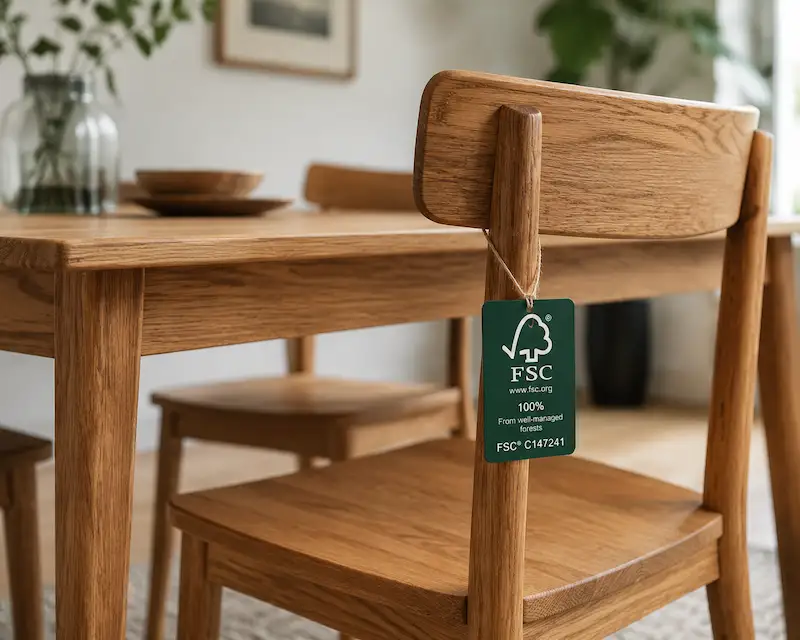
Furniture labeled “sustainably sourced” means very little on its own, since there’s no legal standard behind that phrase. Look instead for the FSC (Forest Stewardship Council) label. Wood sourced from FSC-certified forests is harvested sustainably, meaning there’s no net loss of forest over time, according to FSC’s furniture page.
Budget vs. investment: IKEA now sources FSC-certified wood across much of its range, according to one sustainable-furniture roundup, making it the accessible entry point. At the other end, Room & Board builds more than 90% of its collection in the US from FSC-certified solid wood and recycled steel, per a 2026 furniture brand guide, which is why it reads as an investment rather than a quick refresh.
Sustainable Products Worth Buying, With a Catch
Reusable Bags and Bottles
A 2018 Danish Environmental Protection Agency life cycle assessment found that a cotton tote needs to be reused about 7,100 times to offset its full environmental impact compared to a single-use plastic bag reused once as a trash bag, and an organic cotton tote needs roughly 20,000 uses. A separate UN Environment Programme report put the figure for a sturdy polypropylene bag at 10 to 20 uses, according to CNN’s reporting on both studies.
That doesn’t make reusable bags a bad idea. It means a closet full of free tote bags nobody reuses is worse for the planet than the plastic bags they replaced. Pick one or two sturdy bags and actually use them for years.
Sustainable Home Products to Skip (Or Check Twice Before Buying)
“Biodegradable” and “Compostable” Plastic Products, Without Certification
Under the FTC’s Green Guides, a product can only carry an unqualified compostable claim if it will safely break down into usable compost in a home compost pile within a reasonably short time. If a product only composts in a specialized municipal or industrial facility, the marketer has to disclose that and can’t imply otherwise if those facilities aren’t actually available to most consumers, according to the FTC’s Green Guides summary.
If a label doesn’t specify home compostable with a real timeframe, assume it’s headed to a landfill like everything else.
Vague “Green” or “Eco-Friendly” Cleaning Sprays
EWG’s Guide to Healthy Cleaning, which assessed more than 2,000 household cleaning products, found that just 7% adequately disclosed their contents, while 53% contained ingredients known to harm the lungs and 22% contained chemicals linked to developing asthma, according to EWG’s findings. Check a product in a third-party database before buying, or stick with ingredients you recognize, like vinegar, castile soap, and baking soda.
Single-Use “Eco” Novelty Items
Bamboo is genuinely fast-growing and renewable, which is why it shows up on so much “sustainable” packaging. But the FTC’s own Green Guides use bamboo as a case study for why renewable-material claims can mislead. An unqualified claim about a renewable material can wrongly imply that a product is also recyclable, biodegradable, or made with recycled content, so marketers are expected to qualify the claim unless the item is made almost entirely from that renewable material, according to the FTC’s Green Guides summary. A renewable material doesn’t automatically make the finished product sustainable.
Worth Buying vs. Skip: Quick Comparison
| Product | Verdict | Why | Example (verified) |
| WaterSense showerhead/faucet | Buy first | ~1 year payback, EPA-verified | Kohler Forté, ~$45-55 |
| ENERGY STAR LED bulbs | Buy | 75%+ less energy | Any ENERGY STAR-labeled LED |
| ENERGY STAR smart thermostat | Buy | ~8% HVAC savings, field-tested | ecobee Premium (~$249) or Amazon Smart Thermostat (~$80) |
| ENERGY STAR washer/appliances | Buy | Verified water and energy cuts | Look for the ENERGY STAR label at purchase |
| Weatherstripping and caulk | Buy first | Cheapest fix, ~15% HVAC savings | Any hardware-store kit, ~$20 |
| Countertop compost bin | Buy | Cuts landfill methane | Any bin with a sealed lid |
| FSC-certified furniture | Buy (invest) | Independently traced sourcing | IKEA (budget), Room & Board (investment) |
| Reusable bags/bottles | Buy, but reuse it | Needs 10-7,000+ uses to offset production | Any bag you’ll use for years, not one you’ll hoard |
| “Biodegradable” plastic, uncertified | Verify first | Often industrial-facility-only | Check for explicit “home compostable” language |
| Vague “eco” cleaning sprays | Verify first | Only 7% of products fully disclose ingredients | Check EWG’s database before buying |
| Bamboo single-use novelties | Verify first | Renewable material ≠ sustainable product | N/A |
A Quick Checklist Before You Buy Anything “Sustainable”
- Look for an actual certification (WaterSense, ENERGY STAR, FSC), not just a green leaf icon
- Check whether “compostable” means home compost or industrial-only
- For cleaning products, confirm the full ingredient list is disclosed somewhere
- Ask whether you’ll realistically reuse a reusable item enough times for it to matter
- Compare payback period, not just sticker price, for appliances and fixtures
- Check whether a free habit change (air drying, cold washing, shorter showers) already solves the problem before buying anything new
Frequently Asked Questions
Are sustainable home products worth the extra cost?
It depends on the product. Fixtures and appliances with a real certification, like WaterSense showerheads or ENERGY STAR washers, tend to pay for themselves within one to a few years through lower utility bills. Items sold purely on “eco” branding, without a certification behind them, usually cost more without a matching benefit.
What’s the difference between biodegradable and compostable?
Under FTC guidance, an unqualified biodegradable claim means the whole product breaks down within about a year after normal disposal. A compostable claim means it breaks down into usable compost, and the marketer has to say whether that happens in a home compost pile or only in an industrial facility.
Do reusable bags actually help the environment?
Yes, but only with real reuse. Depending on the material, a reusable bag needs anywhere from about 10 uses (sturdy polypropylene) to several thousand uses (cotton) before it beats a single-use plastic bag on environmental impact.
What’s the single best sustainable home product to buy first?
Weatherstripping, caulk, or a WaterSense showerhead. Both cost under $30, take an afternoon or less to install, and have some of the fastest paybacks of anything on this list.
Should I trust a product just because it says “eco-friendly”?
Not on its own. That phrase has no legal definition. Look for a specific, independently verified certification instead.
Final Thoughts: Where to Start
Start with the cheap, fast-payback items: weatherstripping, caulk, and a WaterSense showerhead. Move on to appliances and furniture as they need replacing anyway, choosing ENERGY STAR or FSC-certified options over uncertified “green” alternatives. Treat any product that only says “eco-friendly,” “natural,” or “sustainable” without a certification as marketing until proven otherwise.
For more low-cost swaps in the same spirit, 25 Sustainable Home Ideas That Save Money and Reduce Waste has additional options to work through room by room.