That first heating bill of the season has a way of arriving just as you finally feel warm. If you’re wondering how to save money on heating without living in a parka, start here. In about 10 minutes, you’ll know which 10 steps can cut your heating bill for your fuel and home, ordered from free to worth paying for, and where help exists.
The U.S. Energy Information Administration (EIA) expects natural gas and propane households to spend less this winter than last, and electricity and heating oil households more, about 21% more for heating oil, per its October 6, 2026 winter outlook. Those are household spending comparisons with last winter.
This guide draws on public sources named in the text, checked as of October 27, 2026. No steps were tested in a home.
Department of Energy guidance says setting your thermostat back 7 to 10°F for eight hours a day can cut up to 10% a year from heating and cooling costs. ENERGY STAR’s model of one home averages 15% on heating and cooling from sealing and insulating. Start with free steps, then check what your fuel costs per unit of heat.
What Saves the Most on a Heating Bill?
You want the biggest move for the least money. No single trick works for everyone, so this table compares ways to lower your heating bill and reduce heating costs, using Department of Energy (DOE) and ENERGY STAR estimates.
| Move | Cost tier | Savings, with condition | Where |
|---|---|---|---|
| Thermostat setback | Free | Up to 10% a year on heating and cooling, an upper bound for 7 to 10°F back for 8 hours a day (DOE) | Step 3 |
| Seal drafts, then insulate | Low to moderate (costs vary) | Average 15% on heating and cooling in ENERGY STAR’s modeled home; 7% to 20% by climate zone | Steps 5 and 9 |
| Sunlight, drapes, layers | Free | Not quantified in the sources used here | Step 4 |
| Budget billing, LIHEAP | Free | Budget billing spreads cost evenly and does not lower the total; LIHEAP help varies by state | Step 6 |
| Space heater in an occupied room | Use what you own | Depends on your electricity rate | Step 7 |
| Filter and service | Low | Not quantified here | Step 8 |
| Equipment replacement | High | Depends on your fuel and local rates | Step 10 |
Don’t add the percentages together, because each estimate has different conditions. The steps below run from free to paid.
Steps 1 and 2: Start With Your Bill and Your Fuel
Step 1: Read your bill before changing anything
You open the bill and see a number, but not what drove it. Find:
- Units used, in kWh, therms or gallons
- Rate per unit
- Billing days
- Any weather note
Then compare with the same month last year. A rate change and a use change call for different fixes: rate, see Steps 2 and 6; use, see Steps 3 to 5, 8 and 9.
Renter? If heat is in your rent, skip to Steps 3 to 5 and ask your landlord about the rest.
Step 2: Find out what your fuel costs per unit of heat
EIA’s averages compare this winter with last winter for each fuel, so they don’t say which fuel is cheaper. Which is the cheapest way to heat a house? It depends on your prices. EIA notes a strong El Niño could change its outlook, so see this winter’s forecast.
Work out the cost per 10,000 BTU:
Cost per 10,000 BTU = (10,000 ÷ BTU per unit) ÷ efficiency × price per unit
Efficiency is a decimal (95% is 0.95). For a heat pump, use its COP; a COP of 3 means 300% efficient. Use your equipment’s rated efficiency (label, manual or installer).
| Fuel | Billing unit | BTU per unit | Efficiency to use | Your price per unit |
|---|---|---|---|---|
| Natural gas | therm | 100,000 | Furnace AFUE (label or manual) | Your gas bill |
| Propane | gallon | About 91,500 | Furnace AFUE | Your last delivery or supplier quote |
| Heating oil | gallon | About 138,500 | Furnace AFUE | Your last delivery or supplier quote |
| Electric resistance (baseboard, plug-in heater) | kWh | 3,412 | 100% | Your electric bill |
| Heat pump | kWh | 3,412 | COP, varies with outdoor temperature | Your electric bill |
EIA forecasts heating oil prices this winter up more than 30%, partly offset by milder weather. That’s a price forecast, not the spending figure above (see EIA’s full winter fuels outlook).
Illustrative only; your rates will differ. Say electricity is $0.16 per kWh, gas is $1.50 per therm, your furnace is 95% efficient and your heat pump’s COP is 3.
- Electric resistance: 10,000 ÷ 3,412 = 2.93 kWh × $0.16 = about $0.47
- Gas: 10,000 ÷ 100,000 = 0.1 therm ÷ 0.95 = 0.105 × $1.50 = about $0.16
- Heat pump: $0.47 ÷ 3 = about $0.16
Compare the rows with your own prices to judge Steps 7 and 10. The fuel with the lowest cost per unit of heat may not match the direction your bill is moving. If you heat with electricity, lowering an electric bill goes beyond heating. With one fuel option and no purchase planned, skip the arithmetic.
Safety. Work on gas, oil and propane equipment is for licensed professionals.
Steps 3 to 5: How to Save Money on Heating This Week for Little or Nothing
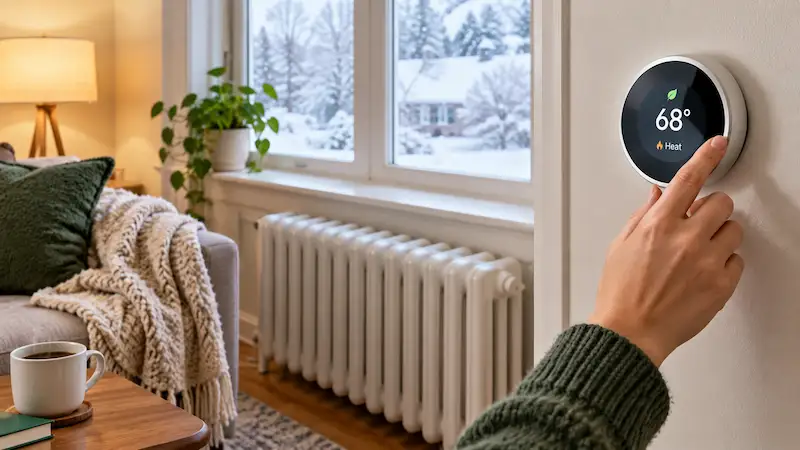
Step 3: Set back the thermostat
Should you turn it down at night? DOE says about 68 to 70°F while you’re awake, and a setback of 7 to 10°F for eight hours can save up to 10% a year on heating and cooling combined. That’s an upper bound, and the percentage is larger in milder climates.
A common myth says the furnace works harder after a thermostat setback and cancels the savings. DOE calls that a misconception, because a cooler house loses heat more slowly. Doing it by hand is free.
Heat pump? Read this first. DOE says a heat pump setback in heating mode can make the unit run inefficiently and cancel the savings, so it points to a moderate setting as the cost-effective choice. Specially designed heat pump thermostats exist.
A programmable or smart thermostat only automates a setback you can do by hand, so buy one only if you tend to forget. If your thermostat isn’t yours to control, as in some apartments with central heat, this step doesn’t apply.
Safety. If anyone at home is an infant, an older adult or has a medical condition, ask their clinician before lowering the temperature, and set back less.
Step 4: Use sunlight, layers and drapes
You pay to heat the room while the afternoon sun warms the window for nothing. Open drapes by day where sun reaches the glass, and close them at night. Add layers and rugs (cost tier: free). If a window gets no direct sun, opening the drapes adds little. Renters can do this one fully.
Step 5: Seal visible drafts
Hold a hand along a door edge on a windy day and you may feel the heat you paid for escaping. Weatherstripping, caulk, door sweeps and outlet gaskets close visible gaps (cost tier: low). Pair this with insulating your windows for winter if film is your plan. If you can’t find gaps you can reach safely, this step isn’t worth forcing.
Safety. Never seal combustion air openings for furnaces, water heaters or fireplaces, because that creates a carbon monoxide risk. Hire a licensed professional for work near fuel-burning equipment. This is general information, not professional advice.
Renter? Ask your landlord before permanent changes.
Step 6: Line Up Help Paying Your Heating Bill
What if the bill is simply more than you can cover? If you can pay comfortably and don’t need smoother payments, you can skip this step.
- Budget billing. According to the Federal Trade Commission’s guidance on heating and cooling costs, budget billing spreads costs evenly and does not lower the total, so the benefit is predictability.
- LIHEAP. The Low Income Home Energy Assistance Program (LIHEAP) offers help with energy bills. Application windows and eligibility vary by state, so check your state’s LIHEAP page.
- Utility payment plans and audits. Ask your utility whether it offers payment plans or energy audits.
- Supplier comparison. Where you can choose your oil or gas supplier, compare prices from more than one.
- Weatherization help. The Weatherization Assistance Program, run through state and local agencies, may help eligible households improve efficiency. Ask your state energy or LIHEAP office whether you qualify.
Scam check. The cooling-off rule gives you 3 business days to cancel a sale made away from the seller’s permanent place of business. The Federal Trade Commission also warns about high-pressure door-to-door sales and callers who impersonate your utility and threaten a shutoff.
Renter? Eligibility varies, so ask each program whether renters, including those whose heat is in the rent, qualify.
Step 7: Use a Space Heater Only When the Math Works
Is that heater under your desk saving money or costing it? A plug-in heater is electric resistance heat, so it costs the same per unit of heat as baseboard (100% efficient in the Step 2 table). For the cost to run a space heater, and the space heater vs furnace cost, use this box.
Is a space heater cheaper than running the furnace? Only when it heats one occupied room while you keep the rest of the home cooler. Cost per hour = watts ÷ 1,000 × your price per kWh. Compare the result with your main fuel’s cost per 10,000 BTU from Step 2.
Illustrative only; your rates will differ. Say a 1,500 W heater runs on $0.16 per kWh. That’s 1,500 ÷ 1,000 = 1.5 kW × $0.16 = $0.24 per hour. It delivers about 5,100 BTU per hour (1.5 × 3,412), so 10,000 BTU costs about $0.47, matching Step 2.
It helps in one occupied room with a lower central setting. It hurts when you heat whole spaces on resistance heat while another fuel costs less per unit of heat. Use a heater you already own before buying one (cost tier: free if you own one).
Follow Safe Electricity’s heating tips:
- Keep it 3 feet from anything that can burn.
- Plug it straight into a wall outlet, not an extension cord.
- Don’t leave it running with no one in the room or while you sleep.
- Don’t use unvented fuel-burning heaters indoors, because of carbon monoxide.
Safety. The Consumer Product Safety Commission gives similar guidance. Have a licensed electrician check any outlet that feels warm or trips often. This is general information, not professional advice.
Steps 8 and 9: Maintain the System, Then Insulate
Step 8: Swap the filter and service the system
Say your furnace filter hasn’t been checked since last winter. Replace or clean it on the schedule in your equipment’s manual (cost tier: low). A gas or oil tune-up and work on ducts in unheated spaces are for a licensed professional. Water heater settings are a separate topic in our whole-home energy-saving checklist. There’s no verified savings figure here, and if your home has no filter, as with some boilers, skip it.
Step 9: Check attic insulation after sealing
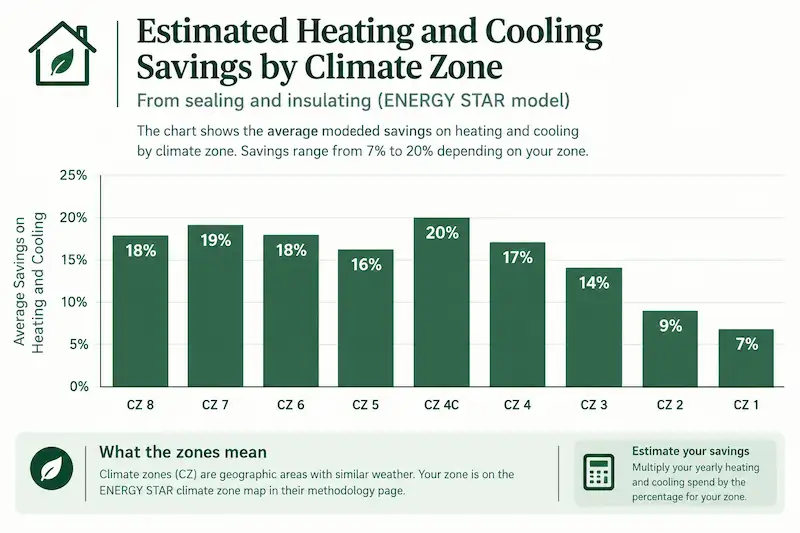
ENERGY STAR’s model finds sealing and insulating saves an average of 15% on heating and cooling and 11% on total energy costs in a modeled 1,700 square foot, 4-bedroom home built 1970 to 1989, with work in attics, floors over crawl spaces and accessible rim joists. Modeled savings by climate zone range from 7% to 20% of heating and cooling costs.
| Climate zone | Average modeled savings on heating and cooling |
|---|---|
| CZ 8 | 18% |
| CZ 7 | 19% |
| CZ 6 | 18% |
| CZ 5 | 16% |
| CZ 4C | 20% |
| CZ 4 | 17% |
| CZ 3 | 14% |
| CZ 2 | 9% |
| CZ 1 | 7% |
Estimated dollars saved = percent × your combined yearly heating and cooling spend. It’s an estimate. Find your zone on the climate zone map on ENERGY STAR’s methodology page.
Break-even example (illustrative only; your numbers will differ). Say your combined yearly heating and cooling spend is $1,500 and the 15% average applied: $1,500 × 15% = $225 a year. A $900 project ÷ $225 = 4 years.
Safety. Attic work has hazards such as unsafe footing and hidden wiring. Hire a licensed professional for wiring concerns or hard-to-reach areas. If your attic is already well insulated, skip ahead.
Renter? Ask your landlord.
Step 10: Replace Equipment Only at End of Life
Come here only after Steps 1 to 9, and don’t replace working equipment early. Compare options by cost per unit of heat using the Step 2 formula (cost tier: high). If a heat pump is on your list, ask about a compatible thermostat, since DOE cautions that a standard setback can cancel its savings. Payback depends on your fuel prices: divide the project cost by the yearly savings, as in Step 9. Compare heat pump and insulation upgrades before you buy.
Hire a licensed professional and get more than one quote. The Federal Trade Commission’s cooling-off rule gives 3 business days to cancel a sale made away from the seller’s permanent place of business. Check your state energy office and your utility for current incentives.
Renter? The decision belongs to your landlord.
Heating Advice to Skip
- Per-degree percentage claims. Sources conflict on them, so this guide gives no per-degree numbers and uses DOE’s 7 to 10°F, eight-hour figure instead.
- Closing vents. There’s no verified savings source here, so ask a licensed professional before closing vents on a ducted system.
- Promises of a 20% to 50% cut with no named source or conditions. Treat them as marketing, not evidence.
- Open-flame draft tests. They’re a fire and carbon monoxide risk, so don’t try them.
Your Heating Checklist for This Week
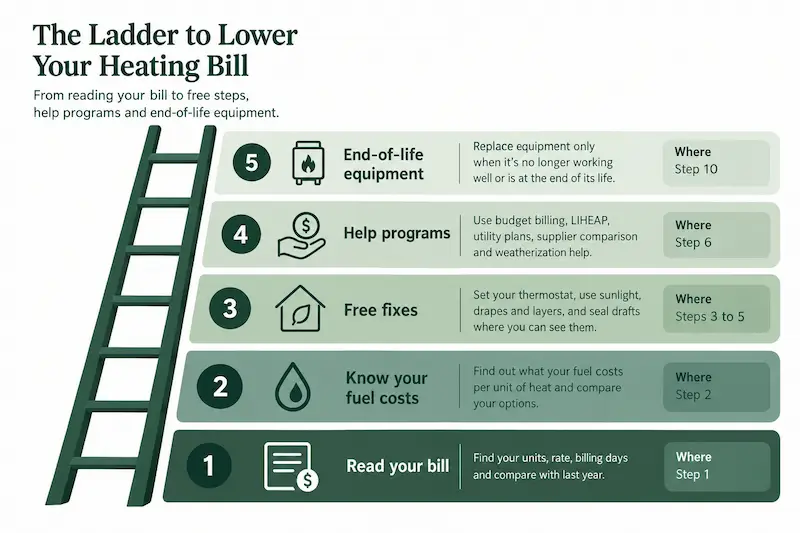
The ladder for how to save money on heating runs from reading your bill, to free fixes, to help programs, to equipment only at end of life.
This week
- Pull your last bill and find the units, rate and billing days.
- Fill in cost per 10,000 BTU for each fuel you can use.
- Set your thermostat back for eight hours.
- Seal the drafts you can see.
- Call your utility about budget billing and check your state’s LIHEAP page.
Checked October 27, 2026. SustainCents plans to update this page after each EIA winter outlook release through March.
Heating Cost FAQ
It depends on your fuel, climate and home. DOE says a thermostat setback can save up to 10% a year on heating and cooling, an upper bound. ENERGY STAR’s model averages 15% on heating and cooling from sealing and insulating one modeled home. Treat them as separate estimates, not a total.