Every item you throw away was bought at some point, and the money went with it. Spoiled leftovers, a gadget bought for a single recipe, and a cheap item replaced for the third time all show up on a bank statement as well as in the trash. That overlap is why zero waste living on a budget is a workable idea, and why it needs some care.
Some waste-reduction habits save money reliably because they prevent purchases. Others mainly reduce waste and leave your spending about where it was. A few cost more than the disposable option they replace. Which category a habit falls into depends on local prices, what you have access to, how often you would use the item, how long it lasts, and how your household lives.
You do not need a starter kit of glass jars, stainless steel containers and bamboo everything. This guide covers 17 practical strategies, then shows how to test whether a swap pays for itself and how to run a 30-day audit of your own spending. The strategies are potential ways to save, not guaranteed savings. The aim is to help you make sound financial decisions that also happen to produce less waste. If you’re new to this approach, our beginner’s guide to a zero-waste lifestyle explains the broader principles behind getting started.
Can Zero-Waste Living Actually Save Money?
Sometimes, and the difference comes down to what the change does. Zero waste is best understood as an aspiration: the goal is to prevent and minimize waste, not to produce literally none. Everything in this article applies equally if you think of yourself as a low-waste household, a frugal one, or simply someone who dislikes throwing things out. You do not have to follow a strict lifestyle to benefit.
A change saves money when it stops you from buying something you did not need to buy. It tends not to save money when the fix is a new product. The approach used throughout this guide is a sequence:
- Find the waste. What is being discarded, replaced, overbought or bought again and again?
- Identify the cost. How much money is attached to it?
- Try the simplest intervention first. Buy nothing, use what you own, repair, borrow, buy secondhand, change quantities or improve storage.
- Evaluate paid alternatives. Only then look at reusables, refills, bulk, concentrates, DIY or more durable products.
- Measure the result. Net financial change equals spending avoided minus additional spending.
It Can Save Money and Reduce Waste
The clearest wins are the ones where waste and spending are the same thing. Food that is thrown out is money that was spent on groceries. The U.S. Environmental Protection Agency says that buying and preparing only what is needed saves grocery money, and its guidance on preventing wasted food points to simple steps like grocery lists and taking inventory of what you already have.
The same logic applies beyond the kitchen. Using a product you already own, repairing something instead of replacing it, borrowing a tool for a one-off job, and skipping a purchase you did not need all remove a cost entirely. None of them requires buying anything first.
It Can Reduce Waste Without Clearly Saving Money
Some choices are good at reducing waste but are roughly cost-neutral, or occasionally more expensive. A reusable item that replaces something very cheap may take a long time to pay for itself, or never do so if it is lost, damaged or rarely used. A refill system may be priced about the same as buying a new bottle. Recycling and composting keep material out of the trash, but they rarely lower your household bills.
None of this makes those choices wrong. It means the reason to make them is waste reduction, and that is a different benefit from savings. Keeping the two separate helps you avoid justifying a purchase with a financial argument that does not hold.
It Can Save Money Only Under Certain Conditions
Bulk buying, secondhand shopping, DIY, concentrated products and durable goods can all save money, but none of them does so automatically. The outcome depends on a handful of variables:
- How much of what you buy you actually use
- How often you use it
- How long it lasts
- What extra costs come with it, such as transport, storage, repairs, cleaning or your time
The sections below show how to put numbers on each of these.
17 Ways to Save Money With Zero-Waste Living
1. Buy Less When You Don’t Actually Need Something
The most reliable way to cut both waste and spending is to skip a purchase. This is also a core principle of frugal living tips for low-income households, where reducing unnecessary spending is often more important than finding new products to buy. When you do not buy something, you avoid the whole purchase price, and there is nothing to store, maintain or dispose of later.
A useful test for a non-urgent purchase is to name the specific problem it solves. If you cannot, or if you already own something that would do the job, the purchase probably is not needed. Impulse buys, duplicates and items bought “just in case” are the usual suspects. For items you need but do not use often, consider whether repairing what you have or borrowing would cover it.
Purchase frequency matters too. Something bought every few weeks, such as a single-use product or a small convenience item, adds up quietly. Spending on things you value and use is not wasteful. The target here is the purchase that gets little use and is bought out of habit.
2. Shop Your Home Before Shopping for New Products
Strategy 1 asks whether you need to buy something. This one asks a different question: do you already own something that can solve the problem?
Before a shopping trip, spend twenty minutes looking through the places where useful items collect. Check the pantry and freezer for ingredients you forgot about. Look through the cupboards for containers with matching lids, and go through cleaning supplies, tools and clothing. People often discover duplicates, half-used products and items that were bought for a purpose and never used.
The point is not to make do with something unsuitable. A jar with a working lid can replace a new storage container, and a worn T-shirt can become a cleaning cloth. Starting with what you already have is one of the simplest zero-waste habits for beginners. If the item you own does the job well enough, its replacement cost is zero.
3. Audit Your Food Waste Before Changing Your Grocery Habits
Before you change how you shop, find out what is actually being thrown away. For seven days, keep a running list of food you discard. For each item, note what it was, roughly how much, why it was discarded, and an approximate cost based on what you paid. Then mark whether the waste could reasonably have been prevented. Peels, bones and shells are usually not, while a forgotten bag of salad is.
This is a practical household exercise, not a scientific measurement. One week can be unrepresentative, so treat it as a snapshot. Its value lies in the pattern. You may find that you overbuy fresh produce, cook more than you eat, forget items at the back of the refrigerator, or buy quantities that do not match how many people eat at home.
Date labels are another common cause. The U.S. Department of Agriculture’s Food Safety and Inspection Service explains that, except for infant formula, dates on food are not an indicator of safety. They mostly describe when the manufacturer expects peak quality, so a passed date does not automatically mean the food should be thrown out. FSIS has a helpful page on food product dating. Quality, safety and spoilage are separate questions, and the same guidance notes that you should still check food for signs of spoilage before eating it.
4. Plan Meals Around Food You Already Have
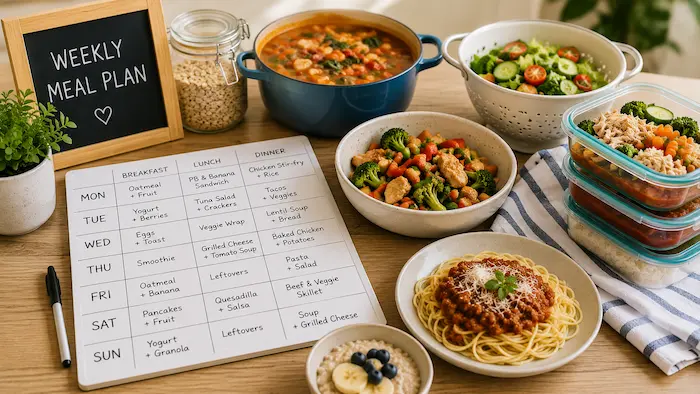
Once the audit shows what tends to go uneaten, use the food you already own as the starting point for the week. Take a quick inventory of the refrigerator, freezer and pantry, and build meals around whatever needs using soonest. Then buy only what fills the gaps.
The EPA lists making grocery lists, taking inventory of supplies and buying only what you need among the simplest ways to prevent wasted food at home. The saving comes from ingredients you do not have to buy again and food that does not have to be thrown out.
A plan does not have to be rigid. If your schedule changes often, sketch three or four flexible meals rather than assigning a recipe to every night, and leave room for a “use it up” meal. Strict weekly plans suit some households and frustrate others. What matters is that you buy with your current stock in mind.
5. Buy Food in Quantities Your Household Can Actually Use
A lower price per kilogram or liter only helps if you use what you buy. The relevant question is how much of the package your household will realistically eat before it goes off or is no longer wanted.
Household size, appetite and cooking habits all affect the answer. A large pack of fresh produce that suits a family of five may be mostly wasted by someone who lives alone. Perishability is the deciding factor: fresh fruit, leafy greens, bread and opened dairy are much less forgiving than rice, dried beans or canned goods. Storage space and how often you shop also count. If buying smaller amounts means an extra trip, weigh the transport and time against the waste you avoid.
This strategy is about right-sizing every food purchase. Strategy 13 covers the calculation for comparing bulk and standard packages.
6. Store and Freeze Food Before It Becomes Waste
Food that you cannot see tends to be food you forget. Keep older items toward the front, use clear containers where helpful, and keep a running list of what is in the freezer. Labeling containers with the date you stored them removes guesswork later.
Temperature matters for safety. FSIS advises keeping the refrigerator at 40°F or below and the freezer at 0°F or below, which is about 4°C and -18°C, and suggests using an appliance thermometer to check. Their food safety basics page explains more.
Freezing is a useful way to stop food from going to waste, but it does not improve quality. FSIS notes that frozen leftovers are safe indefinitely, though they can lose moisture and flavor over long storage. Some foods freeze poorly, and FSIS says salads made with mayonnaise are one example. Thawing in the refrigerator keeps food safe throughout; FSIS says that after thawing, the food should be used within 3 to 4 days or can be refrozen. A “freeze-by” date on a package is about quality as well; it is not a purchase or safety date.
If a food seems questionable, do not rely on a taste test. FSIS’s own guidance is to discard food when you are unsure.
7. Plan for Leftovers Instead of Treating Them as Extra Food
Leftovers are easier to eat when they were intended. If you regularly cook more than the household eats, adjust the amount you cook. If you cook extra deliberately, decide in advance what it will become, such as roasted vegetables that turn into a grain bowl or soup the next day.
Handling matters. According to the USDA, perishable food should go into the refrigerator within two hours of being taken out of the oven or refrigerator, or within one hour when temperatures are above 90°F. FoodSafety.gov recommends storing leftovers in small, shallow containers so they cool faster. FSIS says leftovers can be kept in the refrigerator for 3 to 4 days, and if you will not eat them in that time, freeze them within it. When reheating, bring leftovers to 165°F.
These are United States guidelines. Other countries publish their own, and readers elsewhere should check their national food-safety agency.
8. Repair Before Replacing When the Numbers Make Sense
Repair can be the cheapest option, but only when the numbers work. Compare the cost of the repair, divided by the additional time you expect to get from the item, with the cost of the replacement divided by its expected life.
Here is a hypothetical illustration. Suppose a repair costs $40 and you expect it to extend the item’s life by about two years, or $20 per year. A replacement costs $120 and you expect it to last about five years, or $24 per year. The two are close, so quality, reliability and how much you like the item might decide the matter. If the repair were $90 for one more year, replacement would clearly be cheaper.
Also consider parts availability, labor, warranty and how often you use the item. And be careful about what you attempt yourself. Electrical, gas, structural and similar repairs can be hazardous, and for those a qualified professional is the right choice.
9. Extend the Useful Life of Clothing and Household Items
Repair fixes something that has failed. Extending useful life is about preventing the failure. It covers following care instructions, sewing on a loose button before it falls off, storing items properly, rotating what you wear and use so wear is spread out, and cleaning and maintaining what you own.
Every additional use lowers the cost per use, but only if the item is actually used. A well-cared-for coat that sits unworn does not deliver value. Avoid assuming that a given product will last a set number of years. Lifespans depend on the product, how it is used and how it is cared for.
10. Buy Secondhand When New Is Not Necessary
Secondhand is often a good route for clothing, furniture, books, tools, household goods and some equipment. The comparison to make is total acquisition cost: the purchase price, plus any cleaning, repairs or missing parts, plus transport and time spent searching, minus the value of any return or warranty.
It is not always cheaper. Some secondhand items are priced close to new, and a low-priced new item may beat a secondhand one after you factor in condition and effort. Condition and expected remaining life matter as well. For items where safety is a consideration, such as child car seats and helmets, check the manufacturer’s or safety authority’s guidance before buying used. Where possible, test electrical items before you commit.
11. Borrow, Share or Rent Items You Rarely Use
The question to ask is how often you would really use the item if you owned it. A ladder needed once a year, a party tent, camping equipment or a specialty kitchen appliance may be used only a handful of times over many years.
If renting is an option, a quick break-even helps. If an item costs $150 to buy and $25 to rent for each use, buying pays off after six rentals ($150 ÷ $25), before considering storage, maintenance and the chance you will use it more or less than expected. That is a hypothetical example, not a real price.
Borrowing from friends, neighbors, tool libraries or community groups costs less than renting, though availability varies. It is not always the cheaper choice: frequent use, inconvenient return trips or damage fees can shift the answer.
12. Use Reusable Items You Already Own Before Buying New Ones
If you already have bags, bottles, cups, containers, towels or cloths that work, you do not need new ones. If you do need to buy something, our guide to the best reusable products for beginners focuses on practical options worth considering. A new item labeled “sustainable” is still a new purchase, with its own cost.
Old tote bags, a water bottle from a few years ago and jars or tubs you already use for storage all perform the same job. The financial case for a reusable item comes mainly from replacing a recurring disposable purchase. If you already own a reusable item, that case is settled.
Reusables do carry small costs. They need washing, they get lost, and eventually they wear out. Factor those in when comparing, but do not replace a working item for cosmetic reasons.
13. Compare Bulk Purchases by Usable Unit Cost
Bulk buying often looks cheaper on the label, but the label price is not the same as the price of what you actually use. A useful measure is the usable unit cost:
Unit cost = total purchase price ÷ usable quantity
Usable quantity is what your household eats, uses or consumes, not what is in the package. Here is a hypothetical example. Prices are invented for illustration.
| Large box | Small bag | |
| Price | $8 | $3 |
| Package size | 1 kg | 250 g |
| Sticker price per kg | $8 | $12 |
| Amount your household eats before the rest spoils | 250 g | 250 g |
| Usable unit cost per kg | $32 | $12 |
| Total spent | $8 | $3 |
The large box has the lower sticker price per kilogram, yet it costs more than twice as much per kilogram of food you eat. If some of the surplus could be frozen and eaten later, the numbers would change, so adjust for what is realistic in your household.
Bulk buying tends to work best for shelf-stable items you use steadily, such as rice, dried beans or oats. Other factors to weigh include storage space, membership or transport costs and minimum quantities. Not everyone has a bulk store nearby, and that is not a barrier to reducing waste.
14. Reduce Recurring Convenience Purchases When the Trade-Off Makes Sense
Small, frequent purchases are easy to overlook. Packaged convenience foods, disposable food-service items, individually wrapped products and bottled drinks all fall into this category.
Consider a hypothetical: a $3 item bought every workday for 50 weeks of the year adds up to about $750 ($3 × 5 × 50). Whether that is worth it depends on the value you get. Convenience has real worth, particularly when time, work, caregiving, health, accessibility or transport are constraints. Nobody should feel guilty for paying to make life easier.
A practical approach is to pick one or two recurring purchases where the convenience is not doing much for you and try an alternative there. Bottled water is a common example, but only where tap water is reliably safe to drink. In places where it is not, the calculation is different, and local water authority guidance applies.
15. Evaluate Refillable and Concentrated Products Before Buying Them
Refills and concentrates are sometimes cheaper and sometimes not, so compare prices per usable amount instead of assuming.
For a refillable product, use the break-even formula from later in this article. Suppose, hypothetically, a refillable dispenser costs $18, a refill costs $4 and a standard bottle of the same size costs $5. Each refill saves $1, so the dispenser breaks even after 18 refills ($18 ÷ $1). If refills only ship with a $6 delivery charge, or you have to travel to buy them, the savings could disappear.
Concentrates need a similar check. Compare the price per diluted, ready-to-use amount, following the dilution instructions on the label, and consider where you will store the product. A concentrate that is used slowly may take a long time to justify its price.
16. Make DIY Alternatives Only When the Full Cost Is Worth It
DIY is cheaper only when the total cost, including ingredients, equipment, containers, energy, storage and any failed attempts, is lower than the alternative. Then there is your time.
If homemade saves $2 per batch and each batch takes 30 minutes, you are effectively earning $4 per hour ($2 ÷ 0.5 hours), a hypothetical figure. Some people enjoy the process and would happily make it for that, while others would not. The right answer differs by household.
DIY works best for simple items made with inexpensive ingredients you already use, such as cooking from scratch. For another practical starting point, see these zero-waste bathroom swaps you can make without turning your bathroom into a collection of specialty products. Be cautious with cleaning products. Some chemicals produce hazardous fumes when combined, so follow product labels and reliable safety guidance rather than experimenting.
17. Choose Durable Products When the Higher Upfront Cost Can Be Justified
A more expensive item can be the better financial choice when it lasts long enough and you use it often enough. Evaluate it by dividing the total cost by the realistic number of uses, as shown in the next section.
Price does not guarantee durability. Look for evidence: repairability, availability of replacement parts, warranty terms, manufacturer documentation and long-term owner reviews. A warranty is a useful signal but not a promise of lifespan. If a cheaper version has already failed for you, that is real information about your use case.
Frequency of use decides most cases. A durable product used daily can outperform a cheaper one quickly. The same item used twice a year may never repay its extra cost.
How to Calculate Whether a Zero-Waste Swap Is Worth It
Start With Cost Per Use
The simplest test for any purchase is:
Cost per use = total relevant cost ÷ realistic number of uses
Here is a hypothetical comparison. A $30 pair of boots worn about 40 times costs roughly $0.75 per wear. A $60 pair worn about 150 times costs roughly $0.40 per wear. The more expensive pair wins, but only if the 150 uses is realistic. Use an honest estimate, based on how often you have used similar items, not an optimistic one. Rounded figures are enough, since the underlying assumptions are uncertain.
Calculate a Simplified Break-Even Point
For a reusable item that replaces a disposable, the break-even formula is:
Break-even uses = initial reusable cost ÷ (disposable cost per use − reusable ongoing cost per use)
Here is a hypothetical example: a reusable item costs $20, the disposable alternative costs $2 per use, and the reusable option costs $0.25 per use to maintain, for example in washing.
$20 ÷ ($2 − $0.25) ≈ 11.4 uses
Under these simplified assumptions, the reusable option reaches its estimated break-even point at approximately 12 uses.
This is a simplified hypothetical illustration, not a real product comparison. In practice, break-even can differ because of maintenance, washing, replacement, lifespan, transport and storage. The formula only works when the disposable costs more per use than the reusable’s ongoing cost, since otherwise the denominator is zero or negative and the reusable never pays for itself.
Include Costs Beyond Purchase Price
Purchase price is only part of the picture. Depending on the item, the relevant extras can include:
- Maintenance and cleaning, including water, detergent or energy
- Refills and replacement parts
- Shipping and travel to buy it
- Storage space
- Replacement if it breaks or is lost
Include only the costs that materially change the answer. Adding irrelevant ones just complicates the comparison.
Compare Useful Life and Durability
Two products at the same price can deliver very different value if one lasts twice as long. Expected lifespan is an estimate, not a guarantee, so treat it with caution and look for evidence such as warranty terms, repair options and user reviews. If a product costs more and its extra life is uncertain, factor in the possibility that it fails early.
Consider Time and Effort
A financial saving is only worth having if it is worth your effort. Washing, refilling, traveling to a store, making something from scratch and hunting for secondhand deals all take time. Households value time differently, depending on schedules, energy and caregiving responsibilities. There is no universal right answer, only what fits your circumstances.
Know When Buying Nothing Wins
Many of the calculations above compare one purchase with another. But the strongest financial position is often to compare a purchase with no purchase at all. If something you already own solves the problem, its cost is already paid. If you can borrow it, wait or do without it for now, you avoid the entire price, plus storage and maintenance.
Before you buy a reusable, refill or new sustainable item, ask whether the problem it solves is one you actually have. If you already own a working version, buying nothing beats every other option.
When Zero-Waste Choices Can Cost More
Several common patterns can push spending up:
- Buying sustainable products you did not need. A new set of containers or bags purchased for their look, when you already own something suitable, is added spending.
- Replacing functional items too early. Discarding something that still works to switch to a “better” version wastes both the item and its replacement cost.
- Overbuying in bulk. Stock you cannot use before it spoils or that ties up money and space.
- DIY without counting the full cost. Ingredients, equipment, failed attempts and time can outweigh the saving.
- Paying more for refills. Some refill systems cost more per unit than a standard product.
- Traveling farther for lower-waste options. Fuel, fares and time can exceed any price advantage.
- Choosing expensive alternatives regardless of use. A costly item that sits unused delivers little.
A choice can reduce waste without being cheaper. That is fine, as long as you are clear about which benefit you are paying for. Financial benefit and waste-reduction benefit are separate, and it is reasonable to accept a higher cost for the second. It is less reasonable to assume it comes with the first.
What About Recycling and Composting?
Recycling and composting matter for waste reduction, but they are not automatically money-saving. Putting an item in a recycling bin does not return the purchase price to you, and composting does not lower your grocery bill. In some places, waste collection is charged by volume or type, and composting or recycling services may carry fees, while in other areas they are free or unavailable. Rules on what can be recycled vary by municipality, so follow your local authority’s guidance, not general assumptions.
Prevention sits earlier in the chain. In the EPA’s Wasted Food Scale, preventing food from going to waste is the most environmentally beneficial option. The EPA also notes that the scale does not consider economic and social factors, which is a useful reminder that environmental ranking and household savings are different measures. The Wasted Food Scale is a U.S. framework for food specifically.
The 30-Day Zero-Waste Savings Audit
A month is enough to test which changes actually help your household. The steps below are a guide, not a rigid protocol.
Before You Start: Establish a Simple Baseline
If you have records, review one to three months of spending in the categories most relevant to waste:
- Groceries
- Disposable products
- Household supplies
- Replacement purchases
- Convenience purchases
You do not need perfect records. Bank or card statements and receipts are enough to find a rough monthly figure for each category.
Choose Simple or Detailed Tracking
Simple tracking covers four things: baseline spending, spending avoided, additional spending and food discarded.
Detailed tracking adds repairs, borrowing, secondhand purchases, reusable products bought, disposable purchases avoided, food waste, time spent and unexpected costs.
Pick the level you will stick with. A simple record kept for 30 days is more useful than a detailed one abandoned after a week.
Week 1: Find Waste That Costs Money
Look for spending tied to items that were unnecessary, duplicated, replaced too early or bought repeatedly as disposables. The goal is to identify the waste and estimate its cost, without changing much yet.
Week 2: Focus on Food
Run the seven-day food-waste log from Strategy 3. Track unused ingredients, leftovers that went uneaten, spoiled food, overbuying and package sizes that did not match how much you eat.
Week 3: Reuse, Repair and Borrow
Try the no-cost and low-cost fixes before buying anything. Use what you own, repair what is repairable, and borrow what you rarely need. Record what you avoided buying.
Week 4: Evaluate Paid Alternatives
Now that you know where the real problems are, evaluate reusable products, refill systems, bulk purchases, concentrates, DIY and durable products using cost per use and break-even. Buy only if the calculation supports it.
Calculate the Net Financial Change
The final calculation is:
Net financial change = spending avoided − additional spending
Keep the terms distinct. Baseline spending is what you normally spend. Spending avoided is what you did not spend because of your changes. Additional spending is money spent on new items, refills or fees. The net change is the difference between the last two, not the gross amount avoided.
| Item (hypothetical) | Amount |
| Spending avoided (skipped purchases, less food discarded) | $60 |
| Additional spending (reusable containers, refill costs) | $25 |
| Net financial change | $35 |
The illustration uses invented figures. Do not treat gross spending avoided as savings if new costs came with it. Household spending also changes for reasons unrelated to your experiment, such as price changes, guests, travel or illness, so avoid attributing the whole change to one cause.
Decide What to Keep
For each habit, consider financial value, waste reduction, practicality, convenience, time, effort and personal priorities. Keep what fits your life and drop what does not. There is no need to score habits numerically. A habit that saves little but reduces waste and takes no effort can be worth keeping, and one that saves a few dollars but is a chore may not be.
Conclusion
Zero-waste living is not automatically cheaper. It saves money when it prevents unnecessary spending, and it costs money when it becomes a reason to buy more. That is why the order matters: start by buying less and using what you own, then move to food-waste reduction, repair and borrowing, which cost little and often save the most.
When a paid alternative looks appealing, judge it by total cost, cost per use and break-even, not by how sustainable it appears. A simple 30-day audit can show which changes actually work for your household and which are only good ideas in theory.
The goal is not to buy the perfect zero-waste products. It is to prevent unnecessary consumption and make better use of what you already have.
Frequently Asked Questions
Yes. The strongest starting points cost nothing: use what you own, reduce food waste, repair, borrow and skip unneeded purchases. Special products are optional and only worth buying if the numbers work.