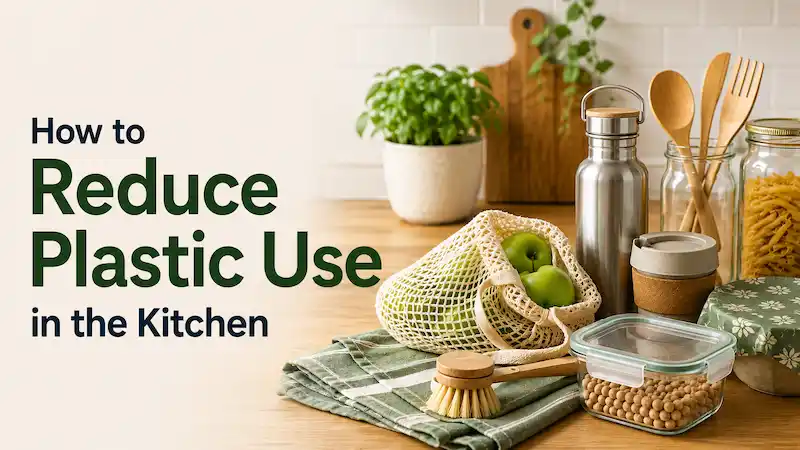
The kitchen is usually the most plastic-heavy room in the house. Food storage containers, cling wrap, sandwich bags, non-stick pans, cutting boards, sponges, and the produce bags from your last grocery run all add up fast.
If you’ve tried to “go zero waste” before and burned out after a week, this guide takes a different approach. Instead of a long checklist of things you should be doing, it starts with the swaps that matter most, for your health, the planet, and your wallet, and works outward from there. You don’t need to replace everything in your kitchen this weekend. A few well-chosen changes go a long way.
For a broader look at cutting plastic across your whole home, see SustainCents’ complete guide to cutting plastic everywhere.
Why the Kitchen Is a Good Place to Start
Not all plastic exposure is equal. The kitchen is where plastic most often meets heat, oil, acid, and time, and each of those speeds up the transfer of chemicals and particles from plastic into food.
Take bisphenol A (BPA), a chemical used in some plastics and can linings. The FDA currently maintains that BPA is safe at the levels typically found in food, based on its ongoing safety reviews, and the agency is separately reassessing certain phthalates used as plasticizers in food packaging. Regardless of where that regulatory science lands, one point isn’t disputed: heat increases how much migrates from plastic into food. That’s why the highest-impact swaps in this guide are the ones involving your microwave, your kettle, and your stovetop, not the plastic items that just sit in a drawer.
It’s also worth saying plainly: microplastics research is still young. Scientists can now measure particles that were invisible a decade ago, but they’re still working out what that actually means for human health. You’ll see specific findings below. Treat them as reasons to make thoughtful swaps, not reasons to panic.
Start Here: The Highest-Impact Swaps
If you only make a few changes, make these. They’re the ones most tied to heat exposure, the most-studied materials, or the easiest wins for your budget.
| Common Item | Swap For | Why It Matters Most |
| Plastic wrap for covering food | Reusable lids, plates, or beeswax wrap | Cuts a recurring purchase immediately, low cost to start |
| Plastic containers you microwave | Glass or ceramic | Heat is when the most chemical migration happens |
| Single-use bottled water | A reusable bottle | Bottled water has measurably higher plastic particle counts than tap |
| A scratched-up plastic cutting board | Wood or bamboo | Worn plastic sheds the most particles directly into food |
| Plastic mesh tea bags | Loose-leaf tea or confirmed plastic-free bags | Steeping in near-boiling water is a worst case for particle release |
The sections below explain the reasoning behind each one, plus other kitchen areas worth tackling once you’ve knocked out this list.
Rethinking Food Storage: Wrap, Bags, and Containers
Plastic wrap and sandwich bags are usually the easiest place to start because they’re consumable. Every roll you don’t buy is a small, permanent win.
- Beeswax wrap or a reusable silicone lid instead of plastic cling film for covering bowls or half-cut produce.
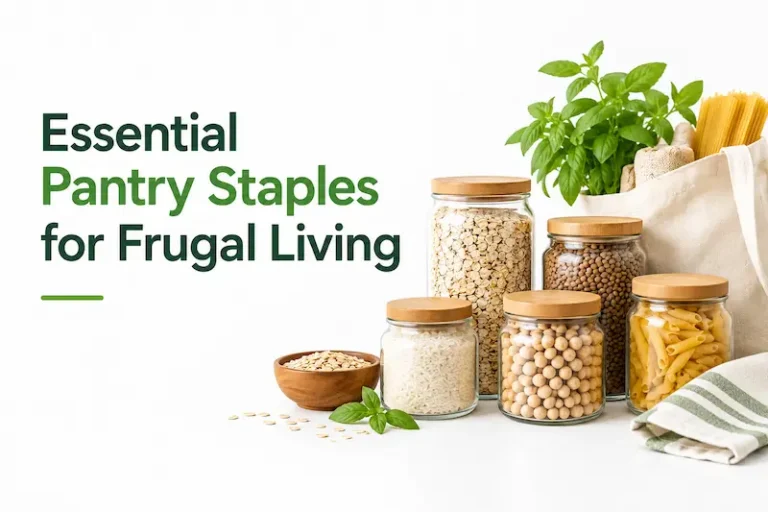
- Glass jars you already have (from pasta sauce, pickles, or jam) work as free food storage. It’s one of the cheapest upgrades available, since you’re reusing something you’d otherwise recycle or toss.
- Stainless steel containers for lunches and freezer storage, since they don’t stain, hold odors, or degrade with repeated heating and washing.
- Silicone bags or stretch lids as a reusable alternative to zip-top bags. Worth a quick caveat: silicone is technically still a synthetic polymer, but it’s generally considered more heat-stable and less prone to shedding particles than typical plastic, according to consumer research from Homes & Gardens. It isn’t a perfect, plastic-free material, but it’s a meaningful step down in risk.
For a deeper comparison of specific products and price points, SustainCents has a full breakdown of budget-friendly swaps for single-use plastic.
What You Cook With Matters: Cookware and Utensils
Non-stick cookware. Most non-stick pans are coated with PTFE (often sold under the brand name Teflon), a type of PFAS, or “forever chemical.” These compounds don’t break down easily and have been linked to concerns like thyroid and hormone disruption, according to the San Francisco Environment Department. A scratched or worn coating raises the risk of chemicals leaching into food, and a “PFOA-free” label doesn’t guarantee a pan is free of PFAS altogether, since it may still contain PTFE. Minnesota became the first state to ban the sale of PFAS-coated non-stick cookware starting in 2025, with several other states moving toward similar restrictions, according to reporting from NC Health News. If you want to keep using non-stick, retire it once the surface is scratched. If you’re ready to replace it, stainless steel and cast iron are durable, PFAS-free options.
Cutting boards. Newer research suggests plastic cutting boards shed microplastics directly into food as a knife scores the surface, with one analysis cited by TIME estimating 100 to 300 particles released per knife stroke. The science on what that means for human health is still early, but the fix is simple and permanent: switch to a wood or bamboo board, especially once your current plastic one is visibly scored.
Utensils. Plastic spatulas and spoons are the items most likely to sit directly in a hot pan. Wood, bamboo, or stainless steel utensils avoid that heat-plus-plastic combination entirely, and they tend to outlast plastic ones anyway.
Drinks Without the Plastic: Water, Coffee, and Tea
Bottled water. Researchers from Columbia and Rutgers found that a typical liter of bottled water contains roughly 240,000 detectable plastic fragments, about 90% of them nanoplastics too small to see, according to Columbia University’s Mailman School of Public Health. That’s 10 to 100 times higher than earlier estimates, mostly because older methods couldn’t detect particles that small. A reusable bottle filled from a filtered tap is the simplest fix, and it’s also one of the cheapest swaps on this list over time.
Coffee pods. Single-serve pods are convenient but rarely recycled in practice, even when labeled recyclable. In 2024, Keurig agreed to pay a $1.5 million penalty after the SEC found the company had misled the public about how recyclable its K-Cup pods actually were, per NPR. If you use a pod machine regularly, a reusable filter pod is a low-cost way to keep the convenience without the packaging waste.
Tea. This one surprises people. A widely cited study from McGill University, published in Environmental Science & Technology and indexed on PubMed, found that steeping a single plastic mesh tea bag at brewing temperature released approximately 11.6 billion microplastics and 3.1 billion nanoplastics into one cup. Not all tea bags contain plastic, but many “silky” pyramid-style bags do, and some paper bags use a plastic layer to seal the seams. Loose-leaf tea with a reusable infuser sidesteps the issue entirely, or check the packaging for bags specifically labeled plastic-free.
Smarter Grocery Shopping Means Less Plastic to Begin With
The easiest plastic to deal with is the plastic that never enters your kitchen. Bringing reusable mesh or cloth bags for produce, buying loose fruits and vegetables instead of pre-packaged ones, and using bulk bins where available all cut down on what you have to store, recycle, or throw away later. This is a big enough topic on its own that SustainCents has a dedicated walkthrough: plastic-free strategies for the grocery store.
The Recycling Question: What Actually Gets Recycled
This is where a lot of well-intentioned effort gets wasted. Plastic wrap, bread bags, and other plastic film cannot go in your curbside recycling bin, even though the material itself is technically recyclable. It tangles sorting equipment and can shut down processing facilities, according to the Association of Plastic Recyclers. Instead, clean, dry plastic film needs to go to a store drop-off bin, commonly found near the entrance of major grocery chains.
The numbers back up why reducing matters more than recycling here. The EPA’s most recently published data shows that in 2018, Americans generated about 4.2 million tons of plastic bags, sacks, and wrap, and only around 10% of that was recycled, per the EPA. In practice, that means the plastic wrap and bags you avoid buying in the first place do more than the ones you carefully sort afterward.
Small Swaps That Add Up
A few smaller changes round out a lower-plastic kitchen without requiring much effort:
- Dish sponges. Standard kitchen sponges are usually made from synthetic foam (a plastic polymer) that sheds microplastics with heat and friction, per NBC News Select. Loofah, cellulose, or coconut-fiber sponges are widely available plastic-free alternatives.
- Dish soap. Concentrated refills or bar soap reduce how many plastic bottles you buy over time.
- Trash bags. If you’re already composting food scraps, you’ll naturally need fewer plastic liners.
Budget-Friendly Ways to Start
Reusable products usually cost more upfront than a roll of plastic wrap or a sleeve of sandwich bags. That’s a real trade-off, not something to gloss over. A few ways to manage it:
- Use what you already own first. Empty jars, existing containers, and old dish towels can cover a lot of ground before you buy anything new.
- Replace items as they wear out, rather than all at once. A cracked plastic container or a scratched cutting board is a natural, low-pressure moment to switch materials.
- Prioritize the swaps that eliminate a recurring purchase (plastic wrap, sandwich bags, bottled water) over one-time replacements, since those pay for themselves the fastest.
For a full plan on sequencing these changes without straining your budget, see SustainCents’ guide to starting a plastic-free lifestyle without overspending.
Your Next Steps
You don’t need a plastic-free kitchen by next week. Pick one or two swaps from the table above, ideally ones tied to heat (your microwave routine, your cutting board, your kettle), and start there. Once those feel automatic, move on to the next item.
For more ideas beyond the kitchen, SustainCents has 25 additional low-effort swaps for the rest of your home.