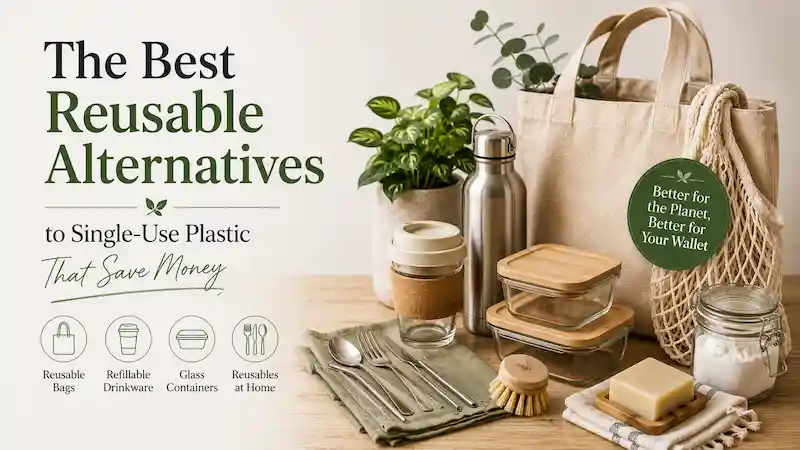
Most articles about reducing plastic lead with guilt. This one leads with math.
Reusable products get pitched as the responsible choice, which is true, but it undersells them. A lot of these swaps are also just better financial decisions, the same way buying a coffee maker beats a daily latte run. The trick is knowing which swaps actually pay for themselves quickly and which ones are a slower burn. Below is a breakdown of the reusable products worth your money, with real numbers behind each one.
If you want the full case for why plastic reduction matters beyond your wallet, start with How to Reduce Plastic Use: The Ultimate Guide to Cutting Plastic Waste in Everyday Life. This piece is narrower on purpose: it’s about return on investment.
Why “Eco-Friendly” Doesn’t Have to Mean Expensive
The assumption that sustainable products cost more usually holds for the upfront price tag and falls apart over time. A stainless steel bottle costs more than a single plastic one. It costs far less than the plastic bottles you’d otherwise buy every week for years.
The other piece of this: plastic recycling doesn’t bail you out the way people assume. Only about 8.7% of plastic generated in the U.S. was actually recycled in 2018, the most recent year the EPA has comprehensive data for. Tossing a plastic container “for recycling” doesn’t mean it becomes a new container. Buying something durable once, instead of buying disposable versions on repeat and hoping they get recycled, tends to be the better bet on both fronts.
Kitchen and Food Swaps That Pay for Themselves
A reusable water bottle beats bottled water fast, often within days.
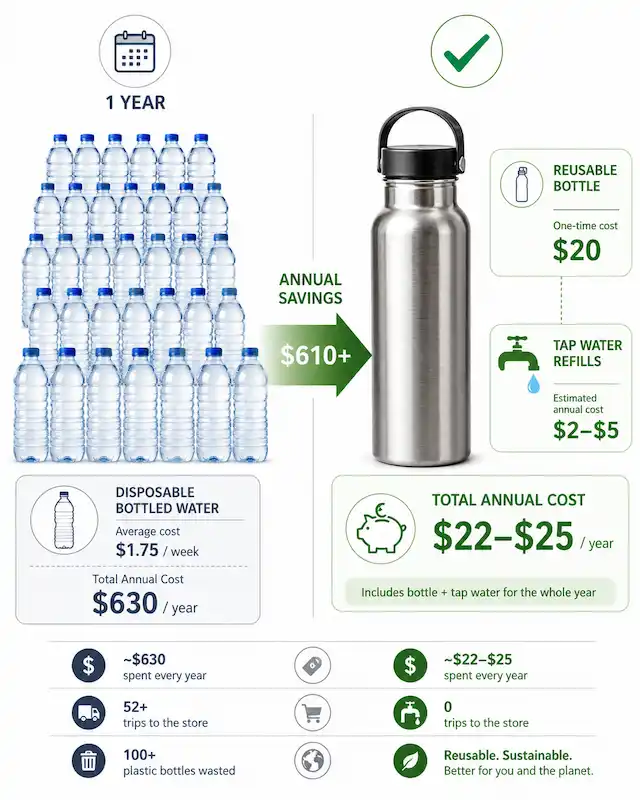
The International Bottled Water Association reported that Americans spent $49.9 billion on 16.2 billion gallons of bottled water in 2024, according to IBWA. Do the division and that works out to a little over $3 per gallon. Tap water, by contrast, runs about $6.64 per 1,000 gallons for water service alone, or roughly two-thirds of a cent per gallon, based on 2023 EPA WaterSense estimates; add sewer costs and it’s closer to a cent and a half per gallon.
Here’s what that gap looks like in practice. Someone who refills a bottle three times a day, roughly 205 gallons a year, would spend around $630 a year buying that water bottled. The same volume from the tap costs a few dollars a year. A $20 stainless steel bottle isn’t just cheaper long term. It’s cheaper within the first week if you were previously buying bottled water daily.
Bringing your own coffee cup earns a small, real discount.
Starbucks confirmed that customers who bring a clean, personal cup get a 10-cent discount on their beverage at participating U.S. and Canada locations, according to the company’s own press release. That’s not going to fund a vacation. Someone getting coffee three times a week picks up about $15.60 a year just from the discount, before counting any loyalty rewards. It’s a small, honest number, and it’s one of the few reusable swaps that pays you back the same day you use it.
Glass and steel containers avoid the replace-and-repeat cycle.
Plastic storage containers stain, warp, and eventually get thrown out, at which point most of them join that 91%-plus of plastic that isn’t actually recycled. Glass containers don’t degrade the same way, so you’re not restocking the same drawer every year or two.
Quick takeaway: The kitchen swaps with the clearest financial case are the ones tied to daily habits. Water and coffee, bought fresh every single day, are where the math adds up fastest.
Bathroom Swaps With Real Payback Periods
Menstrual cups typically pay for themselves within a cycle or two.
The average woman spends between $50 and $150 a year on tampons or pads, while a menstrual cup costs $20 to $40 and can last anywhere from six months to 10 years, according to Mayo Clinic Health System. Even at the low end of both ranges, a $20 cup replacing $50 a year in disposables pays for itself in under five months and then keeps paying off for years.
Safety razors get cheaper than cartridges fast, especially for frequent shavers.
Cartridge prices vary a lot by brand. In its own testing, Consumer Reports found replacement cartridges ranging from 60 cents for a basic two-blade option up to $5.62 for a premium five-blade cartridge. Someone replacing a mid-range cartridge every couple of weeks can easily spend $75 to $150 a year just on blades. A safety razor swaps that recurring cartridge purchase for a simple, replaceable blade that costs a small fraction of a cartridge, so the ongoing cost drops sharply once you own the handle.
Bar soap and shampoo bars skip the bottle without a real downside.
There isn’t a dramatic savings story here so much as a wash: a solid bar often lasts longer per use than its liquid equivalent in a plastic bottle, and you’re not paying for water weight in packaging you’re throwing away.
For more bathroom and personal care swaps beyond the cost angle, see 25 Easy Ways to Reduce Plastic Use at Home.
Shopping Swaps: Skip the Bag Fees
If you live somewhere with a bag fee, reusable totes have one of the fastest, most concrete payback periods on this whole list.
California requires stores to charge at least 10 cents per bag under its statewide carryout bag law, according to CalRecycle and the California Attorney General’s office. Colorado’s carryout bag fee was also set at a minimum of 10 cents per bag, per the Colorado Department of Revenue. Other cities and states run nickel-and-dime fees of their own. None of these numbers sound dramatic on a single trip. They add up over a year of weekly grocery runs.
Say you’d otherwise buy five bags a week at a dime each. That’s about $26 a year, gone, on bags you’d throw away anyway. A set of reusable totes, often $1 to $5 each, pays for itself within the first several trips and then just keeps working for years.
Reusable produce bags work the same logic on a smaller scale, and buying pantry staples in bulk with your own containers sidesteps packaging costs entirely on things like rice, oats, and flour. For the full rundown on smart shopping habits beyond the fee math, see How to Reduce Plastic Use While Grocery Shopping.
The Category Parents Underestimate: Cloth Diapers
Diapers don’t usually make it onto plastic-reduction lists, but disposable diapers contain plastic and the cost adds up fast. Disposable diapers typically run $0.22 to $0.33 each, which works out to roughly $960 to $1,200 a year per child, according to SoFi, citing EPA waste data on the category.
Cloth diapering has real upfront costs of its own, a starter stash plus extra laundry, and the total savings depend heavily on your setup and how many kids use the same stash. It’s worth running your own numbers here rather than trusting a one-size-fits-all savings claim, but the baseline disposable cost above gives you a real number to measure against.
Reusable vs. Single-Use: Which Costs More Over Time?
Looking at the upfront price alone can make reusable products seem expensive. The better comparison is the total cost over months or years. In most cases, disposable products require dozens or even hundreds of repeat purchases, while a reusable alternative continues delivering value long after its initial cost has been recovered.
| Product | Typical Reusable Cost | Typical Disposable Cost | Which Is Cheaper Long-Term? |
| Stainless steel water bottle | $15–$30 | Around $630/year if replacing daily bottled water | Reusable |
| Reusable coffee cup | $10–$25 | Disposable cups plus missed reusable-cup discounts | Reusable |
| Glass food containers | $25–$50 per set | Ongoing replacement of worn plastic containers | Reusable |
| Menstrual cup | $20–$40 | $50–$150 per year for pads or tampons | Reusable |
| Safety razor | $20–$40 | $75–$150 per year for replacement cartridges | Reusable |
| Reusable shopping bags | $1–$5 each | Repeated bag fees where applicable | Reusable |
The exact savings depend on your habits and local prices, but the pattern is remarkably consistent: reusable products usually require a higher upfront investment, while single-use products create recurring expenses that continue indefinitely. The items used every day, such as water bottles, shopping bags, and razors, typically reach their payback point the fastest because they replace purchases you would otherwise make again and again.
Reusable Swap Cost Snapshot
| Swap | Reusable Upfront Cost | Single-Use Ongoing Cost | Rough Payback Time |
| Stainless steel water bottle | $15-$30 | ~$3.08/gallon for bottled water (IBWA-based calculation) | Days to a few weeks of daily use |
| Reusable coffee cup or tumbler | $10-$25 | 10-cent discount per visit at Starbucks | Builds slowly; more of a long-term habit than a fast payback |
| Menstrual cup | $20-$40 | $50-$150/year on pads or tampons | Within the first one to two cycles |
| Safety razor plus blades | $20-$40 to start | $0.60-$5.62 per cartridge | A few months for frequent shavers |
| Reusable shopping bags | $1-$5 each | 5-10 cent bag fees where applicable | Within the first several shopping trips |
Quick Answers to Common Questions
Do reusable products actually save money, or is that a myth?
For the items on this list, yes, and the math holds up under real pricing. The catch is that not every reusable product pays back quickly. Some, like a reusable coffee cup, save you real money slowly rather than dramatically.
How long does it take for a reusable water bottle to pay for itself?
If you were buying bottled water daily, often just days to a couple of weeks, given the roughly 200-to-1 price gap between bottled and tap water.
Are menstrual cups actually cheaper than tampons?
Generally yes. A $20-$40 cup lasting six months to several years compares favorably to $50-$150 a year in disposable products, per Mayo Clinic data.
Is a safety razor cheaper than disposable razors long-term?
For anyone who shaves regularly, yes. Consumer Reports found cartridge prices ranging widely by brand, and the ongoing blade cost for a safety razor is a fraction of most cartridge prices.
Do reusable shopping bags save money?
Mainly in places with bag fees. If your area charges a nickel or dime per bag, a reusable tote pays for itself within a handful of trips.
Getting Started Without Overspending
You don’t need to buy every reusable product on this list at once, and honestly, you shouldn’t. Start with whichever swap matches a habit you already have every single day, since that’s where the payback is fastest. If you drink bottled water daily, that’s your first purchase. If you’re buying pads or tampons monthly, a menstrual cup is worth pricing out next.