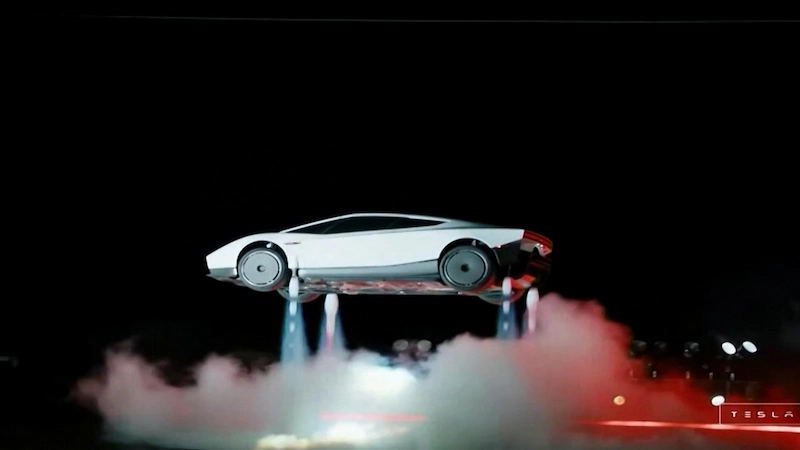
On October 15, 2026, Tesla livestreamed a reveal nine years in the making: a redesigned second-generation Roadster, co-developed with SpaceX, that climbed an inverted ramp, flipped through the air using cold-gas thrusters, and sailed over a lineup of parked Teslas before setting itself down on its wheels, as TechCrunch reported from the event. It’s a real car and a real demonstration. It is not, however, sustained or pilot-controlled flight in the way an aircraft flies, and Tesla still hasn’t said what the car will cost, whether its thruster-equipped trims will be street legal, or how much energy those airborne stunts actually use. If you’re hoping for a clean yes-or-no on whether this “flying car” is sustainable, the evidence so far only supports a conditional one.
Quick answer: Yes, Tesla’s “flying” Roadster is real. A cold-gas thruster and suction-fan system let an uncrewed prototype flip and leap over parked cars at an October 15, 2026 demonstration. It isn’t sustained aircraft-style flight, Tesla hasn’t announced a price or confirmed the thruster trims are street legal, and no energy-use figures exist yet to judge its environmental footprint.
Is Tesla Really Making a Flying Car?
What Tesla showed in Texas combines two separate systems, and keeping them apart matters. The first is a multi-mode suction system: fans mounted under the car pull air out from beneath it, creating downforce that Tesla says can hold the car against a vertical surface while stationary and upside down. Vehicle engineering chief Lars Moravy said on stage that the system can generate up to 2 g’s of downforce, and a technical breakdown of the demo from Trending Topics reported an on-screen readout of roughly 4,700 kilograms of force as the car climbed the ramp, plus details on how the car’s roughly 10 thrusters are arranged: several at the rear for forward push, the rest at the corners for lift and soft landings, with electric actuators fine-tuning them in the air.
The second system is the cold-gas thrusters themselves, which release stored compressed air, not combustion, through those nozzles to rotate and stabilize the car. At the event, the Roadster used them to flip off the ramp and leap over a Cybercab, Cybertruck, Semi, Model Y, and Model 3 before landing, a sequence Electrek documented in detail.
Two details temper the spectacle. The demo car had no driver; it was remotely operated, which Tesla has attributed to the noise and force involved. And Motor1 was careful to describe the maneuver as a controlled, tethered-style flip rather than proof of repeatable, pilot-controlled flight, noting that major performance claims remain unverified outside Tesla’s own demonstration. Not every version of the car does this, either. According to NBC News’s breakdown of the three trims, the entry Performance trim is “road-ready” with the suction system but no thrusters, the Thrust trim adds rear-mounted thrusters for acceleration, and the single-seat Rocket trim, invite-only, carries thrusters around the car’s perimeter and is the one capable of the full aerial routine shown on stage.
| Trim | Reservation (deposit, not final price) | Suction system | Thrusters | Tesla’s claimed 0-60 mph | Street-legal status |
|---|---|---|---|---|---|
| Performance | $50,000 | Yes | No | Under 1.6 seconds | Road-ready; not flagged as a concern in reporting |
| Thrust | $250,000 | Yes | Rear-mounted | Under 0.9 seconds | Unconfirmed |
| Rocket | Invite-only; no public price | Yes | Full perimeter (single-seat) | Under 0.59 seconds | Unconfirmed; pre-event reporting said not street legal |
All performance figures are Tesla’s own announced claims from the October 2026 reveal, not independently verified. Reservation amounts are deposits toward a purchase price Tesla has not announced.
Tesla Flying Car Price and Release Date
Here’s what buyers actually know after the reveal: nothing about final pricing. Tesla did not announce a purchase price for any Roadster configuration. What it reopened were reservations, which are deposits toward an eventual price, not the price itself. NewsNation’s report on the event put the Performance reservation at $50,000, down from the $200,000 figure Tesla had listed years earlier, while TechCrunch’s coverage of the reveal confirmed a $250,000 reservation for Thrust. Rocket has no public reservation price at all; it’s invite-only.
On production, Musk said the Roadster will enter production in 2028, nearly a decade after the car was first shown in 2017 with an original 2020 target that slipped repeatedly, including two postponements of this very reveal event (from April to October 1, then from October 1 to October 15 because of weather). That 2028 date is a target announced from a stage, not a confirmed delivery date. Just as unresolved: whether the thruster-equipped trims will be legal to drive on public roads. Reporting ahead of the event indicated the flying-capable version would not be street legal, and NewsNation’s coverage of the reveal itself confirms that question is still open: it remains unclear whether the car’s more dramatic features are cleared for road use.
How Does the Tesla Flying Car Work?
The suction system and the thrusters do different jobs. The fan-based suction system is the everyday performance feature, adding grip in corners and, more dramatically, letting the car cling to a vertical surface. The thrusters are the system most people mean when they say “flying.” They store compressed air and release it through nozzles aimed for forward push, lift, and soft landings, with electric actuators stabilizing the car mid-air. InsideEVs reported that Tesla’s engineers told Top Gear the air tanks can currently be refilled in two to six hours, with a goal of shortening that to around thirty minutes.
What this demonstrates is that the hardware works, at least once, on a remotely operated car at a controlled test site. What it doesn’t establish is sustained flight, repeatable performance on a public road, or a production-ready version of the system. Tesla hasn’t published independent test data, and there’s no indication that aviation regulators have been involved, since a compressed-air thruster system of this kind isn’t an aircraft and doesn’t operate in regulated airspace.
Can the Tesla Flying Car Be Sustainable?
This is where the marketing gets ahead of the evidence. Start with what’s missing: Tesla hasn’t disclosed how much battery energy its onboard compressor uses to refill the thruster tanks, or how a few seconds of airborne stunts compare, in energy terms, to a few seconds of ordinary acceleration. Without that figure, there’s no honest way to calculate whether “flight” mode meaningfully changes the car’s footprint, and this isn’t a number SustainCents is willing to invent.
What we can say comes from research on electric vehicles generally, which is not the same as research on this car specifically. A two-year life-cycle review by the Union of Concerned Scientists found that battery-electric cars generate roughly half the lifetime emissions of a comparable gasoline car, even after accounting for battery manufacturing, though that same research found that larger, longer-range battery packs, the kind the Roadster is expected to carry, can add as much as two-thirds more manufacturing-stage emissions than a smaller EV. That’s a real cost before the car ever leaves the factory, and it applies to the Roadster as an electric vehicle, not as a flying one. (The 200-kilowatt-hour battery figure attached to the Roadster in older reference material dates to the 2017 concept and hasn’t been independently reconfirmed for the car shown in October 2026.)
It’s also worth separating this from actual electric aviation. NASA’s own research into electric aircraft propulsion has found that current lithium-ion battery technology, which plateaus around 300 watt-hours per kilogram, falls well short of what’s needed for sustained powered flight, which is a large part of why real electric aircraft remain a research problem rather than a commercial product. The Roadster sidesteps that problem by not attempting battery-powered flight at all: it uses stored compressed air for a few seconds of lift, not an electric propulsion system built to keep a vehicle airborne. That makes it a far smaller engineering challenge than an electric plane, but it also means NASA’s aviation research can’t be used to judge the Roadster’s own energy use, because the two technologies aren’t doing the same thing.
Put plainly: there’s no published evidence that the thruster system is a meaningful environmental cost, and no published evidence that it’s negligible either. Until Tesla discloses real numbers, the responsible read is that the Roadster’s day-to-day sustainability case rests on the same factors as any EV, the battery’s manufacturing footprint and the electricity used to charge it, including whether that electricity comes from solar power, not on the thrusters, which remain an unquantified accessory.
Is the Tesla Flying Car Worth the Extra Cost?
Strip away the stunt and you’re left with a genuine six-figure decision built on incomplete information. You know the deposit amounts: $50,000 for Performance, $250,000 for Thrust, and an invitation requirement for Rocket. You don’t know the final price of any of them, whether that deposit is refundable, what insuring a thruster-equipped car might cost, or whether you’d legally be allowed to use the thrusters where you live. Those aren’t minor details for a car Tesla itself doesn’t expect to produce before 2028, from a company that has missed this vehicle’s production and reveal targets repeatedly since 2017.
If the flight capability is the reason you’re interested, it’s worth asking what you’d actually be paying for: a few seconds of airborne spectacle on a closed course, or everyday performance gains like sharper cornering grip from the suction system, which Tesla says comes on every trim. The practical transportation case for the thrusters specifically, as opposed to the car as a whole, hasn’t been made yet, because Tesla hasn’t said where or how owners would be allowed to use them. A responsible buyer would want final pricing, confirmed street-legal status, and production-spec numbers in hand before treating a reservation as anything more than a deposit on a promise, or making other sustainable purchasing decisions.
Tesla Flying Car FAQs
The hardware is real, and Tesla demonstrated it working on October 15, 2026, but it isn’t a flying car in the aircraft sense. It’s an electric sports car with cold-gas thrusters and a suction system that enabled a brief, remotely operated airborne stunt, not sustained or pilot-controlled flight.