Three Ways to Think About the Same Purchase
Imagine you’re replacing your coffee setup. You have a drip machine that still works. A pour-over kit would cost less per cup, reduce your reliance on paper filters, and take up less counter space. There’s also a model made from recycled materials.
From a financial standpoint, you’d want to know whether the switch actually reduces spending. From an ownership standpoint, you’d ask whether you need another brewing method when you already have one. From a waste perspective, you’d consider whether switching from a working appliance creates more waste than it prevents.
Same decision. Three completely different questions.
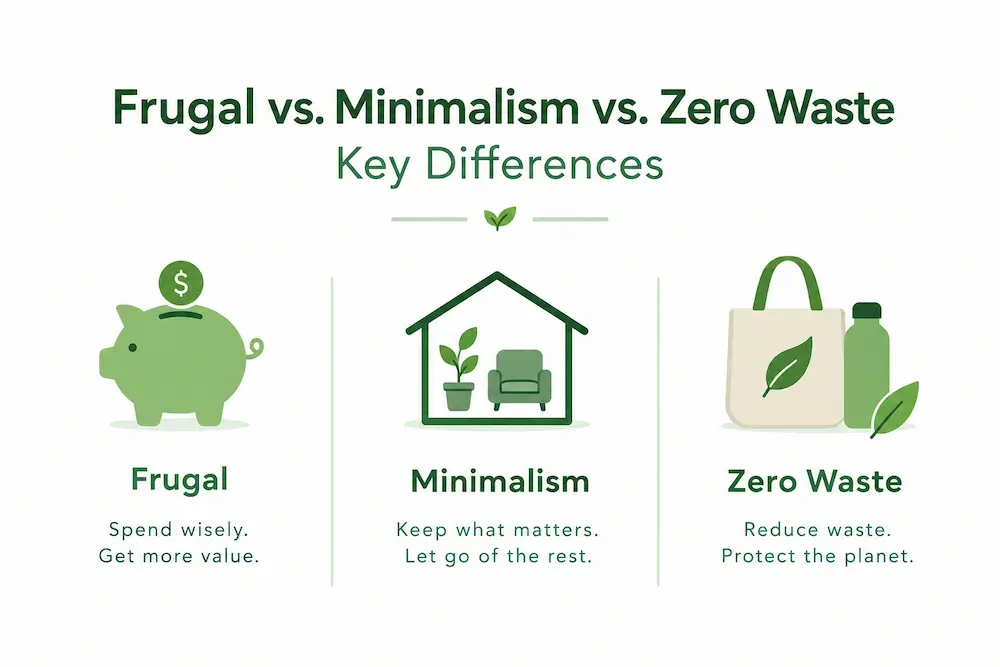
That’s the practical core of frugal vs. minimalism vs. zero waste. These aren’t competing lifestyles fighting for your loyalty. They’re different frameworks for evaluating the same consumption decisions, each asking something distinct:
Frugality asks: Is this financially worthwhile?
Minimalism asks: Does this add enough value to justify owning or consuming it?
Zero waste asks: Can I reduce the waste and resources associated with this decision?
Understanding the distinction matters because the frameworks can agree on a decision, conflict sharply, or arrive at the right answer for entirely different reasons. Most people operate somewhere across all three, making choices that consider cost, clutter, and consequence without committing to any label. This comparison is designed to help you do exactly that.
Frugal vs. Minimalism vs. Zero Waste at a Glance
| Frugal Living | Minimalism | Zero Waste | |
| Primary focus | Financial value | Intentional ownership | Waste prevention and resource use |
| Core question | Is this financially worthwhile? | Does this add enough value to deserve my money, space, and attention? | Can I reduce the waste and resources associated with this decision? |
| Best suited to | Improving spending decisions and long-term financial value | Simplifying possessions and reducing unnecessary consumption | Reducing waste, extending product life, and lowering resource use |
| Buying less | When it avoids a poor financial decision | When it reduces clutter or mental load | When it prevents unnecessary production and disposal |
| Using what you own | Yes, avoids unnecessary spending | Yes, avoids an unnecessary new purchase | Yes, avoids new production and its resource cost |
| Repair / reuse | When repair costs less than replacement | When it preserves something already valued | Prioritized to extend product life |
| Secondhand | When it offers better value than new | When it avoids an unnecessary purchase | When it reduces demand for new manufacturing |
| Potential downside | Can produce false bargains or penny-pinching on the wrong things | Can be used to justify constant upgrading rather than owning less | Can encourage buying “sustainable” products that aren’t actually needed |
All three overlap in meaningful ways and can be combined. They also produce different answers when cost, clutter, and waste prevention don’t point in the same direction.
What Is Frugal Living?
Frugality Is About Value, Not Just the Lowest Price
A common misreading of frugality is that it means always buying the cheapest option. It doesn’t. The difference between frugal and cheap comes down to value, not simply the lowest upfront price. The cheaper item is often poor value if it fails quickly, needs frequent replacement, or doesn’t solve a real problem in the first place.
Frugality considers the full picture: the purchase price, yes, but also a product’s usefulness, expected lifespan, quality, frequency of use, maintenance requirements, and replacement costs. When you account for all of that, cheap and frugal often part ways.
A pair of $40 boots that falls apart after one season is not a frugal purchase. A pair of $120 boots that lasts six years and can be resoled costs less per year of use and requires fewer replacements. Frugality evaluates that comparison, not just the sticker price.
What Frugal Living Looks Like
Frugal living tips vary by household, but common threads include cooking at home when the savings are meaningful, comparing unit costs at the grocery store, choosing durability when the long-term math is clearly better, maintaining what you own to extend its useful life, and skipping purchases when an existing item does the job adequately.
Frugality also doesn’t require uniform deprivation. Spending freely on areas that matter to you while spending carefully elsewhere is entirely consistent with a frugal mindset. The framework is about getting good value, not minimizing every expenditure.
Where Frugality Can Go Wrong
Two failure modes are worth naming. The first is excessive penny-pinching, which can turn into extreme frugal living when you optimize for the cheapest option so aggressively that you end up with inferior products that cost more over time through replacement or repairs. The second is buying multiple “good deals” on things you don’t need. A 40 percent discount on something you wouldn’t otherwise have purchased isn’t savings. It’s spending, at a discount.
What Is Minimalism?
Minimalism Is About Intentional Ownership
Minimalism is often reduced to a visual aesthetic: a sparsely furnished apartment with nothing on the surfaces. But owning fewer things for their own sake isn’t the point. The more useful definition centers on intentionality: owning and consuming what adds real value to your life, and being honest when something doesn’t.
That distinction matters because minimalism isn’t primarily about getting rid of things. It’s about being deliberate before acquiring them in the first place. Decluttering is a behavior associated with minimalism, but it’s the downstream effect of recognizing past overconsumption, not the goal itself.
What Minimalism Looks Like
In practice, minimalism might mean pausing before a purchase to ask whether you’d actually use the item, or whether it fills a gap that already exists in your life. It might mean owning one versatile piece of kitchen equipment instead of several single-purpose gadgets, or donating items that no longer serve a purpose rather than moving them from room to room. There’s no required aesthetic, no rule about how many items you can own, and no correct version of what a minimalist household looks like.
Where Minimalism Can Go Wrong
The more insidious risk isn’t owning too much. It’s using minimalist reasoning to justify constant turnover. Replacing items that still work because they don’t fit a preferred aesthetic, or repeatedly buying “better” versions of things you already own, generates both financial and environmental costs. Minimalism used to justify constant upgrading misses the point.
What Is Zero Waste?
Zero Waste Is About Preventing Waste
The zero waste movement has formal roots in waste management systems engineering. The Zero Waste International Alliance defines zero waste as the conservation of all resources through responsible production, consumption, reuse, and recovery of products, packaging, and materials, with no discharges to land, water, or air that threaten the environment or human health. That’s the organizational standard, written for businesses and municipalities.
At the household level, a zero-waste lifestyle is better understood as a guiding philosophy oriented toward waste prevention and resource conservation, not a competition to produce no landfill material at all.
What Zero-Waste Living Looks Like
The behaviors associated with a zero-waste approach include reducing unnecessary purchases, reusing what you already own, repairing items before replacing them, extending product life through maintenance, avoiding single-use disposables when the alternative makes practical sense, buying secondhand when appropriate, and responsibly managing unavoidable waste through recycling and composting. Each of those is a separate decision with its own trade-offs, not a uniform prescription that applies identically in every household.
Why Zero Waste Does Not Mean Perfectly Zero Waste
No individual household can eliminate every form of waste or environmental impact. Material waste, packaging waste, and the resource footprints of everyday life are embedded in supply chains that consumers can influence but not fully control. Meaningful reduction over time is the realistic and practical goal. Framing it as literal perfection sets people up to feel like failures the moment they throw away a pizza box.
Equally important: waste reduction and total environmental impact are not the same thing. Keeping something out of a landfill doesn’t automatically mean lower overall resource use. The manufacturing, transportation, maintenance, and end-of-life handling of every product are all part of its environmental story.
What Each Approach Is Really Trying to Optimize
Before exploring where these frameworks overlap and conflict, it’s useful to name what each is actually optimizing for.
Frugality optimizes for financial value over time: keeping more of your money, avoiding purchases that don’t hold up against the alternatives, and ensuring cost is proportionate to usefulness.
Minimalism optimizes for personal value and intentional ownership: keeping only what earns its place in your life, and protecting your time and attention from the overhead of managing things you don’t actually use.
Zero waste optimizes for waste prevention and resource conservation: reducing what flows from your household to landfills and what needs to be manufactured to serve your needs.
These are materially different objectives. Frugality doesn’t require caring about waste. Minimalism doesn’t require optimizing for cost. Zero waste doesn’t require being minimal or budget-conscious. The fact that they sometimes align is useful; the fact that they start from different questions is equally important.
Where the Three Approaches Overlap and Conflict
Where They Overlap
All three frameworks tend to favor avoiding unnecessary purchases, using what you already own before buying something new, repairing rather than replacing when the cost and outcome make sense, and considering secondhand options before buying new. The motivations differ: frugality avoids spending, minimalism avoids clutter, zero waste avoids new production. But the resulting behavior is often the same.
A household that buys less, maintains what it owns, and explores secondhand options is probably behaving in ways that reflect all three approaches without having formally committed to any of them.
Where They Conflict
The cheapest option and the most durable option are frequently not the same product. Frugality might favor the lower upfront price if the product lasts long enough; zero-waste thinking might prefer durability regardless of price because it reduces long-run resource use; minimalism might question the purchase entirely if you already own something adequate.
Decluttering creates a genuine tension with zero waste. Letting go of items you no longer use is consistent with minimalism, but if those items end up in a landfill because they can’t be donated, repaired, or resold, the environmental cost of that decluttering is real.
The sustainability trap, covered next, creates perhaps the sharpest conflict of all: a product marketed as the eco-friendly choice can be less sustainable than simply keeping what you already have.
The Sustainability Trap: When Buying Better Means Buying More
The most overlooked risk in all three frameworks is the pull toward buying something new in the name of improving your habits.
Zero-waste product marketing makes this particularly visible. Reusable bags, stainless steel containers, bamboo toothbrushes, and glass straws are sold as sustainable alternatives, and in the right context they can be: when used consistently over time as a real replacement for something you’d otherwise keep buying. But “this is made sustainably” is not the same as “I need to buy this.”
If you already own five grocery bags and buy three more because they’re made from recycled materials, you haven’t made a sustainable choice. You’ve bought more bags. If you replace functioning food storage containers because glass feels more aligned with your values, you’ve added the manufacturing and shipping footprint of the new containers to the waste from discarding the old ones.
Minimalism is not immune to this trap either. Replacing a wardrobe item that still fits and wears fine simply because it doesn’t match a preferred aesthetic generates the same churn. And a frugal justification to “invest in quality” can become a habit of constant upgrades if it’s not examined honestly.
The question to ask before any purchase framed around sustainability, simplicity, or savings is the same: Do I need to buy anything at all?
This isn’t an argument against sustainable products. It’s an argument against using sustainability as a purchasing justification without honest evaluation. A well-chosen reusable product, used consistently over years, in real replacement of disposables you’d otherwise keep buying, can make good financial and environmental sense. The key phrase is “real replacement.” What would you have used otherwise, how often, and for how long? That comparison is what determines whether a purchase actually improves your situation.
Which Approach Saves Money? The Financial Reality
Of the three, frugality has the clearest financial objective. It’s explicitly about extracting more value from your spending over time.
Minimalism can reduce spending when it prevents unnecessary purchases, and many people find that owning less costs less over time. But minimalism is also compatible with spending freely on things that matter deeply to someone. It isn’t a money-saving framework by definition.
Zero waste can produce real savings in specific situations, particularly around food waste and reducing recurring purchases of disposables. The EPA’s 2025 report on the cost of food waste to American consumers puts the figure at $728 per person per year, or roughly $2,913 for a household of four. For families that plan meals, shop with a list, and use ingredients before they spoil, reducing food waste is one of the clearer cases where a zero-waste habit produces real, measurable grocery savings. See how much zero-waste living can save per year for a closer look at the potential financial impact.
But “better for the environment” doesn’t automatically translate to lower spending. Sustainable products are frequently priced higher than conventional alternatives. Repairing instead of replacing can cost more in certain situations. These trade-offs should be stated plainly rather than glossed over.
Avoided Spending Is Not the Same as Savings
This distinction matters more than it might seem. If you decide not to buy a $45 item you were browsing, you’ve avoided spending $45. That’s a reasonable outcome. But it’s not the same as a $45 reduction in an existing expense.
Actual savings occur when a decision reduces a cost that would otherwise have occurred. Cooking dinner instead of ordering delivery saves the delivery cost. Repairing shoes rather than replacing them saves the replacement cost. Choosing a lower-cost product that provides comparable utility saves the price difference.
The distinction matters because people often calculate the “savings” of a frugal or sustainable choice against a hypothetical rather than an actual expense. If you buy a reusable coffee cup to stop buying disposable cups, but you mostly use it at home rather than at coffee shops, the savings calculation doesn’t hold. The relevant question is always: what expense does this actually replace, and does the math work out in my favor over the time I’ll realistically use it?
Opportunity cost applies here too. Money spent on a product that doesn’t generate enough savings or use is money that can’t simultaneously go toward an emergency fund, debt repayment, or something you’d genuinely value.
Three Everyday Purchases Through All Three Lenses
Groceries
A frugal approach to groceries focuses on price per unit, comparing store brands to name brands, buying in bulk when you’ll use the quantity, and avoiding impulse purchases. A minimalist approach asks whether you’re buying only what the household will actually use, keeping the pantry stocked with ingredients that get consumed rather than forgotten. A zero-waste approach focuses on reducing food waste, using what’s already in the refrigerator before shopping for more, considering packaging when alternatives are meaningfully different, and composting unavoidable scraps.
All three lenses converge here more than almost anywhere else. Wasting less food is simultaneously the frugal, the minimalist, and the zero-waste answer. They can diverge on whether to pay a premium for minimal packaging or certain production methods, where frugality asks whether the price difference is justified and zero waste asks whether the environmental difference is real.
Clothing
Frugality in clothing tends to favor durability and cost per wear: a higher-priced garment worn hundreds of times costs less per use than a cheap one worn a handful of times before falling apart. Minimalism asks whether another piece of clothing is actually necessary, regardless of price, and whether it fills a real gap in what you wear regularly. Zero waste favors repair over replacement, secondhand over new when the fit and quality are right, and extends the life of what you already own as long as it’s practical.
These three approaches can conflict when the cheapest option is poorly made, the secondhand option isn’t available in the right size, and buying new is the only practical path. There’s no universal right answer, which is exactly why understanding each lens separately is useful.
A Reusable Household Product
Take beeswax wraps as an example, regularly marketed as a zero-waste replacement for plastic wrap.
Through a frugal lens: Does this reduce an actual recurring expense? If you use plastic wrap regularly and would continue buying it, the math can work over enough uses. If you rarely use plastic wrap in the first place, the savings are minimal to nonexistent.
Through a minimalist lens: Do you already own something that performs this function adequately? Glass containers, silicone lids, or even a damp cloth work for many food storage situations. If you have those, the wraps add redundancy more than they solve a problem.
Through a zero-waste lens: Does the product replace a disposable you’d otherwise use, and will you use it consistently enough to justify the resources involved in making it? A beeswax wrap used twice and forgotten in a drawer didn’t replace much.
The three lenses produce different conclusions depending on the household. They don’t automatically converge, and that’s the point of applying them.
The Total Value Test: Look Beyond the Price Tag
Cost Per Use
Before any significant purchase, a simple calculation clarifies whether the math works:
Cost per use = purchase price divided by expected number of uses
A $60 water bottle used once a day for four years comes to about four cents per use. A $10 water bottle used the same amount costs less than a cent per use. If both last equally long, the cheaper bottle has lower cost per use. But if the $60 bottle has features that make you realistically more likely to use it, or comes with a warranty that matters, the comparison shifts.
Cost per use is useful, not universal. A product can have an extremely low cost per use and still be unnecessary if you already own something that performs the same function. The calculation also only holds when your usage estimate is honest rather than optimistic.
Consider the Full Cost
Beyond purchase price and frequency of use, the complete picture includes storage, maintenance, what the product actually replaces, and what you would have done without it. If a stand mixer means you bake more often and reduce purchases of baked goods, that’s a real change in financial behavior. If it sits in a cabinet used twice a year, it’s a storage cost that doesn’t offset itself.
The most important comparison isn’t between the product you’re considering and an ideal version of it. It’s between the product you’re considering and the realistic alternative: what you’d actually use, buy, or do instead.
Can You Combine Frugality, Minimalism, and Zero Waste?
The Three-Lens Test
You don’t have to choose one framework and follow it exclusively. Most practical decisions benefit from a quick pass through all three, and the three lenses work well together as a brief check rather than an elaborate system:
Frugal lens: Is this financially worthwhile when the full cost and realistic lifespan are considered?
Minimalist lens: Does this add enough value to deserve my money, space, and attention, given what I already own?
Zero-waste lens: Can I reduce the waste and resource use associated with this decision?
A purchase that passes all three is hard to argue against. One that fails all three has a weak case. The most interesting decisions are in the middle, where the lenses conflict, and those are exactly the situations where thinking through each question produces better outcomes than going with a default.
You don’t need to identify as frugal, minimalist, or zero waste to use these questions. They’re useful prompts regardless of label.
The Six-Question Test Before You Buy
These six questions can clarify almost any significant purchase decision, without requiring you to adopt a framework or commit to a lifestyle.
1. Can I solve this problem with something I already own?
If yes, buying is probably unnecessary. If no, continue to the next question.
2. Does this purchase solve a real problem or provide enough value to justify its cost and resources?
This is the frugal and minimalist filter working together. If the value case is unclear, the problem may not be real enough to warrant a purchase.
3. Can I repair, borrow, or buy it secondhand?
Repair is financially and environmentally preferable when the cost and outcome make sense. Borrowing works for infrequent needs. Secondhand purchasing, when the item is in good condition, avoids new manufacturing cost and is often cheaper.
4. If I buy new, is it good long-term value?
This is where durability, quality, and cost per use matter. The cheapest option and the best long-term value are not reliably the same.
5. Will I use it enough to justify the money, space, and resources?
Underuse is one of the most common financial and environmental failures of consumer purchasing. A product that sounds useful but rarely gets used is a cost without a return. Be honest about realistic usage, not aspirational.
6. How can I extend its useful life and reduce waste?
Maintenance, repair, and responsible end-of-life handling (donation, resale, recycling where appropriate) are part of the total picture.
For a small, low-stakes purchase, these answers are obvious in seconds. For a significant purchase, a few minutes of honest thinking can prevent a decision you’d regret.
Common Mistakes to Avoid
Cheap does not automatically mean frugal. A low-priced item that fails quickly, requires frequent replacement, or wasn’t needed in the first place can cost more over time than a considered investment in quality. Value and price are not the same measure.
Decluttering does not automatically equal minimalism. Regularly purging possessions while continuing to acquire new ones isn’t minimalism. It’s a cycle. The more meaningful shift is upstream, in buying decisions, not in clearing out the results of past overconsumption.
Reusable does not automatically mean environmentally better. The environmental benefit of any reusable product depends on how often it’s used, what it replaces, how it was manufactured, and how the alternative would have been managed. These factors vary by product, material, and household. The swap only makes sense when the comparison is honest.
Recycling is not the complete zero-waste strategy. Reducing consumption and reusing what you own sit higher in the waste hierarchy than recycling. Recycling has real value for unavoidable waste, but it isn’t the primary strategy.
Perfect zero waste is not a realistic household standard. Framing it that way sets people up for discouragement, or worse, for using the impossibility as a reason not to try. Meaningful reduction is the realistic and practical goal.
You Don’t Need a Lifestyle Label
None of these frameworks require a commitment, a label, or a complete lifestyle overhaul to be useful. The same principle applies to slow living, which emphasizes making more intentional choices rather than following a rigid lifestyle formula.
Frugality gives you tools for protecting your financial resources: looking past sticker prices, comparing total cost over time, and making sure purchases hold up against the realistic alternatives.
Minimalism gives you tools for protecting your space, attention, and intentionality: keeping what you own connected to actual value rather than impulse, habit, or marketing pressure.
Zero waste gives you tools for thinking about waste prevention and resource use: distinguishing decisions that reduce impact from ones that merely feel like they should.
The goal isn’t perfect consumption. It’s smarter consumption: making your money, possessions, and resources work harder. When you can ask “Can I use what I already have?”, “Does this actually replace something I’d buy anyway?”, and “Is this worth the cost and resources?” without needing a framework to prompt you, you’ve absorbed the best of all three.
Frequently Asked Questions
No. Frugality is primarily about financial value: making spending decisions that hold up over time. Minimalism is about intentional ownership: keeping only what adds real value to your life. A frugal person might own many things if each represents strong value for the cost. A minimalist might spend freely on a few things that matter without much concern for budget optimization. The frameworks can coexist, but they start from different questions.