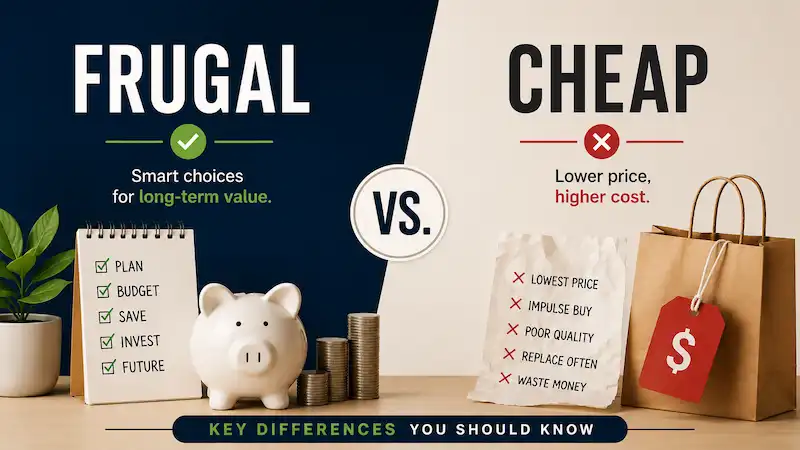
People use “frugal” and “cheap” interchangeably all the time. They are not the same thing.
The person who clips coupons, researches every major purchase, and buys a quality winter coat at an end-of-season sale is frugal. The person who skips the tip at dinner, lets others cover group expenses, and buys the least expensive version of everything regardless of how long it lasts is cheap.
Both spend less than average. But the mindset, the habits, and the real-world results are worlds apart.
Understanding the frugal vs. cheap distinction matters for your wallet, your relationships, and your long-term financial health. Being cheap often costs more over time. Being frugal builds genuine wealth and peace of mind at the same time.
This guide breaks down every meaningful difference, with practical examples, a side-by-side comparison, and honest self-assessment guidance so you know exactly where your habits land.
Key Takeaways
- Frugal and cheap are not the same. Frugal people focus on getting the best long-term value, while cheap people focus only on spending the least.
- Frugality is intentional. It supports financial goals by prioritizing quality, durability, and smart spending decisions.
- Cheapness can cost more over time. Buying low-quality items, skipping maintenance, or avoiding necessary expenses often leads to higher long-term costs.
- Your spending habits affect others. Paying your fair share, tipping appropriately, and avoiding shifting costs onto others are signs of healthy frugality, not cheapness.
- The key difference is mindset. Frugality is driven by values and long-term planning, while cheapness is often driven by fear of spending.
- You can be frugal without sacrificing quality. Focus on value, cost per use, and intentional purchases instead of simply choosing the lowest price every time.
What Does Frugal Actually Mean?
According to Merriam-Webster, “frugal” means “characterized by or reflecting thrift and efficiency in the use of resources.” The word traces back to the Latin frugalis, meaning temperate, virtuous, and not given to excess. There’s a reason the etymology skews positive.
Being frugal is about maximizing the value you get from every dollar. A frugal person doesn’t spend less money for the sake of spending less. They spend deliberately, on things that serve their long-term goals, and they cut back everywhere else without guilt.
Frugality is strategic. A frugal buyer might research a mattress for two weeks, wait for a seasonal sale, and pay $800 instead of $1,200 for one they know will last a decade. They spend more than the cheapest option costs, because they understand the total cost of ownership.
Frugal people are also generous where it matters. They tip fairly at restaurants. They pitch in for group gifts. They don’t make the people around them absorb the cost of their financial discipline.
For a full breakdown of how frugality looks in practice, Frugal Living Tips: The Ultimate Guide to Saving Money and Living Better is a comprehensive starting point worth bookmarking.
What Does Cheap Actually Mean?
Merriam-Webster defines “cheap” in the personal behavior sense as being ungenerously or pettily reluctant to spend money. That phrase carries real weight. Cheap isn’t about smart spending. It’s about refusing to spend, regardless of context or consequence.
A cheap person’s primary filter is price. Quality, durability, long-term cost, and impact on other people are secondary considerations at best. They’ll buy the lowest-priced version of something even if it fails in four months, because dodging the upfront cost feels like winning.
What separates cheap from frugal most clearly is the effect on others. A cheap person often shifts expenses onto the people around them. They consistently underorder at group dinners, avoid driving when carpooling, calculate tips on the pre-tax total, or find reasons why they shouldn’t need to contribute to shared costs. Over time, this pattern strains relationships in ways that feel hard to name but easy to feel.
The Merriam-Webster Thesaurus lists synonyms for cheapness as miserliness, stinginess, and penny-pinching. Those words carry a social charge that “frugal” doesn’t. That’s intentional, and that contrast tells you most of what you need to know.
Frugal vs. Cheap: Core Differences at a Glance
| Factor | Frugal | Cheap |
| Primary focus | Maximum value from every dollar | Lowest possible price, period |
| Motivation | Long-term financial goals | Avoiding spending at any cost |
| Mindset | Intentional and values-driven | Scarcity-based and fear-driven |
| Quality consideration | Central to every decision | Rarely factored in |
| Impact on others | Minimal to positive | Frequently negative |
| Tipping at restaurants | Fair tip, consistently | Often skips or reduces |
| Long-term cost | Lower (fewer replacements) | Often higher over time |
| Relationship health | Generally strong | Can erode trust and goodwill |
| Self-image | Empowered and purposeful | Sometimes defensive about habits |
The mindset row is the most important one. Frugality comes from a place of choice and intentionality. Cheapness typically comes from a scarcity mindset, a deep-seated belief that money is always running out and must be hoarded rather than deployed wisely.
Section takeaway: Both frugal and cheap people spend less than average, but frugality is goal-oriented and values-based while cheapness is price-fixated and avoidant, regardless of the real cost to quality or relationships.
Real-Life Examples: Frugal vs. Cheap in Action
Abstract definitions only go so far. Here is what these two mindsets actually look like.
Buying a Pair of Shoes
A frugal person spends $90 on well-reviewed leather shoes during a sale, knowing they’ll last four or five years. A cheap person buys a $22 pair that falls apart in three months and replaces them four or five times in the same timeframe. The frugal choice costs roughly $18 per year. The cheap choice costs around $100 per year and produces significantly more waste.
At a Restaurant
A frugal person orders thoughtfully, skips the overpriced cocktails, and leaves a fair 18 to 20 percent tip because they understand that tipped workers depend on gratuities. A cheap person orders the least expensive item, calculates the tip on the pre-tax subtotal, and finds reasons to round down.
Handling Car Maintenance
A frugal person stays current on oil changes and tire rotations because they’ve done the math on what deferred maintenance eventually costs. A cheap person skips a $75 oil change and faces a $1,400 engine repair six months later.
Grocery Shopping
A frugal person meal plans for the week, chooses budget-friendly protein sources, and buys store-brand staples. They might still buy the good olive oil because it matters to their cooking. A cheap person buys the lowest-priced version of everything, and regularly throws out produce that went bad before it could be used.
The 50 Frugal Living Tips That Save Money Every Month covers practical moves that fall firmly in the frugal column, from grocery strategy to subscription audits, with the kind of detail that makes each one actionable.
How This Divide Plays Out in Relationships
Money is already one of the primary sources of tension in relationships. The frugal vs. cheap gap amplifies that tension when someone consistently crosses into cheap territory.
A frugal person’s habits are mostly invisible to others. They make their spending choices privately, don’t make the people around them feel guilty for spending, and handle shared costs without drama.
Cheap behavior is different. It’s visible, and other people feel it. When someone consistently finds a reason not to pay their fair share, it creates resentment. When cheapness becomes the family culture, it can limit children’s access to experiences, social participation, and basic comfort in ways that leave a mark.
There is a useful line worth drawing here: frugality becomes cheapness when it starts hurting the people who live with or depend on you. Your financial discipline shouldn’t require other people to subsidize your choices, whether that’s a dinner partner, a server, or a child who wants to join a school trip.
If you’re working within real budget constraints while trying to keep family life stable and relationships intact, Frugal Living Tips for Families on a Tight Budget focuses specifically on approaches that stretch money without creating conflict or deprivation.
The Psychology Behind Each Mindset
The most fundamental difference between frugal and cheap isn’t what you spend. It’s why.
Frugal people operate from clarity about their values and goals. They’ve decided what financial freedom, stability, or independence means to them personally, and they align their spending with that picture. The choice to skip a restaurant dinner isn’t driven by fear. It’s driven by a preference to direct that money somewhere more meaningful.
Cheap people often operate from a scarcity mindset, a persistent belief that there is never enough, and that any spending is a threat. This psychology appears in people across income levels. Someone with significant savings can still operate from scarcity if that’s the mental model they’ve built. The anxiety isn’t really about the money itself. It’s about control.
This distinction matters for one critical reason: the scarcity mindset is hard to satisfy. No account balance tends to resolve it. People who operate from this place often reach comfortable financial positions and still feel the same dread around every purchase. Frugality, by contrast, is sustainable because it’s rooted in intention rather than fear. You know what you’re doing and why, which means the habits feel like choices rather than compulsions.
Signs You’re Frugal (Not Cheap)
If you’re unsure where your habits land, these patterns point toward frugal.
You make decisions based on value, not just price. Sometimes you’ll pay more for something that lasts longer or works better. The lowest price isn’t always the final word.
You tip appropriately and pay your share. You don’t transfer your saving goals onto service workers or expect friends and family to absorb costs that are rightfully yours.
You’re selective about where you cut back. You spend on things that genuinely matter to you and cut where the reduction barely affects your quality of life.
You plan purchases rather than making impulsive decisions. Research, comparison shopping, and waiting for the right timing are built into how you approach buying.
Your habits don’t consistently inconvenience others. The people close to you aren’t quietly covering your costs or avoiding inviting you to shared activities.
You have specific goals your habits are serving. There’s a reason behind the discipline. You’re building an emergency fund, paying off debt, or working toward a larger purchase, and your habits connect directly to that.
Signs You May Have Crossed Into Cheap
These are worth examining honestly.
You consistently undertip or avoid the tip. Tip avoidance is one of the clearest markers of cheap behavior and one of the most socially damaging.
You regularly let others pick up more than their fair share. Whether it’s at restaurants, group gifts, shared subscriptions, or splitting bills, if this happens consistently, it’s a pattern.
Price is always the deciding factor. If you’ve never bought something because it was worth paying more for, you may be operating primarily in cheap mode.
You feel anxious or guilty every time you spend, regardless of the amount. This can signal a scarcity mindset rather than thoughtful financial caution.
Your choices regularly affect other people’s comfort. If friends or family feel they can’t count on you for shared expenses, something has shifted from frugal into something harder to live with.
You defer genuinely necessary spending until it creates larger problems. Delaying healthcare, skipping car maintenance, or avoiding essential repairs to save money in the short term is a pattern with steep long-term consequences.
If some of these are resonating and you want to recalibrate, Frugal Living Tips for Beginners: How to Start Saving Money Today is a practical entry point for building the frugal habits without the avoidance patterns.
Section takeaway: The most honest question to ask yourself is whether your habits reflect intentional values-based choices or reflexive avoidance. The answer usually becomes clear when you look at how your decisions affect others.
How to Be Frugal Without Crossing the Line
The practical goal is to apply frugal thinking consistently without slipping into the patterns above. A few approaches that actually work.
Clarify your values before cutting costs. The goal of frugality is to fund the life you want, not to minimize spending as an end in itself. Get clear on what matters: financial independence, travel, family stability, a comfortable home. Then cut freely in the categories that don’t support those things.
Create a “worth it” category. Decide in advance where you won’t cut corners: quality produce, reliable transportation, a gym membership, or whatever genuinely improves your daily life. Spend well there and reduce elsewhere without guilt.
Keep your habits from landing on other people. Pay your fair share. Tip service workers appropriately. Show up for group events. Your financial goals shouldn’t require other people to subsidize them.
Think in cost-per-use terms. A $180 item used 300 times costs $0.60 per use. A $25 item replaced four times in the same period costs $100 and three times the trouble. The more expensive option is often the more frugal one.
Build the emergency savings buffer that changes your baseline. According to the Federal Reserve’s 2024 Survey of Household Economics and Decisionmaking, only 55 percent of U.S. adults had saved enough to cover three months of essential expenses. That gap is precisely where frugality pays off most. Having a financial cushion removes the pressure that pushes people toward cheap, short-term thinking.
For those ready to take things further, Extreme Frugal Living Tips: 35 Ways to Cut Expenses and Save More goes deeper into advanced cost-cutting strategies worth exploring once the foundational habits are in place.
Frequently Asked Questions
Is being frugal the same as being cheap?
No. Frugal means spending intentionally to maximize the value you receive. Cheap means prioritizing the lowest possible price regardless of quality, long-term cost, or impact on others. The behavior can look similar from the outside, but the motivation and long-term outcomes are very different.
Is being frugal a good thing?
Generally, yes. Frugality helps build financial resilience, reduces money stress, and creates the kind of disciplined spending habits that support long-term goals. The key distinction is that true frugality improves your life rather than restricting it, and doesn’t shift burdens onto others.
Can being cheap hurt your relationships?
Yes, and it does so in slow, incremental ways. When someone consistently avoids paying their fair share at dinners, skips tips, or finds reasons not to contribute to shared expenses, resentment builds over time. People start working around the behavior rather than addressing it, which is its own kind of relationship damage.
How do you know if you’re frugal or cheap?
Ask two questions. First: are your decisions based on getting good value, or simply on spending as little as possible? Second: do your habits regularly inconvenience or cost the people around you? If the answer to the first is “lowest price always wins” and the answer to the second is yes, you may be operating from a cheap mindset rather than a frugal one.
What is the difference between frugal and thrifty?
Frugal and thrifty are closely related. According to the Merriam-Webster Thesaurus, frugal implies the absence of luxury and a simple lifestyle, while thrifty stresses good management and industry. In practice, most people use the terms interchangeably, and both carry positive connotations that “cheap” does not.
Is a frugal person a cheapskate?
No. A frugal person makes deliberate spending choices in service of their values and goals. A cheapskate, as Merriam-Webster defines, is a miserly or stingy person who tries to avoid paying a fair share of costs. The frugal person’s discipline doesn’t require others to cover what they won’t. The cheapskate’s does.
Where the Real Work Starts
The frugal vs. cheap debate is ultimately a debate about intention.
Frugality is deliberate. It’s values-based, goal-oriented, and sustainable over a lifetime. It builds real wealth, preserves relationships, and creates genuine financial resilience. Cheapness is avoidance. It’s price-fixated, often fear-driven, and tends to cost more over time while quietly eroding the things around it.
If your current habits feel more like the latter, the shift doesn’t require a complete overhaul. It starts with getting clear on what you’re actually working toward and making sure your spending and saving habits serve that picture rather than just minimizing numbers.
Your next step depends on where you are right now. If you’re just starting to think about money more intentionally, Frugal Living Tips for Beginners: How to Start Saving Money Today offers a practical foundation. For a comprehensive reference on building and sustaining these habits over time, Frugal Living Tips: The Ultimate Guide to Saving Money and Living Better covers the full picture.
Being frugal isn’t about deprivation. It’s about making sure the money you work for actually works for you.