Most frugal living advice stops at “brew your own coffee” and “cancel one streaming service.” That’s fine for trimming the edges of a budget. It doesn’t do much if you’re facing a debt payoff sprint, a sudden drop in income, or a hard savings goal with a real deadline.
Extreme frugal living tips go further. They’re less comfortable, more specific, and built for people who need to move the needle fast, not just shave a little fat off a healthy budget. This guide covers 35 of them, organized by category, with real numbers behind the ones that need them.
If you’re just getting started with budgeting in general, our Frugal Living Tips for Beginners: How to Start Saving Money Today is a gentler on-ramp. This article assumes you already have the basics down and want to push harder.
What Extreme Frugal Living Actually Means
Extreme frugal living means cutting your expenses well below what’s typical for your income and household size, often through choices that feel like a real sacrifice at first: giving up a car, moving in with roommates, cooking every single meal from scratch, or living for a stretch on one income instead of two.
It’s different from standard frugality mostly in intensity and duration. A frugal household might meal plan and buy generic brands. An extremely frugal household might run a strict no-spend month, sell a car, or put every non-essential purchase on hold for 90 days. Most people who do this treat it as a sprint tied to a specific goal (debt freedom, a house down payment, an emergency fund, early retirement) rather than a permanent identity.
For a broader look at the whole spectrum of frugal living, from mild to extreme, see our Frugal Living Tips: The Ultimate Guide to Saving Money and Living Better.
Why This Matters Right Now
The financial cushion most households are working with is thinner than people assume. According to the Federal Reserve’s 2025 Survey of Household Economics and Decisionmaking, only 63 percent of adults said they could cover a hypothetical $400 emergency expense using cash or its equivalent, a number that’s barely budged in years. That gap is exactly the kind of thing extreme frugality is built to close, quickly.
Takeaway: Extreme frugal living isn’t about permanent deprivation. It’s a set of aggressive, temporary or semi-permanent tactics for closing a specific financial gap fast.
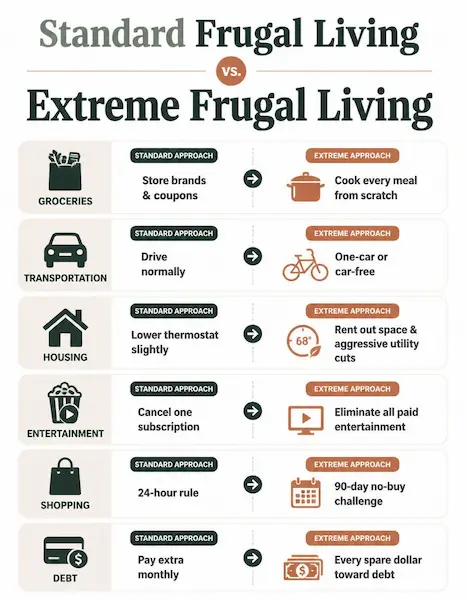
Extreme Frugal Living vs. Standard Frugal Living
| Category | Standard Frugal Approach | Extreme Frugal Approach |
| Groceries | Buy store brands, use coupons | Cook 100% from scratch, eliminate takeout entirely |
| Transportation | Combine errands, maintain your car | Sell a car, go car-free or one-car |
| Housing | Lower the thermostat a few degrees | Rent out a room, do a full energy audit and retrofit |
| Entertainment | Cut one subscription | Cancel all paid entertainment, use only the library |
| Shopping | Wait 24 hours before buying | 90-day spending freeze on non-essentials |
| Debt | Pay a bit extra each month | Throw every spare dollar at one debt, aggressively |
Extreme Housing and Utility Cuts
Housing and energy are usually the biggest line items in a budget, which is also where extreme cuts pay off the most.
1. Drop your thermostat further than feels comfortable, and dress for it instead. For the average U.S. household, heating and cooling eat up almost half the annual energy bill, more than $900 a year. Layer up, use blankets, and treat 66-68°F as your new normal in winter.
2. Do a real home energy audit, not a guess. The U.S. Department of Energy notes that of the roughly $2,000 the average household spends on energy annually, $200 to $400 is wasted through drafts and air leaks alone. Ask your utility company for a free or low-cost audit before spending on anything else.
3. Seal and insulate before you buy new equipment. Combining insulation, air sealing, and smart thermostat use can cut heating and cooling energy use by 20 to 50 percent, according to the DOE. That’s a bigger swing than most people expect from caulk and weatherstripping.
4. Skip the dryer entirely. Line-dry everything you can, indoors on a rack in winter, outside in warmer months. It costs nothing beyond the rack itself.
5. House hack: rent out a spare room, garage, or parking spot. This isn’t for everyone, but even a short-term arrangement can offset a mortgage or rent payment meaningfully.
6. Cancel cable and satellite completely. Pair a digital antenna with library-based streaming and free apps instead of paying for a bundle you’re barely using.
Takeaway: Housing and utility cuts have the highest ceiling for savings because the baseline spending is so large. Start with the audit, not the appliance upgrade.
Extreme Grocery and Food Strategies
Food is the category most people can control fastest, and it’s also where “extreme” tips can tip into unhealthy territory if you’re not careful. These are about efficiency, not restriction.
7. Build your grocery budget around a USDA-style benchmark. The USDA’s Thrifty Food Plan, the government’s own lowest-cost nutritionally adequate diet (it’s also the basis for SNAP benefits), currently runs about $249 to $313 a month for a single adult, and just over $1,000 a month for a family of four. Use that as your real target, not a vague “spend less.”
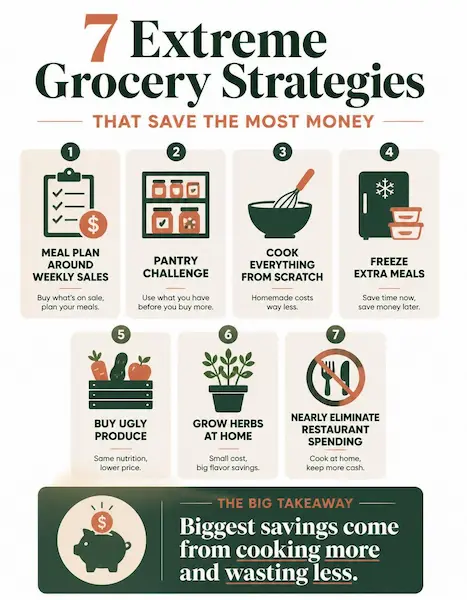
8. Meal-plan backwards from what’s on sale. Instead of picking recipes first, look at the week’s sale flyer and loss leaders, then build meals around whatever’s cheapest. Keeping a reliable selection of essential pantry staples on hand also makes it easier to build inexpensive meals around whatever is on sale.
9. Run a pantry challenge before every shopping trip. Eat down what you already own before buying more. Food waste is more expensive than people think: the EPA’s own cost analysis puts the price of wasted groceries at $728 per person a year, or close to $2,900 for a family of four.
10. Cook double, freeze half, every single time. Turning one cooking session into two meals cuts both time and per-meal cost.
11. Buy the ugly produce and the loss-leader proteins. Bruised fruit and odd-shaped vegetables are usually discounted and identical nutritionally.
12. Grow something, even in containers. Herbs, tomatoes, and leafy greens are cheap to start and expensive to keep buying.
13. Get “food away from home” as close to zero as you can. The average household spent $3,945 a year eating out in 2024, according to the BLS Consumer Expenditure Survey. That’s the single easiest category to cut to nearly nothing without touching your actual grocery bill.
Takeaway: Extreme frugality with food should mean cooking smarter and wasting less, never skipping meals or cutting nutrition. If a tip here starts to feel like restriction rather than efficiency, back off.
Extreme Transportation Cuts
14. Go down to one car, or none if your area allows it. A second car often costs more in insurance, gas, and maintenance than people realize until it’s gone.
15. Walk or bike for anything under two miles. It’s the single easiest way to cut gas spending without changing your whole routine.
16. Batch every errand into one weekly loop. Plan a single route that hits the bank, the store, and the pharmacy in one trip instead of several.
17. Learn basic car maintenance yourself. Oil changes, wiper blades, and air filters are simple enough for most people to do at home with a short tutorial and cheap parts.
Extreme Debt, Banking, and Money Habits
18. Run a real no-spend month. No dining out, no non-essential shopping, no impulse buys, for 30 straight days. Most people are surprised by how much this reveals about default spending.
19. Use a cash envelope for every discretionary category. When the envelope is empty, spending in that category stops, no exceptions and no swiping a card “just this once.”
20. Automate savings before you ever see the money. Set a fixed percentage or dollar amount to move out of checking the day you’re paid.
21. Throw every spare dollar at one debt at a time. This matters more than usual right now: total U.S. credit card debt sits around $1.25 trillion, with average interest rates near 21 percent, according to LendingTree’s analysis of Federal Reserve data. At that rate, minimum payments barely dent the principal.
22. Call and negotiate every recurring bill once a year. Insurance, internet, phone plans, even some medical bills have more room to negotiate than people assume. It costs nothing to ask.
23. Track every dollar for 30 days, no matter how small. Not a rough budget category, the actual transaction. This is uncomfortable and extremely effective at surfacing leaks.
Takeaway: Debt at today’s interest rates works against you fast. Extreme frugality aimed at debt payoff isn’t overkill, it’s proportionate to the problem.
Extreme Shopping and Consumables Cuts
24. Buy secondhand first, always. Check thrift stores, resale apps, and local swap groups before any new purchase, clothing especially.
25. Adopt a hard capsule wardrobe. A small, mix-and-match set of clothes reduces both spending and decision fatigue.
26. Make your own basics. DIY cleaning spray, laundry detergent, and simple baked goods cost a fraction of store-bought versions once you have the base ingredients on hand. Washing clothes in cold water also saves real energy, since about 90 percent of a washing machine’s energy use goes toward heating water, according to ENERGY STAR.
27. Sell what you’re not using before buying anything new. This funds new purchases without touching your regular budget and forces a “do I actually need this” pause.
28. Trim personal care to the essentials, not the necessities. Stretch time between haircuts, use up products fully, and skip the premium versions of things you use daily. This is about cutting the extras, never about skipping things like needed medication or basic hygiene.
29. Start or join a Buy Nothing group in your area. Local give-and-take groups cover everything from furniture to kids’ clothes to tools, often for free.
Extreme Entertainment, Health, and Lifestyle Cuts
30. Replace paid entertainment with the library. Books, movies, museum passes, digital magazines, and sometimes even tools or equipment are available free with a library card.
31. Host instead of going out. Potlucks, game nights, and BYO get-togethers deliver the same social time for a fraction of the cost of restaurants or events.
32. Prioritize preventive care over deferred care. Skipping needed medical or dental care to save money almost always costs more later. Use in-network providers, ask about generic medications, and look into community health centers or sliding-scale clinics if cost is a barrier, rather than skipping care altogether.
Extreme Income and Mindset Levers
33. Turn one existing skill into a few hours of paid work a week. Tutoring, pet sitting, freelance writing, or handyman work all monetize skills you likely already have.
34. Set one specific savings number and one deadline. “Save more” doesn’t create urgency. “$5,000 by October” does.
35. Decide upfront which cuts are temporary and which are permanent. Some of these tips (a spending freeze, a no-spend month) are meant to end. Others (cooking from scratch, buying secondhand) can become long-term habits without feeling like deprivation. Knowing the difference before you start prevents burnout.
Is Extreme Frugal Living Right for You Right Now?
Before going all-in, run through this checklist:
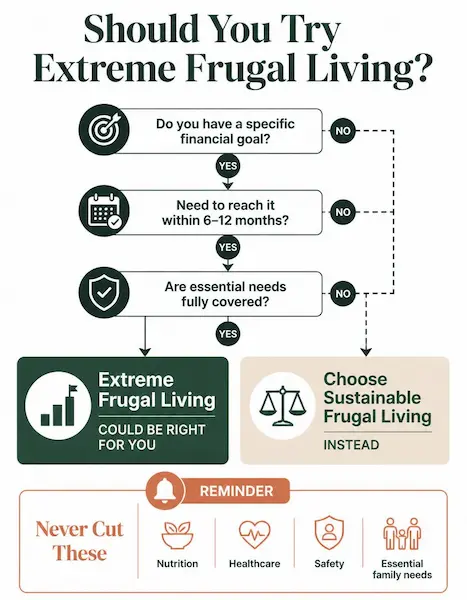
- Do you have a specific dollar goal and deadline, not just a vague “save more”?
- Are your essential needs (food, housing, healthcare, safety) fully covered before you start cutting?
- Is this a temporary sprint, or are you trying to sustain it indefinitely?
- Does anyone else in your household need to be on board with these changes?
- Do you have a plan for what happens once you hit the goal?
If you answered “no” to more than one or two of these, consider starting with our roundup of 50 Frugal Living Tips That Save Money Every Month instead. It covers sustainable, everyday habits without the intensity of a full extreme frugal living approach. And if you’re budgeting for a household with kids, our Frugal Living Tips for Families on a Tight Budget addresses trade-offs specific to family expenses that this list doesn’t cover.
Frequently Asked Questions
What is extreme frugal living?
It’s a set of aggressive, often uncomfortable spending cuts, well beyond typical budgeting advice, usually adopted for a defined period to hit a specific financial goal like paying off debt or building an emergency fund fast.
Is extreme frugal living healthy or sustainable long-term?
Not usually as a permanent lifestyle. Most people treat it as a temporary sprint. Trying to maintain the most intense cuts indefinitely tends to lead to burnout or, worse, cutting corners on things like food quality, healthcare, or safety that shouldn’t be cut.
What’s the difference between being frugal and being cheap?
Frugality, even extreme frugality, is about intentional trade-offs toward a goal. Being cheap usually means cutting corners regardless of the cost to relationships, safety, or quality, without a clear purpose behind it.
What is a no-spend challenge?
A set period, often a week or a month, where you pause all non-essential spending entirely. It’s one of the more common ways people test how “extreme” they can realistically go before committing longer-term.
Can extreme frugal living help me pay off debt or retire early?
It can meaningfully speed up both, especially debt payoff, given how expensive carrying a balance is right now. Results depend entirely on your starting income, expenses, and debt load, so treat any specific savings timeline as an estimate you calculate for your own numbers, not a guarantee.
Next Steps
Pick three tips from this list, the ones that target your biggest expense categories, and commit to them for 30 days before adding more. Trying all 35 at once is a fast route to burnout. Track what each change actually saves you, then decide which ones earn a permanent spot in your routine and which ones were only ever meant to be temporary.
If this feels like more intensity than you need right now, start with our Frugal Living Tips for Beginners: How to Start Saving Money Today guide, or go back to the Frugal Living Tips: The Ultimate Guide to Saving Money and Living Better for the full picture of where these extreme tactics fit into a broader money-saving strategy.