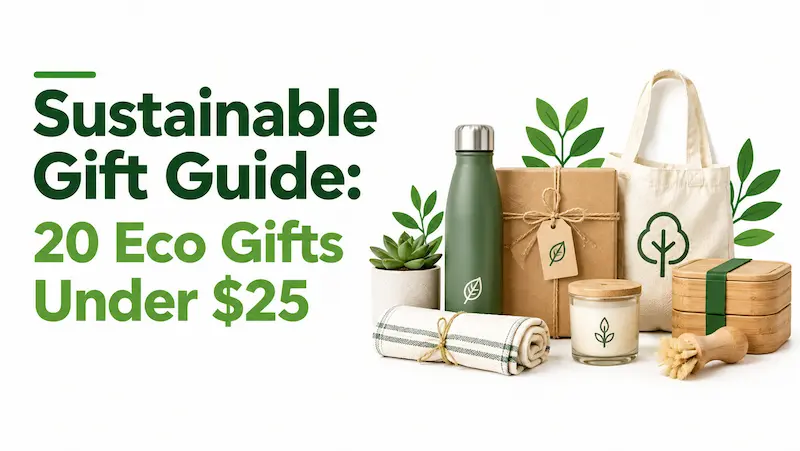
Finding a gift that is thoughtful, environmentally honest, and actually within a $25 budget is harder than most gift guides suggest. The word “sustainable” has been applied so broadly that it has lost most of its meaning. A bamboo-handled product in excessive plastic packaging, a novelty tote with a vague “eco-friendly” label, a bar labeled “plastic-free” without explaining what it is made from instead: none of these are the carefully considered gifts most people have in mind when they start searching.
This guide takes a different approach. Every recommendation here went through a research and verification process that checked current prices, examined sustainability claims against available evidence, and asked a harder question than most roundups do: will the recipient actually use this enough to justify buying it? A sustainable gift that sits in a drawer is still unnecessary consumption, which is why the broader zero-waste approach starts with using what you already have and avoiding unnecessary purchases in the first place.
No affiliate commissions influenced any selection in this guide. Prices were checked in early October 2026. All listed prices refer to the product price before tax and shipping unless otherwise noted.
Quick Picks: 20 Sustainable Best Gifts Under $25
| Gift | Typical Price | Best For | Sustainability Consideration |
| Insulated Stainless Steel Water Bottle | $13-$22 | Most people | Replaces repeated disposable bottle purchases |
| Insulated Travel Coffee Mug | $13-$25 | Daily coffee/tea drinkers | Reduces disposable cup waste over time |
| BAGGU Recycled-Nylon Tote | ~$14-$16 | Everyone | Recycled pre-consumer nylon; foldable |
| Organic Cotton Produce Bags | ~$12-$20 | Grocery shoppers | GOTS-certified options available; washable |
| Stasher Silicone Food Storage Bag | ~$13-$23 | Home cooks | Replaces single-use plastic bags repeatedly |
| Beeswax Food Wraps (9-pack) | ~$14-$18 | Kitchen users | Replaces plastic wrap; cotton and beeswax |
| Decomposition Recycled Notebook | $6-$12 | Writers, students | 100% post-consumer-waste recycled paper |
| Herb or Seed Starter Kit | ~$15-$22 | Home cooks, gardeners | Low-input food growing; reduces packaged herbs |
| Ethique Solid Shampoo Bar | ~$14-$17 | Hair-care users | Plastic-free packaging; concentrated formula |
| Bamboo Travel Utensil Set | $8-$12 | On-the-go eaters | Replaces disposable plastic cutlery |
| Rareform Parker Pouch | $18 | Travelers, organizers | Upcycled billboard vinyl; B Corp certified |
| Swedish Dishcloths (6-pack) | $9-$15 | Kitchen users | Cellulose-based; replaces paper towels |
| Grove Co. Refillable Cleaning Set | ~$13-$15 | Households | Refillable glass bottle; recycled packaging |
| Plantable Seed Greeting Card | $5-$9 | Anyone with outdoor space | Paper embedded with wildflower seeds |
| Dr. Bronner’s Bar Soap | $4-$8/bar | Body-care users | USDA Organic; Fair Trade certified |
| Darning and Mending Kit | ~$10-$19 | Clothing owners, crafters | Extends garment life; reduces textile waste |
| Fair Trade Tea Sampler | $8-$12 | Tea drinkers | Fair trade certified; consumable |
| Fair Trade or Local Coffee | $8-$18 | Coffee drinkers | Fair trade certified; consumable |
| Second-Hand Gift | Under $25 | Various | Avoids new manufacturing entirely |
| Local Experience Gift | $0-$25 | Minimalists | No product, no packaging, no clutter |
How SustainCents Evaluated These Gifts
Every candidate was evaluated on six criteria before being included.
Usefulness. A gift the recipient will use consistently is more valuable than one that reflects good intentions but ends up unused. Products that solve problems most people do not have were ruled out.
Price verification. “Under $25” means the listed product price before tax and shipping. Prices were checked in October 2026 and should be re-verified at the time of purchase, since they change.
Specific sustainability attributes. “Eco-friendly,” “green,” “zero-waste,” and “natural” are not meaningful without supporting evidence. Each recommendation below describes the particular characteristic that makes it worth considering on environmental grounds: recycled material, refillable design, compostable packaging, relevant certification, or a specific reduction in disposable product use.
Certification scope. Where a certification is mentioned, we identify what it actually covers. A textile certification for organic cotton content does not evaluate the entire product’s environmental footprint.
Greenwashing risk. Some product categories are prone to vague environmental claims. We flag this directly.
Financial value. The best gift is the one the recipient will use enough that the purchase justifies itself, whether through durability, daily use, or the reduction of something they would otherwise buy repeatedly.
Throughout this article, we distinguish between verified product facts, manufacturer or retailer claims, third-party certification information, and SustainCents editorial analysis. These are different types of information and should be read as such.
20 Sustainable Best Gifts Under $25
1. Reusable Insulated Water Bottle
Typical price: $13-$22
Best for: Almost anyone who does not already own one
Sustainability angle: Replaces repeated single-use bottle purchases; stainless steel interior is recyclable at end of life
Why consider it
An insulated stainless steel water bottle is one of the most financially defensible gifts on this list, because the numbers work unusually clearly. If the recipient buys even two or three drinks per week that they might otherwise have replaced with tap water in a reusable bottle, the math pays off within weeks. More importantly, water bottles are used daily by most people for years, which spreads the environmental cost of manufacturing over a long and consistent use period.
At the $25 price point, solid options exist from brands like Simple Modern, Contigo, and Thermoflask in the 16-24 ounce range. Premium brands such as Hydro Flask and Klean Kanteen frequently exceed $25 for most sizes, which puts them outside this guide’s scope. A Slickdeals listing from June 2026 showed the S’well 17oz bottle available at $20 as a sale price; the regular retail for that model is typically higher.
What to look for
Double-wall vacuum insulation, a stainless steel interior rather than a plastic lining, and a lid style the recipient will actually use. Wide-mouth openings accommodate ice. Sizes between 16 and 24 ounces tend to be practical for daily carry without becoming too heavy.
Potential downside
Lower-cost bottles sometimes have plastic liners or lids with complicated mechanisms that are difficult to clean thoroughly. A bottle used only a few months before breaking or being replaced offers little advantage over what it was meant to replace.
Consider another option if
The recipient already has one or more water bottles they use daily. Another bottle adds clutter without adding value.
Budget note
Most well-reviewed options in 16-24oz sit at $13-$22 before tax and shipping. Shipping on a single-bottle order can add meaningful cost; look for local retailers or platforms with free shipping thresholds you would meet.
Where to find it
Amazon, Target, REI, and outdoor specialty retailers. Compare lid styles and check dishwasher compatibility before ordering.
2. Reusable Insulated Travel Coffee Mug
Typical price: $13-$25
Best for: Daily coffee and tea drinkers, especially those who buy takeout drinks
Sustainability angle: Replaces single-use disposable cups, most of which cannot be recycled due to plastic film lining; many cafes offer small discounts to customers who bring their own cup
Why consider it
Disposable coffee cups are more environmentally complex than they appear. Most are lined with a thin polyethylene film that prevents recycling in standard facilities. A reusable travel mug eliminates that waste stream for the recipient every time they use it. Several major coffee chains offer discounts of $0.10 to $0.25 per drink for customers who bring their own cup, which adds up at daily use over a year.
Options like the Contigo Byron, Simple Modern Voyager, and similar models fall in the $15-$22 range at most retailers. Stanley’s 12oz Camp Mug is $20 and their 16oz Café-To-Go travel mug is listed at $25 (right at the ceiling). All use stainless steel with vacuum insulation.
What to look for
A leak-proof lid matters for commuters. Cup-holder compatibility matters for car users. Check whether the lid can be fully disassembled for cleaning, since trapped moisture causes odor. A wide enough mouth to clean easily is more practical than a narrow opening.
Potential downside
Travel mugs accumulate. If the recipient already owns one they use consistently, another adds clutter rather than value.
Consider another option if
The recipient primarily works from home, does not drink hot beverages on the go, or already has a travel mug they use.
Budget note
$13-$22 covers most solid options. The Stanley Café-To-Go at $25 sits right at the limit, and shipping on a single order may push the total above $25.
Where to find it
Target, Amazon, REI, and specialty outdoor and kitchen retailers.
3. BAGGU Standard Bag
Typical price: $14-$16
Best for: Anyone who regularly takes plastic bags at grocery stores, markets, or errands
Sustainability angle: Made from recycled ripstop nylon derived from pre-consumer manufacturing waste; machine washable; holds up to 50 pounds; folds into a 5-inch pouch that fits in a coat pocket
Why consider it
The BAGGU Standard Bag has been the same design since the company launched in 2007. The recycled ripstop nylon is produced from pre-consumer waste (manufacturing offcuts), not post-consumer recycled material, which is worth knowing. What makes this a practical sustainable gift is not a certification claim but a behavioral one: because it folds to a 5×5-inch pouch, it is far more likely to actually travel with the recipient than a bulkier canvas tote left behind at home.
Bags left at home do not replace plastic bags. BAGGU’s portability is the feature most responsible for whether the environmental case holds up in real life.
At approximately $14-$16 (verified at the Skirball Museum Shop at $14 and Backcountry at $13.95), this is affordable enough to give as part of a small bundle.
What to look for
The original Standard size (25.5 x 15.5 x 6 inches expanded) is the most versatile. Verify you are buying from an authorized BAGGU retailer, as knockoffs are common and the construction quality differs significantly.
Potential downside
Nylon is a synthetic material and does not biodegrade. Machine washing can release microfibers into wastewater. Organic cotton or natural canvas alternatives avoid synthetic microfibers but are bulkier to carry and thus less likely to be used consistently.
Consider another option if
The recipient already has adequate reusable bags they actually use. An additional tote adds clutter more than it reduces plastic bag use.
Budget note
Regular retail is $14-$16. Available at baggu.com, MoMA Design Store, and independent retailers. Shipping on a single bag order can approach the bag’s price from some retailers; check for local stockists.
Where to find it
BAGGU’s website, MoMA Design Store, and many independent gift and lifestyle shops.
4. Organic Cotton Mesh Produce Bags
Typical price: $12-$20 for a set
Best for: People who do their own grocery shopping or visit farmers markets regularly
Sustainability angle: GOTS-certified organic cotton options available; washable and reusable; replaces single-use plastic produce bags; often labeled with tare weight for bulk-counter use
Why consider it
The lightweight plastic produce bags in grocery stores are among the harder single-use plastics to avoid, since most stores still provide them by default at the produce section. A set of mesh produce bags addresses this specific problem: they hold produce, allow air circulation (which can extend freshness for some items), and go through the washing machine without losing their shape.
Simple Ecology makes a set of six mesh bags in mixed sizes certified to the Global Organic Textile Standard (GOTS), listed at approximately $19.95 for the 6-pack at Walmart (verified July 2025), and $11.95 for a 3-pack. GOTS covers both the organic content of the cotton fibers and labor and environmental standards across the supply chain, which makes it a more comprehensive credential than an “organic cotton” label alone. That said, GOTS evaluates the textile material, not the bag’s full lifecycle.
What to look for
Look for a GOTS or similarly verified organic certification if organic sourcing matters to you. A set with multiple sizes (small for herbs and nuts, large for apples and onions) is more practical than identical sizes. A labeled tare weight is useful for shopping at bulk-food sections.
Potential downside
Mesh bags are not suitable for every produce item. Fine-textured items like loose bulk grains fall through the holes. Muslin or cotton muslin bags handle those items better, though they are harder to dry thoroughly.
Consider another option if
The recipient does not do their own grocery shopping, buys produce primarily through delivery, or already has more reusable bags than they use.
Budget note
The 3-pack at approximately $11.95 and the 6-pack at approximately $19.95 (Simple Ecology, Walmart, prices as of July 2025) are both within the $25 budget before shipping.
Where to find it
Simple Ecology’s website, Walmart, and Amazon. Search for “GOTS certified organic cotton produce bags” to find options with verified material credentials.
5. Stasher Silicone Food Storage Bag
Typical price: $13 (sandwich) to $23 (half-gallon)
Best for: Home cooks, meal preppers, and anyone who regularly reaches for zip-seal bags
Sustainability angle: Made from platinum food-grade silicone described by the manufacturer as free from lead, latex, phthalates, BPA, and BPS; dishwasher-, oven-, freezer-, and microwave-safe; designed for repeated use in place of disposable plastic bags
Why consider it
Stasher is one of the better-documented brands in the reusable food storage category, where replacing disposable bags and containers with products designed for repeated use is one of the more practical zero-waste kitchen changes. The bags are made from platinum-grade silicone and are rated for the dishwasher, microwave, oven (up to 425°F), and freezer, which makes them genuinely versatile. Stasher’s marketing states that one bag replaces 260 single-use plastic bags per year; SustainCents presents this as a manufacturer claim, not an independently verified figure, but the underlying logic is sound: a bag used multiple times per week consistently does reduce disposable bag use over time.
The sandwich size is approximately $12.99 at Walmart (verified late 2025). The half-gallon is approximately $22.99, also within budget. Stasher offers a lifetime product warranty, which is a relevant quality signal. Current pricing should be verified before buying.
What to look for
The sandwich size works for most daily uses. Verify the recipient actually cooks or prepares food regularly; the bags add less value for someone who rarely uses food storage bags. Stasher bags should not be turned inside out during washing, which can cause the seam to split.
Potential downside
Silicone production involves energy-intensive manufacturing processes. These bags earn their sustainability argument primarily by replacing disposable products over a long period, not through the inherent properties of the material itself. The upfront cost is higher than a box of zip-seal bags.
Consider another option if
The recipient rarely uses zip-seal bags to begin with. A product that replaces something the person was not using has no practical benefit.
Budget note
Single bags in sandwich and snack sizes fall comfortably within $25. Multi-bag sets and larger sizes vary; verify current pricing. Prices fluctuate across retailers.
Where to find it
Stasher’s website, Amazon, Walmart, Target, and kitchen specialty stores.
6. Beeswax Food Wraps
Typical price: $14-$18 for a 9-pack
Best for: Households looking to reduce plastic wrap use for food storage
Sustainability angle: Made from organic cotton coated with beeswax, jojoba oil, and tree resin; washable with cool water; generally considered compostable at end of life; replaces plastic cling wrap for covering bowls and wrapping food
Why consider it
Beeswax wraps soften with the warmth of your hands and form a gentle seal around bowls, bread, fruit, and cheese. Unlike cling wrap, they are washable with cool water and mild soap, air-dry between uses, and eventually compost at the end of their life. A 9-pack that includes small, medium, and large sizes covers most household wrapping needs and can be a practical starting point for reducing single-use plastic in the kitchen, particularly if plastic wrap is used regularly.
At $14-$18 for a nine-pack from well-reviewed brands (Amazon pricing verified 2025-2026), this is a practical kitchen gift with a specific and clear purpose: replacing a disposable product. Brands like Abeego and various Amazon options cluster in this price range.
What to look for
Look for wraps made with organic cotton and natural ingredients (beeswax, jojoba oil, tree resin), with a clear ingredient list. Avoid wraps with vague additive language. Important care notes: these wraps should not be used with meat or fish, cannot go in the dishwasher, and should not cover hot food since heat melts the wax.
Potential downside
Beeswax is an animal-derived product, making these wraps unsuitable for vegan recipients. Plant-based wax alternatives exist but tend to cost more or seal less effectively. Usable life varies with care; rough handling shortens it.
Consider another option if
The recipient is vegan, rarely wraps food individually, or already uses reusable containers for most storage.
Budget note
Nine-packs from reputable brands typically land at $14-$18 on Amazon (prices verified 2025-2026). Verify the current price before buying, as these fluctuate.
Where to find it
Amazon and kitchen goods retailers. Look for products that list their full ingredient composition rather than just “beeswax and cotton.”
7. Decomposition Recycled Notebook
Typical price: $6-$12
Best for: Students, writers, journal keepers, or anyone who still uses paper notebooks regularly
Sustainability angle: Made with 100% post-consumer-waste recycled paper; covers are 100% post-consumer waste; printed with soy-based ink; the company states production uses biogas energy (SustainCents has not independently verified this claim); made in the USA
Why consider it
Decomposition Books are produced by Michael Roger Inc., a family-run company in Brooklyn that has made stationery since 1949. The post-consumer-waste recycled paper is a verifiable material claim: the paper is made from recycled materials that have already passed through a consumer’s hands, rather than from virgin wood pulp. The soy-based ink on the cover designs is also a verifiable characteristic.
These are practical notebooks with good paper quality for everyday writing. The cover designs (wildlife, botanicals, geometric patterns, cultural illustrations) make the selection personal. At $6-$12, they are affordable enough to pair with another small gift.
What to look for
The spiral-bound version is better for lay-flat note-taking. The composition (sewn-bound) version is more compact and more portable. Choose based on how the recipient typically takes notes. Cover designs vary widely; choose one that fits the recipient’s taste.
Potential downside
Paper notebooks are resource-intensive products regardless of recycled content, and their environmental case weakens if the recipient does most of their note-taking digitally and would not have bought a paper notebook on their own.
Consider another option if
The recipient keeps all notes digitally and has no current notebook habit.
Budget note
Pocket-sized Decomposition notebooks run approximately $5-$6. Standard composition size (7.5 x 9.75 inches) is approximately $9-$12 at Staples, bookstores, and online retailers.
Where to find it
Decomposition Books’ website, Staples, independent bookstores, and many online retailers.
8. Herb or Seed Starter Kit
Typical price: $15-$22
Best for: Home cooks, people with a windowsill or small outdoor space, beginners interested in growing food
Sustainability angle: Supports low-input food growing at home; fresh herbs harvested from a home kit are not packaged in plastic; ongoing herb growing reduces packaged herb purchases over time
Why consider it
A well-chosen herb starter kit gives someone the tools to grow basil, parsley, cilantro, or thyme from a kitchen windowsill. The practical appeal is clear: a handful of fresh herbs from a grow kit costs far less per use than the plastic-packaged bundles sold at supermarkets, which can make home-grown herbs a small but useful part of a grocery budget focused on reducing both spending and food waste.
The category ranges from simple biodegradable pot and seed-packet bundles ($15-$18) to self-watering mason jar kits ($18-$22). The simpler options are often the better gift: fewer components, no electronics to maintain, and easier to use for someone who is new to growing. Hydroponic systems with grow lights are effective but most quality models exceed $25.
What to look for
Non-GMO seeds, biodegradable or compostable pots, and a manageable number of herb varieties for a beginner are the most important features to look for. Avoid kits with excessive plastic packaging, which contradicts the gift’s environmental intent. The kit should include clear growing instructions.
Potential downside
A grow kit that is not used or that fails to sprout becomes clutter. This gift works best for someone who has expressed interest in gardening or cooking with fresh herbs, who has appropriate light conditions, and who will actually tend to plants.
Consider another option if
The recipient lives somewhere without adequate natural light, travels frequently, or has not shown interest in plants or gardening. A failed grow kit is a discouraging gift.
Budget note
Seed-packet and biodegradable pot kits typically run $15-$18 and fit the budget. Mason jar self-watering kits are $18-$22. Shipping on garden items can add cost; check delivery fees before ordering. Local nurseries sometimes sell seed packets and biodegradable starter pots separately for less than a bundled kit.
Where to find it
Local garden centers, hardware stores with garden sections, and Amazon. Nurseries often sell component kits at competitive prices with the added benefit of local sourcing.
9. Ethique Solid Shampoo Bar
Typical price: Approximately $14-$17 per bar (US market)
Best for: Hair-care users interested in eliminating plastic shampoo bottles from their bathroom
Sustainability angle: Compostable cardboard packaging with no plastic; concentrated solid formula (no water added in production, unlike most liquid shampoos, which are typically 60-80% water); Ethique states each bar replaces approximately three bottles of liquid shampoo (manufacturer claim based on concentration per use)
Why consider it
Ethique was founded in New Zealand in 2012 specifically to create plastic-free personal care products. Their solid shampoo bars arrive in compostable cardboard, contain no plastic packaging, and are formulated without added water, which reduces the packaging and shipping material needed per use compared to equivalent liquid shampoos.
The company’s claim that one bar replaces three liquid shampoo bottles is a marketing figure based on concentration. What it accurately describes is that a solid bar contains more active ingredients per unit weight than a liquid shampoo, because liquid shampoos dilute the same actives with large amounts of water. SustainCents has not independently tested this claim, but the underlying logic (more product per unit of packaging) is reasonable. US retail pricing for a full-size Ethique bar is approximately $14-$17 based on third-party retailer and eBay listing data reviewed through mid-2026.
What to look for
Match the formula to the recipient’s hair type. Ethique makes bars for oily, dry, color-treated, curly, fine, and other hair types. Solid shampoo requires a short adjustment period for some users as hair adapts from liquid formulas. A wooden soap dish or similar drainage stand extends the bar’s life between washes.
Potential downside
Solid shampoo does not work equally well for every hair type or water hardness level, and a transition period exists for some users. This gift lands better with someone who has already expressed interest in trying solid shampoo than with someone who has not considered it.
Consider another option if
The recipient is very satisfied with their current shampoo and has not expressed interest in changing it. A gift that implies their current habits need improvement rarely lands well.
Budget note
A single full-size Ethique bar at approximately $14-$17 fits within the budget. The bars are also stocked at some Target and Whole Foods locations, allowing in-store purchase that avoids a shipping cost.
Where to find it
Ethique’s website, Target, Whole Foods, and some natural grocery retailers.
10. Bamboo Travel Utensil Set
Typical price: $8-$12
Best for: Frequent travelers, daily commuters, anyone who regularly buys takeout and accepts disposable plastic cutlery
Sustainability angle: Replaces disposable plastic cutlery at cafes, food trucks, takeout counters, and delivery meals; bamboo is a fast-growing grass that manufacturers note requires no pesticides in typical natural cultivation
Why consider it
A bamboo travel utensil set (typically a fork, spoon, knife, chopsticks, metal straw, and carry pouch) is a practical gift with a clear use case: the recipient uses it instead of accepting disposable cutlery when they pick up lunch or takeout. This is useful only for someone who regularly buys food out; for someone who rarely does, the set addresses a problem they do not have.
At $8-$12 (Walmart and Amazon prices verified 2025-2026), this is one of the lowest-cost items on this list, which leaves room to pair it with something else if a more substantial gift is appropriate.
On bamboo as a material: it grows quickly and requires no pesticides in natural cultivation, which manufacturers cite as environmental advantages. This does not address how the bamboo is processed into utensils, what adhesives or finishes may be used, or how it is transported. The sustainability advantage here comes primarily from what these utensils replace, not from the material being inherently superior.
What to look for
A compact carry pouch is important, since a utensil set that travels with the person is far more useful than one left on a kitchen shelf. Hand-washing is recommended; prolonged soaking or dishwasher use can cause bamboo to crack. Confirm the set includes the pieces the recipient will actually use.
Potential downside
Bamboo utensils crack over time, particularly with dishwasher use. At end of life, they are not recyclable through standard channels, though they are generally compostable if untreated.
Consider another option if
The recipient works from home and rarely buys food out, or already has a utensil set they carry regularly.
Budget note
Most sets in this category land at $8-$12 with free shipping on many platforms. This is among the most affordable items in this guide.
Where to find it
Amazon and Walmart carry a wide range of options. Look for sets with carry cases and clear material labeling.
11. Rareform Parker Pouch
Typical price: $18
Best for: Organized people who need a compact pouch for cords, earbuds, writing supplies, or travel essentials
Sustainability angle: Made from upcycled billboard vinyl diverted from landfill; interior lining is recycled polyester from water bottles; every piece is unique because no two billboard sections have the same pattern; Rareform is a certified B Corporation
Why consider it
Rareform, based in Agoura Hills, California, partners with outdoor advertising companies to collect discarded vinyl billboard material before it would otherwise be landfilled. That material is hand-cut and sewn into accessories in their US facility. The upcycling model here is specific and verifiable: the vinyl existed as something else before, and was redirected rather than newly produced.
The Parker Pouch is a zippered organizer approximately 7 inches wide and 2.75 inches tall, suitable for cords, earbuds, pens, or cosmetics. It is water-resistant and easy to wipe clean. The lining is described by Rareform as made from recycled polyester derived from water bottles.
B Corporation certification, which Rareform holds, is a company-level designation that evaluates social and environmental performance, accountability, and transparency across the business. It does not certify the environmental impact of any individual product, but it reflects independently verified standards for how Rareform operates.
What to look for
Because each pouch is cut from a different section of billboard vinyl, the color and pattern you receive will vary. This one-of-a-kind characteristic is intentional, but if the recipient strongly prefers predictable aesthetics, it is worth noting.
Potential downside
Vinyl (PVC) is a plastic-based material. While upcycling is genuinely preferable to landfilling, PVC does not biodegrade and cannot easily be returned to a material cycle at end of life. The pouch is best thought of as an extended-life use of a material that would otherwise have become waste, rather than as an inherently sustainable material in the traditional sense.
Consider another option if
The recipient prefers predictable color and pattern, needs a larger bag (most Rareform products above the pouch exceed $25), or lives somewhere where shipping from California would add meaningfully to the total cost.
Budget note
The Parker Pouch is listed at $18 on Rareform’s website (verified at time of writing). Shipping is free on orders above $100, which a single pouch order will not reach; factor in shipping when calculating total spend.
Where to find it
12. Swedish Dishcloths (6-Pack)
Typical price: $9-$15 for a 6-pack
Best for: Kitchen users who go through paper towels regularly
Sustainability angle: Made from cellulose (plant-derived) and cotton; biodegradable and compostable; one manufacturer (Nordhus Design) specifies 70% cellulose from FSC-certified forests and 30% cotton from residual production; manufacturers typically claim each cloth can be used up to 50-120 times before composting
Why consider it
Swedish dishcloths sit between a sponge and a paper towel in use. They are highly absorbent, quick-drying, and machine washable. Because the primary material is cellulose (a plant-derived substance), they are generally considered biodegradable and compostable, unlike synthetic sponges or paper towels that include bleaching agents.
At $9-$15 for a 6-pack (various retailers, verified 2025-2026), they represent solid value if the recipient actually uses paper towels regularly in the kitchen. Material transparency varies by brand: some brands specify their cellulose source and whether FSC certification applies to the wood used; others provide only general biodegradability claims. If the environmental provenance of the material matters, look for brands that document their cellulose source.
What to look for
Look for brands that list their cellulose and cotton composition clearly. Avoid products that claim biodegradability without specifying what they are actually made from. Machine washability at a practical temperature matters for longevity.
Potential downside
Swedish dishcloths require a different habit than paper towels: they need to be rinsed and allowed to dry flat between uses. Left wet and crumpled, they develop odor and wear out faster. This gift is best for recipients who are already looking to reduce paper towel use rather than those who have not considered it.
Consider another option if
The recipient does not cook regularly, does not go through many paper towels, or is unlikely to maintain the rinse-and-dry habit.
Budget note
6-packs run $9-$15 at Walmart and Amazon (prices verified 2025-2026), making this one of the better-value items on the list.
Where to find it
Amazon, Walmart, and kitchen goods retailers. Brands like Nordhus Design and WOWE provide material transparency documentation.
13. Grove Co. Refillable Cleaning Starter Set
Typical price: $13-$15
Best for: Households where someone cleans regularly and is willing to switch to a concentrate-and-refill model
Sustainability angle: Glass spray bottle made from partially recycled lead-free glass; cleaning concentrates sold in small glass bottles packaged in FSC-certified 100% recycled paper; refillable model eliminates the plastic spray bottle on each subsequent purchase
Why consider it
Grove Co.’s refillable cleaning sets bundle a reusable glass spray bottle with concentrated cleaning product that the recipient dilutes with tap water at home. The result is that instead of buying a new plastic spray bottle each time a cleaning product runs out, the recipient keeps the glass bottle and purchases only small concentrated refills in recycled packaging.
The glass cleaner starter set (one glass spray bottle and two concentrates) is listed at approximately $13-$15 at grove.co (verified at time of writing). Several other product types are available in the same format: multi-surface, shower, and floor cleaners. Grove markets their system as “Beyond Plastic,” referring to the shift away from disposable plastic spray bottles.
This is a gift that works best for someone who buys surface cleaners regularly, because the ongoing refill model is where the environmental and financial case builds over time.
What to look for
The set includes both the reusable glass bottle and the initial concentrates. Multi-surface and glass cleaner sets are the most practical for most households. Confirm the set you buy includes the glass bottle, not just the concentrate refills.
Potential downside
The refill model requires the recipient to independently buy new concentrates when the first ones run out. If they do not continue using the system, the glass bottle becomes an item without a purpose. This gift works better for someone already using cleaning sprays regularly than for someone who infrequently cleans.
Consider another option if
The recipient does minimal cleaning, rents and does not buy their own cleaning products, or is unlikely to seek out and purchase refills.
Budget note
Starter sets are approximately $13-$15 at grove.co (current). Check for minimum order requirements or shipping fees before completing the order.
Where to find it
Grove Collaborative’s website.
14. Plantable Seed Greeting Card
Typical price: $5-$9 per card
Best for: Anyone giving a gift that needs a card; especially appropriate for recipients with outdoor space or pots
Sustainability angle: Made from handmade paper embedded with wildflower or herb seeds; typically 100% post-consumer-waste recycled handmade paper; the card is buried in soil at end of use and grows rather than being recycled or discarded
Why consider it
A plantable greeting card turns a normally single-use item into something that becomes part of a garden. After the card has been given and enjoyed, the recipient soaks it briefly in water, tears it into pieces, and buries it lightly in soil. The paper breaks down and the embedded seeds (typically wildflower mixes) germinate.
A Drop in the Ocean, a small shop focused on low-waste products, makes plantable cards with 100% post-consumer-waste recycled handmade paper and wildflower or herb seeds certified for planting anywhere in the US, at approximately $8 per card. Etsy sellers offer similar products, typically in the $5-$9 range.
This works best as a card accompanying another gift, or as the entire gift for an occasion that calls for a small and thoughtful item.
What to look for
Check that the card specifies the seed varieties embedded in the paper and note whether they are suitable for your geographic region. Seeds invasive in certain climates are a meaningful detail that “plant anywhere” marketing sometimes glosses over. Also check how the card arrives: it should not come in excessive plastic packaging.
Potential downside
This gift requires outdoor soil or containers for planting. A recipient who lives in an apartment without outdoor space or pots cannot use the card as intended; it becomes a standard piece of paper they are meant to compost rather than plant.
Consider another option if
The recipient has no outdoor space, no containers, and no interest in gardening.
Budget note
Individual cards run $5-$9, well within budget. Shipping on a single card can be a large fraction of the card’s price from some retailers. Look for local stationery shops that stock plantable cards, or buy in person to avoid shipping fees.
Where to find it
A Drop in the Ocean, Etsy, and many independent stationery and gift stores.
15. Dr. Bronner’s Pure-Castile Bar Soap
Typical price: $4-$8 for a 5oz bar
Best for: Body-care users; also useful for DIY household cleaning
Sustainability angle: USDA Certified Organic (for the organic content of the oils used); Fair For Life fair trade certified (covering at least 80% of ingredients by weight, per retailer product descriptions); packaged in 100% post-consumer-waste recycled paper; Leaping Bunny certified (no animal testing); Non-GMO Project Verified; Certified Vegan
Why consider it
Dr. Bronner’s bar soap carries more independently verified third-party certifications than almost any other product in this price range. The USDA Organic designation applies to the organic oils used in the formula. The Fair For Life certification addresses fair trade and labor standards in the supply chain of those ingredients. The Leaping Bunny certification covers cruelty-free testing practices. Each of these is issued by a separate independent certifying body, not by Dr. Bronner’s marketing department.
SustainCents notes, as a matter of accuracy, that “certified organic” refers to the organic content of the ingredient oils, and that “fair trade certified” addresses the supply chain for those ingredients. Neither claim evaluates every aspect of the product’s total environmental footprint.
At $4-$8 for a 5oz bar (verified at Ralphs/Kroger at approximately $4.79 and Walmart at approximately $5-$8, 2025-2026), this is the most affordable item on this list. Available in peppermint, lavender, eucalyptus, citrus, tea tree, rose, and baby unscented.
What to look for
Choose a scent the recipient will actually enjoy. Peppermint is cooling and stimulating; lavender is calming; baby unscented works for sensitive skin. The soap is multifunctional: some users dilute small amounts in water for dish soap, surface cleaning, or laundry, which extends one bar considerably.
Potential downside
Bar soap is a personal-care product; some people find certain scents or formulas do not suit their skin. Castile soap can also react with hard water to leave a residue on skin or surfaces in some households.
Consider another option if
The recipient has specific skin sensitivities or strong soap preferences that make choosing for them risky.
Budget note
One of the most affordable items in this guide at $4-$8 per bar, making it an ideal complement to another small gift (paired with a plantable card, for example). A two-pack at Walmart runs approximately $10-$11.
Where to find it
Whole Foods, Target, Walmart, Walgreens, most pharmacies, and online at Dr. Bronner’s website.
16. Darning and Visible Mending Kit
Typical price: $10-$19
Best for: Anyone who wears wool socks, knit sweaters, or denim; craft enthusiasts
Sustainability angle: Extends the useful life of existing garments rather than replacing them; textile repair is one of the more direct personal actions against clothing waste
Why consider it
Clothing repair is one of the most underrated environmental actions an individual can take. The textile and apparel industry is a significant contributor to global resource use, and a garment discarded because of a small hole or worn patch represents avoidable waste. A darning kit gives someone the tools to mend rather than replace.
Modern visible mending kits include a small wooden darning mushroom (used to hold fabric taut while working), a miniature loom with metal hooks, large-eye needles, and typically 50 or more thread colors. The “visible mending” approach treats the repaired section as an intentional design element rather than something to hide, which has developed into a distinct craft and aesthetic alongside its practical purpose.
Walmart lists several darning kit options with mushroom, loom, needles, and thread at $10-$19 (prices verified 2025-2026).
What to look for
A kit with at least 30 thread colors is more versatile than one with only a few. A smooth wooden mushroom without rough edges is more comfortable to work with than a plastic version. Confirm the kit includes both the mushroom and the loom for full technique flexibility.
Potential downside
This is a skill-based gift: the recipient needs to be willing to spend time learning the technique. If they have no interest in hand-craft activities, the kit will sit unused.
Consider another option if
The recipient does not wear knits, wool, or denim (the materials most commonly darned), or has no interest in any craft or repair activity.
Budget note
Most kits fall at $10-$19 (Walmart, 2025-2026), well within budget. Craft supply stores like Joann often carry them as well.
Where to find it
Amazon, Walmart, Joann, and Michaels.
17. Fair Trade Tea Sampler
Typical price: $8-$12
Best for: Tea drinkers, especially those who enjoy trying different varieties
Sustainability angle: Fair trade certification addresses wages and labor conditions for tea-farming communities; some options also carry organic certification addressing pesticide use in cultivation
Why consider it
Tea is a category where fair trade certification addresses a genuine and documented concern: wages and working conditions in major tea-growing regions. Choosing a fair trade tea as a gift is one of the cleaner consumable options in this guide: it gets used, requires no ongoing storage beyond the original package, leaves no clutter, and introduces the recipient to sourcing practices they may seek out again.
VAHDAM Teas makes an assorted sampler of 15 pyramid tea bags across five categories (black, chai, green, herbal, oolong), typically available under $12 on Amazon, sometimes under $10. The company uses a stated direct-trade model and carries carbon-neutral certification; the packaging is described as compostable. For loose-leaf tea drinkers, Frontier Co-op offers USDA Organic and Fairtrade USA certified loose-leaf teas in 16oz bulk bags at approximately $18-$22 (Walmart, verified 2025), which offer better value per cup for an existing loose-leaf habit.
What to look for
If the recipient already uses loose-leaf tea, Frontier Co-op’s bulk bags offer more cups per dollar. If they use teabags, a variety sampler like VAHDAM’s is more immediately accessible. Check the specific certifying body behind any “fair trade” claim: Fairtrade America and Fair Trade USA are established bodies with defined standards; generic “fair trade” language without a certifying body is less meaningful.
Potential downside
Tea is personal. If the recipient only drinks one type (only black tea, only herbal), a mixed sampler may include varieties they will not finish.
Consider another option if
The recipient does not drink tea, already has a large tea collection, or prefers coffee exclusively.
Budget note
VAHDAM samplers are typically $8-$12 on Amazon. Frontier Co-op 16oz bags are $18-$22 at Walmart and specialty grocery stores. Both are within the $25 budget.
Where to find it
Amazon for VAHDAM; Walmart, Thrive Market, and natural grocery stores for Frontier Co-op.
18. Fair Trade or Locally Roasted Coffee
Typical price: $8-$18 for a 12oz bag
Best for: Daily coffee drinkers
Sustainability angle: Fair Trade USA or Fairtrade America certification supports minimum price guarantees and community investment for smallholder coffee farmers; Rainforest Alliance certification addresses environmental farming practices
Why consider it
Coffee is one of the most traded commodities globally, and the price and labor conditions for smallholder coffee farmers are a substantive concern, not merely a marketing angle. Fair trade certification is one mechanism designed to address this. From a SustainCents financial perspective, this gift has an unusually clean outcome: a consumable the recipient will use fully, producing no clutter, at a price that almost certainly covers something the recipient was already purchasing.
Green Mountain Coffee, Equal Exchange, and Allegro (Whole Foods’ house brand) produce Fair Trade certified 12oz bags in the $8-$18 range. Local independent roasters frequently offer fair trade and/or organic beans at similar prices with the added benefit of fresher roasting dates and reduced supply-chain shipping distance.
What to look for
Verify that “fair trade” is backed by a recognized certifying body (Fairtrade America, Fair Trade USA, or Fair for Life) rather than used as unverified marketing language. Rainforest Alliance certification is a separate credential from fair trade, addressing environmental farming practices. Many bags carry both. Choose whole bean or pre-ground based on the recipient’s setup.
Potential downside
A recipient who subscribes to a specialty coffee delivery service may have strong bean preferences that make a single bag less meaningful as a gift.
Consider another option if
The recipient does not drink coffee, already has a delivery subscription, or has a very specific single-origin preference.
Budget note
Fair trade 12oz bags are widely available in the $8-$18 range at Whole Foods, Walmart, and Amazon. Local roasters may offer fresher options in the same range; call or visit before buying if freshness matters.
Where to find it
Whole Foods, Walmart, Amazon, and local independent coffee roasters.
19. Second-Hand Gift
Typical price: Under $25 (often considerably under)
Best for: Recipients who appreciate pre-owned items; gift-givers who know the recipient’s taste well
Sustainability angle: Avoids the production of a newly manufactured item entirely; extends the useful life of an existing object; this approach frequently offers better financial value alongside a lower production footprint
Why consider it
Buying something second-hand is the option most sustainable gift guides skip over, and the omission is worth noting. A thoughtfully chosen pre-owned item avoids all the resource use associated with manufacturing and shipping a new product. The environmental case is not theoretical: it is the actual substitution of a newly made item with one that already exists, while buying secondhand can also reduce what you spend on items you need in the first place.
This is most successful as a gift when the item is genuinely suited to the recipient: a first-edition book they mentioned, a piece of vintage kitchenware in excellent condition, a well-made garment in their size and style. Presentation matters as much as the item itself: clean it, wrap it thoughtfully, and write a note explaining why you chose it.
What to look for
Quality and remaining useful life are the primary considerations. A poorly maintained item that still needs significant work is not a ready gift. Local thrift stores, estate sales, eBay, ThredUp (for clothing), and local resale shops are all starting points.
Potential downside
Second-hand gifting requires more time, knowledge of the recipient’s preferences, and social awareness. Not every recipient values pre-owned items equally, and without context, a second-hand gift can read as low effort rather than thoughtful. A brief note explaining the intentional choice helps.
Consider another option if
You do not know the recipient’s taste, style, or living situation well enough to choose something specific. A generic thrift-store purchase without clear intentionality is less compelling than a well-chosen new item.
Budget note
Budget varies widely depending on the item and source; at most thrift stores and estate sales, you will spend well under $25, which leaves room to present the gift with nicer wrapping or a card.
Where to find it
Local thrift stores and charity shops, ThredUp for clothing, eBay for specific items, Facebook Marketplace, and local buy-nothing groups.
20. Local Experience Gift
Typical price: $0-$25
Best for: Minimalists, people who have explicitly said they do not want more things, or someone you want to spend time with
Sustainability angle: No physical product, no manufacturing footprint, no packaging, and no shipping; the experience is the gift
Why consider it
There is no version of a physical gift that produces less waste than not buying a physical gift at all. For recipients who live in small spaces, who have expressed they have enough, or who are genuine minimalists, an experience is frequently more welcome than another object.
Within a $25 budget, realistic options include local cooking, art, or fitness classes (often $15-$25 through Groupon or local studios), museum day passes (typically $15-$25 for adults in most cities), botanical garden entry, local park fees, or a committed and planned shared outing organized entirely by you. Library events and programs, often free, are an underused option in this category.
The gift should be specific and scheduled rather than vague. “Let’s get coffee sometime” is an intention, not a gift. “I’ve booked us a spot in a local bread-making class on the 15th” is a gift.
What to look for
The more specific the offer, the better it reads as an intentional gift. Booking the activity in advance rather than giving an open-ended voucher prevents the common failure mode of shared experiences that are agreed upon but never scheduled.
Potential downside
Experience gifts require coordination. If schedules fail to align and the experience is never redeemed, it becomes a well-intentioned idea that did not actually happen.
Consider another option if
The recipient lives far away, making shared local experiences impractical. For distant recipients, a consumable gift (coffee, tea, soap) may serve better.
Budget note
$0-$25 depending on the experience. Museum passes and ticketed classes may require advance booking; library programs are often free.
Where to find it
Groupon, local museum and cultural institution websites, your city’s parks and recreation programs, and library event calendars.
Sustainable Best Gifts Under $25 by Budget
Under $10
Dr. Bronner’s bar soap ($4-$8), Decomposition pocket notebook ($5-$6), plantable seed greeting card ($5-$9), and a VAHDAM tea sampler or small fair trade tea ($8-$9) are all well within this range.
$10 to $15
Bamboo travel utensil set ($8-$12), Swedish dishcloths 6-pack ($9-$15), Decomposition standard notebook ($9-$12), darning kit ($10-$13), Stasher silicone sandwich bag ($13), and Grove Co. cleaning starter set ($13-$15) all land in this range.
$15 to $25
BAGGU recycled-nylon tote ($14-$16), Rareform Parker Pouch ($18), Ethique solid shampoo bar ($14-$17), insulated water bottle ($13-$22), insulated travel mug ($13-$25), herb starter kit ($15-$22), organic cotton produce bags ($12-$20), beeswax wraps 9-pack ($14-$18), and fair trade coffee ($8-$18) all fit here, though several of these approach the $25 ceiling and should be verified for current pricing.
Sustainable Best Gifts Under $25 by Recipient
| Recipient | Well-matched options |
| Coworker | Plantable seed card, Decomposition notebook, Dr. Bronner’s soap, fair trade tea |
| Student | Decomposition notebook, bamboo utensil set, insulated water bottle |
| Gardener | Herb starter kit, plantable seed card, produce bag set |
| Home cook | Beeswax wraps, Swedish dishcloths, Stasher bag, bamboo utensil set |
| Traveler | Insulated water bottle, travel mug, BAGGU tote, bamboo utensil set |
| Minimalist | Plantable seed card, fair trade coffee, experience gift, Dr. Bronner’s soap |
| Eco-conscious friend | Rareform Parker Pouch, Grove Co. set, Ethique shampoo bar, produce bags |
Sustainable Gifts That Don’t Create More Clutter
Sustainable gifting does not require purchasing another permanent physical object. Some of the most genuinely thoughtful options in this category are things that get used up, experienced, or planted.
Consumables
Fair trade tea and fair trade coffee are two of the cleanest gift options from a clutter perspective: they get consumed, need no long-term storage, and introduce the recipient to sourcing practices they may continue to seek out. Dr. Bronner’s soap works the same way. A bar takes up almost no space and leaves nothing behind when finished.
Experiences
A cooking class, museum visit, shared hike, or afternoon at a community garden involves no packaging, no carbon footprint from manufacturing, and no clutter afterward. For recipients who have said they do not want more things, taking that at face value and giving time and attention instead is often genuinely appreciated.
Refillable gifts
The Grove Co. refillable cleaning set is designed around ongoing refills. The glass spray bottle stays in the kitchen permanently; the concentrate is replaced with a small glass bottle rather than an entire new plastic one. The gift establishes a habit rather than simply providing an object.
Plantable gifts
Plantable seed cards and herb starter kits are gifts that are intended to become something else. A planted card disappears into the soil; a herb kit becomes fresh ingredients over weeks and months. Neither leaves clutter.
Second-hand gifts
A thoughtfully chosen pre-owned item avoids adding new manufactured goods while still giving something tangible.
How to Spot Greenwashing When Buying a Sustainable Gift
The sustainable products market contains a significant amount of unsubstantiated environmental marketing. A practical framework for evaluating claims before you buy:
Look for specific claims
“Eco-friendly” is not a claim. “Made from 100% post-consumer-waste recycled paper” is a claim. Specific claims can be verified; vague ones cannot. If a product’s environmental case consists primarily of green packaging and nature imagery without explaining what specifically makes it more sustainable, treat that as a signal worth investigating further.
Check the materials
A product described as “natural” or “organic” should specify which materials carry those designations and what evidence supports them. Bamboo products are a common area of confusion: bamboo is a fast-growing plant that requires no pesticides in natural cultivation, but it is often processed with chemicals, and bamboo products may include synthetic adhesives, dyes, or coatings. Ask: what specifically is the sustainability claim, and does the evidence support it?
Verify certifications
The Federal Trade Commission’s Green Guides govern environmental marketing claims in the US and identify commonly misleading practices. A specific certification from a recognized independent body (USDA Organic, Fair Trade USA, GOTS, FSC, B Corp) is more meaningful than language that sounds like a certification but is actually a product description written by the company’s marketing team.
Look at the entire product
A product made from recycled paper but shipped in excessive plastic packaging has a different environmental footprint than the recycled paper claim alone suggests. A bamboo toothbrush with a nylon bristle head is not fully compostable, despite some marketing that implies otherwise. Evaluate the product as a whole, not just its most prominent environmental claim.
Consider packaging
Excessive or non-recyclable packaging undermines the environmental case for even an otherwise thoughtful product. A solid shampoo bar wrapped in a plastic sleeve has not fully earned its plastic-free positioning.
Think about actual use
A reusable product that gets used consistently for years has a much better environmental outcome than one used briefly before being discarded. The most sustainable gift is frequently the most useful and durable one rather than the one with the most certifications.
What Does “Under $25” Really Mean?
For this guide, “under $25” refers to the listed product price before tax and shipping unless otherwise stated.
The total you actually pay can differ from that in several ways. Shipping on a single small item often adds $5-$10. Some retailers require a minimum order for free shipping, pushing total spend above what you planned. Membership pricing through services like Amazon Prime or Grove Collaborative may make some items appear cheaper than they are without the membership. Sale pricing is also worth scrutinizing: some products are presented as affordable because they are currently discounted from a normally higher regular price.
Before finalizing any purchase, check: what is the shipping cost on a single-item order? Is the current price a sale that may not persist? Does the retailer require a membership or minimum spend to reach this price?
Prices checked: October 2026. Product prices change frequently. Verify current pricing at the retailer before buying. SustainCents does not guarantee that the prices in this guide are current at the time of your visit.
How to Get More Sustainability for Your $25
The single most impactful thing you can do within a $25 sustainable gift budget is choose something the recipient will genuinely use. A beautifully packaged product that sits unused contributes to resource consumption without replacing anything. The following principles help stretch both the environmental and financial value of any gift.
Buy something the recipient will actually use. A $15 item used 200 times over three years has a far better outcome than a $5 item that ends up discarded after a few uses. Usefulness is the foundation of the sustainability case for almost every reusable product.
Prioritize durability. Products with longer usable lives and, where possible, replaceable parts reduce replacement frequency. Quality matters more than the number of certifications.
Consider second-hand first, a well-chosen pre-owned item often delivers better financial value and a lower production footprint than a new “eco-friendly” alternative.
Choose consumables for recipients who have enough stuff. Food, personal care products, and experiences get used and gone; they do not add permanent objects to someone’s life.
Avoid vague green premiums. Some products charge a significant markup for environmental marketing language that does not correspond to verifiable differences in materials or production. If the sustainability claim cannot be explained specifically, it may not exist.
30-Second Sustainable Gift Checklist
Before finalizing a purchase, run through these seven questions:
- Will this recipient actually use it, and how often?
- Is it likely to last, or does construction quality suggest it will wear out quickly?
- What specifically makes this product sustainable, and where does that claim come from?
- Is that claim backed by a third-party certification or specific material description, or is it primarily marketing language?
- Does the packaging contradict the product’s environmental positioning?
- Could I find this second-hand, give a consumable, or offer an experience instead?
- Is the final cost (product price plus shipping plus any membership or minimum-spend requirement) actually within my budget?
Final Thoughts
A thoughtful gift within a $25 budget is entirely achievable, and it does not require compromising on usefulness or environmental care. What it does require is honest thinking about the recipient’s habits, some scrutiny of environmental marketing claims, and an acknowledgment that the best sustainable gift is not the one with the most certifications on the label but the one the recipient will genuinely use.
The most valuable picks on this list share a practical core: they replace something the recipient was already buying, they are durable enough to do that job for years, and they are well-matched to how the person actually lives. The worst sustainable gift outcomes happen when care for the environment overrides care for the recipient, producing a well-intentioned product that sits unused.
Second-hand gifts, consumables, and shared experiences deserve serious consideration alongside the reusable products that dominate most gift guides in this space. A bag of fair trade coffee, a morning at a local museum, and a darning kit that helps someone mend their favorite sweater each leave a lighter footprint than another object to find a place for.
Buy with intention, verify the claims that matter to you, and trust that a $25 gift chosen with genuine thought for the recipient carries more meaning than a more expensive one chosen to signal the right values.
Prices in this article were checked in October 2026. Product prices, availability, and specifications change frequently. Always verify current pricing and product details at the retailer before purchasing. This guide contains no affiliate links and no products were included based on any commercial relationship.
Frequently Asked Questions
A more useful framing than “eco-friendly” asks: what specific environmental harm does this product reduce, and is that reduction supported by evidence? A gift that reduces the recipient’s dependence on disposable products, extends the life of something they already own, introduces them to certified fair-trade or organic sourcing, or avoids the production of a new object altogether each has a specific, defensible claim. A gift whose case rests entirely on vague language (“natural,” “green,” “conscious”) without explaining anything specific deserves more scrutiny before you buy.