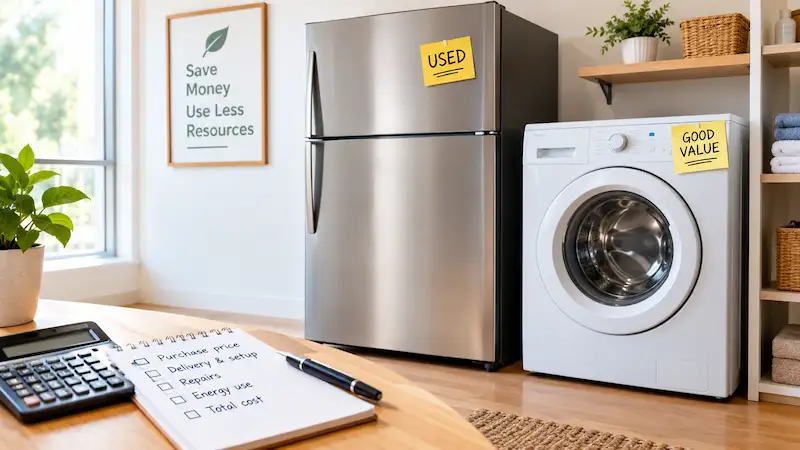
A used refrigerator at half the price of a new one looks like an easy call. Then the delivery fee appears, the seller mentions a 90-day warranty, and you notice the model is eight years old. The sticker price tells you what you pay on day one. It tells you much less about what the appliance costs over the years you actually use it.
So is buying used appliances worth it? That depends on the total, not the discount. This guide shows you how to compare used, new, refurbished, and open-box options over the same period, counting delivery, setup, repair risk, energy use, and replacement. It then works through an example with numbers you can swap for your own.
Is Buying Used Appliances Worth It?
Often yes, when the discount is large, the seller has tested the unit and backs it in writing, and the appliance has real life left. Sometimes no, and those cases are easy to miss because the used price looks so good.
Consumer Reports’ 2022 guide to buying used appliances reported savings of up to 75 percent off original retail price at used-appliance stores and repair shops, with about 50 percent typical. It pointed readers to those shops rather than online marketplaces, largely because of the warranty. Those figures are four years old, so treat them as context, not current quotes.
Used tends to make sense when the discount survives delivery and setup, the seller inspected the unit and offers written terms, the model is young enough to have meaningful life left, and its running cost is close to a new model’s. That last point matters most for refrigerators and freezers, which run all day.
New, open-box, or refurbished may be the better value when the discount is thin, when you want a long manufacturer warranty, when an older used unit would run constantly, or when a retailer bundles delivery, installation, and haul-away.
Used vs. New Appliances: Compare Prices and Potential Savings
Prices vary too much by region, brand, age, and seller for one national table to be fair, and a handful of asking prices would not represent your local market. Use these published reference points as a sanity check, then price your own shortlist. All come from Consumer Reports’ 2022 reporting:
- Discount: up to 75 percent off original retail, about 50 percent on average, before delivery and installation.
- Delivery: $25 to $200 at the shops it contacted, often local only.
- Installation: HomeAdvisor estimates, quoted by CR, of $100 to $200 for a range and $50 to $150 for a washer and dryer, assuming gas, water, electrical lines, and venting already exist.
- Warranty: six weeks to six months, including parts and labor, across a dozen shops.
CR warned that delivery and installation can cost more than the appliance itself, in which case a new unit from a store that includes those services may be the better buy. It described open-box appliances as discounted simply because the box was opened, though some have minor scratches or dents or lack nonessential parts.
This article uses one definition of upfront savings throughout:
Net upfront savings = comparable new purchase and setup cost minus used purchase and setup cost.
Setup means delivery, installation, and any repairs you expect to need right away. Sales tax is left out. Upfront savings are not total savings: a used model that costs less today can cost more to run, repair, and replace.
How to Calculate the True Cost of a Used Appliance
Count the costs beyond the purchase price
Acquisition costs are the purchase price, delivery, installation, required parts, immediate repairs, and any haul-away fee. Operating costs are electricity or gas, water, maintenance, future repairs, and replacement if the appliance fails before you’re done needing it.
For energy, start with the yellow EnergyGuide label and consider other ways to lower your electricity bill. The FTC explains that the label’s yearly energy cost is an estimate based on typical use and a national average energy price, so your cost will differ. Not every appliance carries a label, and the FTC notes it may be inside the appliance. The U.S. Energy Information Administration’s short-term outlook puts the 2026 residential electricity average at 18.2 cents per kilowatt-hour. Your own bill gives the real number.
Estimate remaining useful life
Published lifespans are broad context, not predictions for the machine in front of you, and they don’t always agree. Consumer Reports’ 2022 guide passed along trade-group estimates of 16 years for an electric range. NerdWallet’s report on a 2019 estimate from the same group, the Association of Home Appliance Manufacturers, listed 11.6 years. Both put top-freezer refrigerators at 14 years. Subtracting an appliance’s age from an average and calling it remaining life would be false precision.
Condition, model history, maintenance, usage, and parts availability tell you more. In CR’s reporting, most used-store inventory was under 10 years old, and one repair-shop owner said he aims for customers to get about seven more years from the units he sells. If remaining life drives your decision and you can’t pin it down, run low, base, and high scenarios, as the example below does.
Calculate annualized acquisition cost
Net acquisition cost = purchase price + delivery and setup + initial repairs – expected resale value
Annualized acquisition cost = net acquisition cost ÷ expected years of use
This is a simplified measure of what the purchase costs per year of service. It leaves out operating costs and is not a forecast of lifetime cost. It does show how much the lifespan assumption matters: a $525 acquisition cost is $65.63 a year over eight years but $131.25 over four.
Compare total ownership cost
Total ownership cost = acquisition and setup + operating costs + maintenance and repairs + required replacement – resale value
Use one evaluation period for both options. If one appliance is likely to stop working sooner, add a replacement (stating when, and whether new or used, for both options) or say the comparison is incomplete. The example below ignores resale value and doesn’t discount future costs, so its results are undiscounted estimates.
Find the break-even point
Break-even is where the two options cost the same, such as the repair budget, lifespan, or energy gap that erases the used option’s head start. The used option is cheaper only when its calculated total is lower under your stated assumptions, and that is not a guarantee. Repair cost often decides it, so work out your break-even repair budget: the spending at which the totals match, and consider whether repairing household items makes financial sense.
A worked example (hypothetical numbers)
Every figure here is an assumption chosen to show the method, not market data. Suppose you’re comparing a new and a used 18-cubic-foot top-freezer refrigerator over eight years, shorter than the 11 to 14 years published estimates give for refrigerators and close to the seven years that repair-shop owner told CR he aims for.
- New: $900 price, $50 delivery and haul-away, 400 kWh a year, no repairs.
- Used: $450 price (50 percent off), $75 delivery, 500 kWh a year, shop-inspected so no initial repairs, and one $150 repair after the warranty ends.
- Energy: $0.18 per kWh, rounded from the EIA figure.
- Everything else: no resale value, no discounting, no sales tax.
The used unit’s 25 percent higher energy use sits inside the range of published claims about older refrigerators, covered below.
| Cost over 8 years | New | Used (base case) |
|---|---|---|
| Purchase price | $900 | $450 |
| Delivery and haul-away | $50 | $75 |
| Upfront cost | $950 | $525 |
| Electricity | $576 | $720 |
| Repairs | $0 | $150 |
| Total | $1,526 | $1,395 |
Electricity is kWh times $0.18 times eight years: $72 a year for 400 kWh, $90 for 500. Net upfront savings are $950 minus $525, or $425. Annualized acquisition cost is $118.75 for the new unit and $65.63 for the used one. Over eight years the used unit comes out $131 cheaper, because the $425 head start shrinks by $144 in extra electricity and the $150 repair.
Sensitivity test. The new unit’s total stays at $1,526:
| Scenario for the used unit | Used total | Result |
|---|---|---|
| Base case ($150 repair) | $1,395 | Used is $131 cheaper |
| No repairs | $1,245 | Used is $281 cheaper |
| $400 repair instead | $1,645 | New is $119 cheaper |
| Fails after year 4, replaced by an identical used unit | $1,770 | New is $244 cheaper |
| Uses 650 kWh a year, $150 repair | $1,611 | New is $85 cheaper |
The break-even repair budget at base-case energy use is $281; above that, the new unit wins. The failure scenario assumes a second used unit at the same $525, no repairs, and no cost to haul away the first. Every scenario assumes the new unit never needs a repair, which favors new. These are illustrative scenarios, not probabilities, and your inputs will differ.
Which Appliances Are Worth Buying Used?
No category is universally worth buying used or universally not.
Refrigerators and freezers. They run around the clock, so efficiency matters more here than almost anywhere. ENERGY STAR says an old refrigerator uses about 20 percent more energy on average than a certified model, while the Department of Energy’s refrigerator guidance says 35 percent. Treat that spread as a rough guide and check the model’s EnergyGuide figure or ENERGY STAR’s Flip Your Fridge calculator. Ask about the ice maker, which CR flags as a common problem. If the unit travels on its back, CR says to let it stand upright for a day before plugging it in.
Washers and dryers. Ask what the seller tested, and watch the machine run if you can. Look for leaks, unusual noise, and a door or lid that doesn’t latch; CR says latch switches commonly fail and the drum won’t spin without one. On front-loaders, sniff for mildew and check under the rubber gasket. Confirm that parts exist for the model number. A gas dryer hookup or vent connection is a job for a professional, as CR advises.
Ranges and stoves. Check for visible damage and that knobs, switches, and lights work. CR treats a cracked glass top or a frayed cord as a safety problem and a reason to walk away. Gas connections and new electrical work belong to qualified installers; your own inspection stays visual.
Dishwashers and microwaves. Used shops rarely stock them because new prices are already low, according to CR. Compare against new and open-box prices, and ask whether the discount covers delivery, installation, and a shorter warranty. A $60 saving on a hypothetical $350 dishwasher can vanish in one delivery fee; a much larger gap may justify the risk.
Where to Buy Used Appliances and What Warranty to Expect
Used-appliance stores and repair shops. CR recommends these over other channels: prices tend to be lower, and the main selling point is the warranty. Ask what was inspected, which parts were replaced, whether replacements were new or original-equipment parts, and what the repair history is. CR also suggests checking Yelp and the Better Business Bureau for warranty complaints. Some Habitat for Humanity ReStores offer a 30-day guarantee, CR noted, though their checks may go no further than plugging the unit in.
Private sellers and online marketplaces. CR advises skipping yard sales and online marketplaces because those sellers usually can’t offer a warranty. The FTC’s warranty guide explains the gap: implied warranties on used goods apply when the seller is a merchant who deals in such goods, not when a private individual sells. If you buy privately anyway, test the appliance in person, record the model and serial numbers, and read the platform’s buyer-protection terms, which vary.
Used vs. refurbished vs. open-box. Sellers use these labels loosely, so look past the label to the condition, testing, and written coverage. “Used” generally means previously owned and sold as it is. “Refurbished” suggests repair or testing, but what it includes depends on the seller. “Open-box” usually means a customer return or display model.
Review warranty and return terms. Get them in writing before you pay. Check the duration, whether parts and labor are both covered, exclusions, service fees, who pays for transport or haul-away, and the return deadline. CR says a shop should hand you a printed warranty that spells out coverage. The FTC’s guide adds that written warranties on consumer products costing more than $15 must be available to read before you buy, that a seller who gives a written warranty can’t disclaim implied warranties, that most states but not all allow “as is” sales if the seller says so clearly, generally in writing, and that implied warranties cover condition at the time of sale rather than promising a set lifespan. State law varies, and this is general information, not legal advice.
How to Inspect a Used Appliance Before Buying
Verify model, age, and recall status. Find the manufacturer’s rating sticker, which CR says is usually on a doorjamb or another out-of-the-way spot, and write down the model and serial numbers. CR suggests skipping an appliance with no sticker, since it could have been recalled or scrapped and then illegally salvaged. Then search the Consumer Product Safety Commission’s recall listings for the brand and model; its refrigerator recall page shows what a listing looks like, including model and serial details. CPSC states that federal law prohibits selling products subject to a Commission-ordered recall or a voluntary recall undertaken with the agency. Ask the seller about age and repair history too.
Inspect visible condition and normal operation. CR’s checklist starts with plugging the unit in with the seller present. Check doors, knobs, switches, lights, and fans. Look for rust and damage, confirm it sits level, and sniff for musty odors that can signal water damage. Make sure shelves, drawers, and racks are included; the manual, available online by model number, shows what should come with it. Keep checks external: don’t remove panels or probe live electrical or gas connections.
Know when to walk away. Pass if the sticker is missing, the cord is frayed, a glass cooktop is cracked, you smell mildew, or you see leaks. Pass if the seller can’t or won’t state the age, repair history, and terms in writing, if you can’t confirm recall status, or if the price after delivery and setup is close to a new unit. For gas lines, venting, or electrical hookups, hire a qualified professional.
Pre-purchase checklist
- Model and serial number recorded
- Recall status checked
- Age and repair history discussed
- Normal operation tested where safe
- Parts and accessories confirmed
- Delivery and installation costs confirmed
- Warranty and return terms reviewed in writing
- Total cost compared with new and open-box alternatives
Can Buying Used Appliances Save Money and Reduce Waste?
Extending an appliance’s life keeps it out of the waste stream longer and defers the resources needed to build a replacement, helping reduce waste while saving money through zero-waste living. CR’s 2022 guide, citing United Nations data, noted that large appliances make up about a quarter of global e-waste.
The benefit isn’t automatic. A University of Michigan life cycle model of U.S. refrigerators found that, depending on model year, the replacement interval that minimized energy use ranged from 2 to 7 years and the one that minimized greenhouse gas emissions from 2 to 11 years, while an 18-year lifetime minimized cost. It is an older study of mid-size U.S. models, but it shows how an inefficient old unit can offset the benefit of reuse. A 2022 life cycle study of microwaves, dishwashers, and washing machines found the lowest-footprint operating period ranged from a few years to more than 30, depending on the scenario. Buying used is not automatically greener.
You can often negotiate. CR says haggling is acceptable and even expected, with more room if you pay cash, buy more than one item, or take the unit home immediately. Specific arguments work best: a documented defect, a missing part, a comparable listing at a lower price, your transport costs, or a short warranty.
Your Final Used-Appliance Buying Checklist
Five criteria decide whether a used appliance is a good deal:
- Total upfront price. Purchase price plus delivery, installation, removal, and immediate repairs, compared with a comparable new or open-box unit.
- Condition and recall status. Model and serial recorded, recall search done, condition and operation checked.
- Expected useful life. Age, repair history, parts availability, and low, base, and high scenarios instead of one guess.
- Operating, maintenance, repair, and replacement costs. Energy use from the EnergyGuide label or ENERGY STAR’s calculator, plus a repair budget and break-even figure.
- Warranty, return, delivery, and installation terms. Written, specific, and from a seller you can reach.
Buy used when the numbers hold up: a discount that survives delivery and setup, a young appliance with documented condition, and written coverage from a seller who answers the phone. If the discount is small, the unit is old, or the seller won’t put terms in writing, a new or open-box unit with a full warranty is likely the safer value. Run the numbers on your shortlist first, because the answer can flip on a single repair.
Frequently Asked Questions
There is no universal threshold. CR reported typical discounts of about 50 percent and up to 75 percent in 2022, but the right discount depends on age, condition, warranty, and energy use. In the example above, a used unit that cost about 45 percent less upfront ($525 against $950) came out only $131 cheaper over eight years, and it lost its edge if repairs passed $281. Compare totals over the same period rather than chasing a percentage.