Your phone says the temperature drops into the teens tonight. Before you head to the hardware store, here is how to prevent frozen pipes, starting with steps that cost nothing.
About 1 in 60 insured homes has a water damage or freezing claim each year, based on 2018 to 2020 data from Triple-I’s homeowners insurance statistics. That category is broader than frozen pipes.
This plan gives you seven steps, ordered from free to paid. Each has a sourced cost or an honest trade-off, and temperature triggers help you lower your odds of a freeze.
This guide is built from the public sources named in this article and checked as of October 2026. Because we are editors, not plumbers, each step says when to hire a licensed pro.
To prevent frozen pipes, keep your thermostat at 55°F or higher day and night, open cabinet doors under sinks on exterior walls, and let a faucet on the most exposed pipe run at a slow trickle when a hard freeze is forecast. Before winter, drain and disconnect outdoor hoses and insulate pipes in attics, crawl spaces, garages and exterior walls.
Your plan at a glance
- Open cabinet doors under sinks on exterior walls (Free)
- Disconnect and drain hoses, then protect outdoor faucets (Free)
- Keep the heat on, same setting day and night (No purchase, higher heating bill)
- Let a faucet trickle during a hard freeze (Pennies)
- Seal air leaks near pipes (Price varies, check the store)
- Insulate exposed pipes (Free first, then low cost)
- Use heat cable only for stubborn spots (Price varies, check the store)
Why Pipes Freeze, and Which Ones Are Most at Risk
Which of your pipes sit against an outside wall or in a room you don’t heat? Water expands as it freezes, and that pressure can split a pipe. The Department of Energy’s Energy Saver guidance, checked October 2026, says uninsulated pipes in or near exterior walls can burst in freezing weather.
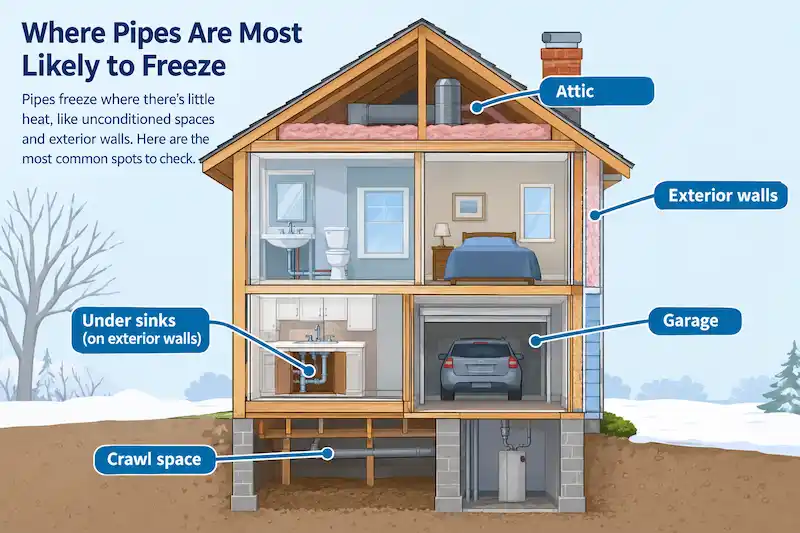
Where pipes freeze comes down to location, because little heat reaches them there. Check these spots first:
- Attics
- Crawl spaces
- Garages
- Exterior walls
- Unheated basements
- Cabinets under sinks on exterior walls
Walk through your home with a flashlight and note which of these spots hold pipes. In states with milder winters, plumbing may sit in less protected spots, so even a short cold snap can cause trouble. Knowing which pipes are exposed lets you spend time and money only where it matters.
What Temperature Do Pipes Freeze? When to Start Acting
Your forecast says 22°F tonight. Is that cold enough to worry? It depends on where your pipes sit.
Multnomah County’s published copy of IBHS guidance, checked October 2026, cites University of Illinois Building Research Council tests. It treats 20°F as the alert point for southern and occasional-freeze areas. That’s a prompt to act, not a floor: where a pipe sits, plus drafts and wind, can matter as much as the number.
| Situation | When to act | Source |
|---|---|---|
| Southern or occasional-freeze area, uninsulated pipes in an unconditioned space such as an attic | Start Steps 1 to 4 as forecast lows approach 20°F | Multnomah County copy of IBHS guidance (University of Illinois tests) |
| Pipes exposed to drafts or wind | Act earlier than the number suggests | Editorial guidance |
| Colder region with longer cold spells | Start before the first hard freeze and watch your local forecast | Editorial guidance |
The 20°F alert was written for southern and occasional-freeze areas. Wind chill describes how cold it feels to people, not a pipe temperature. Wind and drafts do speed heat loss, which can bring freezing on sooner. Seasonal forecasts like this winter’s NOAA and EIA outlook deal in odds, so check your National Weather Service forecast before a cold night. Acting on these triggers means you run a drip or extra heat only when needed.
How to Prevent Frozen Pipes in 7 Steps, Starting With What’s Free
Work down this list in order. Steps 1 to 4 need no purchase, and each step says when to call a licensed pro. Together they help prevent pipes from freezing, but none of them is a promise.
1. Open the cabinet doors under sinks on exterior walls
You can open the cabinet doors when a hard freeze is forecast, then close them once it passes. Warm room air then reaches the pipes, as the Red Cross frozen pipes guidance explains (checked October 2026).
Cost: Free.
Safety: move cleaners and household chemicals up and out of children’s reach before you open the doors.
2. Disconnect and drain hoses, then protect outdoor faucets
You can disconnect your garden hoses and drain them before the freeze arrives. Leave the hose bib open once it’s drained, per the Red Cross guidance, so leftover water has room to expand. If you replace a hose bib, ask a plumber about a frost-proof faucet. No price is sourced here, so ask for a quote.
Cost: Free.
Safety: hose bib replacement is a job for a licensed plumber.
3. Keep the heat on, same setting day and night
You can start by checking whether your thermostat drops overnight, then set it to the same temperature day and night. The Red Cross guidance puts the setting at 55°F or higher, including when you’re away. Sources can differ on the exact minimum, so treat 55°F as a starting point.
Cost: No purchase, but a higher heating bill. Heating costs vary by state, region and utility.
You’ll pay a little more for heat, and you’ll lower the odds of a messy repair.
4. Let a faucet trickle during a hard freeze
You can pick a tap served by the most exposed pipe and let a faucet drip at a slow trickle while the hard freeze lasts. Mississippi State University Extension’s faucet-dripping guidance, checked October 2026, says a trickle helps but cannot guarantee protection. Which tap to open, hot or cold, is where sources differ, so see the FAQ below. A trickle uses water, so for context, see how much water everyday habits use.
Cost: Pennies per faucet, with the math in the cost section below. Water rates vary by utility.
A drip won’t save money or water, and it’s one layer of protection, not a promise.
5. Seal air leaks near pipes
You can look for gaps where cold air reaches your pipes, starting with openings around cables, vents and pipes. Use the same draft-sealing basics we cover for windows around cables and vents that pass through an exterior wall.
Cost: Price varies, check the store.
Safety: seal around vents, never over a vent opening or flue. If you’re unsure what an opening does, ask a licensed pro before you seal it.
6. Insulate exposed pipes
You can start free by wrapping exposed pipes in a quarter inch of newspaper. The Red Cross guidance says that helps where freezes aren’t frequent or prolonged, so it suits mild climates only. Keep it away from heat cable and space heaters.
Foam pipe insulation sleeves come next. DOE’s Energy Saver page estimates $10 to $15 and about 3 hours for hot water pipes in a small house (checked October 2026). Measure first and buy only the length you need. It lists no price for cold pipes or larger homes. On hot water pipes, DOE also lists 3% to 4% in yearly water-heating savings and water 2°F to 4°F hotter. Those are water-heating benefits, not freeze protection. Insulation can also help you cut your water-heating costs.
Cost: Free for newspaper. Foam sleeve prices vary by store and region.
Safety: keep insulation well clear of any gas flue or vent, and see DOE’s page for its clearances. Hire a licensed pro for anything near one.
7. Use heat cable only for stubborn spots
You can add heat cable to a spot that stays cold after Steps 1 to 6. Choose a UL-listed product and follow the manufacturer’s instructions, as the Red Cross guidance advises. Michigan’s winter prep guidance gives similar advice. Placement advice varies between sources, so follow the product’s instructions.
| What it does | Needs power | Main risk |
|---|---|---|
| Foam sleeve: slows heat loss | No | Can still freeze in long deep cold |
| Heat cable: adds heat along the pipe | Yes | Electricity use, fire and shock risk if misused |
Cost: Price varies, check the store, plus the electricity it uses.
Safety: hire a licensed electrician if you’re unsure about outlets.
Skip these shortcuts: Don’t put antifreeze in pool or sprinkler lines unless the maker or installer directs it, per the Red Cross guidance. Keep flammables, including newspaper wraps, stored chemicals and rags, away from heat cable, space heaters and any other heat source.
What Prevention Costs Next to a Water Damage Claim
Prevention costs little next to a typical water damage or freezing claim.
| Step | Cost | Conditions |
|---|---|---|
| Steps 1 and 2 | $0 | None |
| Step 3 | A higher heating bill | No figure; varies by region and utility |
| Step 4 | About 2 cents per night (Mississippi State Extension) to about 15 cents per day (KATV’s report on dripping faucets) | Per faucet; different units |
| Step 6 | $10 to $15 | Hot water pipes, small house (DOE) |
| Steps 5 and 7 | Price varies, check the store | None |
| For comparison | A typical water damage or freezing claim averages $15,400 | Triple-I, 2019 to 2023 |
Triple-I’s category is broader than frozen pipes, covers homeowners policies and excludes AK, TX and PR. Figures checked October 2026.
How much does it cost to let a faucet drip?
The cost of letting a faucet drip is pennies, though your water rate and flow set the exact figure. Mississippi State Extension estimates about 2 cents a night per faucet. KATV, citing Central Arkansas Water, puts a steady stream near 15 cents a day.
| Source | Estimate | Conditions |
|---|---|---|
| Mississippi State Extension | About 2 cents per night | About a gallon an hour; page may date to 2019 |
| KATV | About 15 cents per day | Steady stream; about half a penny a gallon; date unknown |
Find the water rate on your last bill. How many cents does a gallon cost you? Then multiply gallons dripped × your price per gallon, converting units if needed.
Illustrative math, with assumptions:
- Mississippi State: 1 gallon an hour × an assumed 10-hour night = about 10 gallons, so 2 cents implies about $0.002 per gallon.
- KATV: about $0.005 per gallon, so 15 cents a day implies about 30 gallons a day.
- Per faucet, that’s roughly 2 to 15 cents a night or day, or about 6 to 45 cents over three.
- Sleeve payback = project cost ÷ (annual water-heating bill × 3% to 4%). On hypothetical $300 and $500 bills, savings run $9 to $12 and $15 to $20 a year. Payback runs from about 0.5 year ($10 ÷ $20) to about 1.7 years ($15 ÷ $9). Use your own bill.
A drip doesn’t save money, and no step is a promise.
Should You Leave the Heat On When You’re Away?
Yes, keep the Step 3 setting while away: 55°F or higher, day and night, per the Red Cross guidance. Ask a neighbor or friend to check the house, and tell them where your main water shutoff is. Draining the system is an option for a long absence, so ask a licensed plumber how to do it for your home. You’ll pay for some heat, and you’ll lower the odds of a messy repair. Both of those steps are free, but heating costs vary by state, region and utility. Check your policy.
If a Pipe Freezes Anyway: The Short Safety Version
Safety first. Know where your main water shutoff is before you need it. For thawing, the Red Cross guidance lists a hair dryer, a heating pad or warm towels. Never use a blowtorch, kerosene or propane heater, charcoal stove or open flame. Fuel-burning heaters also add a carbon monoxide risk. If water is near outlets or appliances, stay clear of them. Shut off power at the panel only if you can reach it without standing in water, and call a licensed electrician or your utility if you’re unsure. For a burst pipe, call a licensed plumber.
What to Do Tonight
To prevent frozen pipes, start with what you own: open the cabinet doors, drain and disconnect hoses, keep the thermostat steady, and let a faucet trickle if a hard freeze arrives. Add sealing or insulation where free fixes can’t reach. Tonight, do Steps 1 and 2, then check your thermostat’s overnight setting. Call a licensed plumber for hose bib replacement, burst pipes or anything near a gas flue, and an electrician for outlet or cable doubts. For the broader cold-weather checklist, use our guide to winterize your home on a budget.
Frequently Asked Questions
It depends on the source, so open the tap on the most exposed pipe and follow your plumber’s advice. The Red Cross guidance and Mississippi State Extension point to the cold tap. Travelers’ guidance and a contractor quoted by KATV say to drip both hot and cold lines.