Before You Buy It, See If You Can Get It Another Way
You need a drill for one afternoon. There’s a shelf bracket that’s been leaning against the wall for three weeks, waiting to be hung. Your first instinct is to search for the cheapest option online. Within two minutes you’ve found one for $55, and your hand is hovering over the buy button.
Before you click, there’s a different question worth asking: does someone nearby already have a drill they’re not using right now?
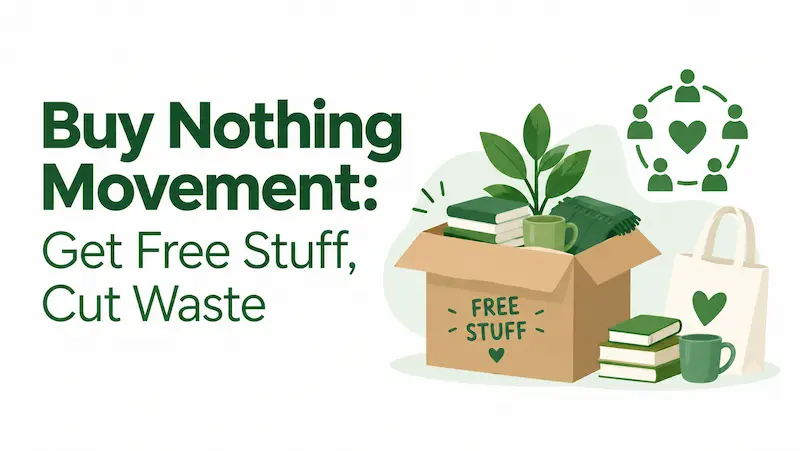
That’s the practical starting point for the Buy Nothing Movement, a global network of hyper-local gift economies where neighbors give, receive, and ask freely, with no buying, selling, or trading involved. But the deeper lesson here isn’t really about the drill. It’s about that pause before the checkout page. The habit of asking whether you need to buy something at all, before you’ve already bought it.
This article explains how the Buy Nothing Movement works, how to find a group near you, how to think about whether “free” is actually the smarter financial choice, and when buying new is still the right decision.
What Is the Buy Nothing Movement?
The Basic Idea
The Buy Nothing Project was founded in 2013 by Rebecca Rockefeller and Liesl Clark in Bainbridge Island, Washington, as a local experiment in community gifting. The idea was simple: give what you no longer need, ask for what you do, and let the value of exchange live in the connection between neighbors rather than in money.
It grew considerably. Today the Buy Nothing Project has more than 14 million members across 50-plus countries, facilitating the redistribution of 2.6 million items monthly, diverting an estimated 162,000 tons of waste from landfills each year.
The word “gift” here is specific. The rules require members to give freely, without any expectation of reward or compensation, and “trading, bartering, buying or selling is counter to the Buy Nothing Project mission.” Everything flows freely, with no expectation of anything in return. The only currency the community runs on is gratitude.
Buy Nothing Doesn’t Mean Never Buying Anything
The name is a little misleading if you take it literally. “Buy Nothing” is more accurately understood as “buy less automatically.” The movement doesn’t require you to swear off retail or treat every purchase as a moral failure. What it asks is that you slow the reflex between “I need something” and “I’ll order it right now.”
Most of us skip a step. We identify a need and move directly to acquisition, usually the most expensive form of acquisition available. The Buy Nothing Movement encourages you to insert a check: what do I already own that might work? Do I need to own this, or just borrow it temporarily? Would someone nearby give it away or lend it out?
The goal is intentional consumption, not consumption avoidance.
Buy Nothing vs. Freecycle, Swapping, and Secondhand Shopping
These terms get used interchangeably, but they mean different things and operate on different rules. Getting them confused leads to misunderstandings about what’s acceptable in a Buy Nothing community.
The Buy Nothing Project is specifically a gift community, not a buy-sell-trade group or barter group. When groups join the Buy Nothing brand, there’s an expectation of what happens in those communities. Members are also asked to participate in only one local Buy Nothing group at a time, to maintain the hyper-local spirit of the project.
Freecycle is an older platform that also facilitates free item exchange, but without the same community-building philosophy or strict geographic restrictions. It operates more transactionally and allows members to join multiple groups.
Swapping and trading communities operate on the exchange of approximately equal value, which is a fundamentally different system. Secondhand marketplaces involve money. All of these have their place, but none of them are Buy Nothing. When someone talks about using Buy Nothing, they should mean the gift economy specifically: free, local, no strings attached.
How Does Buy Nothing Work?
Giving
There are three types of posts available in Buy Nothing communities: Give, Ask, and Gratitude. A Give post is for anything you want to gift to others. You describe the item, add a photo, and members comment to express interest. The giver chooses who receives the item, for any reason they like, and there is no “first come, first served” rule in Buy Nothing.
Asking
When you need something, you post an Ask. Think of it as a neighborhood signal: does anyone have moving boxes? A folding table for a party next weekend? A baby carrier they’ve outgrown? Members who have what you need can respond, and you arrange pickup directly. You won’t always get what you ask for, but even a partial response can save a purchase you were about to make automatically.
Receiving
Receiving a gift in a Buy Nothing community means being chosen by the giver from among people who expressed interest. Following through on a pickup matters. Standing someone up when you’ve agreed to take their item wastes their time and chips away at the trust the whole system runs on.
Gratitude and Community Participation
The third type of post is Gratitude: a way to say thank you to a neighbor or share appreciation about anything Buy Nothing related. Gratitude posts aren’t required, but they do something practical: they show the rest of the community that giving works, which encourages more of it. Groups that practice gratitude actively tend to be more active overall.
Buy Nothing groups are volunteer-run. Local community leaders and group admins generously gift their time and energy to serve their communities. Some groups have their own norms beyond the core guidelines. Reading the pinned posts before your first contribution is always worth two minutes.
How to Find a Buy Nothing Group or Local Sharing Community
Start with the Official Buy Nothing App
The most straightforward path is the BuyNothing app, available for iOS and Android. The app offers the most flexibility for sharing with your neighbors. You can start sharing immediately with people nearby based on your location, and there’s also an option to join or create private sharing communities for specific groups, like a neighborhood, workplace, or apartment building.
The official worldwide directory of registered Buy Nothing groups and communities is accessed through the Buy Nothing app, where location-based search tools make it easier to find nearby options.
Look for Local Facebook Groups
The Buy Nothing Project launched on Facebook, and the majority of its communities still operate there. To find a registered group on Facebook, you can visit the Buy Nothing website, sign in, and navigate to the Registered Groups list in Settings, or search Facebook for “Buy Nothing” followed by the name of your specific neighborhood, town, or city.
Because these groups are hyper-local by design, often covering just a few blocks in a dense city, searching “Buy Nothing Park Slope” will return better results than “Buy Nothing Brooklyn.” When you request to join, most groups will ask a couple of questions to confirm you’re local.
One note worth being aware of: the Buy Nothing Project began enforcing its trademark in late 2025, leading to the shutdown of many independent Facebook gifting groups that used the term “Buy Nothing” without official affiliation. To confirm a group is genuinely registered, check the official list within the Buy Nothing app.
What If There Isn’t a Local Buy Nothing Group?
The app shows nearby participants even where no formal Facebook group exists, so it’s worth checking first. If coverage in your area is genuinely thin, the Buy Nothing Project website explains how to start a registered group.
In the meantime, Freecycle and neighborhood platforms like Nextdoor’s “Free” section can serve a similar purpose, though they operate differently and aren’t part of the official Buy Nothing gift economy.
Read the Rules Before You Post
Every local group has its own culture. Some expect items to “simmer” for at least 24 hours before a giver chooses a recipient. Others move quickly. Some have restrictions on certain items or post formats. A few minutes with the pinned posts will save you an awkward correction on your first contribution.
What Can You Get Without Buying?
The honest answer: a wide range of things, but not everything and not always. What flows reliably through Buy Nothing communities tends to fall into recognizable categories.
Items You Need Only Occasionally
Party supplies, a camping cooler, a ladder, moving boxes: things with an obvious short-use life cycle. You use them once or twice a year, then they sit in storage. They move freely through gift economies because people are relieved to have them go to someone who actually needs them right now.
Items People Commonly Outgrow
Children’s clothing, toys, baby gear, and age-specific sports equipment are among the most actively gifted categories. One household’s “too small” is another’s “exactly right,” and these exchanges happen quickly.
Items That Often Sit Unused
Kitchen appliances used twice a year, duplicate tools, exercise equipment that hasn’t moved since January: these flow out of homes and into ones where they’ll actually get used. One person’s sunk cost is another person’s good timing.
Items With Short-Term Uses
Specialty baking pans, a specific tool for one renovation project, seasonal decorations for an event: things with a defined and time-limited purpose are ideal candidates for borrowing or receiving rather than purchasing. If you’ll use something for two weeks and then never again, ownership was probably the wrong model in the first place.
What’s trickier: large furniture requiring a truck to transport, items needing significant repair before they’re usable, and anything whose true condition can’t be assessed from a photo. Some items also raise safety questions that deserve careful thought before accepting. More on that shortly.
How to Ask for Something Without Buying It
Be Specific About What You Need
“Does anyone have an orbital sander?” is a better Ask than “looking for tools.” Specificity helps the right person recognize they have exactly what you need, and it prevents you from receiving something that doesn’t actually solve your problem.
Be Flexible
If a neighbor has what you need but can only arrange a pickup on a specific day, accommodating that when you can is both considerate and practical. Communities run on goodwill, and flexibility makes them work better for everyone.
Don’t Treat the Group Like a Free Store
Posting multiple Asks simultaneously, requesting high-value items without any prior participation, or returning every week with a new list can feel extractive. The Buy Nothing ethos is that no one is under any obligation to give or receive. Everyone may ask as they choose, and give as they choose. Giving and asking in some reasonable proportion is part of what keeps communities healthy.
Respect the Giver’s Conditions
Pickup windows and communication preferences are the giver’s to set. If you’ve agreed to collect something and can no longer make it, letting them know promptly is basic consideration. It’s also practical: a giver who has a good experience is more likely to post again.
Be Comfortable Saying No
If an offered item doesn’t quite meet your need, or if the condition concerns you, declining is the right call. Accepting things you won’t use transfers the storage and eventual disposal problem from their home to yours without actually solving anything.
How to Give Away Items Responsibly
Start With Your Own Home
Before buying anything new, look around. There are often duplicates, working items that got replaced without real reason, or things that served a life phase that’s now past. Giving these away is the most direct form of Buy Nothing participation, and it’s the side that tends to be underestimated.
Describe the Condition Honestly
A photo and a plain description of any wear, damage, or missing parts prevents wasted trips and disappointed recipients. Items that have seen better days are okay to post as long as you’re upfront about their condition. Honest descriptions match items with the right people.
Don’t Use Giving Away as a Substitute for Proper Disposal
If something is broken beyond practical use, genuinely unsafe, or missing components that make it functional, giving it away doesn’t solve the problem. It moves it to someone else. Broken electronics, structurally compromised furniture, and items at the end of their useful lives belong in the appropriate disposal channel: electronics recycling, hazardous waste programs, or the bin when nothing else applies. The test is whether a recipient could realistically use the item, not simply whether you can find someone to take it.
Is Free Actually Cheaper? The Financial Side of Buy Nothing
This is where careful thinking pays off, because the instinct to count retail value as money saved is nearly universal and often wrong.
“Free” Doesn’t Automatically Mean “Money Saved”
Say someone in your local group is giving away a stand mixer with a retail value of $180. If you weren’t planning to buy a stand mixer, accepting it doesn’t save you $180. It gives you an appliance you didn’t need, that now occupies storage space, and that you’ll eventually have to find a home for.
The more useful question is: was I already planning to spend money on this, and does the free version genuinely replace that planned purchase?
Example: Borrowing a Tool
You were about to spend $65 on a drill for one afternoon of use. A neighbor lends you theirs, and the pickup is two streets away. Actual cash impact: you’ve avoided a $65 purchase with no meaningful additional cost. That’s a concrete financial win.
If the same drill required a 45-minute round trip across town, the calculation shifts. You’ve spent fuel and time. The purchase is still avoided, but the net value of “free” is smaller than it first appeared.
Example: Receiving an Item You Actually Needed
You were planning to spend roughly $35 on moving boxes. Someone in your local group is giving away a stack of clean, intact boxes. You pick them up on your way home from work. The boxes meet your need. You’ve meaningfully avoided a planned $35 purchase, money that could instead go toward your emergency fund.
That’s financially different from receiving a $250 kitchen appliance you weren’t going to buy. The retail value is higher, but the actual financial benefit to you is approximately zero, unless you were genuinely planning to buy that appliance anyway.
Don’t Count Retail Price as Automatic Savings
A practical framework for evaluating the real impact of a “free” item:
Actual financial impact = planned purchase cost minus additional costs
Additional costs can include transportation, repairs needed before the item is functional, required accessories (a printer without ink, a blender without a compatible lid), and cleaning or sanitation. When that result is positive, the free option is genuinely saving you money and fits naturally into a frugal living approach. When it’s zero or negative, the item is just free, not financially advantageous.
When Free Isn’t the Best Deal
Transportation Costs
Picking up a dresser across town means fuel, time, and possibly a borrowed or rented vehicle. If you were about to spend $80 on a dresser at a nearby consignment shop, and the “free” one from across town costs $35 in logistics, the free option has saved you $45, not $80. Still potentially worth it, but worth calculating first.
Repair Costs
A free appliance that needs a $90 repair is only a good deal if the working version would cost you more than $90 to replace outright, and if the repaired version is actually superior to what you could buy for that money.
Time Has Value
Time spent coordinating pickup, driving across town, cleaning an item before it’s usable: these aren’t zero-cost. You don’t need to assign an hourly rate to feel the difference between a five-minute pickup and one that consumes an afternoon.
Condition and Reliability Matter
For items you’ll use regularly, reliability matters more than acquisition cost. A free slow cooker that works intermittently isn’t an equivalent substitute for one you know works every time. For occasional use, some unreliability might be acceptable. For daily use, the calculus is different.
Storage Has a Cost Too
Your home has finite space. Accepting items you don’t have an immediate use for, on the theory that they might come in handy someday, is how clutter accumulates. “Free but I might need it someday” is a different thing from “free and I was about to buy this anyway.”
How Buy Nothing Can Help Reduce Waste
Keep Useful Items in Circulation
The most direct environmental benefit is simple: a usable item that finds a second home stays in circulation longer. That’s better than the same item going to landfill while a new one gets manufactured elsewhere to replace it.
Avoid Unnecessary New Purchases
When a gifting or borrowing arrangement genuinely replaces a new purchase, it avoids the manufacturing, packaging, and transportation associated with that purchase. At the individual level, this is modest. Across millions of exchanges, the aggregate becomes meaningful.
Give Unwanted Items a Useful Second Life
Specialty items, seasonal equipment, and things that have simply been outgrown often have years of useful life ahead of them. Buy Nothing communities extend that life by connecting them with people who need them.
Don’t Turn Waste Into Someone Else’s Problem
The environmental benefit of giving something away only materializes if the recipient actually uses it. An item that moves from your closet to someone else’s closet and then to their bin hasn’t achieved much. This is why declining things you don’t genuinely need, and why honest condition descriptions from donors, are both environmentally relevant behaviors, not just etiquette.
The Buy Nothing Project reports its communities divert an estimated 162,000 tons of waste from landfills each year, based on the volume of items shared monthly. That figure comes from the organization’s own reporting, but the directional claim is reasonable: keeping usable goods circulating locally does reduce waste.
When Buying New Makes More Sense
The Buy Nothing Movement is not an argument against shopping. It’s an argument for shopping more deliberately. There are real situations where buying new is the right decision.
Safety-Critical Products
Car seats, bike helmets, smoke detectors, and children’s safety equipment are the clearest cases. These items may have been through impacts that compromised their structural integrity without visible evidence. They may have passed manufacturer-specified expiration dates. They may have been subject to recalls you can’t verify the resolution of. For products where failure could cause serious injury, buying new with documentation and a warranty is often the smarter choice.
Before accepting any used product in a safety-sensitive category, it’s worth checking the U.S. Consumer Product Safety Commission’s recall database by brand and model number. The search takes about two minutes and can tell you whether a specific item has been recalled and whether a remedy was issued.
Hygiene-Sensitive Items
Mattresses, some bedding, undergarments, and certain personal care equipment are generally better purchased new, for reasons that don’t require extensive explanation.
Products You Will Use Frequently
For items that form part of your daily routine, the cost of unreliability can exceed the cost of buying something dependable. A free work bag with a broken zipper is not a better deal than a reasonably priced one that works consistently.
When the Alternatives Don’t Meet Your Needs
Accepting the wrong thing because it’s free, then buying the right thing anyway, costs more than simply buying the right thing at the outset. Knowing what to stop buying can also help you identify which purchases are worth avoiding altogether. If the free version doesn’t meet your actual need, it’s fine to decline and buy what you need.
The Goal Is Intentional Consumption
None of this is about shopping more, or about feeling guilty for buying. It’s about pausing long enough to ask whether you need to acquire something right now, in the most expensive way available. Often the answer is still yes, and that’s perfectly fine. The goal is just to make that a considered answer rather than a reflexive one.
Try a 7-Day Buy-Less Experiment
This is a SustainCents reader experiment inspired by Buy Nothing principles. It is not an official Buy Nothing Project program. It works much like a short no-spend challenge, but focuses specifically on pausing unnecessary purchases and using community alternatives.
Day 1: Pause Before Buying. Before any non-essential purchase today, stop for sixty seconds. Ask whether you already own something that meets this need. You don’t have to change your decision. Just notice what the pause reveals.
Day 2: Check What You Already Own. Spend fifteen minutes looking through your kitchen, closet, or garage. Many needs dissolve here.
Day 3: Ask. Post an Ask in your local Buy Nothing group or mention a need to a neighbor. See what comes back. The response itself is informative, whether or not you receive anything.
Day 4: Borrow. Identify something you need temporarily rather than permanently. Ask to borrow it rather than acquiring it as a permanent gift or buying it new.
Day 5: Give. Find one item you no longer need and offer it to your community.
Day 6: Avoid One Unnecessary Purchase. Choose one item on your shopping list or in your cart that you don’t genuinely need right now. Leave it.
Day 7: Review. Look back at the week. What did you give? What did you receive or borrow? Which purchases dissolved when you paused? Which ones did you go ahead with, and why? Track what actually worked and what didn’t.
The point isn’t to maximize how much you can get for free. It’s to discover which purchases were automatic rather than considered, and to find out whether a pause makes any of them disappear.
Your Buy-Nothing Decision Checklist
Before spending money on something non-essential, work through these:
- Do I already own something that works well enough for this purpose?
- Do I only need this temporarily, not permanently?
- Could I borrow it from someone I know or through my local community?
- Is there an Ask worth posting in my local Buy Nothing group?
- If I receive something free, will transportation or repair costs reduce or eliminate the financial advantage?
- Is this a safety-critical item where buying new with documentation is the smarter choice?
- Is this item hygiene-sensitive, where used isn’t appropriate?
- Will I actually use this, or am I accepting it primarily because it’s available?
- If I do need to buy something, am I buying the right version for my actual need?
Most purchases don’t need every question on this list. Running through even two or three of them before an unplanned purchase is where most of the real-world savings from Buy Nothing thinking tend to accumulate.
Buy Nothing Etiquette and Safety
Communicate Clearly
Respond when someone contacts you about a Give or Ask. If you’re offering something, set a clear pickup window and stick to it. If you’ve agreed to receive something and can’t make it, let the giver know promptly. Clear, timely communication is what keeps the system functional.
Describe Items Honestly
A photo and an accurate description of any damage, wear, or missing components prevents wasted trips and disappointed outcomes. Omitting relevant flaws isn’t just inconsiderate; it sends the wrong item to the wrong person.
Respect Privacy During Pickup
Pickup is a moment of trust. Keep exchanges pleasant, brief, and considerate. Most community norms advise against asking to enter a home unless specifically invited.
Follow Local Group Rules
Each Buy Nothing community has its own rhythm and any local additions to the project’s broader guidelines. Reading the pinned posts before your first contribution affects how your participation lands.
Don’t Pressure People
If someone chooses a different recipient for their Give, that’s their right. There is no “first come, first served” rule in Buy Nothing. Expressing frustration when not chosen, or pressing a giver to reconsider, is not consistent with the community’s spirit.
Check Product Condition and Relevant Safety Information
For anything used by children, involving electrical components, or serving a structural or safety function, check its condition carefully before accepting. For specific brands and models, the CPSC recall database lets you search to see whether an item has been recalled and whether a remedy has been issued.
Decline Anything You Don’t Need or Trust
You’re not obligated to accept anything offered to you. If an item’s condition concerns you, if it doesn’t meet your actual need, or if you simply don’t have a use for it, saying no is the right decision for everyone involved.
Before You Buy, Ask
Come back to that drill from the beginning. You needed it for one afternoon. Your instinct was to search and buy.
The Buy Nothing approach doesn’t say don’t buy the drill. It says: first, check what you already own. Think about whether you need to own this or just use it once. Ask your neighbors. If none of that works, or if a pickup across town costs more than the drill is worth to you, or if you’re going to use it every weekend and reliability matters, then buy the drill. The right drill, from a source you trust, at a price that makes sense for how you’ll actually use it.
The shift the Buy Nothing Movement offers isn’t from “buy” to “never buy.” It’s a different sequence:
Need → Search → Buy
becomes:
Need → Check → Ask → Borrow or Receive → Evaluate → Buy if necessary
That sequence, applied consistently, is where the real savings and real waste reductions happen, especially when you’re trying to save money while living paycheck to paycheck.
The most useful habit the Buy Nothing Movement builds isn’t getting more free stuff. It’s learning to pause long enough to ask whether you needed to buy something in the first place.
Spend less when you can. Keep useful things in circulation. Buy intentionally when you need to.
FAQs
The Buy Nothing Movement refers broadly to the practice of intentional consumption and local sharing. Its most organized expression is the Buy Nothing Project, a gift economy network founded in 2013 where members give freely, receive freely, and share freely, with no selling, buying, renting, trading, or bartering, and all gifts offered and requested must be freely given without expectation of any reward or reimbursement.