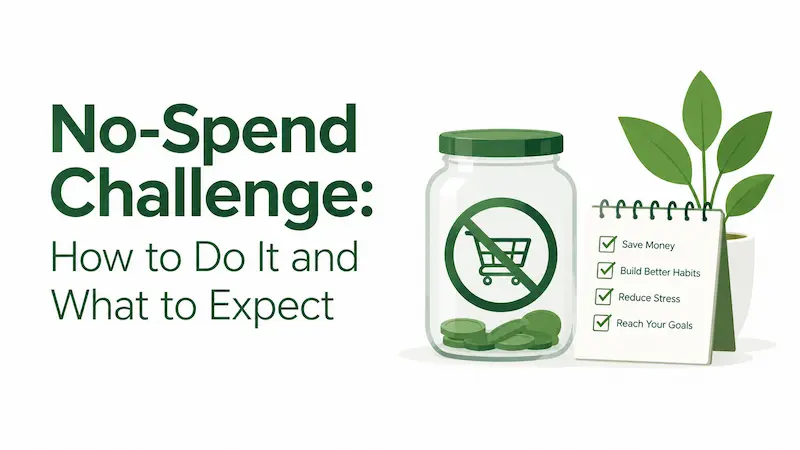
Most people who try a no-spend challenge discover something they didn’t expect: it’s not the absence of purchases that teaches them the most. It’s what happens right before, during, and after.
A no-spend challenge typically means temporarily avoiding most discretionary spending while continuing to pay for necessary expenses. Rent, utilities, groceries, healthcare, and debt payments don’t disappear. What you’re pausing is everything else: the takeout orders, the clothing you didn’t plan to buy, the subscriptions you barely use, the items you add to a cart out of habit.
Framed the right way, a no-spend challenge is a short-term financial experiment. Its real value isn’t willpower. It’s data. When you know what you normally spend, what you actually spend during the challenge, and what happens in the weeks after, you can make deliberate decisions about what to keep, what to reduce, and where the money should go instead.
What Is a No-Spend Challenge?
A no-spend challenge is a personal-finance practice in which someone voluntarily restricts most discretionary spending for a defined period, usually between one week and one month. The term is widely used in personal-finance communities, but it isn’t a standardized program with universal rules. Different households run the challenge differently.
The core idea is consistent: you keep paying for what you need while pausing purchases that aren’t necessary. Discretionary spending covers things like restaurants and takeout, shopping for clothing or household items you don’t urgently need, entertainment purchases, convenience buys, and hobby-related spending. Necessary expenses, including housing, utilities, groceries, insurance, healthcare, and debt payments, continue as normal.
How long a challenge runs, exactly which categories are paused, and what exceptions are allowed are all decisions the household makes in advance.
What a No-Spend Challenge Is Not
A no-spend challenge isn’t an instruction to spend nothing. It doesn’t mean skipping food, skipping healthcare, ignoring bills, or refusing to pay for essential repairs. Households with children don’t stop buying what their children genuinely need. People on medication don’t stop filling prescriptions.
It also isn’t a solution to financial hardship. If essential expenses already exceed or strain your income, restricting discretionary spending may help in some situations, but an extreme spending restriction isn’t a substitute for addressing the underlying gap. If you’re living paycheck to paycheck, a more appropriate starting point may be strategies designed around managing tight cash flow and building savings from a limited margin. The challenge is designed for people who have discretionary spending to pause, not for people already struggling to cover the basics. If you want broader ways to reduce everyday expenses beyond a temporary spending challenge, these frugal living tips cover practical strategies across major household spending categories.
How to Set Your No-Spend Challenge Rules
The rules you set before starting matter more than the ones you improvise along the way. A challenge with clear parameters produces clearer data.
Choose How Long the Challenge Will Last
A 7-day challenge is a reasonable starting point if you haven’t tried this before. It’s short enough to feel manageable and long enough to reveal some patterns. A 14-day challenge gives you more data, particularly if your spending tends to cluster around certain parts of the month. A 30-day challenge, often called a no-spend month, produces the clearest before-and-after comparison but requires more planning.
Longer isn’t automatically better. A well-structured 7-day challenge will teach you more than a poorly defined 30-day one. Choose the duration that fits your upcoming calendar.
Define What You Will Keep Paying For
Before the challenge starts, write down what you will continue to pay. This might include:
- Rent or mortgage payments
- Utilities, including internet and phone
- Groceries (necessary food, not convenience or specialty purchases)
- Transportation costs required for work
- Healthcare appointments and prescriptions
- Insurance premiums
- Minimum or scheduled debt payments
- Necessary household and work-related expenses
What counts as necessary varies by household. A work-from-home contractor who pays for a cloud storage subscription may legitimately consider it a necessary expense. Someone paying for the same service they rarely use probably doesn’t.
Decide Which Spending You Will Pause
Common categories to pause include restaurants and takeout, clothing purchases, nonessential shopping, entertainment subscriptions or purchases you add impulsively, home goods and decor, hobby purchases, and convenience spending like delivery fees for items you could pick up yourself.
The list should reflect where your actual discretionary spending goes, not a generic template. If you rarely eat out but frequently buy hobby supplies, your list should reflect that.
Set Your Exceptions Before You Start
Planned exceptions are different from breaking the rules. If you have a birthday dinner on the calendar, a wedding gift to buy, or a work event that requires spending, acknowledge those now and decide how you’ll handle them. Exceptions decided in advance are part of the rules. Exceptions invented in the moment when something sounds appealing are not.
What Counts as Essential Spending?
“Essential” is contextual, and gray areas come up quickly. A car repair isn’t discretionary if you need the car to get to work. A dental appointment that’s been on the calendar for six months isn’t avoidable. A school supply your child needs for Monday isn’t optional.
A Simple Decision Framework
When a purchase doesn’t fit neatly into your established categories, run through these questions:
- Is this purchase necessary? Not just useful or enjoyable, but genuinely necessary for health, work, safety, or a prior commitment.
- Is it already committed or unavoidable? A scheduled bill, a prior agreement, or a repair that will cost more if delayed.
- Can it reasonably wait until after the challenge? If yes, note it and revisit it later.
- Was it defined as allowed before the challenge started? If it falls within your established exceptions, it qualifies.
- Can I use, repair, borrow, or substitute something I already have? If a need can be met without purchasing something new, that’s worth trying first.
This isn’t a legal test. It’s a practical thinking tool for the moment you’re standing at checkout and aren’t sure.
How to Prepare for a No-Spend Challenge
Preparation is where most challenges succeed or fail before they begin.
Review Your Recent Spending
Pull up the last 30 days of bank or credit card transactions. Look specifically at restaurants, takeout, online shopping, entertainment, subscriptions, and anything that qualifies as a convenience or impulse purchase. Total those categories. This number is your spending baseline. You’ll need it later to calculate what actually changed.
If you haven’t tracked spending in detail before, the Consumer Financial Protection Bureau’s Your Money, Your Goals toolkit includes a free, downloadable spending tracker that helps you sort purchases into categories and identify patterns. Working through even one month of transactions with that kind of structure can make the baseline comparison much more useful.
Check Upcoming Expenses
Look at what’s coming up during your challenge period: birthdays, school events, travel, annual renewals, medical appointments, planned repairs. Flag anything you’ll need to spend on and decide in advance how you’ll handle each item. Surprises during the challenge are often just expenses you forgot to check for.
Review Recurring Charges
Subscriptions and automatic charges are easy to overlook. Go through your bank and card statements and list every recurring charge, monthly or otherwise. Some of these may count as necessary. Others may be services you don’t actively use. If you decide to cancel something, do it because it makes sense for your situation, not just for the duration of the challenge. Canceling and re-subscribing can sometimes cost more than pausing, depending on the service terms.
Plan Groceries Around What You Already Have
Before your challenge starts, take an inventory of your pantry, freezer, and refrigerator. Grocery spending can stay flat or even decrease when meal planning starts with what you already have rather than a blank list. This connects naturally to the broader goal of making consumption more intentional: using existing resources before adding new ones.
Shop Your Home First
Before buying something during the challenge, check whether you already own it or something that could serve the same purpose. A lot of households have duplicate items or things bought and then set aside. Repair when practical, borrow when appropriate, repurpose when possible. This isn’t a zero-waste exercise. It’s a practical audit of existing resources.
Remove Spending Triggers
Unsubscribe from promotional emails. Delete shopping apps or move them off your home screen. Remove saved payment information from retailers where you tend to browse casually. Turn off push notifications from apps that send deals and sale alerts. These steps reduce the number of times you’re prompted to buy something without needing to. They’re optional, but many people find them helpful.
Don’t Stockpile Before the Challenge
Buying a surplus of discretionary items right before the challenge starts doesn’t reduce spending. It moves spending forward. Necessary preparation, like stocking the pantry with staples, is different from a pre-challenge shopping run to buy everything you might want during the restricted period. One is practical planning; the other just inflates your pre-challenge spending and muddies the comparison.
What to Expect During a No-Spend Challenge
You May Notice Your Spending Triggers
A spending trigger is whatever typically prompts a purchase you didn’t plan in advance. Common ones include boredom, convenience, promotional notifications, social situations, and habitual browsing. During a challenge, because you’re paying more attention to each purchase decision, these triggers tend to become visible in a way they normally aren’t. Not every trigger leads to a regrettable purchase. But identifying the ones that do is useful information.
You May Find Alternatives to Buying
Many people discover, midway through a challenge, that they can cook a meal from ingredients they already had, that a borrowed item worked fine, or that entertainment they were paying for was replaceable with something free. These substitutions aren’t universal wins, but when they work, they can reveal spending that was happening out of habit rather than genuine preference.
Essential Expenses Will Still Exist
A no-spend challenge doesn’t eliminate most of your household expenses. Rent, utilities, groceries, and debt payments typically represent the large majority of what a household spends. The Bureau of Labor Statistics’ Consumer Expenditure Survey consistently shows that housing, transportation, and food together account for well over half of average household expenditures before discretionary categories are counted at all. The challenge pauses a subset of spending on top of that, not total spending. Managing expectations here helps you evaluate the results honestly.
Social Situations Can Make the Challenge Harder
Dinners with friends, birthday celebrations, family outings, and casual group plans often involve spending. These situations can create genuine pressure to participate financially, and not all of them have free alternatives. It’s worth thinking through at least one likely scenario before the challenge rather than on the night itself.
You May Be Tempted to Spend at the End
As a challenge nears its end, it’s common to start anticipating purchases that have been postponed. Some of that is fine. Some of it can tip into a rebound spending pattern that offsets what was avoided. How you handle the end of the challenge matters nearly as much as how you handle the middle.
Watch for Spending Displacement
Spending displacement happens when you reduce discretionary spending in one category while increasing it in another. You stop ordering takeout but start buying more expensive groceries, specialty ingredients, and kitchen gadgets. You skip the clothing purchase but replace it with an online purchase in a different category you didn’t initially count as discretionary.
The category reduction is real. The overall financial change may be minimal.
This is why the most useful unit of measurement isn’t one spending category in isolation. It’s total discretionary spending across the challenge period compared with your baseline. If you reduced restaurant spending by $200 but increased convenience and grocery spending by $180, the net change is $20, not $200.
This doesn’t mean every substitution is a problem. Cooking more and eating out less is a genuine shift with financial and other benefits. The point is to measure the result honestly rather than counting only the reduction and ignoring what replaced it.
How Much Can a No-Spend Challenge Actually Save?
The honest answer: it depends on your baseline, what you actually spend during the challenge, and what happens afterward.
Start With Your Baseline
Your baseline is your normal discretionary spending over a comparable period. If you’re running a 30-day challenge, use your previous 30 days as the comparison. Include all the categories you’re pausing, but exclude the necessary expenses you’ll continue to pay. This gives you a realistic picture of what’s actually available to reduce.
Measure Spending During the Challenge
Track discretionary purchases during the challenge. This means logging everything, including allowed exceptions. Don’t estimate. Actual numbers are the only ones worth working with.
Calculate Spending Reduction
The basic calculation is:
Spending reduction = baseline discretionary spending minus discretionary spending during the challenge
Hypothetical example: If your baseline discretionary spending for the month was $600 and your spending during a 30-day challenge came to $180 (mostly planned exceptions), your spending reduction is $420. This number tells you what didn’t leave your account during the challenge. It doesn’t yet tell you whether that $420 is actually saved.
Account for Delayed Purchases
Some purchases you skipped during the challenge will happen afterward. The clothing you didn’t buy, the household item you postponed, the dinner out you held off on: some of these will eventually occur and should be counted against your challenge savings. The honest question is which postponed purchases you ultimately chose not to make versus which ones you simply deferred. A deferred purchase is not a permanently avoided one.
Measure Retained Savings
Retained savings is the portion of spending reduction that remains available after accounting for delayed purchases and any rebound spending. This is a more precise and more honest number than the raw spending reduction.
If you reduced spending by $420 during the challenge but spent $150 on deferred purchases in the following two weeks, your potential retained savings is closer to $270, assuming the rest was intentionally redirected rather than absorbed back into ordinary spending. That assumption matters. Spending reduction becomes retained savings only when the money is actually kept, directed toward a goal, or used to pay down a debt. A number that drifts back into daily spending isn’t savings in any meaningful sense.
No-Spend Challenge Calculator
Use the inputs below to estimate what your challenge may realistically produce. The results depend entirely on the numbers you provide.
Inputs:
- Challenge duration (days)
- Normal weekly discretionary spending
- Expected or actual challenge-period discretionary spending
- Estimated delayed purchases expected after the challenge ends
What the calculator shows:
- Baseline discretionary spending: your normal spending scaled to the challenge period
- Estimated spending reduction: the difference between baseline and challenge-period spending
- Potential amount available to redirect: spending reduction before accounting for delayed purchases
- Estimated retained savings: spending reduction minus estimated delayed purchases
Unless you track your actual spending after the challenge, the retained savings figure is an estimate based on your inputs, not a confirmed result. The calculator is a planning and measurement tool. It reflects what you tell it, which means its output is only as reliable as the numbers you put in.
Common No-Spend Challenge Mistakes
Making Rules Unrealistically Strict
A challenge that prohibits every possible purchase, including genuinely necessary ones, tends to collapse quickly or create stress without producing useful data. Realistic rules are more sustainable than perfect ones, and they produce more honest comparisons.
Forgetting Upcoming Expenses
Discovering a planned expense during the challenge that you didn’t account for can feel like a rule violation when it’s actually just a failure to plan. A calendar review before you start prevents most of these surprises.
Forgetting Recurring Charges
Automatic renewals, subscription deliveries, and membership fees can charge during your challenge period without any active decision on your part. Reviewing these in advance prevents unexpected deductions that skew your numbers.
Stockpiling Before the Challenge
A pre-challenge shopping run for discretionary items produces a higher bill before the challenge starts and a cleaner challenge period that looks better than it actually was. The overall spending picture doesn’t improve.
Treating One Purchase as Total Failure
An unexpected purchase or a weak moment doesn’t invalidate the rest of the challenge. How you handle an individual exception matters less than continuing to track the rest of the period accurately.
Replacing One Spending Habit With Another
As discussed in the displacement section, substituting one discretionary category for another can leave total spending largely unchanged. Watch the aggregate, not just the single category you set out to restrict.
Counting Delayed Purchases as Permanent Savings
If you plan to buy something after the challenge ends, that purchase will show up in your actual numbers eventually. It belongs in your accounting, not your savings column.
Spending Everything Immediately After the Challenge
Rebound spending, buying impulsively once the restriction lifts, can offset the challenge’s results quickly. The end of the challenge is a decision point, not a reset.
Giving the Redirected Money No Purpose
A spending reduction that sits in a checking account until it’s absorbed into ordinary spending has produced no lasting financial change. The redirected money needs a destination decided in advance.
What Should You Do With the Money You Don’t Spend?
The most effective approach is to decide where redirected money will go before the challenge starts, not after. Common options include:
- Adding to an emergency fund
- Applying extra payments toward a high-interest debt
- Contributing to a specific savings goal
- Setting aside money for an upcoming necessary expense
- Directing the amount toward regular monthly savings
Which of these makes the most sense depends on your situation. If you don’t have an emergency fund, that’s often a reasonable first priority: unexpected expenses are more manageable when there’s a cash reserve to draw on rather than a credit card. The CFPB’s guide to building an emergency fund covers the basics of how much to aim for, where to keep it, and how to build one incrementally. High-interest debt is another common priority because carrying it has an ongoing cost that erodes savings made elsewhere. But this is a decision that should fit your actual circumstances, not a universal prescription.
What to Do After the No-Spend Challenge
This section matters as much as any other. The data the challenge generated is only useful if you do something with it.
Compare Your Spending Before and During
Pull your numbers and compare total discretionary spending during the challenge against your baseline. Then look at the category breakdown. Where did the reduction actually come from? Where did spending persist despite your intentions? Were there categories you didn’t expect to reduce that decreased anyway?
Check What Happened Afterward
In the two to four weeks after the challenge ends, track your discretionary spending the same way you did during the challenge. Did total spending return to your pre-challenge level? Did postponed purchases happen, and if so, which ones? Did any money remain set aside? This is where the experiment either holds up or reveals what actually changed versus what was simply postponed.
Identify Purchases You Didn’t Miss
This is one of the most practically useful outputs of the challenge. Spending you skipped and didn’t think about afterward is a strong candidate for permanent reduction. If you went 30 days without a streaming service you’d been paying for and found you didn’t miss it, that’s a clear signal worth acting on.
Identify Purchases That Added Real Value
Discretionary spending isn’t inherently wasteful. Some of it reflects genuine priorities: connecting with people, pursuing something you care about, making your home more livable. The goal of a no-spend challenge isn’t to eliminate everything enjoyable. It’s to spend on what you actually value and reduce what you don’t. Those two categories are worth distinguishing.
Turn the Lessons Into Permanent Rules
Based on what the challenge revealed, consider building one or more lasting practices. If you want additional ideas for turning short-term spending reductions into frugal habits that save money every month, use the lessons from your challenge to choose strategies that fit your actual spending patterns. A few possibilities:
- A limit on how many times per week you order takeout
- A waiting period before non-essential purchases above a certain amount
- A quarterly subscription audit
- A clothing or hobby budget that replaces unlimited spending
- A planned discretionary category that makes intentional spending visible instead of invisible
These aren’t obligations. They’re options based on what your own data showed. The ones worth keeping are the ones that reflect actual patterns you want to change, not arbitrary restrictions applied from the outside.
Is a No-Spend Challenge Right for You?
It May Be Useful If You Want to
- Understand where your discretionary money is actually going
- Interrupt a pattern of impulse or convenience spending
- Run a structured short-term experiment to generate useful spending data
- Redirect money toward a specific financial goal
- Examine consumption habits without committing to a permanent lifestyle change
A Different Approach May Be Better If
- Most of your income already goes toward necessary expenses with little left over
- You’re struggling to cover essential costs, and restricting further could create real problems
- The structure of a strict challenge is likely to produce heavy rebound spending afterward
- Your household requires significant financial flexibility that a rigid rule set would disrupt
If any of these apply, a no-spend challenge could generate stress without producing the useful data it’s designed to reveal. If you’re trying to save on a tight budget with very little discretionary income, a beginner-focused guide to saving money on a low income may be a better place to start.
Consider a Low-Spend or Category-Specific Challenge Instead
If a full no-spend challenge feels either too disruptive or too easy given your current spending level, a low-spend or category-specific challenge may be a better fit. A no-buy challenge applied to a single category, like clothing or takeout, addresses a specific spending pattern without restricting everything else.
No-Spend vs. Low-Spend vs. No-Buy
| Approach | Main Idea | Flexibility | Best Use |
| No-spend | Pause most discretionary spending | Low | Short-term reset and spending audit |
| Low-spend | Reduce discretionary spending | Medium to high | Sustainable habit change over time |
| No-buy | Ban selected categories only | Medium | Addressing a specific spending pattern |
These are different tools, not a hierarchy. None is universally better than the others. The right choice depends on what you’re trying to learn or change and how your household tends to respond to structured restrictions.
Can You Do a No-Spend Challenge With a Family?
If You Have a Partner
The challenge works best when both adults agree on the rules before it starts, including exceptions and how to handle shared versus individual spending. Disagreements about what counts as necessary or discretionary are easier to resolve in advance than in the moment. Some households include a small personal spending allowance for each adult that doesn’t require justification, which can reduce friction without undermining the overall goal.
If You Have Children
Children’s necessary expenses, including school supplies, medical needs, and age-appropriate activities, are not the target of a no-spend challenge. The challenge can still work with children in the household; it just requires more planning around upcoming school requirements, activities, and family plans. Involving older children in age-appropriate ways, such as explaining the goal or suggesting free weekend alternatives, can help without placing adult financial pressure on them. Necessary spending on children isn’t a failure of the challenge.
For Shared Household Expenses
Shared household necessities continue as normal. Individual discretionary spending is where the restrictions apply. Keeping those two categories clearly defined reduces the chance of disagreement about what the challenge actually covers.
No-Spend Challenge Rules Template
Copy this template and fill it in before your challenge starts.
Challenge dates:
Goal:
Essential spending allowed:
Categories I will pause:
Planned exceptions:
How I will handle unexpected essential expenses:
Where redirected money will go:
No-Spend Challenge Checklist
Before
- Choose start and end dates
- Set a clear goal for the challenge
- Review the last 30 days of spending to establish a baseline
- Define which spending counts as essential
- Define which categories you will pause
- Write down planned exceptions
- Check upcoming expenses and scheduled bills
- Review recurring subscriptions and automatic charges
- Take a pantry and freezer inventory; plan meals around what you have
- Decide where redirected money will go
During
- Track all discretionary spending, including allowed exceptions
- Record purchases you considered but chose not to make
- Watch your total discretionary spending for displacement across categories
- Note what triggers the urge to buy something
- If you make an unplanned purchase, continue the challenge rather than abandoning it
After
- Calculate total spending reduction compared with baseline
- Identify which skipped purchases you’ve since made (delayed purchases)
- Determine retained savings where you can actually measure it
- Compare before, during, and after spending by category
- Identify habits that are worth keeping permanently
The purpose of a no-spend challenge isn’t to prove something about self-discipline or to see how many days you can go without buying anything enjoyable. Those frames miss the point. The longer-term goal is to become more intentional about spending, which is where developing a frugal mindset can help turn the lessons from a temporary challenge into lasting behavior.
What the challenge is actually designed to produce is data you didn’t have before: a clear look at where discretionary money goes, which spending patterns are habitual rather than intentional, and whether the money you temporarily redirect stays redirected or quietly flows back into ordinary spending.
The most useful outcome isn’t a number from the middle of the challenge. It’s the comparison between before, during, and after, including what happened to the money once the restrictions lifted. That comparison is what turns a short-term experiment into a lasting financial decision.
Frequently Asked Questions
A no-spend challenge is a voluntary, time-limited practice of avoiding most discretionary purchases while continuing to pay for necessary expenses. The duration and specific rules vary by household. Its primary use is as a short-term spending audit, not a permanent lifestyle.