The average American generates 4.9 pounds of trash per day, according to the Environmental Protection Agency . Over a full year, that adds up to roughly 1,800 pounds of discarded material per person, the vast majority of which ends up in a landfill where it sits for decades, releasing methane and leaching chemicals into groundwater.
The zero waste lifestyle is a direct, practical response to that reality. It is not a perfect solution, and it does not require you to overhaul your entire household in a weekend. What it does require is a shift in how you think about consumption, and a willingness to make a series of small, permanent changes that compound over time into something significant.
This guide covers everything you need to start. You’ll learn what zero waste actually means, how the 5 R’s framework works in practice, what to do during your first 30 days, and how to build habits that last rather than trends that fade by February. If you want a hands-on roadmap with more granular first steps, How to Start a Zero Waste Lifestyle (Step-by-Step for Beginners) walks through the exact process in sequential detail.
What Is a Zero Waste Lifestyle?
A zero waste lifestyle is a set of principles and daily habits designed to minimize the amount of material a person sends to landfills, incinerators, and waterways. The goal is not the literal elimination of all waste, but a fundamental rethinking of consumption: refusing what you do not need, reducing what you buy, reusing what you have, and composting or recycling only what remains.
The Philosophy Behind Zero Waste
The zero waste movement is built on one central challenge to modern consumer culture: the most sustainable product is one that never gets made in the first place.
Most products today follow a linear path. Raw materials are extracted, manufactured into goods, purchased, used briefly, and discarded. Zero waste advocates for a different model, a circular one in which materials stay in use for as long as possible, products are designed for durability and repairability, and the concept of “trash” is replaced with the idea of “resources temporarily out of place.”
The Zero Waste International Alliance defines zero waste as “the conservation of all resources by means of responsible production, consumption, reuse, and recovery of products, packaging, and materials without burning and with no discharges to land, water, or air that threaten the environment or human health.” That definition is technical. The lived version is far more accessible. It starts with small, repeatable decisions: carrying a reusable bag, buying produce loose instead of pre-packaged, composting kitchen scraps instead of bagging them.
AUTHOR NOTE: The single biggest misconception about this lifestyle is the word “zero.” People hear it and immediately imagine a purity standard they cannot meet, so they don’t start at all. In every practical sense, zero is the direction, not the destination. The households making the most meaningful environmental impact are not the ones producing no trash whatsoever. They are the ones who reduced their waste by 70 or 80 percent and kept that reduction sustainable for years.
Zero Waste vs. Recycling: What Most Beginners Get Wrong
Recycling is a waste management tool. Zero waste is a consumption philosophy. These are not the same thing, and conflating them is one of the most common reasons beginners make slow progress.
Recycling sits near the bottom of the waste hierarchy because it still consumes energy, water, and industrial processing to work. A recycled plastic bottle is better than a landfilled one, but it is not better than a reusable bottle that replaces 500 plastic ones over five years. Zero waste reorients your entire relationship with stuff. Instead of asking “can I recycle this?”, you learn to ask “can I avoid needing this in the first place?”
The scale of the problem makes this distinction important. The EPA reported that in 2018, Americans generated 292.4 million tons of municipal solid waste, with only about 94 million tons (32.1%) being recycled or composted. Recycling infrastructure alone cannot solve a waste problem generated at that volume.
The 5 R’s of Zero Waste: The Framework Behind the Philosophy
Before you touch a shopping list or browse reusable products, it helps to understand the decision-making hierarchy that makes zero waste coherent rather than a random collection of eco-tips. The 5 R’s framework, popularized by Bea Johnson in Zero Waste Home, gives you a mental model you can apply to virtually any purchase or disposal decision you face.
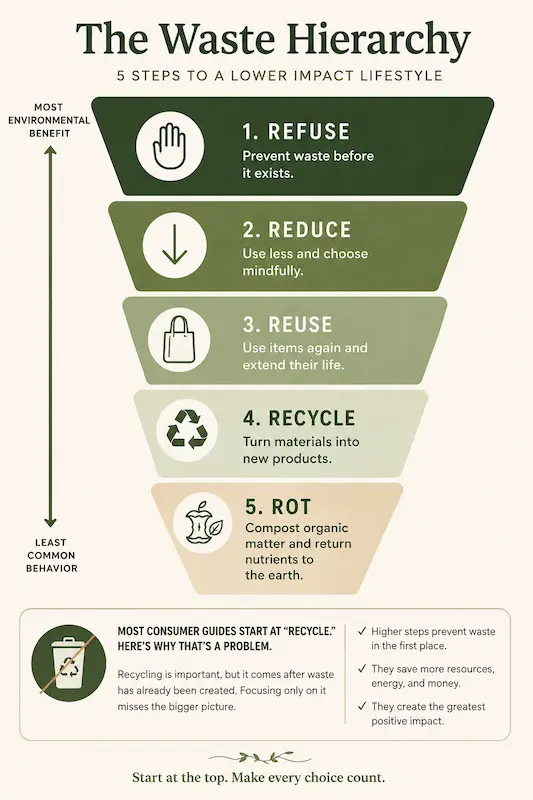
Refuse, Reduce, Reuse, Recycle, Rot — In That Order
| Priority | The R | What It Means in Practice | Real-World Example |
| 1 | Refuse | Decline things you don’t need, before they enter your home | Say no to a plastic straw, a promotional tote, a paper receipt |
| 2 | Reduce | Buy and consume less overall, choose quality over quantity | Buy fewer clothes, use a library instead of buying books |
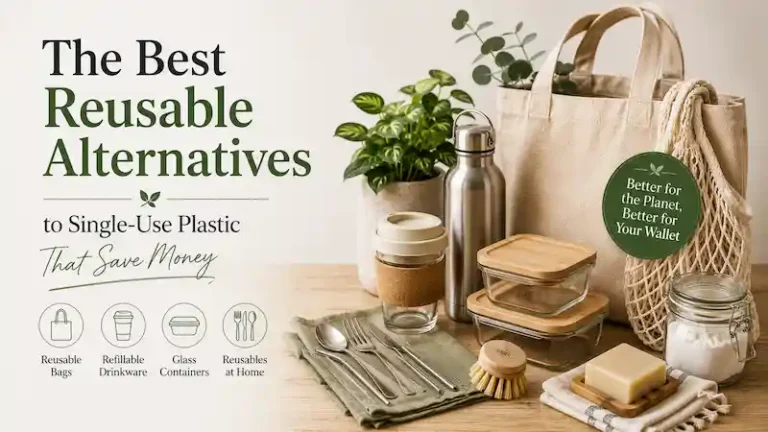
| 3 | Reuse | Choose durable alternatives over single-use items | Stainless water bottle, cloth napkins, refillable coffee cup |
| 4 | Recycle | Process materials into new raw materials (last resort) | Glass jars, flattened cardboard, clean paper |
| 5 | Rot | Compost organic material to divert it from landfill | Food scraps, yard waste, unbleached paper towels |
Most beginner guides skip straight to “Recycle” because it is the step that requires the least change in daily behavior. The 5 R’s invert that logic intentionally. The steps that matter most appear first, and they involve changing what you bring into your home before worrying about what happens to it afterward.
Why the Sequence of the 5 R’s Changes Everything
If you begin with recycling and work backward only occasionally, your consumption rate stays roughly the same. You are managing waste more responsibly, which matters, but you are still generating it at the same pace. The 5 R’s sequence is designed to break that pattern at the source.
PRO INSIGHT: In observing hundreds of household zero waste transitions, the fastest measurable impact consistently comes from “Refuse” in the first 90 days. Declining junk mail, marketing inserts, promotional freebies, single-use condiment packets, and unnecessary packaging before it crosses your threshold eliminates waste before you ever have to sort, clean, or compost it. That is fundamentally more efficient than managing it downstream.
“Rot” refers to composting, and it occupies the fifth position because it addresses organic material that cannot realistically be refused, reduced, or reused. Food scraps decomposing in landfills do so without oxygen, producing methane, a greenhouse gas the EPA identifies as roughly 28–36 times more potent than carbon dioxide over a 100-year period. Composting converts those same scraps into soil amendment with no methane output at all.
How to Start a Zero Waste Lifestyle in Your First 30 Days
Most people who try zero waste and abandon it within three months make the same mistake: they attempt too much change simultaneously. The result is friction, frustration, and an eventual return to previous habits. A structured 30-day approach builds one habit at a time, giving each change time to become automatic before adding the next.
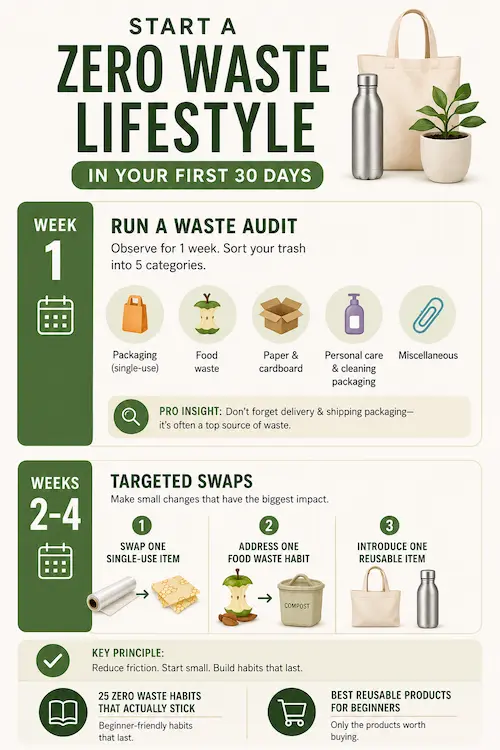
Week 1 — Run a Waste Audit Before Changing Anything
The most useful first step in a zero waste lifestyle is also the most overlooked: spend one week generating waste exactly as you normally do, but collect everything in a single trash bag rather than emptying it as you go. Do not change your behavior. Observe it.
At the end of the week, sort your trash into five categories:
- Single-use packaging (plastic bags, food wrappers, takeaway containers, coffee cups)
- Food waste (produce that spoiled, leftovers that weren’t eaten, expired pantry items)
- Paper and cardboard (paper towels, mail, packaging, tissues)
- Personal care and cleaning product packaging (bottles, tubes, wipes, disposable razors)
- Miscellaneous (broken items, pens, receipts, random plastic odds and ends)
Weigh each pile if possible, or simply rank them by volume. Most households discover that food waste and single-use packaging together represent 60 to 80 percent of their total trash. Targeting those two categories first produces faster results than spreading effort thinly across all five.
PRO INSIGHT: The audit consistently reveals a category most households are not tracking: delivery and shipping packaging. Cardboard boxes, bubble wrap, air pillows, and plastic film from online orders accumulate invisibly because they arrive separately from regular household trash and get recycled (optimistically) or binned without much thought. Before your audit, log every online order placed in that week. For most households in 2026, this category rivals food packaging in total volume.
Weeks 2 Through 4 — Targeted Swaps Based on What You Actually Throw Away
Once you know where your waste comes from, you make targeted changes instead of guessing. The goal in weeks two through four is not to replace everything at once. It is to work through what you already have and introduce one or two alternatives as items run out.
Start with your highest-volume, highest-frequency waste items. For most households coming out of the audit, this means:
- Swap one single-use kitchen item: plastic wrap replaced with beeswax wraps, or paper towels replaced with washable cloth alternatives
- Address one food waste habit: start a meal-planning system, or begin composting kitchen scraps
- Introduce one reusable carry item: a cloth grocery bag kept by the door, a reusable water bottle for daily use
The principle here is friction reduction. The easier a zero waste habit is to execute, the more likely it becomes permanent. 25 Zero Waste Habits That Actually Stick (Beginner-Friendly) covers the specific habits with the highest sustainability rates, based on what beginners actually maintain past the six-month mark versus what gets abandoned.
Zero Waste by Room: Where to Make the Biggest Impact
The zero waste lifestyle touches every area of your home, but not every room deserves equal attention from the start. Three areas generate the overwhelming majority of household waste and offer the clearest entry points for change.
After reviewing waste audits from dozens of households across varying income levels and living situations, the pattern holds: kitchen, bathroom, and grocery shopping are responsible for the majority of single-use plastic and avoidable waste in most homes. Start there.
The Zero Waste Kitchen: Your Highest-Leverage Starting Point
The kitchen is where most household waste originates. Food packaging, food scraps, paper towels, plastic wrap, disposable storage bags, and single-use cleaning supplies all accumulate here at a pace that makes the kitchen the single highest-leverage starting point for any zero waste transition.
The single most impactful kitchen change for most households is eliminating the three disposable storage defaults: plastic bags, cling wrap, and paper towels.
Replacing these three items with reusable silicone bags, beeswax wraps, and washable cloth towels removes a significant share of the average kitchen’s weekly trash without requiring any change to cooking habits, meal planning, or grocery shopping. These swaps also cost less over time, because the reusable versions last years rather than weeks.
Beyond storage, food waste itself represents one of the most significant and most fixable contributors to household garbage. The USDA estimates that between 30 and 40 percent of the food supply in the United States is wasted each year. At the household level, this manifests as produce that spoils before use, portions that get cooked but not eaten, and pantry items that expire. A zero waste kitchen approach addresses shopping habits, storage methods, and meal planning as a connected system rather than isolated fixes.
The Zero Waste Bathroom: Easy Swaps That Last Years
The bathroom is dense with products designed for single or short-term use. Razors, cotton rounds, shampoo and conditioner bottles, plastic toothbrushes, and single-use makeup wipes cycle through most households at a fast pace, generating substantial packaging waste that is almost entirely avoidable.
Several durable alternatives to these items now outperform their disposable counterparts on user experience, not just environmental impact. A safety razor with replaceable blades eliminates plastic handle waste entirely; one handle lasts indefinitely, and replacement blades are sold in paper packaging. Shampoo bars in minimal or zero packaging replace plastic bottles. Bamboo toothbrushes have a compostable handle. Reusable cotton rounds, typically sold in sets of 10 to 16 and washed between uses, replace disposable ones.
The transition does not require overhauling your bathroom in a single shopping trip. Work through what you already have before replacing it, then choose the lower-waste alternative when you run out. Discarding a functional product to replace it with a “greener” version defeats the purpose entirely.
Zero Waste Grocery Shopping: Where Most Single-Use Plastic Enters Your Home
Grocery shopping is the primary entry point for single-use plastic in most households. Produce bags, food wrappers, plastic clamshells, and packaging for pantry staples enter the home every week and exit as trash within days. Addressing this one shopping routine has an outsized effect on overall waste output.
The most effective grocery changes are behavioral rather than product-dependent: buying loose produce instead of pre-packaged, choosing bulk bins over individually packaged items where available, and bringing your own reusable bags and lightweight produce bags. Many urban and suburban areas now have farmers markets, package-free retailers, and bulk food stores that make lower-waste grocery shopping significantly more accessible than it was five years ago.
What Zero Waste Actually Costs: A Realistic Budget Breakdown
One of the most persistent and damaging myths about the zero waste lifestyle is that it requires significant upfront spending. Specialty shops and Instagram aesthetics have built an association between zero waste and premium bamboo products, glass storage sets, and artisanal beeswax wraps that can make the lifestyle appear inaccessible. The financial reality is more nuanced, and for most households, it is considerably more favorable.
Free Changes You Can Make Before Spending a Dollar
The majority of meaningful zero waste practices cost nothing. They involve behavioral changes that reduce consumption rather than substituting one product for another:
- Refusing plastic bags at checkout by carrying a bag you already own
- Declining promotional freebies, branded giveaways, and single-use items you do not need
- Canceling catalog and junk mail subscriptions through a free opt-out service
- Switching to paperless billing and digital statements
- Planning meals for the week to eliminate impulse produce purchases that spoil
- Repairing items before replacing them (a loose button, a broken zipper, a cracked handle)
- Borrowing, renting, or buying secondhand before purchasing new
These changes save money immediately and require zero product purchases. A household that eliminates food waste alone, through better meal planning and storage habits, saves an average of several hundred dollars per year. A zero waste lifestyle can also reduce spending across everyday household purchases by replacing disposable products, cutting unnecessary consumption, and making better use of what you already own. Zero Waste Lifestyle on a Budget: Save Money While Going Green puts real numbers to these savings, including a breakdown of how much the average household spends annually on items that zero waste habits replace.
Reusable Swaps Worth the Upfront Investment (With Payback Timelines)
When you do spend money on reusable alternatives, the math nearly always works in your favor over a time horizon of six to twelve months. The following table shows the most common beginner swaps, their typical annual cost in disposable form, and how long the reusable alternative takes to pay for itself:
| Item | Disposable Annual Cost | Reusable Alternative | Upfront Cost | Payback Period |
| Bottled water | $300–$500 | Stainless steel water bottle | $20–$35 | 3–5 weeks |
| Paper towels | $80–$130 | Cloth unpaper towels (12–16 pack) | $18–$28 | 2–3 months |
| Plastic sandwich bags | $35–$55 | Silicone reusable bags (6-pack) | $18–$28 | 4–6 months |
| Disposable razors | $55–$90 | Safety razor + bulk blades | $25–$45 | 4–8 months |
| Disposable cotton rounds | $25–$45 | Reusable cotton pads (12–16 pack) | $12–$20 | 3–5 months |
| Plastic produce bags | $10–$20 | Mesh reusable produce bags | $8–$14 | 4–6 months |
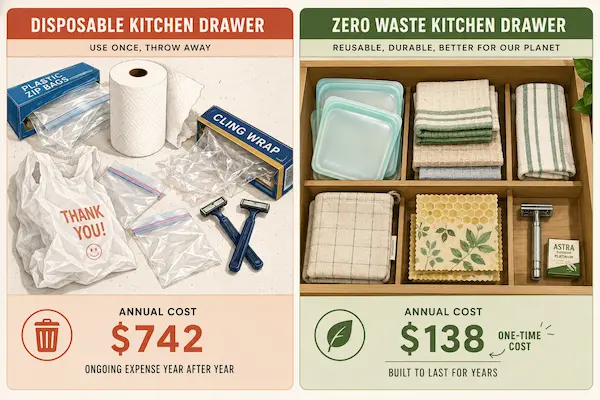
The operating principle behind all of these swaps is the same: a higher one-time cost replaces a lower recurring cost. Over three to five years, most zero waste households spend substantially less on consumables than they did before making the switch.
The key is sequencing. Replace items as they run out, not before. Throwing away a half-used roll of plastic wrap to buy beeswax wraps immediately is still waste, and it is still spending that was not necessary. Frugal Zero Waste Living: Spend Less, Waste Nothing covers the financial side of this lifestyle in more depth, including how to phase transitions so you are never spending on things you don’t yet need.
Zero Waste Beyond Your Kitchen and Bathroom
The zero waste lifestyle extends beyond the rooms you visit most often. It shapes how you approach shopping, celebrations, home cleaning routines, your living situation, and even how you give gifts.
After working with households at different life stages, one consistent observation stands out: the people who sustain zero waste long-term are the ones who connect it to a broader set of values, rather than treating it as a checklist of product swaps. The kitchen and bathroom swaps are tactics. The philosophy is what keeps them going.
Zero Waste and Minimalism: Two Philosophies That Reinforce Each Other
Zero waste and minimalism are separate philosophies that point in the same direction. Minimalism focuses on the number and quality of possessions you own. Zero waste focuses on what happens to those possessions across their full lifecycle. They reinforce each other naturally: a household with fewer possessions generates less packaging waste when shopping and less material waste when items wear out or become obsolete.
Adapting Zero Waste to Your Living Situation
Zero waste does not look the same in every household. Families with young children face specific pressures: constant snack packaging, school supplies, toys that break quickly, and a continuous cycle of outgrown clothing.
Apartment dwellers work with different constraints: limited storage space, no backyard for composting, shared recycling infrastructure that may or may not be adequate, and landlords who control whether energy-efficient appliances are installed.
Gift-giving is another area where waste accumulates invisibly. Excessive packaging, unwanted items that end up in landfills, and single-use decorative wrapping paper together represent a meaningful waste category that concentrates around holidays and celebrations.
For laundry specifically, the standard routine generates consistent plastic waste through liquid detergent bottles, single-use dryer sheets, and fabric softener jugs. Concentrated detergent strips, powder in cardboard packaging, and wool dryer balls eliminate most of this packaging without sacrificing cleaning performance.
One terminological distinction worth clarifying: zero waste and sustainable living are related but not identical. Zero waste focuses specifically on what you discard and where materials go at the end of their useful life. Sustainable living is a broader framework encompassing energy use, water consumption, food sourcing, and transportation choices in addition to waste.
Realistic Expectations and the Mistakes That Derail Beginners
The zero waste lifestyle has an image problem that its most enthusiastic advocates inadvertently created. Photos of a full year’s worth of waste fitting into a single mason jar, pantries lined with identically labeled glass jars, and morning routines executed without a single piece of packaging make the lifestyle look both effortless and absolute. For a beginner, this creates a standard that feels impossible before they have even started.
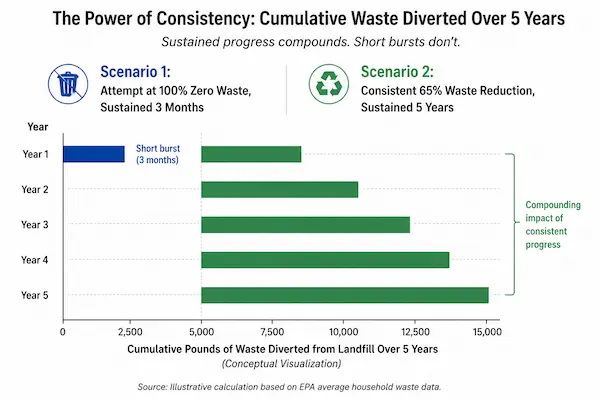
The most important mindset shift for anyone starting a zero waste lifestyle is accepting that “progress over perfection” is not a compromise or a consolation prize. It is the actual operating philosophy.
No household eliminates all waste in the first month, or the first year. Expecting to do so sets up a guilt cycle in which any lapse feels like failure rather than a normal part of changing established habits. Consistent, incremental progress over two or three years produces more environmental impact than a single perfect week followed by burnout and abandonment.
Why “Progress Over Perfection” Is Not a Compromise, It Is the Method
The environmental math on this is straightforward. A household that reduces its waste by 60 percent and sustains that reduction for five years removes far more material from the waste stream than one that achieves 100 percent zero waste for three months before reverting entirely. Sustainability, in the behavioral sense, is what multiplies impact over time.
This framing also changes how you respond to setbacks. You forgot your bag and accepted a plastic one. You ordered takeout and got three containers and a plastic fork. You bought something with unnecessary packaging because it was the only option available. None of these events undo the habits you have built, and none of them are reasons to stop. They are normal moments in a real-world zero waste practice.
Five Beginner Mistakes That Cause Early Abandonment
These five patterns appear consistently among people who start zero waste with genuine intention but struggle to sustain it past the 90-day mark.
- Replacing functional items before they wear out. Using a working plastic container is more zero waste than throwing it away to buy a glass one. Replace as items naturally reach end of life.
- Treating the lifestyle as binary. Any reduction in waste is meaningful. Abandoning the entire practice over occasional plastic use defeats the purpose entirely.
- Skipping the waste audit. Without knowing where your waste actually comes from, you are guessing at solutions. The audit removes the guesswork and makes everything more efficient.
- Optimizing aesthetics before habits. Matching glass jars and linen produce bags are a result, not a prerequisite. Build the habits first.
- Attempting it alone in a shared household. A household where one person is zero waste and everyone else is not creates friction that exhausts the motivated person. Getting basic alignment from the people you live with, even at a minimal level, changes the sustainability equation dramatically.
PRO INSIGHT: The households that maintain zero waste practices for three-plus years share one behavioral trait: they engineer their environment to make the right choice the easiest choice. A compost bin positioned next to the kitchen sink eliminates the extra step that causes most people to toss food scraps in the regular bin instead. A hook at the front door for reusable bags means they are never forgotten. A designated spot for items to be repaired prevents the “I’ll deal with it later” cycle that ends in disposal. Systems outlast motivation every time.
Frequently Asked Questions About Zero Waste Living
These questions come up consistently among people starting a zero waste lifestyle, and each answer is designed to be a self-contained, complete response rather than a partial answer that requires reading the rest of the article for context.
What is a zero waste lifestyle?
A zero waste lifestyle is an approach to daily life that prioritizes refusing unnecessary items, reducing consumption, reusing products, recycling as a last resort, and composting organic waste. The goal is to divert as much material as possible from landfills and incinerators by rethinking what you buy and how you use it, guided by the 5 R’s framework.
How do I start a zero waste lifestyle as a beginner?
Start with a one-week waste audit: collect your trash without changing your behavior, then sort and categorize it. Identify your top two waste sources and address those first rather than changing everything at once. For most beginners, the kitchen and bathroom offer the most accessible high-impact changes within the first 30 days.
Is zero waste realistic for the average person?
A lifestyle of literal zero waste is not realistic for most people within modern consumer systems, where single-use packaging is often the only available option. Significant waste reduction is fully realistic. Most households can eliminate 50 to 70 percent of their waste within six to twelve months through behavioral shifts and targeted product swaps, without dramatic lifestyle disruption.
What are the benefits of a zero waste lifestyle?
Key benefits include reduced household spending as disposable products are replaced by durable ones, lower environmental impact through landfill diversion, a less cluttered home, and greater intentionality around consumption. Many practitioners also report a stronger sense of alignment between their values and daily habits, which carries its own quality-of-life benefit.
How much does it cost to start a zero waste lifestyle?
Starting a zero waste lifestyle costs very little if you begin with behavioral changes: refusing unnecessary items, reducing food waste, and reusing what you already own are all free. Essential reusable products (a cloth bag, a water bottle, beeswax wraps) represent a one-time outlay under $50 for most households, with a payback period of two to four months.
Your First Step Starts This Week
A zero waste lifestyle is not a destination you arrive at fully formed. It is a set of principles that gradually reshape how you buy, use, and discard the things you own, and it gets easier with every habit that becomes automatic. The 5 R’s give you a decision-making framework you can apply anywhere. The waste audit gives you a starting point specific to your household, not a generic list of tips someone else wrote for their household. The understanding that progress outweighs perfection gives you the permission to start where you are.
Your most useful action this week is the waste audit. Spend seven days collecting your trash without changing your behavior, then identify your top two waste categories. From there, How to Start a Zero Waste Lifestyle (Step-by-Step for Beginners) walks you through the exact process for making your first targeted changes based on what you actually find.
Zero waste is one of the most practical forms of environmental action available to individuals. It costs less than conventional consumption over any meaningful time horizon. It produces a cleaner, less cluttered home as a side effect. And unlike many environmental commitments that require infrastructure or policy change to work, it is entirely within your control to begin today.