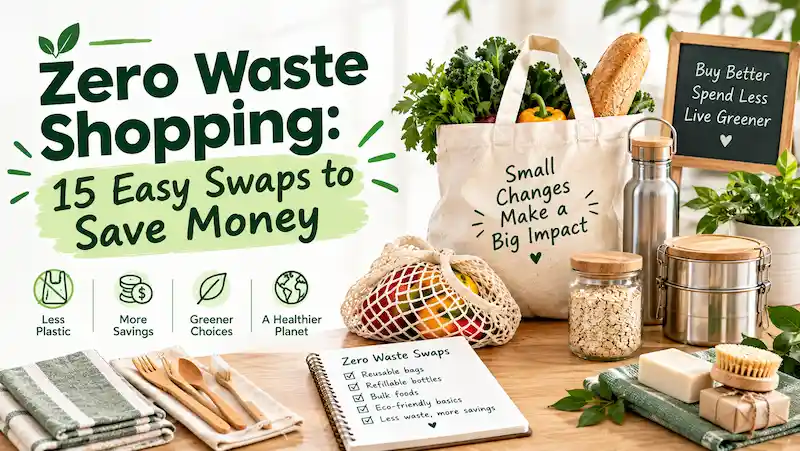
After three years of zero waste shopping and tracking every dollar saved, here are the 15 swaps that actually moved the needle.
You are spending more than you need to
The problem is not how much you buy. It is how you buy it. Single-use packaging, impulse purchases, and no system for what is already in your fridge are costing you real money every week. Households that cut food waste by 50% save $800 to $1,000 a year, and that is just one of the 15 swaps on this list. For a broader breakdown of the potential financial benefits, read how much zero-waste living can save per year.
Zero waste shopping means buying in ways that produce less waste from the start, not recycling harder afterward. It is a purchasing strategy, not a lifestyle overhaul, and it does not require specialty stores or extra hours. For a broader look at reducing waste across your kitchen, bathroom, and cleaning routine, see this zero waste grocery shopping guide. The myth worth setting aside first: the sustainable version costs more than the conventional one. The opposite is true.
Every swap below comes with its upfront cost, annual savings, and one honest caveat, so you can decide what actually fits your situation before you commit to anything.
All 15 zero waste shopping swaps at a glance
Before the full breakdown, here is every swap with its cost and savings side by side.
| Swap # | Swap (old to new) | Upfront cost | Annual savings | Difficulty |
| 1 | Plastic bags to reusable tote bags | $0 | $20 to $60 | Easy |
| 2 | Pre-packaged goods to bulk bins | $0 | $200 to $400 | Easy |
| 3 | Cling wrap and zip bags to beeswax wraps and silicone lids | $18 to $25 | $40 to $70 | Easy |
| 4 | Supermarket produce to farmers’ market | $0 | $150 to $300 | Easy |
| 5 | Plastic wrap and zip bags to glass jars | $20 to $30 | $48 to $80 | Easy |
| 6 | Bottled water and drinks to filtered water bottle | $25 to $40 | $100 to $200 | Easy |
| 7 | Plastic shampoo bottles to shampoo bars | $10 to $14 | $60 to $120 | Easy |
| 8 | Paper towels to cloth rags | $0 | $100 to $140 | Easy |
| 9 | Disposable razors to safety razor | $25 to $40 | $120 to $200 | Medium |
| 10 | Bottled cleaners to concentrated refillable | $15 to $25 | $80 to $140 | Easy |
| 11 | Disposable cups to reusable coffee cup | $15 to $25 | $26 to $130 | Easy |
| 12 | New non-consumables to secondhand | $0 | $200 to $500 | Medium |
| 13 | Takeout and delivery to batch home cooking | $0 | $400 to $800 | Medium |
| 14 | Bought cleaners to one DIY formula | $5 | $60 to $100 | Easy |
| 15 | Impulse buying to pre-shop pantry audit | $0 | $100 to $250 | Easy |
The 15 zero waste shopping swaps that actually save money
Here is the full breakdown. Each swap follows the same format so you can scan straight to the ones that fit your situation.
Grocery and food swaps (swaps 1 to 6)
Swap 1: Plastic bags to reusable tote bags
- Upfront cost: $0
- Annual savings: $20 to $60
- Honest caveat: The savings depend on how consistently you remember to bring them.
Grab the tote bags already sitting on a hook by your door and start leaving them in the car. Most grocery stores now charge $0.05 to $0.15 per plastic bag, which adds up to $13 to $39 per year if you grab five bags per weekly shop. In states with mandatory bag fees, that figure climbs faster.
Swap 2: Pre-packaged goods to bulk bins
- Upfront cost: $0
- Annual savings: $200 to $400
- Honest caveat: You need to be willing to weigh, label, and store loose goods at home.
Bulk oats run about $1.20 to $1.60 per pound. A name-brand box of oat cereal costs closer to $4.50 to $6.00 per pound. Buy just oats, rice, lentils, and nuts from the bulk aisle and you are looking at $200 to $400 back in your pocket each year without changing what you eat, only how you buy it.
Swap 3: Cling wrap and zip bags to beeswax wraps and silicone lids
- Upfront cost: $18 to $25
- Annual savings: $40 to $70
- Honest caveat: Beeswax wraps cannot go in the microwave or cover hot food.
Cling wrap and zip bags are the kind of household expense that hides in plain sight. At $3 to $4 per 30-count box, going through one box per month costs $36 to $48 per year in disposable plastic. A set of beeswax wraps costs $18 to $25 upfront, lasts one to three years, and covers the same job permanently for less than the price of eight months of zip bags.
Swap 4: Supermarket produce to farmers’ market
- Upfront cost: $0
- Annual savings: $150 to $300
You waste less at a farmers’ market because you buy in exact quantities rather than pre-portioned bags. Produce that has traveled fewer miles also lasts longer in the fridge, which means fewer limp vegetables at the back of the crisper drawer. Seasonal local items typically run 20 to 40 percent cheaper than equivalent organic produce at mainstream grocery stores.
- Honest caveat: Farmers’ markets are seasonal, so this works better as a complement to your regular shopping than a full replacement.
Swap 5: Plastic wrap and zip bags to glass jars
- Upfront cost: $20 to $30
- Annual savings: $48 to $80
- Honest caveat: Glass jars are heavier than plastic containers and require careful handling.
A set of mason jars runs $20 to $30 and handles leftovers, bulk grains, sauces, and dry goods for years. Your ongoing cost after the initial purchase drops to zero. For more affordable ways to reduce kitchen waste, explore these zero waste kitchen swaps under $5. If you were previously spending $4 to $7 per month on plastic wrap, zip bags, and disposable containers combined, that is $48 to $84 recovered in year one.
Swap 6: Bottled water and drinks to filtered water bottle
- Upfront cost: $25 to $40
- Annual savings: $100 to $200
- Honest caveat: If your tap water quality is poor, you may need an additional countertop filter, which adds $20 to $50 upfront.
The average American spends $100 to $200 per year on bottled water and single-serve drinks. A quality filtered water bottle costs $25 to $40 and handles 150 to 300 gallons before the filter needs replacing. Fill it at home, at work, or at the gym; by month two you have broken even, and by month six you are $50 to $100 ahead.
Household and personal care swaps (swaps 7 to 11)
Swap 7: Plastic shampoo bottles to shampoo bars
- Upfront cost: $10 to $14
- Annual savings: $60 to $120
- Honest caveat: There is a two-week adjustment period while your scalp recalibrates, and some people find their hair texture feels different at first.
A single shampoo bar replaces two to three bottles of liquid shampoo and typically lasts four to six weeks with regular use. Compared to a $7 to $10 liquid shampoo bottle, bars save $60 to $120 over 12 months once your hair adapts. The packaging is compostable paper or nothing at all.
Swap 8: Paper towels to cloth rags
- Upfront cost: $0
- Annual savings: $100 to $140
Old t-shirts work perfectly as cloth rags at genuinely zero cost. Cut them into palm-sized squares, keep a stack in your kitchen drawer, and the paper towel line item disappears from your budget. The average household spends $80 to $140 per year on paper towels; cloth rags reduce that cost to laundry water.
- Honest caveat: The one-time effort is cutting an old t-shirt into squares, which takes about five minutes.
Swap 9: Disposable razors to safety razor
- Upfront cost: $25 to $40
- Annual savings: $120 to $200
- Honest caveat: The learning curve is real: safety razors require a lighter touch, and the first few shaves take longer than you expect.
Replacement razor cartridges run $3 to $5 each, adding up to $150 to $200 per year for a regular shaver. Safety razor blades cost $0.10 to $0.30 each, and the razor itself breaks even in 6 to 8 weeks of regular use. After that point, you are saving $10 to $17 per month that previously went to cartridge packaging and retail markup.
Swap 10: Bottled cleaners to concentrated refillable
- Upfront cost: $15 to $25
- Annual savings: $80 to $140
- Honest caveat: Concentrated products require precise dilution; too much wastes product and too little reduces cleaning effectiveness.
Buy the bottle once. A pack of 60 concentrated cleaning tablets costs $15 to $20 and produces 60 full spray bottles. The equivalent in single-use plastic spray bottles would run $90 to $150 at retail, and the system pays for itself after three refills.
Swap 11: Disposable cups to reusable coffee cup
- Upfront cost: $15 to $25
- Annual savings: $26 to $130
- Honest caveat: You have to remember to bring it, wash it between uses, and accept that lid styles vary by shop.
Many coffee shops offer a 10 to 50 cent discount when you bring your own cup. Visit a café five times per week at an average 25-cent discount and you recover $65 per year from the discount alone. A reusable cup can also make a practical present, and this sustainable gift guide under $25 offers more ideas for useful, lower-waste gifts. Add the cost of paper cups you are no longer buying for home use, and regular coffee drinkers reach $100 in annual savings well inside the first year.
Lifestyle and purchasing swaps (swaps 12 to 15)
Swap 12: New non-consumables to secondhand
- Upfront cost: $0
- Annual savings: $200 to $500
For non-consumables, including books, kitchenware, furniture, clothing, and electronics, secondhand is almost always 50 to 80 percent cheaper than retail. A kitchen stand mixer that retails for $400 might cost $60 to $100 at a thrift store or on Facebook Marketplace. Households that shift to secondhand-first consistently recover $200 to $500 per year without giving up the products they actually want.
- Honest caveat: Thrift stores and resale platforms require more patience than buying new; availability varies, and sizing runs inconsistently.
Swap 13: Takeout and delivery to batch home cooking
- Upfront cost: $0
- Annual savings: $400 to $800
- Honest caveat: Batch cooking requires two to three hours per session and upfront planning; it is the highest-effort swap on this list.
This is the highest-ROI swap on the list. The average American household spends $9,831 on food per year, a significant portion of which goes to takeout and delivery markup, and cooking in bulk at home cuts both packaging waste and food waste simultaneously. Shifting even three takeout nights per week to home cooking saves most households $400 to $800 annually without any meaningful change in what you eat.
Swap 14: Bought cleaners to one DIY formula
- Upfront cost: $5
- Annual savings: $60 to $100
- Honest caveat: DIY cleaners work well on most surfaces but are not rated for heavy-duty disinfection or mold removal.
The recipe for a universal household cleaner fits in one sentence: water, white vinegar, and a few drops of essential oil. Mix it in any spray bottle; the cost per bottle is approximately $0.30. A commercial all-purpose cleaner runs $3 to $5 per bottle, so replacing one per month saves $32 to $57 per year in product costs alone, plus eliminates a stream of single-use plastic from your budget.
Swap 15: Impulse buying to pre-shop pantry audit
- Upfront cost: $0
- Annual savings: $100 to $250
- Honest caveat: It only saves money if you actually do the audit before every shop, not in theory.
Food waste cost households globally $1.05 trillion in 2024, and a significant share of that starts with buying duplicates of what you already own. Spend five minutes before each shopping trip checking what is in your pantry, fridge, and freezer, then write a list based only on what you need. List-based shopping consistently reduces food waste by 20 to 30 percent and trims impulse purchases across every household size.
Your zero waste shopping starter plan: pick three
You do not need to do all 15 at once. Pick one from each tier and you are already ahead.
Start today at $0: Swaps 1, 8, and 15
This week for $10 to $20: Swaps 2, 3, and 6
This month for $20 to $40: Swaps 9, 10, and 11
Behavioral research on habit formation consistently shows that people who adopt one or two new behaviors at a time sustain them at a significantly higher rate than those who attempt sweeping simultaneous changes. Trying all 15 swaps in a single weekend sounds motivating in the moment. It tends to collapse by week two when the friction of managing new routines across every category at once catches up with the initial enthusiasm. Three specific swaps, practiced until they feel automatic, outperform fifteen swaps abandoned after the first stumble.
The tier structure is deliberate. Starting at zero cost removes the financial barrier entirely, and once the first swaps feel routine, a small $10 to $20 investment in the second tier extends the habit without pressure. By the time you reach the $20 to $40 tier, the earlier swaps are already generating savings that offset the new purchases.
Three swaps. That is the whole ask.
Start your zero waste shopping journey this week
The $800 to $1,000 in annual savings from food waste reduction alone is a real number, not a projection for someone else’s household. A fully committed household that adopts most of the 15 swaps here can save $2,500 to $4,000 compared to conventional spending habits, but that is not where you need to start.
Start with what costs nothing. Swaps 1, 8, and 15 take fewer than ten minutes to set up and return savings from the first week. The $800 to $1,000 anchor figure comes from food waste alone, which means measurable money is already sitting in your kitchen, waiting on a better system.
The tote bag is probably by your door. The t-shirt rag is one pair of scissors away. Start there.
Zero waste shopping questions, answered
For the vast majority of households, yes. Zero-waste swaps can save $800 to $2,500 annually depending on which swaps you adopt and how consistently you apply them. The lower end is achievable with just three to four swaps from this list. The upper end requires committing to most of them, but even Swaps 1, 8, and 15 cost nothing and start returning savings from day one.