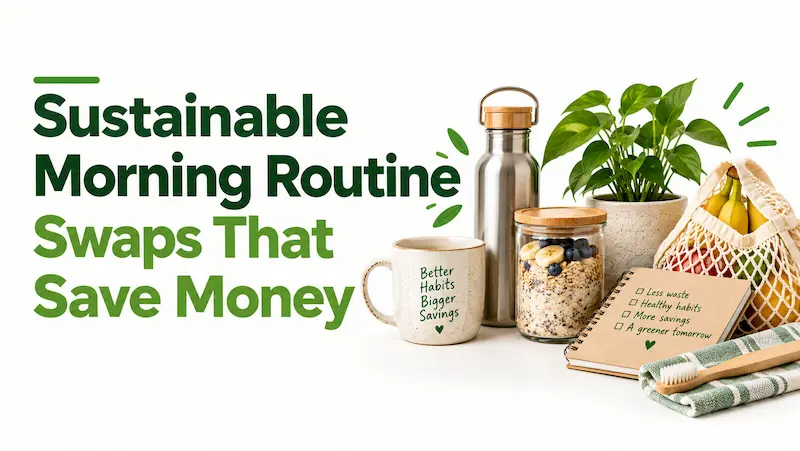
The average morning has a way of quietly draining money. A coffee on the way to work, a breakfast picked up at a counter, a bottle of water grabbed near the till: each purchase seems minor in isolation, but recurring daily habits compound quickly. For people who buy coffee and breakfast on the go most mornings, the annual total can easily reach several hundred to several thousand dollars, depending on local prices and frequency.
Sustainability and personal finance are not usually presented together, but the morning is one place where they overlap naturally. Many of the habits that cost the most also produce the most waste: single-use cups, takeaway packaging, individually wrapped convenience foods, and bottled drinks. Reducing those habits tends to lower both spending and waste at the same time.
This article is not a guide to buying eco-friendly products. It is a guide to spending less, wasting less, and getting more practical use out of what you already own. Some of the swaps below can reduce recurring costs meaningfully; others have a more modest financial impact but still help lower unnecessary consumption. The goal is to give you enough information to decide which changes are actually worth making in your own morning routine.
What Is a Sustainable Morning Routine?
A sustainable morning routine is one that involves less unnecessary consumption, fewer disposable purchases, and less wasted resource use, without requiring a complete overhaul of how you live.
It does not mean a perfect routine. In practical terms, a sustainable morning routine means being more deliberate: choosing what you actually need, using what you already have effectively, and avoiding habitual spending that generates more waste than value. That is a realistic standard, and it is where most useful changes happen.
What Makes a Sustainable Swap Worth Making?
Not every change labeled “sustainable” makes sense from a personal-finance perspective, and this distinction matters.
A swap is most likely worth pursuing when it reduces a recurring expense, does not require significant upfront spending, is realistic enough to maintain consistently, and provides a clear practical or environmental benefit. Many of these small changes can also add up to meaningful savings when you approach zero-waste living from a practical, cost-conscious perspective. A change that requires $80 of new equipment to save $20 per year deserves more scrutiny than one that requires no outlay at all.
The word “reusable” does not automatically mean cheaper. A reusable product saves money when it is used regularly and held for long enough to offset its cost. A reusable coffee cup that sits unused does not save money. A food container purchased with good intentions but never opened does not either.
The most reliable test is simple: does this change reduce something you currently spend repeatedly, without adding an equivalent new cost? If yes, it is probably worth making. If the math requires optimistic assumptions or meaningful upfront spending, it is worth calculating carefully before committing.
Before You Buy Anything, Use What You Already Have
The most useful principle for thinking about sustainable swaps is sequential rather than transactional: use what you have, reuse or repurpose it where possible, repair it when needed, and replace it only when genuinely necessary. This approach is also one of the simplest ways to connect zero-waste habits with saving money, because avoiding unnecessary replacement purchases protects both your budget and your existing resources.
In practice, this means a perfectly functional coffee maker, water bottle, or food container is already a sustainable item, regardless of what it is made from. Replacing it with a new “eco-friendly” version generates manufacturing waste, costs money, and is difficult to justify on either financial or environmental grounds.
Before buying anything in the name of sustainability, it is worth asking whether something you already own could do the job. In most cases, the answer is yes.
10 Sustainable Morning Routine Swaps That Save Money
1. Swap Takeaway Coffee for Coffee Made at Home
Takeaway coffee is one of the clearest examples of a recurring convenience purchase. At a typical coffee shop, a single drink often costs between $4 and $6, sometimes more. Someone who buys coffee five mornings a week is spending, depending on price and location, somewhere between $1,000 and $1,500 per year on a single habit.
Home-brewed coffee made from ground beans costs a fraction of that per cup. The equipment needed, whether a basic drip coffee maker, a French press, or a simple pour-over, is probably already in your kitchen. If you have equipment you are not currently using, it has no ongoing cost. The only recurring expense is the coffee itself.
The financial difference between a daily takeaway habit and a home-brewing habit can be significant over a year, depending on your current spending. The calculation is simple: multiply what you typically spend per visit by how many times you buy per week, then by 52. Compare that to a realistic estimate for ground coffee per cup.
There is a sustainability dimension too. Takeaway coffee commonly involves a single-use cup, a sleeve, a lid, and sometimes a bag for accompanying food. Making coffee at home eliminates most of that packaging. For mornings when you want to take coffee with you, a reusable travel mug you already own works for that purpose.
One caveat: if you do not currently own any coffee-making equipment and would need to buy something first, factor that cost into your break-even calculation before assuming the change saves money immediately.
2. Swap Bought-on-the-Go Breakfast for Breakfast at Home
Convenience breakfast options, whether from a cafe, a bakery, a gas station, or a fast-food counter, carry a significant markup over the cost of preparing something at home. A pastry and a juice can easily cost $6 to $10 or more. Breakfast made from ingredients already at home (eggs, toast, oats, yogurt, or similar) will almost always be cheaper per serving, particularly once you account for volume.
The sustainability side operates through packaging. Pre-made convenience breakfasts typically come in disposable formats: paper bags, plastic containers, wrappers, and cups. Breakfast prepared at home generates considerably less of it.
The practical constraint here is time. If the appeal of a bought breakfast is speed, several home options take only a few minutes: overnight oats prepared the previous evening, eggs that take four minutes to scramble, or a piece of toast with whatever is available. Pre-planning the night before removes most of the friction.
It is also worth noting that using food already in the fridge or cupboards before it spoils is itself a form of sustainability. Food thrown away represents both a financial loss and wasted resources.
3. Swap Bottled Drinks for Refillable Water
Buying bottled water as a regular habit is one of the more visible spending inefficiencies in a morning routine. Tap water in most parts of the developed world costs a small fraction of a cent per litre, while a single-serve bottle typically costs between $1 and $3 or more depending on the brand and location. The price difference per volume is substantial.
If you already own a water bottle that you are not using, filling it at home before leaving costs virtually nothing. That is the change in its simplest form.
A few honest caveats: tap water quality varies by location, and some people have specific reasons to choose filtered water. A basic filter pitcher, if you do not already own one, adds an upfront cost but typically still produces a lower cost per litre than bottled water. What matters is calculating your own figures based on what bottled water actually costs you and how often you buy it, rather than assuming a particular saving.
The reduction in single-use plastic bottles is meaningful regardless of the financial calculation, and the two benefits tend to align naturally here. The same principle applies to other everyday disposables, where reusable alternatives can reduce both recurring purchases and single-use plastic waste.
What a $12 Morning Could Cost: An Illustrative Example
The following uses rounded figures for illustration only. Actual prices vary significantly by location, store type, and individual habits.
| Item | Illustrative Cost |
| Takeaway coffee | $4.00 |
| Bought breakfast | $6.00 |
| Bottled drink | $2.00 |
| Daily total | $12.00 |
Across a five-day working week, that illustrative daily total comes to $60 per week, or roughly $3,000 per year.
The alternative: coffee brewed at home, breakfast prepared from food already in the kitchen, and tap water in a bottle you already own. The cost per day for the same function could plausibly be less than $2 depending on your ingredients and local prices.
The purpose of this example is not to assert a specific saving but to show how recurring convenience purchases compound over time. Small daily amounts produce large annual totals.
4. Swap Long Hot Showers for Shorter Showers
Shortening a shower reduces two things simultaneously: the volume of water used and the energy required to heat it. Both carry a cost, though the financial impact depends on your current shower habits, your water rate, and how you heat water.
According to the EPA’s WaterSense program, standard showerheads use 2.5 gallons of water per minute. A ten-minute shower with a standard showerhead uses 25 gallons. Reducing that to seven minutes uses 17.5 gallons: a saving of 7.5 gallons per shower, or roughly 2,700 gallons per year for someone who showers daily.
The energy component matters too. The U.S. Department of Energy notes that water heating accounts for about 18% of home energy use, making it the second largest household energy expense. Hot showers draw on that energy. Reducing shower duration reduces the amount of energy consumed to heat water, though the specific dollar saving will depend on your energy tariff, your water temperature, and how much you reduce your shower time.
The financial saving from shortening a shower is real but modest for most individual households. Where it matters more is at scale: in households where several people shower daily, the aggregate reduction can be more meaningful.
5. Swap Running Water While Brushing for Turning Off the Tap
This is a small change with a clear mechanism. A bathroom faucet typically runs at around 2 gallons per minute. According to EPA’s WaterSense program, turning off the tap while brushing your teeth or shaving can save more than 200 gallons of water per month for an individual.
In financial terms, the direct saving is real but unlikely to be large in dollar terms for most households, given that water tends to be one of the less expensive utilities. The more meaningful benefit is reducing unnecessary water use, which is worth doing regardless of cost.
The change requires nothing. It costs nothing. Turning off the tap before you start brushing and turning it back on when you are ready to rinse is the complete action.
6. Swap Disposable Personal-Care Habits for Longer-Lasting Alternatives
Many morning personal-care products are designed for single use or frequent replacement: disposable razors, single-use cotton pads, packaged wipes, toothbrush heads replaced every few weeks. These create recurring purchases over time and a steady stream of packaging waste.
The general principle is that a longer-lasting alternative, used enough times, often costs less per use than frequent disposable purchases. Whether a specific reusable product is actually cheaper depends on: the purchase price of the reusable option, how long it actually lasts with consistent use, the cost of any maintenance or consumables it requires, and the current cost of what you are replacing.
A safety razor with replaceable blades, for example, typically has a higher initial price than a pack of disposable razors but lower ongoing blade costs for someone who shaves regularly. Whether it saves money depends on your current spending and how long you actually keep using the razor. The same logic applies across other personal-care products.
If you are considering a switch, calculate the break-even point first: divide the additional upfront cost by the saving per use. That shows how many uses are needed to come out ahead financially. If the product is something you will use consistently over several years, the economics are often favorable. If you are uncertain about your commitment, the existing option may be the more practical choice.
This section is not a recommendation to replace working products. If you have personal-care items that function well, they are already the sustainable option. There is no financial or environmental benefit in replacing them prematurely.
7. Swap Individually Packaged Breakfast Foods for Lower-Cost, Lower-Packaging Options
Pre-portioned and individually wrapped breakfast products, including single-serve yogurts, portion-pack oat sachets, miniature cereal boxes, and wrapped snack bars, typically cost more per serving than buying the same food in larger quantities. They also produce significantly more packaging per portion.
Switching from individually packaged options to ingredients that you portion at home can reduce both cost and packaging. A 500g tub of yogurt usually offers a lower cost per serving than the same total amount purchased in individual pots. A larger bag of rolled oats typically costs less per serving than single-serve oat sachets.
Important caveat: buying in bulk is not always cheaper. The relevant measure is the unit price: the cost per gram, per serving, or per portion. Buying a large quantity at a lower unit price only saves money when you actually use the product before it spoils or expires. A cheaper large-format item that generates food waste may cost more in practice than the smaller version.
Before changing purchasing habits, compare unit prices directly rather than assuming that larger is better. For most breakfast staples such as oats, yogurt, cereals, and eggs, larger formats at the same retailer usually offer a better unit price, but this is worth confirming for your specific products and local stores.
8. Swap Morning Convenience Purchases for a Prepared Grab-and-Go Setup
Some morning spending is driven by a lack of preparation rather than a considered preference. Buying coffee at a shop when running late, picking up a snack because nothing is ready at home, or stopping for a drink because you forgot to fill a bottle: these are purchases made under time pressure rather than by choice.
Setting up a grab-and-go routine the night before can reduce or eliminate most of those last-minute costs. The components are simple: coffee ready to pour or set to brew, breakfast prepared or ingredients laid out, a refilled bottle by the door, any snacks or food for later already packed.
The financial benefit comes not from the evening preparation itself but from what it replaces: unplanned purchases made under time pressure, which tend to be more expensive and more wasteful than planned alternatives. The preparation typically takes a few minutes the night before.
This is less a product-focused swap and more a structural change to how the morning is organized. Its impact depends entirely on how often unplanned morning purchases currently occur and what they cost.
9. Swap Unnecessary Morning Energy Use for More Efficient Habits
Most households use more energy in the morning than strictly necessary, not through any single large drain but through small habitual inefficiencies: lights left on in rooms not in use, devices running unnecessarily, appliances heating up while nothing is being prepared.
Addressing these individually produces small savings, and it is worth being realistic about their scale. Switching off a single light does not materially change a monthly bill on its own. The more relevant question is whether there are patterns of inefficiency in your morning that add up across a year.
Practical habits with some impact include: not boiling more water than you will use (heating unnecessary water uses unnecessary energy), switching off lights when leaving a room, and not leaving screens or devices running during bathroom or shower time. For households where heating is a significant cost, briefly adjusting thermostat settings while the house is unoccupied can make a marginal difference.
The financial benefit here is modest for most households and should not be overstated. The value is in developing a generally efficient relationship with resource use rather than in any single action.
10. Swap Last-Minute Morning Snacks for a Prepared Option
Buying a snack on the way to work or school from a convenience store or gas station typically costs more than the equivalent purchased elsewhere and prepared in advance. A bag of chips, a chocolate bar, a small packaged snack grabbed near a register: individually small purchases, but recurring ones.
The practical alternative is to prepare snacks the previous evening or keep a supply of easy-to-pack options at home. Fruit, nuts, crackers, or any non-perishable option already in the kitchen can fill this role without requiring any new purchase.
The sustainability benefit mirrors the breakfast argument: reducing convenience-store packaging and replacing impulse purchases with planned alternatives. This habit is distinct from the breakfast section because the trigger is different. Snacks purchased in the morning are often an afterthought, driven by mid-morning hunger rather than a deliberate part of the routine. Treating them as a separate habit to address can be more effective than rolling them into a broader meal-prep effort.
How to Calculate Your Real Savings From a Sustainable Swap
Before committing to a change, it helps to calculate whether it actually saves money and by how much. The method is consistent across any swap.
Current annual cost
Cost per use × uses per week × 52
Example: $4.50 takeaway coffee × 4 times per week × 52 = $936 per year
Alternative annual cost
Upfront cost (amortized over expected lifespan) + annual consumables + maintenance + any relevant utility costs
Example: Home brewing, assuming existing equipment: ground coffee at $1.00 per cup equivalent × 4 per week × 52 = $208 per year
Potential annual saving
Current annual cost minus alternative annual cost
Example: $936 – $208 = $728 potential saving per year in this illustrative scenario
Break-even point (when upfront spending is involved)
Upfront cost divided by saving per use
Example: A $30 piece of equipment saving $3.50 per use breaks even after approximately 9 uses.
Use your own prices, your own frequency, and your local costs. The figures above are illustrative. The method works for any swap, whether it involves a new purchase or simply a change in behavior. The break-even calculation is particularly useful when a reusable product requires an initial investment: it prevents the assumption that a longer-lasting product automatically saves money without working out whether the math actually holds.
When a Sustainable Swap Is Not Worth the Money
Not every change saves money, and being clear about where the logic breaks down is useful.
Replacing something that works. A functioning product replaced purely because a newer item is marketed as eco-friendly creates unnecessary spending and disposal waste. The most sustainable item is generally the one already in use.
Paying a premium for “eco” branding. Some products carry higher prices because of their environmental positioning rather than their performance or durability. An expensive “natural” version of a product does not automatically justify the cost. Compare total cost of ownership, not surface appeal.
Assuming reusable always means cheaper. A reusable product saves money when used regularly and long enough to offset its purchase price. A reusable coffee cup only breaks even if you actually bring it and use it consistently. Products that sit in a drawer represent additional spending, not savings.
Assuming bulk always means cheaper. Larger package sizes often carry a better unit price, but only when the product is used before it expires or spoils, and when the unit price is actually lower. Always compare unit prices directly rather than assuming format size determines value.
Buying products you will not actually use. Motivated purchases made during a moment of enthusiasm, reusable bags that never leave the cupboard, a container system that never gets used, are not sustainable investments. They are an avoidable cost.
Ignoring maintenance and replacement costs. Reusable products can require specialized care, replacement parts, or eventual full replacement. These costs should be included in any comparison rather than treating the initial purchase as the total cost.
Underestimating food waste. Buying larger quantities of fresh food to reduce packaging or unit cost only works financially when the food is actually consumed. Wasted food is both financially and environmentally costly.
Find Your Biggest Morning Expense in 7 Days
Rather than guessing which changes might save the most, track your actual morning spending for seven days. Record every purchase made during the morning, from waking until you arrive at your destination, including drinks, food, personal-care items, and anything bought on impulse.
The goal is to identify where recurring spending actually occurs before deciding what to change.
| Morning expense | Daily cost | Days/week | Weekly cost | Annual cost |
| Coffee | ||||
| Breakfast | ||||
| Drinks | ||||
| Snacks | ||||
| Personal care | ||||
| Other |
To fill in the annual cost column, multiply the weekly cost by 52. The resulting figures will show clearly which habits carry the most financial weight and which are relatively minor. That is the most practical starting point for deciding where to make changes.
Memory tends to underestimate spending. Tracking actual purchases, even briefly, almost always produces a more accurate picture than recollection.
A $0 Sustainable Morning Routine You Can Start Tomorrow
No new purchases are required to begin. The following uses only what most households already have. If you are new to zero-waste living, this kind of low-cost, habit-first approach is a practical place to start.
Wake up
Switch off any lights or devices in rooms you are not using.
Bathroom
Turn off the tap while brushing your teeth. Turn it on when you are ready to rinse.
Shower
Aim to reduce your shower time by two or three minutes. That reduces both water use and the energy required to heat it.
Breakfast
Eat food that is already at home. If something in the fridge needs using before it spoils, start there.
Coffee
Use the coffee-making equipment you already own. If you do not own any, instant coffee from the tin already in the kitchen works perfectly well for this purpose.
Before leaving
Fill a bottle with tap water. Any existing bottle will do.
Grab-and-go
Take food or drinks from home for later in the day. Anything that prevents a last-minute purchase is sufficient.
That is the complete zero-cost routine. Nothing purchased, nothing replaced. The changes are behavioral, not commercial.
Key Takeaways
- The largest potential savings in a morning routine typically come from reducing recurring food and drink purchases: takeaway coffee, convenience breakfasts, bottled drinks, and last-minute snacks. These are recurring costs that compound significantly over a year.
- Use what you already own before buying anything new. A functional item is already a sustainable item, regardless of what it is made from or when it was purchased.
- Track your actual morning spending for a week before deciding what to change. Recurring totals are almost always larger than memory suggests.
- Not all sustainable swaps save meaningful amounts of money. Some reduce resource use or waste without significant financial impact. Honest assessment of the actual benefit, financial or environmental, is more useful than overstating either.
- Avoid buying “eco-friendly” products to replace working items. The financial and environmental case for early replacement is usually weaker than it appears.
Frequently Asked Questions
A sustainable morning routine is a daily morning practice that reduces unnecessary consumption, minimises avoidable waste, and avoids recurring purchases that do not add proportionate value. It does not require perfection or new spending. In practical terms, it means using what you already have more efficiently and avoiding habitual purchases that could reasonably be replaced with lower-cost, lower-waste alternatives.