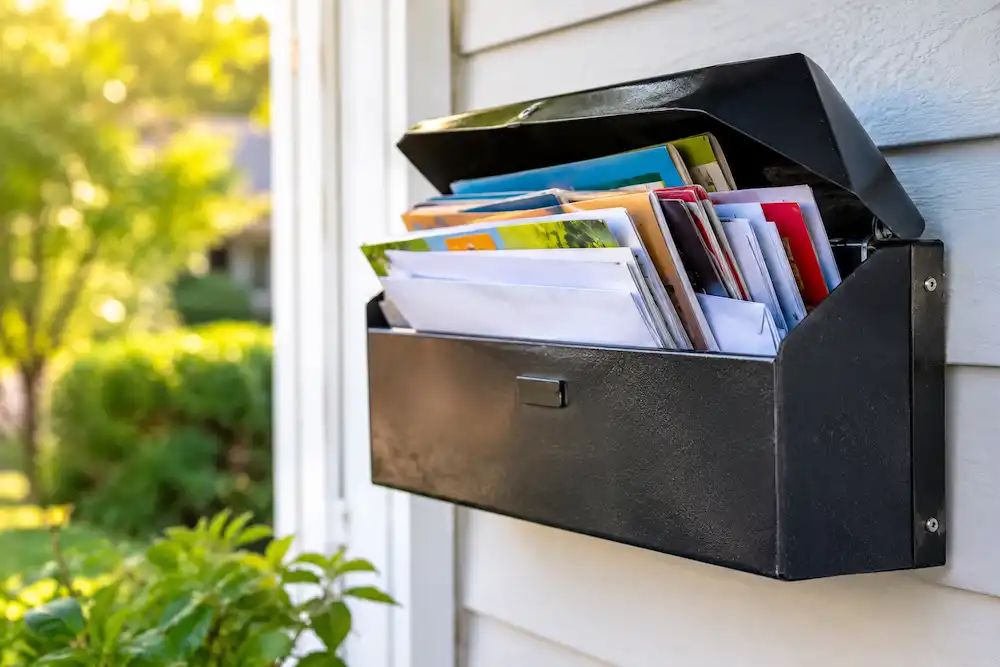
Every November, the mailbox fills with holiday catalogs, “you’re pre-approved” credit card offers, charity appeals and flyers addressed to “Current Resident” or to whoever lived here before you. You didn’t ask for any of it.
The good news: learning how to stop junk mail takes less effort than you’d think. A handful of free or low-cost opt-outs cut most of it, usually for a one-time fee of about $8 and roughly an hour of setup.
The honest limit: you’ll reduce junk mail, not erase it. Political mailings, hand-delivered flyers and mail from companies you’ve bought from can still arrive.
Here’s what you’ll learn: which opt-out matches which kind of mail, what each costs, how long it takes to work, and what to do about mail for previous residents. If you want to opt out of junk mail in one sitting, start with the short version below.
How to stop junk mail: the short version
- Register with DMAchoice (about $8, lasts 10 years) to cut prospect mail from participating marketers.
- Opt out of prescreened credit and insurance offers at OptOutPrescreen.com (free; five years online, permanent with a signed form).
- Contact the charities, catalogs and companies you’ve dealt with directly, because DMAchoice doesn’t cover your customer or donor mail.
- Write “Not at this address” on mail for former residents, and refuse unwanted addressed mail you haven’t opened.
- Remove yourself from data brokers (California residents can use the state’s DROP tool).
- Stop feeding new lists: skip warranty cards, read privacy policies, ask companies not to share your name.
Why you get so much junk mail (and why it never fully stops)
Junk mail isn’t random. Marketers build mailing lists from purchases, donations, warranty cards, credit-bureau data and data brokers, then sell or rent them. Your name lands on dozens of lists, and each one keeps working on its own schedule.
The volume is real. The U.S. Postal Service delivered about 56.8 billion pieces of Marketing Mail in fiscal 2025 and reaches more than 170 million addresses, according to USPS’s fiscal year 2025 results release. Spread across all those addresses, that’s on the order of hundreds of pieces per year, though the total includes business addresses, so treat it as a sense of scale, not a per-household figure.
One tool can’t fix everything because direct mail splits into two camps: prospect mail, sent to people a company hopes to win, and customer mail, sent to people it already has a relationship with. Opt-out services mostly target the first kind.
It’s also built to work on your wallet. Catalogs and “pre-approved” offers make spending feel easy, which is why a system that makes every dollar visible, like envelope budgeting, pairs well with fewer ads.
Before you opt out of anything, measure what you’re dealing with.
“Before we opted out of anything, we saved every piece of non-bill mail for four weeks in July 2026. We logged each piece in a Google Sheet: sender, how it was addressed, and type. The total was 52 pieces. Of those, 29 were addressed to us by name (11 catalogs, 7 credit or insurance offers, 6 charity appeals, 5 retail promotions), 14 were addressed to ‘Current Resident,’ and 9 were for a previous owner. The pile weighed about 3 pounds on a kitchen scale and took roughly 10 minutes a week to log. The surprise: the charity appeals came from groups we’d given $25 to once, two years ago.”
Before you start: sort your pile
Not all junk mail is the same, and the right tool depends on who sent it. Sort your pile first, then match each type to the fix.
| What you’re getting | Who sends it | Best tool | Will it stop? |
|---|---|---|---|
| Catalogs, magazine offers, retail promos | Companies you’ve never bought from | DMAchoice | Mostly |
| “You’re pre-approved” credit or insurance offers | Lenders and insurers using credit-bureau lists | OptOutPrescreen.com | Yes for credit-bureau-based offers (not all unsolicited offers) |
| Mail from stores or charities | Places you’ve bought from or donated to in the past two years | Contact them directly | Yes, if they honor it |
| Political mailings | Campaigns and committees | Exempt from DMAchoice | Not through these tools |
| “Current Resident” flyers (Every Door Direct Mail) | Local advertisers, by ZIP code | Limited; ask your local Post Office | Rarely |
| Mail for a previous resident | Anyone with an old address on file | “Not at this address” | Usually |
| Bills, statements, notices | Your accounts | Not junk | n/a |
Start with the two broad opt-outs in Steps 1 and 2, then use Steps 3 and 4 to mop up what’s left.
Step 1: Register with DMAchoice
This is the single biggest cut in marketing mail. DMAchoice is the mail preference service run by the Association of National Advertisers (ANA). Participating marketers use it as a suppression list: when your name is on it, they’re supposed to stop sending you prospect promotional mail.
What it costs and how long it lasts. Per the DMAchoice Consumer Choices FAQ, registration is $8 online or $9 by mail (check or money order), and it lasts 10 years. Fair warning: prices for this service vary around the web. The FTC’s consumer page still lists an older $6 online / $7 by mail fee, and other sites show other numbers. Confirm the price at checkout on dmachoice.org, because that’s the one you’ll actually pay.
How to do it
- Go to dmachoice.org (type it in yourself rather than clicking an ad).
- Create an account.
- Choose the mail categories you want to stop.
- Add name variations and addresses. You can add up to five of each, so include “J. Smith,” a version with a middle initial and any old addresses that still get mail.
- Pay the fee and keep your confirmation.
The ANA says registration covers catalogs, magazine offers, donation requests and retail promotions from companies you don’t already have a relationship with. It estimates about an 80% reduction in the mail you’d otherwise get. That’s the ANA’s estimate, not an independent measurement, so judge it by your own recount. Allow 90 days for it to work, because many mailings are printed and queued before you register.
“We registered at DMAchoice.org in July 2026. The checkout showed $8, which we paid by credit card; the whole process took about 7 minutes. We first entered just one spelling of our name, then realized mail also arrives as ‘J. Smith’ and with a middle initial, so we added three name variations in the profile. We chose to stop catalogs, magazine offers and ‘other’ mail. A confirmation email arrived within a few minutes and told us to allow about 90 days. The FTC’s page still lists a $6 fee, so we were glad we checked the price at checkout.”
Sidebar: mail for someone who has died or can’t manage their own mail. The FTC’s junk mail page also points to a Deceased Do Not Contact list and a Do Not Contact for Caretakers list. Check that page for current details before using either.
What DMAchoice won’t stop
DMAchoice doesn’t cover prescreened credit offers, political mail, mail from companies you’ve bought from or donated to in the past two years, “Current Resident” mail, or mail from marketers who don’t subscribe to the service. That’s why Steps 2 through 4 exist.
Step 2: Opt out of credit card and insurance offers
Those “you’re pre-approved” envelopes are prescreened offers, also called firm offers of credit, and they’re built from credit-bureau lists. A separate opt-out handles them, and it’s free.
Who runs it. The major credit bureaus (Equifax, Experian, Innovis and TransUnion) operate OptOutPrescreen.com and the phone line 1-888-5-OPT-OUT (1-888-567-8688). One request covers all of them.
Your two choices. According to the FTC’s How To Stop Junk Mail page, you can opt out for five years online, or opt out permanently. For a permanent opt-out, start online, then print, sign and mail the Permanent Opt-Out Election form.
What it asks for. The form requests your name, address, Social Security number and date of birth. The FTC says the last two are optional, but the site says providing them helps process your request. Type the URL yourself instead of clicking a search ad, and decide how much you’re comfortable sharing.
Your credit score. Removing your name from prescreened lists shouldn’t affect your ability to get credit; you can still apply for any card you want.
How fast it works. Per Experian’s opt-out page, the opt-out takes effect within five days, but it may take several months to see fewer offers. You can opt back in later if you change your mind.
The limit. This stops offers based on credit-bureau lists. It won’t stop a bank that mails you because you’re already its customer, or marketing it bought elsewhere.
“We typed OptOutPrescreen.com directly into the browser rather than clicking a search ad. We did the five-year electronic opt-out first (about 4 minutes), then started the permanent opt-out, printed the Permanent Opt-Out Election form, signed it and mailed it with one stamp (about 12 minutes total). We left the Social Security number and date of birth fields blank because the FTC says they’re optional, and the request went through without trouble. In our baseline month we received 7 prescreened offers. Eight weeks later we got 1.”
Step 3: Contact companies and charities directly
DMAchoice can’t touch mail from places that already know you, so this step handles the rest. It’s also the best way to stop charity mail and catalogs you actually have a history with.
Mailing lists get sold and rented, so you may need to ask where a company got your name. The Mass.gov Consumer Guide to Stopping Junk Mail notes that the code printed on a mailing label can tell the company who supplied your name. Mass.gov also recommends asking every company or nonprofit you deal with not to rent or share your name.
Here’s a script you can copy:
Please remove [name, address] from your mailing and list-rental files and note my request not to share my information.
Use a web form, email or a phone call, whichever the sender makes easiest. Keep a record of when and how you asked, so a follow-up is quick if the mail keeps coming. Expect some senders to take several weeks, since campaigns are printed ahead of time.
“We contacted five senders from our baseline pile: three charities and two catalog brands. We used web forms for three and the phone for two, and the whole round took about 25 minutes. Four confirmed removal in writing within a week; one said to allow six to eight weeks. When we asked one catalog company where it got our name, the representative said it was their own customer file. Keeping a note of the date and method made the follow-up call easy.”
Step 4: Handle mail addressed to someone else
The rule depends on who the mail is addressed to. Here are the three cases, based on USPS’s FAQ on undeliverable and misdelivered mail.
- A former resident (previous owner). Write “Not at this address” on the envelope. Don’t erase or mark over the name or address. Drop it in a collection box or hand it to your carrier. Don’t throw it away: USPS warns that destroying mail meant for someone else may be prohibited by law.
- Addressed to you, but unwanted. If it’s unopened, mark it “Refused.” USPS handles undeliverable Marketing Mail according to the sender’s endorsement and disposes of pieces without one, so don’t expect this to remove you from the list.
- “Current Resident.” Nothing to return; see “What you can’t stop” below.
The honest takeaway: “return to sender” is a patch. Opt-outs and direct requests fix the source.
“We wrote ‘Not at this address’ on all 9 pieces addressed to the previous owner and dropped them in a blue collection box, taking care not to cross out the name or our address. After eight weeks, 3 pieces were still showing up, so we contacted those senders directly.”
Step 5: Go to the source: data brokers and California’s DROP
Data brokers feed the lists that fill your mailbox, so removing yourself from them goes after the source. This step reduces unwanted marketing in general; it isn’t a guarantee of fewer paper pieces.
If you live in California. The state’s Delete Request and Opt-out Platform (DROP) lets you send one deletion and opt-out request to all registered data brokers, free. Per the California Privacy Protection Agency’s DROP page, it launched January 1, 2026, and brokers must process requests starting August 1, 2026, and every 45 days after. The state says it can take up to 90 days to see status updates and that results vary. You’ll need to be a California resident, verified through the California Identity Gateway or Login.gov.
If you don’t. DROP isn’t available to you. Use the broker-by-broker opt-outs you can find, and keep Steps 1 through 3 as your base. We’re not aware of a verified national equivalent, so be skeptical of anyone claiming one.
“We submitted a DROP request in August 2026. Verifying our California residency through the California Identity Gateway, took about 8 minutes, and the request itself took a few more. The state says it can take up to 90 days to see status updates, and ours showed pending after 30 days.”
What you can’t stop (and what to do instead)
Some mail is out of reach, and it’s better to know that up front.
- Political mail. It’s exempt from DMAchoice. Ask the campaign or committee directly if a particular sender bothers you.
- “Current Resident” mail. Every Door Direct Mail goes out by ZIP code or carrier route, not by name, so no name-based opt-out applies. The DMAchoice FAQ says you can ask your local Post Office, but a carrier will find it hard to honor. Expect this to keep coming.
- Mail from places you’ve bought from or donated to in the past two years. Contact them directly (Step 3).
- Hand-delivered flyers. A “No junk mail” sign on your door or mailbox may deter private distributors, but it doesn’t bind USPS.
What to do instead: recycle what’s left, and treat the leftover pile as your baseline for the next recount.
Your 90-day plan
Expect about 90 days to see a real drop. Registrations take time to reach marketers, and mail already printed keeps arriving. Credit-offer opt-outs start working within days but may take months to show. Mail from companies you’ve bought from or donated to won’t stop until you ask them directly.
| When | What to do |
|---|---|
| Day 1 | Register with DMAchoice, opt out at OptOutPrescreen.com, send your direct requests |
| Weeks 2–4 | Keep logging mail; contact any new senders |
| Day 90 | Recount for four weeks and compare to your baseline |
| Month 6 | Re-contact anyone still mailing; add new name variations |
Set a calendar reminder for day 90. If you chose the five-year OptOutPrescreen option, add another for the five-year expiry. And if your mailbox fills up fastest between now and New Year’s, our low-waste holiday planning guide shows how to cut the seasonal clutter on the shopping side too.
“About 90 days after our opt-outs, we repeated the four-week audit. Total mail fell from 52 pieces to 24. Mail addressed to us by name dropped from 29 to 8, a 72% decrease. ‘Current Resident’ mail barely moved (14 to 13), and previous-owner mail fell from 9 to 3. Our cost was a one-time $8 fee plus one stamp, and our setup time was about an hour.”
How to keep junk mail from coming back
Opting out only works if you stop handing your name to new lists. A few habits help, all drawn from the Mass.gov guide:
- Skip warranty and product-registration cards when the warranty doesn’t require them, and keep your receipt instead.
- Be careful with store discount cards and toll-free calls that capture your number.
- Tell new magazines, catalogs and charities not to rent, sell or trade your information when you sign up.
These cost nothing, and they fit the frugal habit of making fewer impulse decisions in the first place.
Conclusion
Three moves do most of the work: DMAchoice for prospect mail, OptOutPrescreen for credit and insurance offers, and direct requests to the senders who already know you. Add “Not at this address” for previous residents and, if you’re in California, DROP for data brokers.
You’ll reduce junk mail, not eliminate it, and the 90-day recount is how you’ll know it worked.
Do the two big opt-outs today, DMAchoice and OptOutPrescreen, then set a calendar reminder for day 90 and recount your mail.
Less paper in the mailbox is one small piece of a bigger habit, and the savings add up, as we show in how a zero waste lifestyle can save you real money.
Prices and policies checked in November 2026. This guide is educational and not legal advice.
FAQ
You can’t stop all of it permanently, but you can cut most. Register with DMAchoice (about $8, lasts 10 years), opt out of prescreened credit offers permanently by returning the signed form, and contact charities and companies you’ve dealt with directly. Political mail, “Resident” flyers and mail from places you’ve bought from can still arrive.