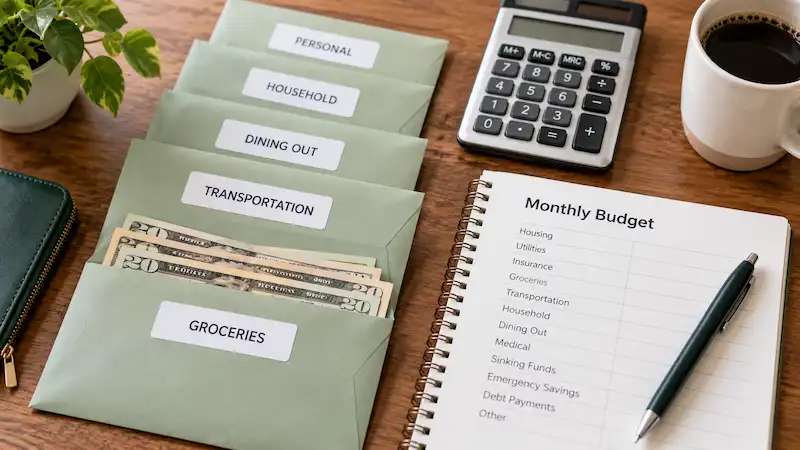
Envelope budgeting is a practical answer to a common problem: you have a budget, yet your spending still drifts. A grocery run here and a takeout order there, and by the 20th your account no longer matches the plan. With this method, you assign available money to specific spending categories and spend each one only up to its limit. Your envelopes can be physical cash, digital categories in a spreadsheet or app, or a mix of both.
Below, you’ll see how the method works, follow a full month on a hypothetical $3,000, and compare cash and digital options. It can’t make unaffordable bills affordable, but it can make your spending choices much easier to see.
What Is Envelope Budgeting?
Envelope budgeting divides your money into spending categories, called envelopes, each with an assigned amount that acts as a limit. When an envelope is empty, spending in that category stops, or you deliberately move money in from another category.
The traditional version is the cash envelope system: you withdraw cash, sort it into labeled envelopes, and pay for those categories from them. Online, this practice is often called cash stuffing. Digital envelope budgeting does the same job with recorded balances in a spreadsheet, a budgeting app, or a bank feature, so no physical cash is involved.
Envelope budgeting is not the same as zero-based budgeting. Zero-based budgeting assigns every dollar of income to a planned use, so income minus assignments equals zero. Envelope budgeting focuses on category limits during the month. You can combine the two, but one doesn’t automatically include the other.
The central rule is simple: money assigned to one category can’t be treated as freely available for another. Moving it is a deliberate decision, never a default.
How to Start Envelope Budgeting in 5 Steps
Step 1: Calculate your available income
Start with take-home income, the amount that reaches your account after taxes and deductions, not your gross pay. If your income varies, plan around a conservative figure. Penn State Extension’s budgeting guidance suggests using net income and offers your lowest monthly income from the past six months as a cautious estimate. Treat anything above that baseline as extra to assign later.
Step 2: List your bills and spending categories
Write down essential bills (housing, utilities, insurance), groceries, transportation, household needs, savings, discretionary spending, and required debt payments. Required minimum debt payments come first, before any additional debt repayment, because they are obligations rather than options.
Step 3: Set realistic limits for each envelope
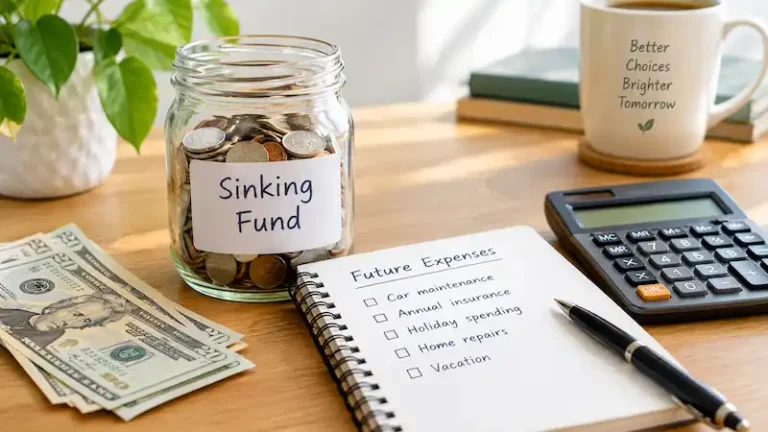
Use your last two or three months of bank and card statements, your actual bills, and any upcoming costs. Set limits you can follow, not ones that only look good on paper. Keep recurring monthly costs separate from sinking funds, which set money aside gradually for predictable but less frequent costs. Our guide to how sinking funds work shows the math.
Step 4: Fund and track the envelopes
For cash, withdraw the amount for your cash categories and divide it among labeled envelopes. For digital envelopes, record a balance for each category. A digital envelope is usually a tracking category, not a separate bank account, so check that your category balances never add up to more money than you actually have. That prevents the same dollars from being assigned to two purposes.
Step 5: Review and adjust weekly
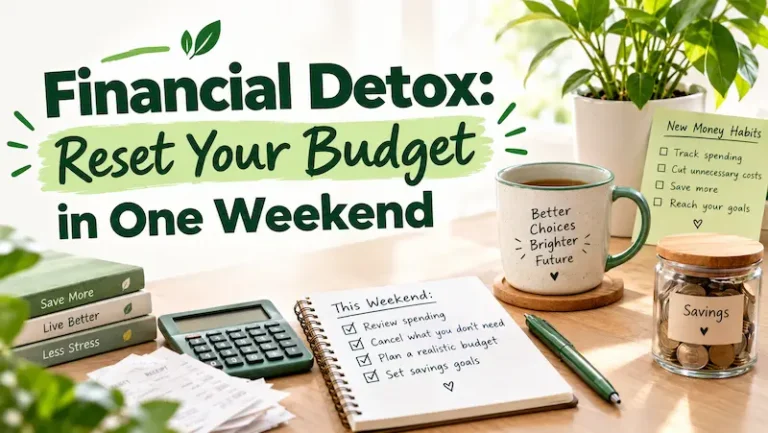
Once a week, compare your transactions with each category’s remaining balance, add anything missing, and change limits that no longer fit. A budget isn’t a contract. If rent rises or a bill changes, update the plan. If the whole budget needs a reset, our financial detox guide can help.
Envelope Budgeting Example: A Full Month on $3,000
This is a hypothetical illustration of how category allocations work. It is not a recommended budget for a typical US household and does not reflect average living costs. It assumes $3,000 in available monthly take-home income and no additional unlisted expenses.
| Budget category | Monthly allocation |
|---|---|
| Housing | $900 |
| Utilities and phone | $200 |
| Insurance | $100 |
| Minimum debt payments | $100 |
| Groceries | $400 |
| Transportation | $200 |
| Household and personal essentials | $100 |
| Dining out and entertainment | $100 |
| Medical and other variable essentials | $100 |
| Sinking funds | $200 |
| Emergency savings | $150 |
| Additional debt payments | $200 |
| Other planned household expenses | $250 |
| Total | $3,000 |
A few qualifications matter:
- The $100 for insurance and the $100 for minimum debt payments are placeholders, not recommended amounts. Your required payments must be paid in full. If they exceed the placeholders, reduce other allocations and recalculate before using this budget. Never skip a required payment to make the numbers fit.
- The $200 for additional debt payments is in addition to your minimum payments.
- The $250 for other planned household expenses must go to real costs not already listed elsewhere, such as childcare, pet care, or subscriptions, depending on your household. Don’t count any expense twice.
What happens when you spend from an envelope?
Say you start the month with $400 in groceries and spend $85. The grocery category drops to $315. If you paid by debit card, your bank balance also falls by $85. The category record and the bank transaction describe the same purchase, not two expenses.
Sinking funds versus emergency savings
Sinking funds cover costs you can anticipate, such as annual fees, vehicle maintenance, or holiday spending. Emergency savings are for unexpected shocks, such as a job loss or a sudden medical bill. Penn State Extension describes emergency funds as cover for critical expenses after events like these, and treats money set aside for periodic costs such as car repairs and holidays as a separate goal. The two serve different purposes and aren’t interchangeable.
Frugal Envelope Categories That Help You Spend Intentionally
The ideas below are subcategories or spending strategies within your existing allocations, not extra money on top of the $3,000. Splitting a $100 household-and-personal envelope into smaller tracking categories, for example, still totals $100.
- Groceries: Plan meals around food you already have, compare unit prices, and use leftovers before buying more. Our guides to frugal meal planning and saving on groceries without coupons go deeper.
- Household supplies: Use what you already own first, choose refills only where the cost per use is actually lower, and avoid replacing items before they wear out.
- Clothing and personal purchases: Consider repair, borrowing, or a secondhand purchase, or wait before buying. In the example above, these costs would come from an existing allocation such as household and personal essentials.
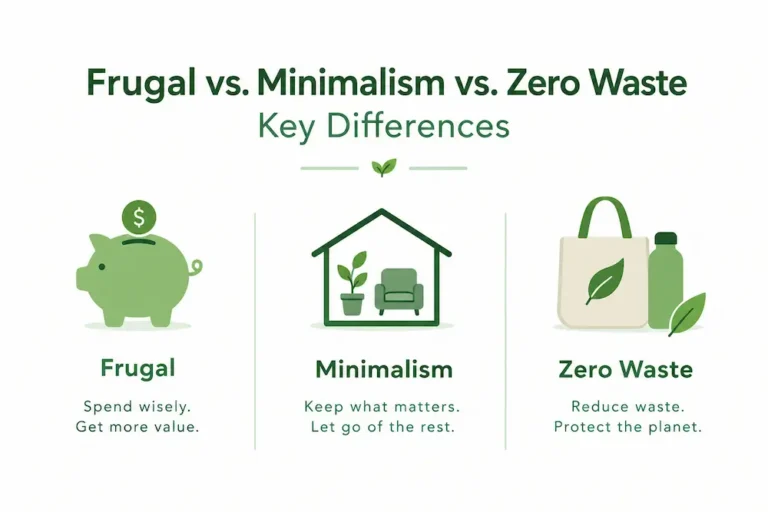
Frugality here means fewer unnecessary purchases, longer product life, and deliberate decisions. It doesn’t mean every reusable or “sustainable” product saves money, so compare the real cost per use before you buy.
Cash vs. Digital Envelope Budgeting: Which Should You Choose?
The right method depends on your spending habits, how you pay bills, and whether you can keep accurate records. Many households end up with a hybrid.
| # | Cash | Digital | Hybrid |
|---|---|---|---|
| How it works | Physical cash sorted into labeled envelopes | Category balances tracked in a spreadsheet, app, or bank feature | Cash for variable spending, digital categories for everything else |
| Balance visibility | Immediate: you see what’s left | Only as current as your records | Cash is visible; digital needs updating |
| Online bills | Awkward; money must be deposited first | Well suited | Bills digital, in-person spending cash |
| Recordkeeping | Light for envelopes; withdrawals still need tracking | Every transaction recorded or imported | Both sets must be reconciled |
| Practical points | Can be lost or stolen | Accuracy depends on entries; app features vary | More moving parts, so keep categories few |
One more difference: money held in an account at an FDIC-insured bank is covered by FDIC deposit insurance in the event of a bank failure, up to the standard limit. Cash in a drawer isn’t a bank deposit.
How to handle online bills and credit cards
Electronic bills can be assigned to digital categories even when all your money sits in one bank account. You decide which dollars are reserved for rent, utilities, or the phone bill, then pay them online as usual.
Credit cards need one extra principle: a card purchase is a real expense on the day you make it, even though the cash leaves later. Suppose you buy $60 of groceries with a credit card. When you record it, the grocery envelope decreases by $60, and you keep that $60 available to repay the card instead of spending it elsewhere. When you later pay the $60 charge, that payment settles an existing card balance. It is not a second grocery expense.
The difference is between new purchases, which reduce a category, and repayments of pre-existing debt, which come from your debt payment allocations. Don’t assume your app reserves money or tracks card payments correctly. Check how it behaves, and rely on the principle rather than the tool. Available credit is never budget money.
How to account for cash withdrawals and transfers
Here’s a reconciliation example:
- Withdraw $100 from your bank account to fund cash envelopes.
- Put $60 in groceries and $40 in household supplies.
- Spend $25 on groceries.
- You now hold $75 in cash: $35 for groceries and $40 for household supplies.
The $100 withdrawal is a transfer, not an expense. The $25 grocery purchase is the expense. Moving money between categories changes allocations but never creates a new expense. Your bank balance, cash on hand, and category records should always agree: here, the account is $100 lower, $75 sits in envelopes, and $25 was spent.
How to Handle Irregular Income, Shared Expenses, and Overspending
If your income changes from month to month
Cover essential bills, required minimum debt payments, and immediate needs first. Fund other categories as money arrives, using the conservative baseline from Step 1, and assign anything above it only after urgent obligations are met.
This situation is common. Penn State Extension, citing a 2020 CFPB survey, reports that almost one-quarter of US consumers say their income changes somewhat or a lot from month to month, and that people with variable income are more likely to have trouble paying a bill. A budgeting method can’t close an income shortfall by itself.
If you share expenses with a partner or household
Agree on which categories are shared, how much each person contributes, each category’s limit, who records transactions, and how reimbursements work. You can track shared household categories separately from each person’s discretionary spending, which keeps one person’s coffee habit out of the grocery envelope.
If an envelope runs out before the month ends
- Pause discretionary spending in that category.
- Check for missing transactions or an unrealistic limit.
- If appropriate, move money from a less urgent category and update both balances.
- Don’t count the same dollars twice, and don’t treat available credit as extra budget money.
If essential costs exceed your available income, tightening an envelope won’t fix it. You may need a broader plan covering income, expenses, or assistance.
Common Envelope Budgeting Mistakes and How to Avoid Them
- Unrealistic limits: Base them on recent statements, then adjust.
- Forgetting irregular expenses: Add sinking funds for annual or seasonal costs.
- Not recording transactions: Log purchases as they happen, or do a weekly catch-up.
- Too many categories: Start with the categories where your spending actually varies.
- Treating allocated savings as spare money: Label savings clearly and keep them out of everyday spending view.
- Refusing to adjust: Revise limits when bills, income, or household needs change.
Is Envelope Budgeting Right for You?
Three common approaches solve slightly different problems:
- Envelope budgeting: Useful for managing spending through category limits.
- Zero-based budgeting: Useful for assigning available income to planned uses, including expenses, savings, and debt repayment.
- 50/30/20 budgeting: A broad framework that splits income among needs, wants, and savings or debt goals. U.S. Bank’s explanation of the rule notes that it’s a framework, not a mandate, and that the proportions can be adjusted.
These approaches overlap. You could plan your income with zero-based budgeting and track variable spending, such as groceries and dining out, with digital envelopes. No method is best for everyone. The better question is which one you can maintain.
Frequently Asked Questions
Yes. Spreadsheets, budgeting apps, and some bank features can track category balances. The key is recording every transaction accurately and making sure no dollar is assigned to two categories.