Prices and availability checked on October 9, 2026. This comparison is based on documented research, not hands-on testing.
A Cleaner Home Without Overspending
Comparing cleaners that make environmental claims is harder than it looks. One bottle says “plant-powered,” another is refillable, a third carries a government-run label, and each one holds a different amount of product. A low shelf price can hide a formula you have to use heavily, and a higher price can hide a concentrate that makes gallons.
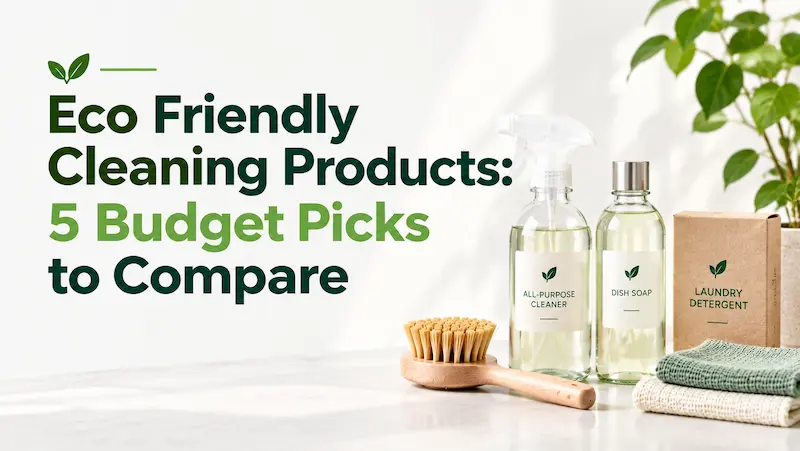
This guide compares five eco friendly cleaning products on details you can check: what each is meant to clean, the price listed on October 9, 2026, cost per use where the label’s directions allow the math, packaging, and whether each environmental claim comes from an independent program or from the company selling the product. Treat the prices as a snapshot. They change by retailer, by week, and by promotion.
This guide compares five eco friendly cleaning products on details you can check: what each is meant to clean, the price listed on October 9, 2026, cost per use where the label’s directions allow the math, packaging, and whether each environmental claim comes from an independent program or from the company selling the product. Prices change by retailer, week, and promotion. If you’re exploring other practical upgrades for your home, our guide to sustainable home products worth buying offers more ideas for choosing products with sustainability and value in mind.
What Makes a Cleaning Product a More Eco-Conscious Choice?
Look for Evidence Behind Environmental Claims
Words such as “natural,” “green,” and “plant-powered” describe a marketing position, not a verified outcome. The FTC’s environmental marketing guidance says companies need competent and reliable scientific evidence to support environmental claims, whether the claim is about a product or its packaging. You can’t see that evidence on a shelf, which is why third-party programs are worth knowing.
The most relevant one for household cleaners is EPA’s Safer Choice program. It is voluntary. According to EPA, every chemical ingredient is reviewed regardless of its percentage in the formula, products must meet category-specific performance standards, and the review also covers pH, volatile organic compounds, and packaging. EPA says it audits certified products annually and that nearly 2,000 products currently qualify. “Safer” is a comparison, not a promise that a product carries no risk, so you still need to follow the label.
Other badges in this roundup, such as USDA biobased percentages and cruelty-free marks, answer narrower questions: how much of a product comes from renewable sources, or whether animal testing was avoided. They don’t measure how well a product cleans or its overall environmental impact. To confirm a Safer Choice claim for the exact product you plan to buy, use EPA’s product search, which also points to a downloadable list of certified products.
Compare Packaging and Refill Options
Each format trades one benefit for another:
- Concentrated cleaning products ship and store less water, but you still dilute them into a bottle, and the container is usually plastic.
- Tablets and powders are compact, and the refill packaging in this roundup is paper-based. Blueland describes that packaging as designed for industrial composting, which most households can’t do at home, and the company points shoppers to a composter locator for that reason.
- Ready-to-use sprays and disposable wipes are convenient, but you pay for the water or the single-use cloth with every purchase. They aren’t included here because their details couldn’t be documented to the same standard in this round of research.
- Reusable cloths reduce disposable wipes but need laundering, and they weren’t evaluated.
None of these formats is universally better. The right one depends on how often you clean, how much storage you have, and which trade-off bothers you most.
Choose Products for the Job You Need Done
The label is the only reliable guide to which surfaces a product can handle. The manufacturers in this roundup are specific about it. Blueland’s multi-surface cleaner is designed for counters, sealed wood, and sealed stone, and it is not indicated for floors. Blueland’s laundry tablets are not appropriate for silk, wool, satin, or cashmere. Simple Green’s directions call for a spot test on a hidden area first, and label text on a retailer’s listing says not to use it on suede, leather, opals, or pearls. Puracy states that its multi-surface cleaner does not sanitize and points readers to CDC guidance for that.
How This Roundup Was Built
- Method: The research draws on manufacturer product pages, retailer listings, and guidance from EPA and the FTC. No products were used, tested, or lab-evaluated for this article, so it makes no claim about which product cleans best.
- What “budget” means: This roundup does not use a flat price cap. It compares cost per use within a category, because a $14 concentrate can cost about the same per bottle as a $5 two-tablet pack. Bottles, shipping thresholds, and subscription terms are noted where they change the real cost.
- Prices: Blueland and Puracy prices come from their own product pages on October 9, 2026. Simple Green and Seventh Generation prices come from retailer listings, which vary by store and weren’t confirmed at checkout. Sale prices are labeled as sale prices.
- Environmental claims: Each claim is sorted into an independent program or a seller’s statement. EPA’s Safer Choice database requires an interactive search that wasn’t available during this research, so the Safer Choice status below reflects what manufacturers and retailers state. Confirm it in EPA’s database before relying on it.
- Inclusion: Candidates whose price, directions, and claims couldn’t be documented to the same standard were left out. That is why this list has five products rather than more.
5 Eco Friendly Cleaning Products to Compare
| Product | Price seen on Oct. 9, 2026 | Cost measure | Safer Choice status (as stated by seller) |
| Simple Green All-Purpose Cleaner concentrate, 32 fl oz | $4.97 (Walmart.com listing) | About $0.34 per 24 oz bottle at 1:10 | Stated on manufacturer page |
| Blueland Multi-Surface Cleaner Tablet Refills | $5 for 2 tablets; $4 with autoship | $2.50 or $2.00 per 24 oz bottle | Stated on manufacturer page |
| Puracy Natural Multi-Surface Cleaner Concentrate, 16 fl oz | $13.99 sale (regular $19.99) | About $2.62 sale or $3.75 regular, per 24 oz bottle | Not claimed on the page reviewed |
| Seventh Generation Free & Clear Dish Liquid, 25 fl oz | $3.49 at Kroger (was $3.99) | 14.0 cents per fl oz | Stated on retailer listing |
| Blueland Laundry Detergent Tablet Refills, Free & Clear, 60 tablets | $21; $16.80 with autoship | $0.35 or $0.28 per load, one tablet | Stated on manufacturer page |
Simple Green All-Purpose Cleaner Concentrate, 32 fl oz: The Lowest Cost Per Bottle Here
Simple Green’s all-purpose concentrate is the product in this set where dilution does most of the work. The directions give three strengths: full strength to 1:1 for heavy messes, up to 1:10 for general purpose, and up to 1:30 for light cleaning such as dust and fingerprints.
A Walmart.com listing showed $4.97 for the 32-fluid-ounce bottle on October 9, 2026, which is 15.5 cents per fluid ounce of concentrate. Other listings surfaced during research showed $5.99 and $8.99, so where you shop matters. At $4.97, a 24-ounce spray bottle mixed at 1:10 needs about 2.2 ounces of concentrate (24 ÷ 11), or about $0.34. At 1:30 that falls to about $0.12, and at 1:1 it rises to about $1.86. The full bottle makes roughly 2.75 gallons at 1:10.
The manufacturer’s page states that the product is EPA Safer Choice certified, and retailer labels carry Safer Choice text. Here that is a seller statement, not a database check. A grocery retailer’s listing for a related 22-ounce Simple Green concentrate also describes the formula as biodegradable within six months in a typical sanitary sewer or septic system, which is a company claim with stated conditions. That same listing’s ingredient list includes methylchloroisothiazolinone and methylisothiazolinone preservatives, so read the label on the exact bottle if you avoid them. The bottle itself is plastic, and no independent comparison of cleaning performance was found.
This one suits you if you clean often, like adjusting strength to the mess, and want the lowest cost per use.
Blueland Multi-Surface Cleaner Tablet Refills: The Compact Refill Format
Blueland’s multi-surface tablet refills turn one tablet and 24 ounces of water into a bottle of cleaner. The one-time price on the page was $5 for two tablets ($2.50 per bottle, or 10.4 cents per ounce). Autoship was listed at $4 for two ($2.00 per bottle), delivered every three months and cancelable. Free shipping starts at $50, and the shipping charge on a smaller order wasn’t checked.
The tablet is only part of the cost. Blueland’s directions refer to its own reusable bottle, and the price and materials of that bottle weren’t verified. The page lists EPA Safer Choice, Cradle to Cradle Certified, and Leaping Bunny among its certifications. Those are the company’s statements here, not confirmed in the databases of the programs involved. The tablets and refill packets are described as plastic-free and designed to be industrially compostable, so the packaging benefit depends on whether you have access to that kind of composting.
The page says the formula was “independently tested to perform alongside major brands,” but no test report was located. Practical limits: it is meant for sealed surfaces and isn’t indicated for floors, though sealed floors can be spot cleaned.
This suits you if storage space or bottle waste matters more to you than cost per use, and you’ll accept paying more for it.
Puracy Natural Multi-Surface Cleaner Concentrate, 16 fl oz: A Plant-Derived Concentrate
Puracy’s concentrate was listed at a $13.99 sale price against a $19.99 regular price on October 9, 2026, a 30 percent markdown that shouldn’t be read as an everyday price. The company states that the 16-ounce bottle makes one gallon, and an older version of its page said to add 3 ounces of concentrate to a 25-ounce bottle and fill the rest with water. On that basis, a 24-ounce bottle uses 3 ounces: about $2.62 at the sale price and $3.75 at the regular price. That puts it close to Blueland’s tablet per bottle, without the need for a proprietary bottle.
The page lists USDA biobased and PETA cruelty-free badges, and no Safer Choice claim was found on it. That doesn’t mean the product isn’t certified, only that this page doesn’t say so. The ingredients include decyl glucoside and an alcohol ethoxylate, with benzisothiazolinone as a preservative. The “99.51% natural” figure is Puracy’s own calculation. The page also says the cleaner does not sanitize.
This suits you if you prefer plant-derived surfactants and a fragrance sourced from natural oils, and you’re comfortable paying more per bottle than you would for the Simple Green concentrate.
Seventh Generation Free & Clear Dish Liquid, 25 fl oz: A Familiar Dish Soap With a Safer Choice Claim
This is the most ordinary product in the roundup, and that’s the point for anyone who wants a dish soap with a stated Safer Choice listing without ordering online. A Kroger.com listing showed $3.49, marked down from $3.99, for 25 fluid ounces: 14.0 cents per ounce on sale and 16.0 cents at the listed regular price. Kroger prices are store-specific.
Dish soap use varies too much for a per-wash figure, so per-ounce cost is the only fair measure, and it can’t be compared with concentrate cost per ounce. The listing states the product is fragrance-free, dye-free, and phosphate-free, and that it is EPA Safer Choice certified and USDA Certified Biobased at 95 percent. Those are statements repeated by a retailer, and Seventh Generation’s own page wasn’t opened for this research.
A caution on refills: Walmart listings surfaced during research priced the 50-ounce refill at $13.99 to $15.99, or 28.0 to 32.0 cents per ounce. Prices differ by retailer, but a refill pouch isn’t automatically the cheaper option.
This suits you if you want an unscented dish soap from a mainstream retailer and prefer to avoid shopping around.
Blueland Laundry Detergent Tablet Refills, Free & Clear: Eco-Friendly Laundry Detergent by the Load
Blueland’s laundry tablets are priced at $21 for 60 tablets on the page, or $16.80 with autoship. One tablet per load works out to $0.35 one time and $0.28 on autoship. The directions say to use two tablets for large or messy loads, which doubles those figures to $0.70 and $0.56. The tablets are listed as compatible with high-efficiency machines, front loaders, and top loaders.
The page states EPA Safer Choice, Cradle to Cradle Certified, and Leaping Bunny status, and says the Free & Clear scent is accepted by the National Eczema Association. As with the other Blueland products, these are the company’s statements. The formula is listed as free of PVA, the plastic-like film found in some laundry sheets, and the refill packaging is described as industrially compostable. Blueland’s own comparison chart lists competing brands at $0.30 to $0.45 per load, which suggests a similar range, but those are the company’s figures. The page says the tablets are not appropriate for silk, wool, satin, or cashmere. The performance language, “tried, tested and proven to perform alongside major brands,” is also the company’s.
This suits you if you do a few loads a week and want pre-measured doses with no jug. The page itself suggests the 60-tablet pack for two to four loads weekly.
How to Compare the Real Cost
Compare Cost Per Use, Not Just Shelf Price
The formula depends on the product type. For concentrates, divide the price by the ounces of concentrate, then multiply by the ounces your directions call for. For tablets, divide the price by the number of tablets. For laundry, divide the price by the loads the label supports at the dose you use.
| General-purpose cleaner | Calculation | Cost per 24 oz bottle |
| Simple Green at 1:10 | $4.97 ÷ 32 oz × (24 ÷ 11) oz | About $0.34 |
| Puracy at the stated gallon yield | $13.99 ÷ 16 oz × 3 oz | About $2.62 (sale); $3.75 at $19.99 |
| Blueland tablet | $5 ÷ 2 tablets | $2.50 one time; $2.00 autoship |
Two cautions apply. Simple Green’s figure uses the most diluted end of its general-purpose range, so stronger mixes cost more. And the table compares price, not cleaning results, since no independent performance comparison was found for any of these. Also avoid comparing concentrate and ready-to-use prices per ounce. Simple Green’s concentrate costs 15.5 cents per ounce as sold, but after dilution at 1:10 it costs about 1.4 cents per ounce of finished cleaner.
Watch for Additional Costs
- Bottles: Blueland’s tablets assume its reusable bottle, whose price wasn’t verified.
- Shipping: Blueland lists free shipping over $50. Puracy’s terms vary by offer, with free shipping noted for new customers and subscribers.
- Subscriptions: Blueland autoship takes 20 percent off but renews every three months. Puracy’s subscription page lists 25 percent off the first order and 15 percent off recurring ones. These are conditional prices.
- Promotions: Puracy’s 30 percent markdown was running on October 9 and may not last.
- Retailer spread: Simple Green appeared between $4.97 and $8.99 across listings.
Are Eco Friendly Cleaning Products Worth It?
It depends on what you’re paying for. In this set, the concentrate costs a fraction of the other general-purpose options per bottle, while the refill tablets cost more per bottle and offer compact storage and plastic-free refills. A product with a stated Safer Choice listing may matter to you for ingredient review, while another may matter for fragrance or packaging. Frequency of use changes the math: someone who cleans counters daily will notice a gap of a few dollars a month, and someone who cleans weekly may not.
The best approach is to decide which attribute matters most to you, check the cost per use for that format, and confirm any certification you’re relying on in the official record. Among budget-friendly cleaning products, the cheapest per use isn’t always the one that fits your habits.
Conclusion: Start With One Practical Swap
The useful questions are simple: is the product made for the task, what does it cost per use, and who stands behind each claim? You don’t need to replace your whole routine to apply them. Pick the cleaner or detergent you buy most often, work out its cost per use from the label, and compare it with one option from this list. Check any certification in the official record before it influences the purchase, and let the numbers decide what comes next.
The best approach is to decide which attribute matters most to you, check the cost per use for that format, and confirm any certification you’re relying on in the official record. If you’re looking for more ways to make your home sustainable without overspending, explore our Sustainable Home guides for practical ideas on reducing waste, saving resources, and making more informed household choices.
Frequently Asked Questions
Look for clear directions, a full ingredient list, a certification you can verify in the issuing program’s database, and specific claims rather than words like “natural.” Check what each environmental claim covers, such as a formula, a package, or both.