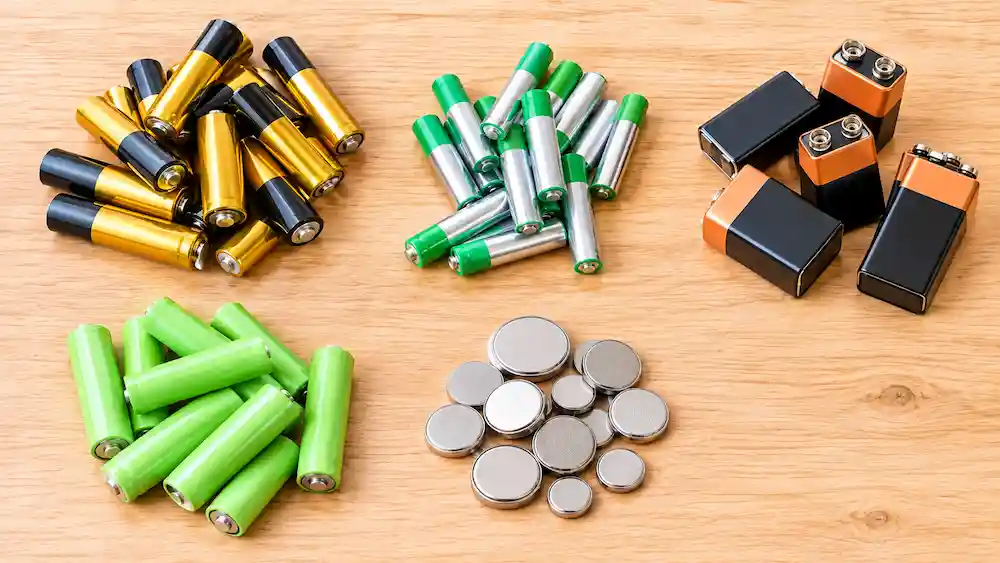
You open the junk drawer and there they are: dead AAs, a corroded 9-volt and an old phone pack you never knew what to do with. You know you shouldn’t just toss them. You’re just not sure which ones can go where.
Here’s how to dispose of batteries without the guesswork. It matters because even used batteries can hold enough charge to start a fire. EPA found more than 240 lithium-ion battery fires at 64 waste facilities from 2013 to 2020 (EPA fire analysis).
By the end, you’ll know your battery type, whether trash is legal where you live, and where your nearest drop-off is. One note on names: the biggest drop-off network is now The Battery Network (formerly Call2Recycle). You’ll see both names here so you can find it either way. Battery disposal gets easier from here, so start with the quick answer below.
How to Dispose of Batteries in 5 Steps
- Read the label to identify the chemistry: alkaline, lithium, lithium-ion, NiMH or lead-acid.
- Check whether your state or city bans putting that type in the trash.
- Tape the terminals or bag each battery separately.
- Store them in a plastic (not metal) container away from heat.
- Drop them off at a store bin, county hazardous waste site or mail-in kit.
Each step takes minutes. The sections below walk through them in order, starting with which batteries can legally go in the trash.
Can You Throw Batteries in the Trash? It Depends on the Type
In most U.S. communities you can throw away used alkaline and zinc-carbon batteries, though EPA recommends recycling them. Rechargeable, lithium and button batteries should never go in household trash or curbside recycling. California and several other states restrict or ban batteries in the trash, so check local rules first.
Alkaline and zinc-carbon batteries (AA, AAA, C, D, 9-volt)
EPA says most communities allow these in household trash, but it recommends recycling them or checking with your local or state solid waste authority. That’s how to dispose of alkaline batteries in most places: trash is allowed, recycling is better.
Batteries that should never go in the trash
Button and coin cells, single-use lithium (look for the word “lithium” on the label), every rechargeable type and lead-acid batteries all need a proper drop-off. Per EPA, battery type is identified by marking and labeling, not by shape or color.
The reason: batteries can contain mercury, lead, cadmium, nickel and silver, and they can start fires even when they appear discharged.
| Battery type | Common uses | Trash OK? | Where to take it |
|---|---|---|---|
| Alkaline / zinc-carbon | AA, AAA, C, D and 9-volt cells | Usually yes, but recycling is recommended | County household hazardous waste (HHW) site or another single-use program |
| Single-use lithium | Cells marked “lithium” on the label | No | HHW site or mail-in kit; some Battery Network sites |
| Button / coin cell | Watches, hearing aids, key fobs | No | HHW site or mail-in kit; keep away from children |
| Lithium-ion | Phones, laptops, power tools, e-cigarettes | No | Store bin, HHW site or electronics recycler |
| NiMH and Ni-Cd | Older cordless tools and phones | No | Store bin or the drop-off locator |
| Small sealed lead-acid | Backup power, mobility scooters | No | Drop-off locator or HHW site |
| Car (lead-acid) | Vehicles | No | Return to the retailer or take to an HHW site |
We emptied the junk drawers in three team households and ended up with 47 batteries on one table: 31 alkaline AA and AAA (mostly Duracell Coppertop and Kirkland Signature), 4 alkaline 9-volts, 6 CR2032 coin cells, 3 Panasonic Eneloop AA rechargeables, 2 old phone and camera lithium-ion packs, and 1 battery with no readable label. The pile weighed about 2.5 pounds on a kitchen scale, and sorting took 25 minutes. Our mistake: we almost tossed two Energizer Ultimate Lithium AAs into the “alkaline, trash is okay” pile because they’re the same size as an alkaline AA. Only the word “Lithium” on the label gave them away, which is exactly why EPA says to read the label, not judge by size or color. The surprise was the 9-volts: two had white crust on the terminals, so we put on gloves.
Prep Your Batteries Before You Drop Them Off
Used batteries can still spark if their terminals touch metal or each other. EPA warns that even used batteries can have enough energy to injure or start fires, and that crushing in trucks and sorting equipment creates a fire risk. Prep takes about a minute per battery:
- Tape the terminals with clear packing or electrical tape, or bag each battery separately. Start with lithium of any kind, 9-volts and button cells. This is also how to dispose of lithium-ion batteries safely: tape or bag them, then take them to a drop-off.
- Skip the wrong tape. The Battery Network says masking, painter’s and Scotch tape can fall off. If you use opaque tape, keep the brand and chemistry visible.
- Store them in plastic, not metal, in a cool, dry spot. Home Depot says up to six months between trips is fine.
- Keep button cells away from children. EPA flags them as a swallowing hazard.
- Never mix in damaged batteries. Swollen or leaking packs need the steps in the damaged-battery section below.
A labeled battery box by the junk drawer is the kind of tiny routine that makes zero-waste habits stick.
To see why taping matters, we checked “dead” batteries with a Klein Tools MM300 multimeter. The AAs read 0.9 to 1.3 volts, the 9-volts 6.2 to 7.4 volts and the coin cells 2.5 to 2.9 volts. A fresh AA reads about 1.6 volts, so these still held charge. We then tried three tapes on the same batch. Clear packing tape and electrical tape stayed put after a week in a plastic tub, but masking tape curled and slid off several terminals within two days. Taping all 47 batteries took about 12 minutes and cost roughly $7: a roll of Scotch heavy-duty packing tape and a box of zip-top bags.
Where to Find the Right Drop-Off Near You
Rechargeables are easy to drop off. Single-use batteries are the hard part. Work down this ladder until you find a site that takes what you have.
Home Depot, Lowe’s, Best Buy and Staples (rechargeables)
Home Depot takes rechargeable batteries up to 11 pounds, with bins usually near the entrance or Customer Service. Call2Recycle suggests bringing 1–4 batteries at a time, and Home Depot says its program has helped recycle 17+ million pounds (Home Depot Eco Actions).
Staples takes rechargeables only (Ni-Cd, Li-ion, small sealed lead-acid, NiMH and Ni-Zn), 11 pounds or less, with a limit of 7 items per customer per day (Staples).
Lowe’s and Best Buy are both named as participating retailers by The Battery Network.
| Store | What to bring | Limits | Verified? |
|---|---|---|---|
| Home Depot | Rechargeables | Up to 11 lb; 1–4 batteries at a time suggested | Yes, per Home Depot |
| Staples | Ni-Cd, Li-ion, small sealed lead-acid, NiMH, Ni-Zn; no alkaline or non-rechargeable lithium | 11 lb or less; 7 items per customer per day | Partly; source page may be stale |
| Lowe’s | Rechargeables | Not yet confirmed | No |
| Best Buy | Rechargeables | Not yet confirmed | No |
We made four stops one Saturday, about 90 minutes including driving.
| Store | Where the bin was | What was accepted | Time |
|---|---|---|---|
| Home Depot | Just inside the entrance, near Customer Service | Lithium-ion and NiMH packs; no alkaline or coin cells | 8 min |
| Lowe’s | Near the exit and service desk | Same as Home Depot | 7 min |
| Best Buy | Kiosk inside the front doors | Rechargeables | 6 min |
| Staples | Customer service counter | Rechargeables only; AAs turned away | 9 min |
Surprise: nobody asked for a receipt or membership, and no store took our single-use batteries.
The Battery Network drop-off locator (formerly Call2Recycle)
Call2Recycle became The Battery Network on January 13, 2026 (Resource Recycling). Its network has 20,000+ drop-off locations. Every site takes rechargeables, but only some take single-use batteries (Battery Network FAQ).
For battery recycling near me, enter your ZIP code in the locator and filter by battery type. Prefer a person? Call 1-877-2-RECYCLE.
Your county’s household hazardous waste program
Search “[your county] household hazardous waste.” EPA lists household hazardous waste points as an acceptable route for every battery type, which makes this the best household hazardous waste battery drop-off option for button cells, lithium and single-use batteries. Earth911’s search is another place to look. Call ahead to confirm hours and accepted types.
We searched the locator for three ZIP codes. The suburban one returned 14 rechargeable sites within 10 miles but only 3 that took single-use batteries. The rural one returned 2 rechargeable sites within 15 miles and none for single-use. Each search took under a minute. Then we called the suburban county’s household hazardous waste line: about a 4-minute hold, open Saturdays 8 a.m. to 2 p.m., free for residents with ID, and they took every battery type. The surprise: the single-use filter changed the answer far more than distance did.
Single-use batteries: the hard part
The Battery Network says there is no national free program for single-use batteries except in Vermont, Illinois and D.C. Local HHW and municipal programs may charge a small fee.
The honest fallback: where your state allows it, EPA says alkaline batteries can go in household trash. Tape 9-volts first. Button cells and lithium batteries still need a proper drop-off.
Mail-in kits
The Battery Network’s online store sells an all-battery kit you fill and ship.
We ordered The Battery Network’s all-battery recycling kit for about $55 (check the current price). Packing 4 pounds of taped batteries took 10 minutes. The box came with a prepaid label, and we dropped it at a UPS Store. It was the only option that took our alkalines and coin cells in one trip, but it cost more than the batteries were worth, so we’d use it only when no local program accepts single-use.
Car batteries
Here’s how to dispose of car batteries: The Battery Network does not accept them, so return them to the retailer or take them to an HHW site. EPA notes lead-acid batteries can hold up to 18 pounds of lead and about a gallon of acid.
Battery Disposal Rules by State
Rules differ by state and by battery type, and EPA leaves single-use trash disposal to state and local authorities. This snapshot draws on The Battery Network’s state-laws page.
| State | What the rule says |
|---|---|
| California | Batteries are universal waste; households must recycle them and may not put them in the trash (California DTSC). |
| New York | Disposing of rechargeable batteries as solid waste is prohibited; retailers that sell rechargeables must take them back. |
| Washington, D.C. | A battery disposal ban has been in effect since 2022. |
| Washington State | SB 5144 bans disposal of portable batteries starting January 1, 2027. |
| Illinois | A disposal ban for portable and medium-format batteries applies after January 1, 2028. |
| Nebraska | Disposal-ban compliance begins January 1, 2028. |
| Minnesota | Rechargeable batteries cannot go in mixed municipal waste. |
| Vermont | A 2026 act expanded its stewardship rules to portable batteries of both kinds. |
| Lead-acid (many states) | Many states, including Texas, Virginia and North Carolina, bar lead-acid batteries from the trash. |
To check your own rules in 30 seconds, search “[your city] battery disposal” or visit your county solid-waste site.
Last verified: November 14, 2026.
What to Do With Damaged, Swollen or Leaking Batteries
A damaged or defective battery is swollen, leaking, punctured or overheating. Warning signs include bulging, a strong odor, a cracked or warped casing, burn marks, water damage and odd behavior while charging.
If you find one, here is how to dispose of a swollen battery safely:
- Isolate it from everything else.
- Set it in sand or kitty litter in a non-flammable container.
- Never put it in the trash, water, home recycling or a collection box.
- Call the manufacturer for instructions.
Most drop-off sites do not accept damaged or recalled batteries. In Illinois, New York, Vermont and D.C., trained sites may. Use the locator: deselect “Rechargeable” and select “Damaged/Defective” (Battery Network guidance). For a recalled battery, contact the manufacturer and check the CPSC for active recalls.
Corroded or leaking alkaline batteries are different: they are not classed as damaged. Wear gloves and handle them like regular alkalines.
Special Cases: Phones, Laptops, E-Bikes and Vapes
Phones and laptops with built-in batteries
For laptop and phone battery disposal, recycle the whole device through a certified electronics recycler or retailer take-back, per EPA. Tape or bag any removable battery.
E-bikes, power tools and large packs
These follow stricter rules. For e-bike battery disposal, The Battery Network runs e-bike and “high-energy” (300+ watt-hour) programs through participating brands and trained sites. Contact the manufacturer first.
Vapes
For vape battery disposal, The Battery Network does not take disposable vapes unless the battery can be fully removed. Check the maker or retailer.
| Item | First step |
|---|---|
| Phones and laptops (built-in battery) | Electronics recycler or retailer take-back; recycle the whole device |
| E-bikes, power tools, large packs | Contact the manufacturer, then trained sites in participating programs |
| Vapes | Check the maker or retailer; the battery must be fully removable for The Battery Network |
Cut Down on Battery Waste (and Save Money)
Disposal is the last step. The cheaper move is buying fewer batteries. Switch high-drain, high-use devices such as game controllers, wireless keyboards and flashlights to NiMH rechargeables. If you swap your most-used devices, you’re joining the short list of reusable products worth buying.
Then buy only what you’ll use, and keep a single labeled battery box. Small swaps like this add up; see how much zero-waste habits can save over a full year.
We priced a 4-pack of Panasonic Eneloop AA batteries and a Panasonic basic charger at about $32 together. Panasonic rates standard Eneloops for up to 2,100 recharge cycles. A 24-pack of Duracell Coppertop AAs ran about $0.50 per battery. At that price, the rechargeable kit breaks even after roughly 64 alkaline AAs. In our wireless keyboard and two game controllers, that took about eight months.
Conclusion
Battery disposal comes down to three habits: identify the chemistry, prep the terminals, and drop off whatever the trash can’t take. That’s how to dispose of batteries safely, and it’s a ten-minute errand.
Tape up what’s in your drawer tonight, then run the drop-off locator for your ZIP code.
The bigger win is buying fewer batteries. Live well, spend less, waste nothing: a $32 rechargeable kit breaks even after roughly 64 alkaline AAs, about eight months of keyboard and controller use. Ready for your next step? Here’s how to start a zero-waste lifestyle without spending a fortune.
Your one action for tonight: tape the lithium, 9-volt and coin cell batteries first.
Frequently Asked Questions
In most U.S. communities you can throw away used alkaline and zinc-carbon batteries (AA, AAA, C, D, 9-volt), though EPA recommends recycling them. Never trash rechargeable, lithium, or button batteries. California, and a growing list of states and D.C., restrict or ban batteries in trash, so check your local rules.