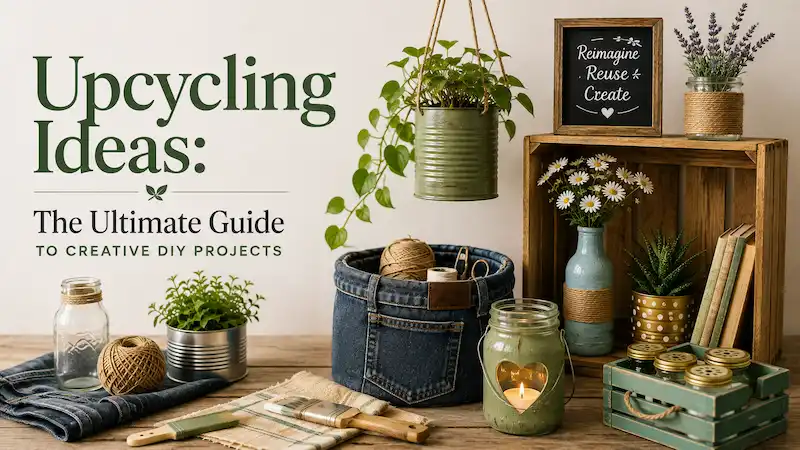
There is something genuinely satisfying about turning a worn-out dresser into a showpiece, or watching a pile of old pallets become patio furniture. That is the essence of upcycling ideas: giving ordinary objects a second life that looks better, functions better, and means something more than what they started out as.
Upcycling has moved well beyond a niche craft hobby. It has become a practical approach to home design, sustainable living, and even a source of income for creative makers. Whether you are drawn by the cost savings, the environmental benefit, or simply the appeal of making something unique, there has never been a better time to start exploring what you can make from what you already have.
This guide covers everything from the definition and history of upcycling to room-by-room project ideas, furniture transformations, textile work, garden projects, tips for selling what you make, and the most common mistakes to avoid. By the end, you will have a clear picture of where to start and what to tackle next.
What are upcycling ideas? Upcycling ideas involve creatively transforming old or discarded items into something new, functional, and higher in value. Common projects include turning wooden pallets into furniture, wine bottles into vases, and worn denim into tote bags. Unlike recycling, upcycling skips the industrial breakdown process, saving energy and producing unique, one-of-a-kind pieces.
Key Takeaways
- Upcycling means transforming old or unwanted items into something more valuable, functional, or beautiful without breaking them down into raw materials.
- Unlike recycling, upcycling preserves the original material, requires less energy, and often creates unique, one-of-a-kind products.
- Anyone can start upcycling with simple tools and everyday household items like glass jars, wooden pallets, old furniture, fabric scraps, and tin cans.
- Upcycling helps reduce waste, saves money, extends the life of usable materials, and supports a more sustainable lifestyle.
- Beginner-friendly projects such as painted furniture, pantry storage jars, tote bags, herb planters, and pallet décor are inexpensive and easy to complete.
- Proper preparation, including cleaning, sanding, and choosing the right materials, is the key to creating durable, professional-looking results.
- Upcycled furniture, home décor, clothing, and handmade accessories can also become a profitable side business through local markets and online platforms.
- The best way to get started is to choose one simple project, complete it successfully, and gradually build your skills, confidence, and toolkit.
What Is Upcycling?
Upcycling is the process of taking something discarded or underused and transforming it into a product of greater value, quality, or purpose without breaking it down into raw materials first. A cracked ceramic bowl becomes a wall-mounted planter. A stack of jeans that no longer fits becomes a quilted throw. A wooden shipping pallet becomes a garden bench.
The term has a specific origin. The word “upcycling” was first used in 1994 by Reiner Pilz, a mechanical engineer, in the architecture magazine Salvo. Pilz contrasted the practice with recycling, referring to conventional recycling as “down-cycling” and noting that recycled products often lose their value in the process. He argued that what was needed was upcycling, where old products are given more value, not less.
The concept gained wider attention in 2002, when architect William McDonough and chemist Michael Braungart published Cradle to Cradle: Remaking the Way We Make Things. Their framework championed the idea of designing products whose materials could be perpetually cycled in either biological or technical loops, maintaining or increasing quality and value. Their work provided a robust theoretical and design philosophy that powerfully resonated with the core idea of upcycling and helped solidify the term in the language of sustainability.
That history matters because it shows upcycling is not a social media trend. It is a genuinely considered response to how industrial economies have historically treated materials as disposable.
Upcycling vs. Recycling: What’s the Real Difference?
This is one of the most common questions people ask, and the answer has practical implications for how you approach waste at home.
Recycling is an industrial process. It involves collecting materials, sorting them, breaking them down into raw form (melting glass, shredding plastic, pulping paper), and manufacturing those raw materials into something new. The output is useful, but the process requires significant energy, transportation, and infrastructure. And the resulting material is often lower in quality than the original, which is why critics sometimes call it “downcycling.”
Upcycling, by contrast, turns old items into products with equal or higher value, often without heavy processing. In most cases, upcycling uses less energy and keeps more of the original item intact. Instead of shredding your old jeans to recover raw cotton fiber, you cut and sew them into a tote bag. Instead of melting glass bottles back into cullet, you turn them into pendant lights. The original material stays structurally intact, which means less energy is consumed and the final product often carries higher perceived value.
The Ellen MacArthur Foundation points out that it is the consequences of decisions made at the design stage that determine around 80% of environmental impacts. Recycling begins at the end of a product’s lifecycle, while the circular economy approach goes right back to the beginning to prevent waste and pollution from being created in the first place.
Here is a side-by-side comparison to make the distinction concrete:
| Feature | Upcycling | Recycling |
| Process | Creative reuse without breakdown | Industrial breakdown and reprocessing |
| Energy required | Lower (minimal processing) | Higher (collection, sorting, factories) |
| Output quality | Equal to or higher than original | Often lower (downcycling) |
| Scale | Individual or small-scale | Industrial scale |
| Cost to do it | Low (uses what you already have) | Infrastructure-dependent |
| End result | Unique, often artisan product | Standardized new material or product |
| Best for | Structurally sound items with creative potential | Damaged, contaminated, or high-volume waste |
| Examples | Pallet to sofa, jeans to tote bag | Plastic bottles reprocessed into pellets |
Takeaway: Recycling is essential for managing large volumes of waste. Upcycling is usually the better choice when an item still has structural integrity and can be creatively repurposed without energy-intensive processing.
Why Upcycling Matters More Than Ever
The practical motivation for upcycling ideas is real and well-documented. According to the EPA’s Facts and Figures report, the total generation of municipal solid waste in the US in 2018 was 292.4 million tons, of which more than 146 million tons (50 percent) were landfilled. And despite progress over recent decades, a 2025 study by researchers at UC Berkeley found that almost 70% of the municipal solid waste generated in the US is still not recycled or composted.
Those numbers reflect how much material is still leaving the economy as waste. Upcycling is one of the most accessible ways for individuals to change that at home.
The environmental case goes beyond landfill diversion. The Ellen MacArthur Foundation highlights that in agriculture alone, shifting to regenerative production practices, eliminating food waste, and using better and upcycled ingredients in our food products could halve food system emissions by 2050. These principles extend to every category of material reuse.
On the market side, interest in upcycled goods is growing consistently across categories. The global upcycled fashion market was valued at $9.33 billion in 2025 and is projected to reach over $22 billion by 2035, according to Precedence Research. The U.S. market for recycled and upcycled building materials alone exceeded $97.2 billion in 2024. These figures reflect real consumer and commercial demand shifting toward reused and repurposed materials.
For most people reading this, the motivation is more personal. A beautiful, functional object you made from something heading to the bin is its own reward. The environmental benefits are significant and real, but they tend to be secondary to the satisfaction of finishing a good project.
Getting Started: What You Actually Need
The biggest myth about upcycling is that you need a fully equipped workshop. Most projects require far less than people expect.
Essential tools for a starter upcycling kit:
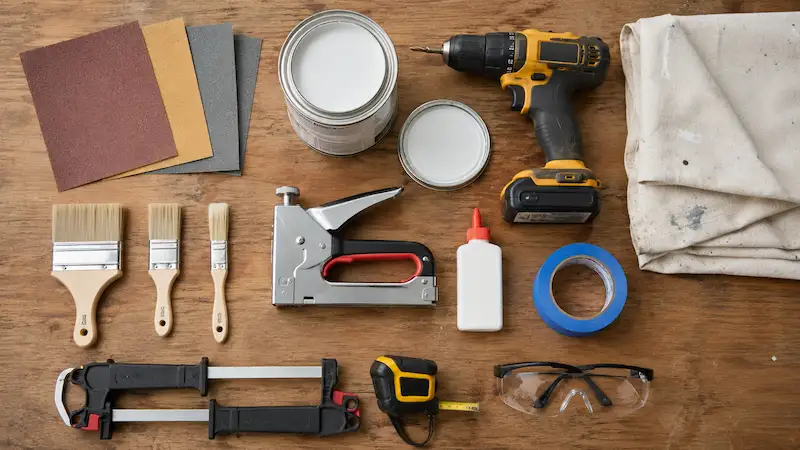
- Sandpaper in several grits (80, 120, and 220)
- Chalk paint or acrylic craft paint and a quality brush set
- A staple gun with 8mm and 12mm staples (invaluable for upholstery work)
- Wood glue and two or three clamps
- A basic drill with common bit sizes
- Strong multi-surface adhesive (E6000 works well for mixed materials)
- Painter’s tape and drop cloths
You do not need all of these at once. If your first project is painting a side table, sandpaper, chalk paint, and a brush get you started. Grow your toolkit as your projects become more varied.
Where to find upcycling materials: Thrift stores, estate sales, Facebook Marketplace, Freecycle, and Buy Nothing groups are the obvious starting points. Some of the best raw materials are already in your home. Old wooden crates, glass jars, tin cans, and fabric scraps are consistently useful. Many local restaurants, coffee shops, and garden centers will also give away pallets, jars, and crates if you ask.
The most useful mindset shift for beginners is thinking in reverse. Rather than asking “I have this object, what can I make?” try “I need a bedside table. What do I already own that could become one?” Starting with function leads to projects you will actually use and keep.
For step-by-step walkthroughs built specifically for those just getting started, 25 Easy Upcycling Ideas for Beginners covers the most beginner-friendly projects with full instructions.
Room-by-Room Upcycling Ideas for Your Home
The following section covers specific, doable upcycling ideas organized by room. These are not theoretical possibilities. They are proven projects that work at beginner-to-intermediate skill levels without specialized tools.
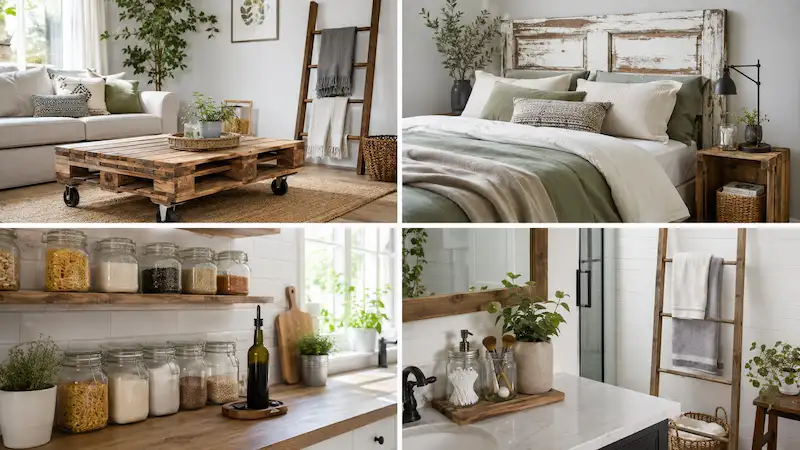
Living Room Upcycling Ideas
The living room is one of the best places to introduce upcycled pieces because the space naturally accommodates a mix of styles, and personality tends to be an asset rather than a liability.
Wooden pallets into a coffee table. Standard shipping pallets are free or nearly free from local warehouses, garden centers, and community boards. Sand them thoroughly, seal the wood with stain or paint, attach furniture legs from any hardware store, and you have a solid, industrial-style coffee table for under $30 in materials. A sheet of tempered glass cut to size (available cheaply from glass suppliers) can be set on top for a cleaner surface.
Wine crates as wall shelving. Wooden wine crates from local restaurants, liquor stores, or auction sites can be stacked, mounted individually, or arranged in a grid on the wall. Sand rough edges, seal the wood with a matte varnish, and mount with heavy-duty L-brackets. They are particularly effective for displaying books, trailing plants, small ceramics, and travel objects.
An old ladder as a blanket and magazine rack. A salvaged wooden ladder, given a light sand and a coat of paint, leans beautifully against a living room wall and holds throws, rolled magazines, or hanging plants. It requires no power tools and works in almost any interior style, from rustic to Scandinavian.
Vintage suitcases as a stacked side table. Two mismatched thrifted suitcases stacked on hairpin legs become a functional and visually interesting side table or low storage piece. The cases themselves provide storage for off-season items or board games, and the legs give the whole arrangement enough height to be practical.
Bedroom Upcycling Ideas
In the bedroom, texture and character matter more than visual uniformity. Upcycled pieces perform particularly well here because uniqueness is genuinely valued.
A drawer as a floating bedside shelf. A single drawer from a broken dresser, mounted flush to the wall with the opening facing outward, becomes an excellent floating bedside table with built-in storage. Sand it, paint it, add a new drawer pull, and mount it at the appropriate height. It is genuinely practical and costs almost nothing if you salvage the drawer for free.
An antique window frame as a decorative mirror. Old multi-pane window frames, cleaned up and hung vertically on the wall, read immediately as large-format mirrors even without the original glass intact. Add inexpensive mirror panels cut to fit each pane at a glass supplier, or use the frame as layered decorative wall art with a vintage map or fabric backing instead.
A salvaged door as a headboard. A wooden paneled door, refinished and mounted horizontally at the head of the bed, creates a striking focal point. Doors with original hardware or paneling detail work especially well. This is one of the most dramatic single-piece transformations you can make to a bedroom for under $50.
Stacked wooden crates as bedside storage. A group of identical-sized wooden crates placed side by side or stacked two high serves as a practical alternative to a nightstand or drawer unit. Paint them all the same color for cohesion, or leave them natural for a warm, textural look.
Kitchen and Dining Room Upcycling Ideas
The kitchen is where small upcycling ideas have the most daily impact, simply because you interact with the space so frequently.
Tin cans as a kitchen herb garden. Large cans from tinned tomatoes, chickpeas, or any other pantry staple become excellent kitchen herb planters. Remove the labels, punch drainage holes in the base, paint or wrap in twine for a more finished look, and plant directly. Lined up on a windowsill, they are both functional and attractive.
Glass jars as a pantry storage system. Old pasta sauce jars, pickle jars, and jam jars work just as well as expensive store-bought mason jars for dry goods storage. Clean them, add chalkboard labels, and line them on open shelving for an organized and genuinely airtight pantry system that costs almost nothing to put together.
Wooden crates as open kitchen shelving. A pair of small wooden crates, sanded and mounted to a kitchen wall with basic shelf brackets, add warm, textural storage for cookbooks, small appliances, or herb pots. The crates can be stained to match existing cabinetry or painted as a contrast feature.
Wine bottles as olive oil dispensers. A clean glass wine bottle fitted with a pour spout (inexpensive online) is an elegant and practical olive oil dispenser. Three different bottles on a small wooden tray make an attractive oil-and-vinegar display next to the stove that looks considerably more intentional than plastic store bottles.
Bathroom Upcycling Ideas
Space is typically limited in bathrooms, which makes this a good room for small, creative upcycling ideas that add character without requiring significant floor area.
Mason jars as bathroom organizers. A set of wide-mouth jars, either mounted in a small wooden frame made from scrap timber or lined along a shelf, organize cotton balls, cotton swabs, bath salts, and small toiletries more attractively than plastic containers. Glass allows you to see contents immediately, which is useful when you are in a hurry.
A wooden ladder as a towel rack. A thin wooden ladder leaned against the bathroom wall or mounted flat holds towels beautifully and frees up towel-bar wall space. Small hooks attached to the rungs hold washcloths and hand towels. Sand it smooth and seal it to handle the humidity.
Vintage crate as toilet paper storage. A small wooden crate, mounted next to the toilet or standing on the floor beside it, holds spare toilet rolls far more attractively than a commercial toilet roll holder. Add a small plant or candle on top to make the space feel intentional.
Takeaway: The most effective room-by-room approach is to choose one standout upcycled piece per room and build the decorative decisions around it. One excellent piece is more impactful than five average ones.
Upcycled Furniture Ideas to Transform Old Pieces
Furniture upcycling consistently produces the most visible and rewarding results. It is also the category where beginners see the fastest skill development, because each project teaches you something transferable to the next one.
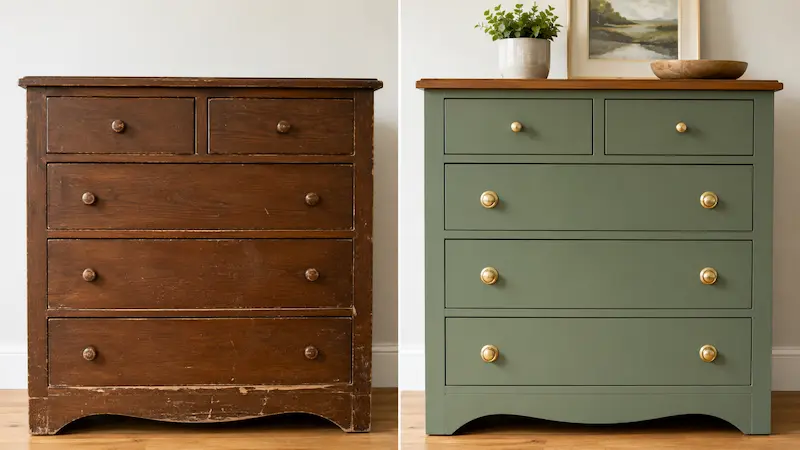
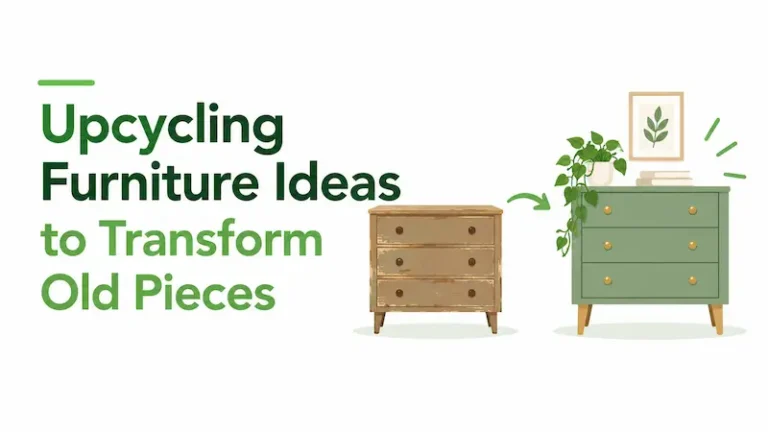
The most common starting point is painting furniture with chalk paint. Unlike standard emulsion or gloss paint, chalk paint bonds to almost any surface without extensive sanding or priming first, and dries to a matte, slightly powdery finish that reads as genuinely high-end on almost any piece. A $15 thrifted dresser with the right chalk paint color and new hardware can become a piece that would sell for $150 to $200 online, or anchor your bedroom design for a decade.
Reupholstering dining chairs is the next level up and more beginner-friendly than most people expect. Dining chairs with removable padded seat cushions are ideal. Remove the seat from the frame, cut new fabric slightly larger than the seat area, stretch it firmly over the existing padding (or replace the foam if it has compressed), and staple it to the underside of the seat board. Reattach the seat to the frame. A solid fabric choice and a staple gun are genuinely all you need. The same chair you bought for $8 at a thrift store becomes something you would not trade away.
Hairpin legs are one of the most useful and underused hardware additions for furniture upcycling. Sets of hairpin legs are widely available online and at most hardware stores. They can be screwed into almost any flat, structurally sound surface: vintage suitcases, wooden crates, old doors, salvaged timber planks. They instantly convert flat objects into tables, benches, and desks with a mid-century modern character.
Pallet furniture deserves its own mention. With sanding, basic joinery skills, and either paint or outdoor oil, standard shipping pallets can become garden sofas with cushions, platform bed frames, outdoor bar counters, headboards, vertical garden panels, and potting benches. The scale and low cost make pallets one of the most impactful single materials in the upcycling toolkit.
Garden and Outdoor Upcycling Ideas
Outdoor spaces are particularly forgiving for upcycling projects. Weather-worn textures and imperfect finishes often add character rather than detracting from the result, which makes the garden ideal for first-time projects.
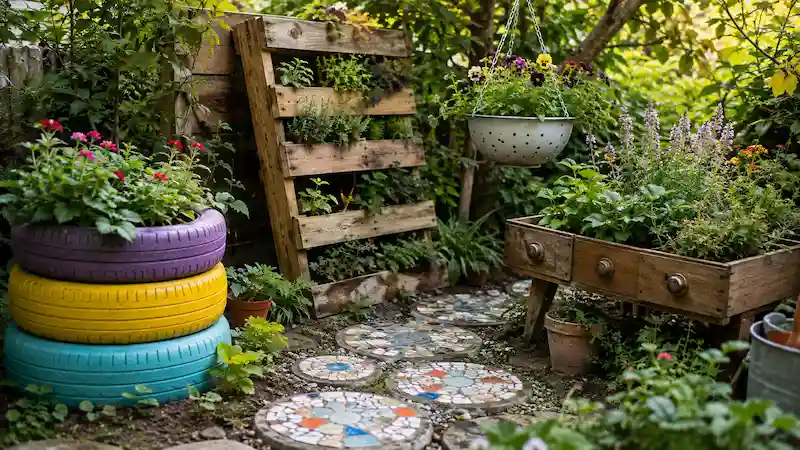
Old tire planters. Salvaged car tires, painted in solid bright colors, become striking raised planters for flowers, herbs, or compact shrubs. Stack two tires of the same size for taller displays, or cut a single tire into a decorative scalloped-edge planter shape using a jigsaw or box cutter. Fill with good-quality compost, plant directly, and water well in the first few weeks.
Pallet vertical garden wall. A standard wooden pallet, stood upright and secured flat against a fence or exterior wall, becomes an efficient vertical planting structure for small gardens and balconies. Line each slat gap with landscape fabric stapled to the back of the pallet to create individual planting pockets, fill with potting mix, and plant trailing herbs, succulents, or strawberries directly into the gaps. This is one of the most space-efficient upcycling ideas for anyone without significant ground-level planting space.
Broken crockery as garden stepping stones. Shards of broken tiles, ceramics, and pottery can be pressed into quick-setting concrete stepping stones using silicone cake mold kits. The resulting mosaic stones are durable, attractive, and genuinely useful as paths through a planted border. This is also one of the most useful projects for broken household ceramics that would otherwise go to landfill or cannot be conventionally recycled.
Colander as a hanging basket. An old metal colander comes pre-drilled with drainage holes and is perfectly shaped for planting. Line the inside with sphagnum moss or coir fiber to retain the potting mix, fill with a suitable compost, plant trailing flowers or herbs, and attach three equal lengths of chain to the rim to hang it. The result is an instant hanging basket with significantly more visual character than commercial versions.
Wooden drawers as raised garden beds. Wide, shallow drawers from salvaged dressers make excellent shallow raised beds for herb gardens or compact salad crops. Drill drainage holes in the base, line with landscape fabric, fill with a good-quality potting mix, and group several together at the same height for an attractive, unified raised bed arrangement.
Upcycling Clothes and Textiles
Textiles are one of the most available categories of material for upcycling, and the projects range from beginner-level cuts to more involved sewing work.
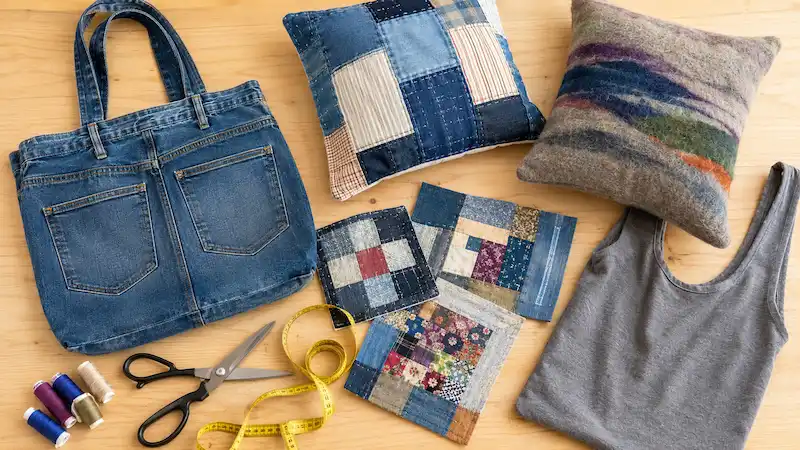
Denim into new pieces. Old jeans are one of the most structurally versatile textiles for upcycling. Basic scissors work produces denim shorts from any pair of jeans that are worn in the legs. A more involved project transforms an old pair into a tote bag, using the waistband as the bag’s top edge and the body of the jeans as the bag structure. The material is durable, holds dye cleanly, and has enough body to hold shape without additional interfacing.
T-shirts into tote bags. This is the most beginner-accessible textile upcycling project, requiring no sewing machine for the basic version. Cut off the sleeves, cut a wider scoop at the neckline to create bag handles, and either sew or knot the bottom hem closed. The result is a functional, machine-washable tote bag that takes under fifteen minutes to make.
Fabric scraps into patchwork. Anyone who sews regularly will accumulate more fabric scraps than individual projects can absorb. Saving them and cutting them into consistent squares (four-inch squares work well as a standard unit) produces enough material over time for patchwork cushion covers, small quilts, and table runners. Patchwork is also an excellent project for children learning basic hand-sewing.
A worn dress shirt into an apron. A men’s dress shirt that is too worn to wear but too good to discard can be folded, repositioned, and stitched into a practical kitchen or workshop apron. The chest pocket survives the transformation and becomes a useful tool or utensil pocket on the finished apron. The shirt’s existing structure does most of the work.
Felted wool sweaters into cushion covers. A wool sweater that has shrunk or felted in a too-hot wash is structurally ruined for wearing but becomes an excellent fabric for upcycling. Cut it to cushion size, sew three sides closed with a simple running stitch, add a button or zip closure on the fourth side, and insert a cushion pad. Felted wool is warm, naturally textural, and very attractive.
Creative Upcycling Ideas Using Everyday Household Items
Some of the most consistently useful upcycling materials are objects most households handle every day without noticing their potential. Glass jars, tin cans, wine corks, cardboard tubes, and newspaper are reliable raw materials that cost nothing.
Glass jars in multiple sizes are the most universally useful upcycling material in any household, beyond the pantry and bathroom storage already covered. They work as flower vases for single stems, as candle holders with tea lights inside, as drinking glasses, as paint pot storage during craft sessions, as craft supply organizers for small beads and buttons, as lanterns with string lights coiled inside, and as attractive gift packaging for homemade items like jams, spice blends, or bath salts.
Wine corks as a functional notice board. A collection of wine corks, cut lengthways in half and mounted into a wooden picture frame using strong adhesive, creates a functional and attractive pinboard for notes, receipts, and photos. It is a much better-looking solution than a standard cork tile board, and it makes good use of material that most households accumulate in larger quantities than expected.
Cardboard tubes as a desk organizer. Toilet roll tubes and kitchen roll tubes, cut to varying heights and grouped together inside a painted tin can or small wooden box, hold pens, pencils, scissors, rulers, and markers neatly. Cover the outer container with paper or leftover fabric to make the whole thing look considered.
Newspaper and magazines as gift wrap. The comic section of a weekend newspaper wraps gifts as attractively as expensive tissue paper, especially for books and boxed gifts. Magazine pages with strong graphic design work equally well for smaller parcels, and the recipient often comments on it positively.
Upcycling to Sell: How to Turn Projects Into Real Income
A significant number of people start upcycling for the satisfaction of the process and realize there is a real market for what they make. Furniture flipping in particular has a robust market on Etsy, Facebook Marketplace, eBay, and at local vintage fairs.
The projects that sell most consistently are those where the finished upcycled piece is clearly better than anything comparable available new at the same price. A chalk-painted mid-century dresser with updated hardware, priced at $150, will sell faster than a flat-pack equivalent from a furniture retailer at the same price point. The uniqueness is part of the value.
What tends to sell well: Chalk-painted furniture with updated brass or ceramic hardware. Upcycled home accessories such as glass-jar lantern sets and wooden-crate shelf units. Garden planters made from painted tyres and colander hanging baskets. Textile pieces including patchwork cushion covers and upcycled denim bags.
Pricing your work fairly: A practical formula is the total cost of materials, plus your time at a fair hourly rate, plus 20-30% to cover overhead, platform fees, and packaging. The most common mistake new sellers make is undervaluing their time. If a project took four hours of skilled work, it should not sell for $25 regardless of how inexpensive the raw materials were.
Starting locally tends to be more effective than jumping straight to online platforms. Local vintage markets and neighborhood groups allow buyers to see and physically assess furniture before purchasing, which matters significantly for larger pieces. Build your portfolio and process locally first, then expand online when you have a consistent body of work.
Budget-Friendly Upcycling for Home Decor
One of the most consistently underappreciated aspects of upcycling is how meaningfully it reduces home decorating costs. A painted $12 thrift store chair can look more deliberately styled than a $180 chair from a furniture chain. A set of matching glass jars sourced at $2 each replace the $40 kitchen canisters you were considering.
The key to keeping upcycling costs genuinely low is patient sourcing. Wait until you find the right piece at the right price rather than buying the first available option. Set up search alerts on Facebook Marketplace for specific items you are looking for. Visit the same thrift stores and charity shops regularly, because stock turns over frequently and the same shelf that had nothing useful last week may have the exact piece you need this week.
The three investments that produce the most visible transformations at the lowest unit cost are chalk paint, sandpaper, and hardware. New drawer pulls and door knobs make an outsized difference to tired furniture. A full set of mismatched brass pulls from a thrift store, spray-painted in the same metallic finish, looks entirely intentional on a painted piece and typically costs under $10 for the spray paint itself.
Tips to Make Every Upcycling Project More Successful
These are the practical habits that consistently separate finished projects that look considered from ones that disappoint.
Clean before you do anything else. Grease, grime, and wax residue prevent paint and adhesive from bonding correctly. Wipe down any surface you plan to paint or glue with a degreasing cleaner before beginning any other preparation. This single step makes a material difference to the quality of the finished surface.
Sand strategically, not extensively. You rarely need to strip furniture back to bare wood. A light scuff with 120-grit sandpaper is usually sufficient to help paint adhere and smooth out minor scratches. Save thorough sanding for pieces with thick, peeling existing paint or high-gloss surfaces that would otherwise resist a new coat.
Test your paint color on a hidden area first. Colors look different on the actual surface of a piece than they do on a paint card or on a screen. The grain, existing color, and lighting all affect how the final coat reads. Test on the underside or back before applying to the visible surfaces.
Seal everything that gets daily use. Paint without a protective sealant will not last on functional furniture. A hard wax works well over chalk paint for decorative pieces and gives a matte, tactile result. A water-based polyurethane is more durable and better suited to tabletops and surfaces that will have cups, plates, or wet items placed on them regularly.
Respect drying and curing times. Most adhesive failures and paint finish problems come from moving too quickly between steps. Read the manufacturer’s guidelines for the specific products you are using and observe them. Adhesives that feel dry to the touch may not have reached their full strength yet and can fail under stress if rushed.
Document your projects. Taking before-and-after photographs, even casually on a phone, gives you a useful record of your techniques and progress. After six months, the visible improvement in skill and finish quality is encouraging. If you plan to sell, the documentation is also commercially useful.
Common Upcycling Mistakes to Avoid
Most upcycling projects go wrong for a small number of consistent and avoidable reasons.
Spending more than a new version would cost. When you add up materials, tools, paint, and hardware, some projects cost more than a comparable new item from a budget retailer. This does not automatically mean you should not do it (the uniqueness, sustainability, and enjoyment of the process have real value), but go in with honest numbers. Upcycling is not always the cheapest route, and knowing that beforehand prevents frustration.
Skipping surface preparation. This is the most common explanation for a paint or adhesive finish that looks amateur. Paint does not bond cleanly to greasy, dusty, or high-gloss surfaces, and the resulting problems (uneven coverage, peeling, bubbling) are avoidable with five extra minutes of preparation. The actual painting step is quick; the prep is where most of the quality comes from.
Taking on a project that is too complex too soon. Starting with a three-piece sofa reupholstery when you have never handled a staple gun before is a reliable path to a half-finished project sitting in the garage for six months. Build skills in a logical sequence: paint a small side table before a large wardrobe; reupholster a dining chair seat before a full armchair. Each project teaches you something directly applicable to the next.
Ignoring structural damage. A wobbly chair that needs new joinery, or a tabletop with a significant crack, will not be fixed by paint and new hardware. Structural issues need to be addressed before cosmetic ones. A piece that looks beautiful but breaks within two weeks of completion is more frustrating than leaving it at the thrift store in the first place.
Starting projects without a clear purpose or destination. The most reliable cause of an accumulating backlog of finished upcycled items is beginning projects without knowing where the finished piece will live or what function it will serve. Before you start, know where it is going and what need it fills.
Where to Go From Here
The most practical approach to upcycling ideas is to pick one specific project or one room and begin there, rather than trying to tackle everything at once. The skills developed on the first project transfer directly to the second one, and the confidence built from a successful result is its own motivation to continue.
If you are completely new to this, the painted furniture projects and glass jar ideas in this guide are the most reliable starting points. Both are low-risk, require minimal equipment, and produce results that are actually functional and attractive in your home. As your confidence grows, move into textiles, more complex furniture builds, and structural garden projects.
The most consistent observation from people who have been upcycling for a while is that they begin to see everything differently. Objects stop looking like waste and start looking like potential materials. That shift in perspective is genuinely the foundation of the practice.